
- The basic colors in Japanese
- A comprehensive list of colors in Japanese
- Aoi vs. midori: Understanding blue-green in Japanese
- Practical usage of colors in everyday Japanese
- Learn Japanese color words to make your conversations more vibrant
- Frequently Asked Questions
- What is the Japanese word for color?
- How do you turn a Japanese color noun into an adjective?
- What is the adjective form of the color green in Japanese?
- What is an example of a Japanese phrase that uses a color?
- How does the Japanese language differentiate between blue and green?
Dive into the dynamic realm of Japanese colors! Grasping the nuances of color in Japanese goes beyond merely enhancing your vocabulary; it enriches your understanding of the language as a whole. In this article, you’ll explore a spectrum of Japanese colors, discover their noun and adjective forms, and pick up practical phrases to enhance your conversations.
The basic colors in Japanese
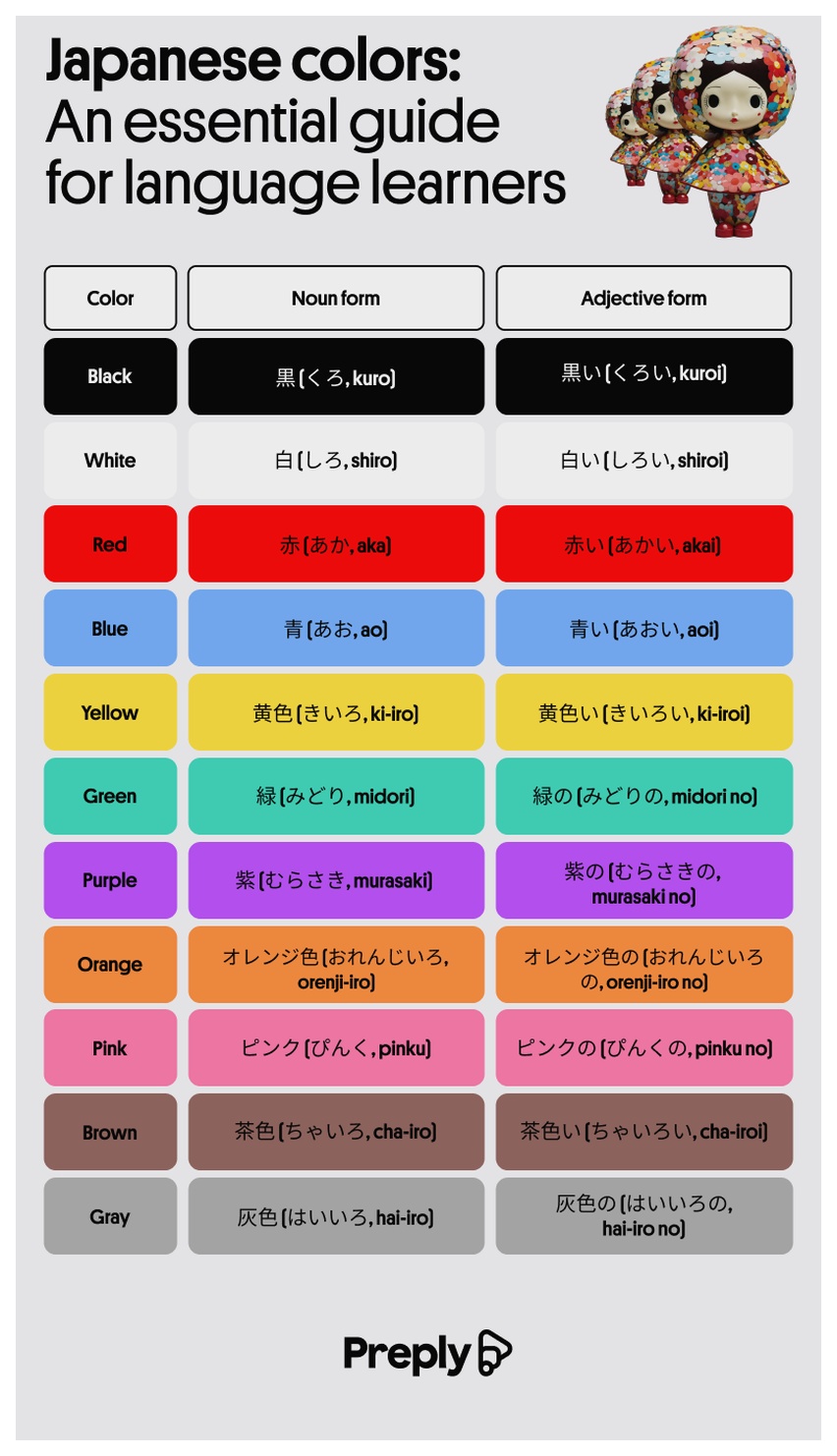
To understand Japanese colors, let’s begin with the fundamentals. The term for color in Japanese is 色 (いろ, iro). Many Japanese color names are derived from nouns. To transform these nouns into adjectives, simply attach the possessive particle “の” (no), similar to adding “’s” in English. For instance, the noun for green is 緑 (みどり, midori), while the adjective form is 緑の (みどりの, midori no).
Let’s explore how the word “green” functions in different contexts. In the first sentence, “green” serves as a noun, while in the second sentence, it takes on the role of an adjective, describing and modifying the noun.
- その木は緑です (そのきはみどりです, sono ki ha midori desu) = That tree is green.
- それは緑の木です (それはみどりのきです, sore he midori no ki desu) = That’s a green tree.
Unlike other nouns, colors like red, blue, yellow, black, and white transform into adjectives by appending い (i) to their base form instead of using の (no). For instance, “the red flower” is expressed as 赤い花 (あかいはな, akai hana).
Let’s explore the fundamental colors in Japanese, including their noun and adjective forms. Refer to the ‘Adjective form’ column in the table to determine whether the color requires の or い to be used as an adjective.
| Color | Noun form | Adjective form |
| Black | 黒 (くろ, kuro) | 黒い (くろい, kuroi) |
| White | 白 (しろ, shiro) | 白い (しろい, shiroi) |
| Red | 赤 (あか, aka) | 赤い (あかい, akai) |
| Blue | 青 (あお, ao) | 青い (あおい, aoi) |
| Yellow | 黄色 (きいろ, ki-iro) | 黄色い (きいろい, ki-iroi) |
| Green | 緑 (みどり, midori) | 緑の (みどりの, midori no) |
| Purple | 紫 (むらさき, murasaki) | 紫の (むらさきの, murasaki no) |
| Orange | オレンジ色 (おれんじいろ, orenji-iro) | オレンジ色の (おれんじいろの, orenji-iro no) |
| Pink | ピンク (ぴんく, pinku) | ピンクの (ぴんくの, pinku no) |
| Brown | 茶色 (ちゃいろ, cha-iro) | 茶色い (ちゃいろい, cha-iroi) |
| Gray | 灰色 (はいいろ, hai-iro) | 灰色の (はいいろの, hai-iro no) |
Mastering the pronunciation of these colors is your gateway to vividly describing your surroundings in Japanese. Keep in mind that practice is key—repeatedly say the colors, combine them with other basic vocabulary to form sentences, and incorporate them into conversations. Before you know it, you’ll be speaking like a native!
Check out this video to hear the native pronunciation of some of these basic colors.
A comprehensive list of colors in Japanese
Now, let’s broaden your horizons! The Japanese language offers a vibrant and diverse vocabulary for colors, and we’ve gathered a comprehensive list just for you.
| Color | Noun form | Adjective form |
| Gold | 金色 (きんいろ, kin-iro) | 金色の (きんいろの, kin-iro no) |
| Silver | 銀色 (ぎんいろ, gin-iro) | 銀色の (ぎんいろの, gin-iro no) |
| Peach | 桃色 (ももいろ, momo-iro) | 桃色の (ももいろの, momo-iro no) |
| Sky blue | 空色 (そらいろ, sora-iro) | 空色の (そらいろの, sora-iro no) |
| Beige | ベージュ (べーじゅ, be-ju) | ベージュの (べーじゅの, be-ju no) |
| Navy blue | 紺 (こん, kon) | 紺の (こんの, kon no) |
| Apricot | 杏色 (あんずいろ, anzu-iro) | 杏色の (あんずいろの, anzu-iro no) |
| Indigo | 藍色 (あいいろ, ai-iro) | 藍色の (あいいろの, ai-iro no) |
| Teal | 青緑 (あおみどり, aomidori) | 青緑の (あおみどりの, aomidori no) |
| Light blue | 水色 (みずいろ, mizu-iro) | 水色の (みずいろの, mizu-iro no) |
| Light green | 薄緑 (うすみどり, usumidori) | 薄緑の (うすみどりの, usumidori no) |
| Scarlet | 緋色 (ひいろ, hi-iro) | 緋色の (ひいろの, hi-iro no) |
| Maroon | 栗色 (くりいろ, kuri-iro) | 栗色の (くりいろの, kuri-iro no) |
| Ivory | 象牙色 (ぞうげいろ, zouge-iro) | 象牙色の (ぞうげいろの, zouge-iro no) |
| Coral | 珊瑚色 (さんごいろ, sango-iro) | 珊瑚色の (さんごいろの, sango-iro no |
| Jade | 翡翠色 (ひすいいろ, hisui-iro) | 翡翠色の (ひすいいろの, hisui-iro no) |
| Dark purple | 桔梗色 (ききょういろ, kikyō-iro) | 桔梗色の (ききょういろの, kikyō-iro no) |
Each of these colors can be used in various contexts, whether you’re discussing fashion, nature, or art.
Aoi vs. midori: Understanding blue-green in Japanese
In English, blue and green are clearly defined colors, but the Japanese language tells a different tale. Traditionally, the word 青い (あおい, aoi) encompassed both blue skies and green mountains. Nowadays, 緑 (みどり, midori) is specifically used for green, particularly when discussing leaves, while 青 continues to denote blue. Interestingly, you might still hear a Japanese person refer to a green traffic light as 青, reflecting a fascinating linguistic legacy that persists today.
Practical usage of colors in everyday Japanese
In Japanese, colors go beyond mere descriptions of objects; they play a significant role in idioms and expressions. Here are some intriguing Japanese phrases that incorporate colors for you to explore and use!
- 赤字 (あかじ, akaji) – “Red character,” referring to a financial deficit or being in the red, akin to the English expression.
- 赤の他人 (あかのたにん, aka no tannin) – “red stranger.” This phrase describes a total stranger.
- 黄色い声 (きろいこえ, kiroi koe) – “yellow voice,” refers to high-pitched fan screams, typically from women or children, commonly heard at idol concerts and events.
- 白紙に戻す (はくしのもどす, hakushi ni modosu) – “to return to a blank slate.” This phrase signifies starting over from scratch or going back to square one.
- 白々しい (しらじらしい, shirajirashii) – This term means “blatantly obvious,” often used to describe something like an easily detectable lie.
- 緑の指 (みどりのゆび, midori no yubi) – Translated as “green fingers,” this Japanese idiom refers to someone with a natural talent for gardening, similar to its English counterpart.
- 黒歴史 (くろれきし, kurorekishi) – “black history,” denotes personal experiences or past events that individuals feel embarrassed about or wish to forget.
- ブラック企業 (ぶらっくきぎょう, burakku kigyō) – “black company.” This describes a company that exploits its employees.
- 青二才 (あおにさい, aonisai) – “blue two-year-old.” This describes an inexperienced or immature person.
- 色眼鏡で見る (いろめがねでみる, iro megane de miru) – This Japanese idiom translates to “to look through colored glasses,” signifying a biased or prejudiced perspective.
- 十人十色 (じゅうにんといろ, ju nin to iro) – Translated as “10 people, 10 colors,” this Japanese expression conveys the idea that everyone has unique preferences, similar to the English saying “different strokes for different folks.”
Learn Japanese color words to make your conversations more vibrant
Incorporating colors and their associated idioms into your Japanese vocabulary can enhance your conversational skills and make you sound more like a native speaker. So, why not give them a shot during your next conversation with a Japanese friend or while practicing with LingualNeeds online tutors?
Frequently Asked Questions
What is the Japanese word for color?
The Japanese word for color is 色 (いろ, iro).
How do you turn a Japanese color noun into an adjective?
To turn a Japanese color noun into an adjective, you attach the possessive particle “の” (no) or append い (i) to the base form, depending on the color.
What is the adjective form of the color green in Japanese?
The adjective form of the color green in Japanese is 緑の (みどりの, midori no).
What is an example of a Japanese phrase that uses a color?
An example is 赤字 (あかじ, akaji), which means ‘red character’ and refers to a financial deficit.
How does the Japanese language differentiate between blue and green?
Traditionally, the word 青い (あおい, aoi) encompassed both blue and green, but now 緑 (みどり, midori) is specifically used for green.


