

- How to start learning Japanese for beginners
- 1. Set up a Japanese language learning schedule
- 2. Learn the Japanese alphabet
- Hiragana
- Katakana
- Kanji
- 3. Practice grammar
- 4. Learn some key phrases
- 5. Study on the go with Japanese learning apps
- 6. Pay attention to flashcards
- 7. Practice your Japanese skills with language exchange partners
- 8. Read manga
- 9. Watch anime
- 10. Listen to podcasts
- 11. Study real-life Japanese dialogues
- 12. Immerse yourself in the language
- 13. Don’t be afraid to make mistakes
- Master Japanese faster with 1-on-1 tutoring
- Frequently Asked Questions
- What are the essential steps to start learning Japanese as a beginner?
- How long does it typically take to achieve fluency in Japanese?
- What are the three writing systems used in Japanese?
- How can I practice my Japanese speaking skills effectively?
- What resources can help me improve my Japanese listening skills?
Are you eager to embark on your journey to learn Japanese as a beginner? Follow these straightforward steps to kickstart your language adventure today!
Japanese is a prominent East Asian language, boasting over 128 million speakers globally. While it serves as the national language of Japan, it has also found a vibrant presence in countries like Korea, the United States, and Brazil, largely due to the strong immigrant communities in these regions.
Is Japanese challenging to learn? Many learners feel that mastering Japanese is much tougher than acquiring other languages. However, it’s important to remember that learning any language requires dedication and effort, regardless of its complexity.
No need to stress! With Japanese lessons and the valuable tools, resources, and tips provided in this article, you’re well on your way to achieving fluency in Japanese. If you’re eager to elevate your skills further, consider exploring our online Japanese classes for even more opportunities to learn!
How to start learning Japanese for beginners
To accelerate your language learning journey, concentrate on the essential pillars that will drive your progress. Begin by mastering the fundamentals of Japanese, set up a consistent study schedule, and immerse yourself in the vibrant culture—each element plays a crucial role in enhancing your learning experience.
Explore these 13 straightforward steps designed to guide you as you embark on your journey to learn Japanese. Each step will help you build a solid foundation for your language skills.
1. Set up a Japanese language learning schedule
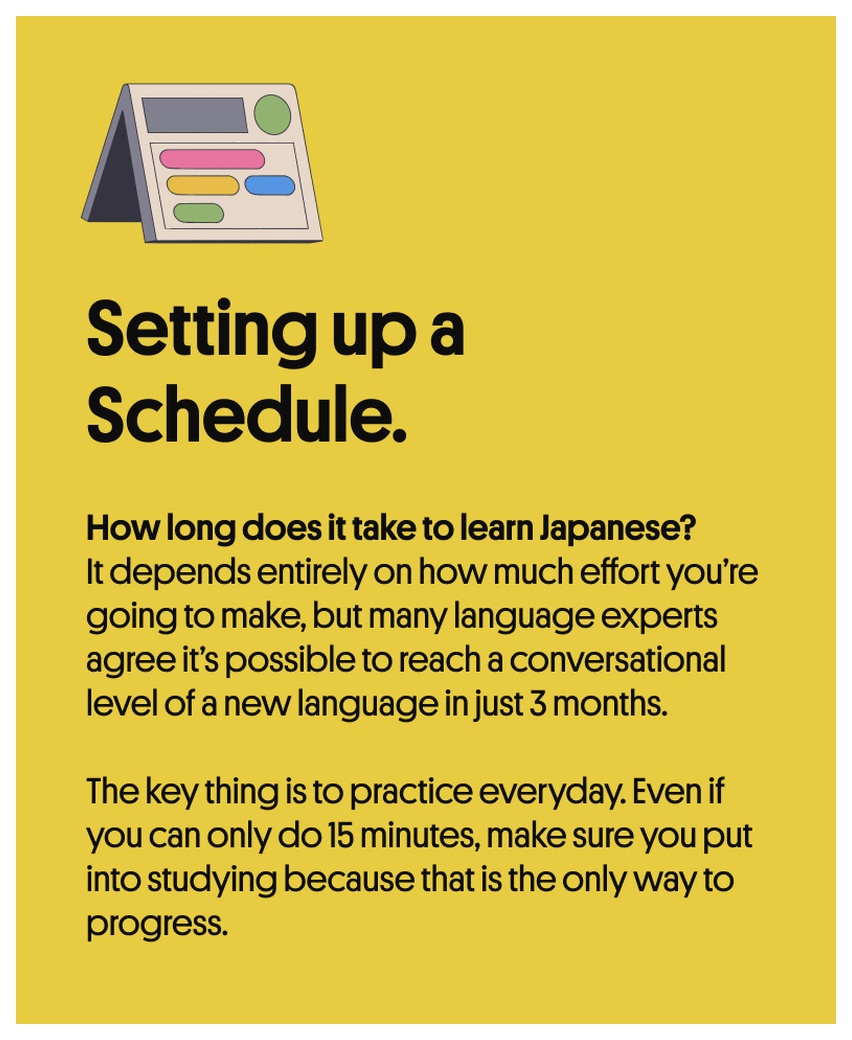
One of the most frequently asked questions about learning Japanese is, “How long does it take to achieve fluency?” While there isn’t a definitive answer, language expert Benny Lewis suggests that it typically requires between 400 to 600 hours of study. If Japanese is your first foreign language, you can expect to spend around 600 hours to reach fluency.
Ultimately, the key to advancing your Japanese skills lies in the effort you’re willing to invest in your learning journey.
To achieve rapid progress in language learning, make daily practice a priority! With countless apps and effective learning strategies available, you can easily fit language study into your busy schedule and discover a pace that works best for you.
Eager to jumpstart your learning journey with hourly lessons? Absolutely! Even if you can only dedicate 15 minutes a day to studying Japanese, that’s perfectly fine! Use that time wisely to maximize your progress.
Here are some tips to help you establish an effective routine:
- Set realistic goals: Start with small, achievable targets and gradually increase them as you progress
- Choose a regular time: Pick a time of day when you’re most alert and least likely to be interrupted
- Diversify Your Study Materials: Incorporate various resources to enhance engagement and comprehensively address all language aspects.
- Track your progress: Keep a log of what you’ve learned to stay motivated and identify areas for improvement
- Be flexible: If you miss a day, don’t get discouraged! Just get back on track the next day
2. Learn the Japanese alphabet
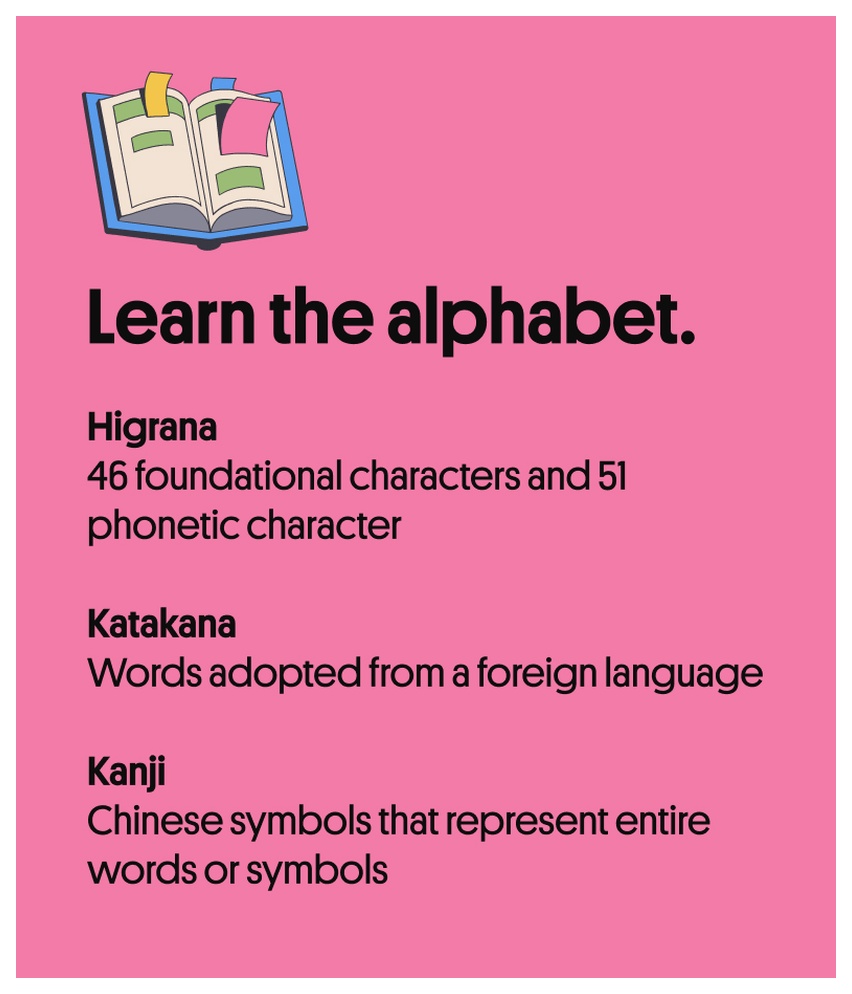
To embark on your journey of learning Japanese, the first step is mastering the alphabet. This fascinating language utilizes three essential writing systems: Hiragana, Katakana, and Kanji. Understanding these scripts is crucial for reading and fully appreciating the richness of Japanese.
Hiragana
Mastering Hiragana is essential for anyone starting to learn Japanese. This phonetic script comprises 46 basic characters and a few additional ones, serving as the foundation for native Japanese vocabulary. Understanding Hiragana unlocks the pronunciation and nuances of Japanese words, making it a vital step in your language journey.
Hiragana is relatively easy to learn since most of its characters have a single pronunciation. Mastering this script will provide you with a solid foundation for developing a native-sounding accent.
Katakana
Unlike Hiragana, which is primarily used for native Japanese words, Katakana serves a distinct purpose: it represents non-Japanese words and loanwords—those borrowed from foreign languages. This includes a variety of terms, such as technical jargon, scientific terminology, and even the names of certain plants and animals.
Katakana can be trickier than Hiragana, particularly for beginners, since it’s not used as often in the early stages of language learning. As you progress in your studies, you’ll encounter Katakana more frequently. For now, though, simply being able to read Katakana is sufficient for newcomers.
Kanji
Kanji is made up of thousands of intricate Chinese characters, each symbolizing complete words, concepts, or phrases. Many learners find mastering Kanji to be the toughest aspect of their language journey.
Conversely, mastering basic Kanji is essential for anyone learning Japanese. It lays the foundation for understanding, speaking, and writing simple sentences, making your language journey much smoother.
Kanji is a fascinating and intricate writing system, where the meanings of characters often defy direct translation into English. As a result, one Kanji can have multiple valid English interpretations, highlighting the rich nuances of the Japanese language.
While we can’t promise that learning Japanese is a walk in the park, mastering Kanji opens up a wealth of expression. If you’re curious about how to tackle Kanji, consider starting with specialized websites designed to guide you on your journey.
3. Practice grammar
Are you eager to embark on your journey of learning Japanese grammar? To truly excel, it’s essential to set aside your understanding of English grammar, as the two languages have strikingly different structures and rules. Embrace this fresh perspective, and you’ll be well on your way to mastering Japanese!
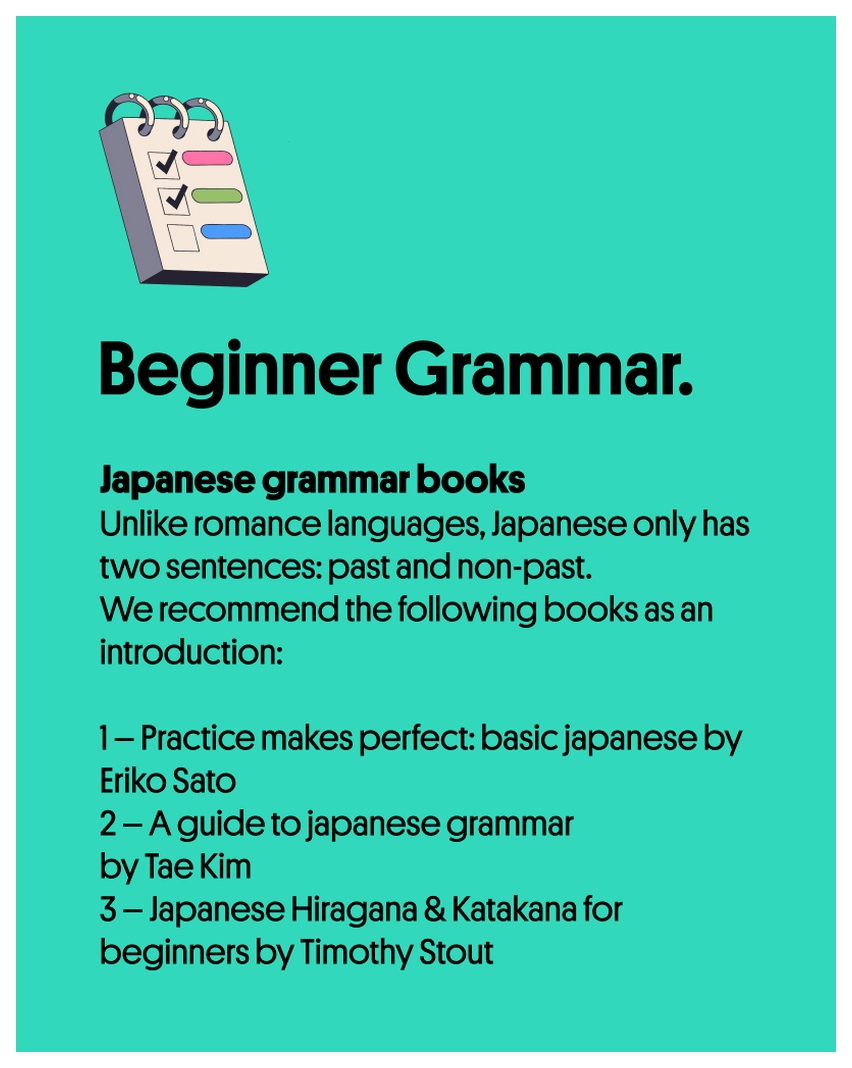
In contrast to numerous romance languages, Japanese features just two tenses: past and non-past, which encompasses both present and future. Additionally, Japanese is spoken in two distinct forms: polite and plain. The plain form is typically reserved for casual conversations, while the polite form is used in more formal contexts.
To kickstart your journey in mastering Japanese grammar, we highly recommend using textbooks as your primary resource. Here are some of the top books to guide you in learning Japanese grammar effectively:
- Practice Makes Perfect: Basic Japanese
- A Guide to Japanese Grammar by Tae Kim
- Japanese Hiragana & Katakana for Beginners
It’s worth noting that Japanese uses a unique writing system that flows from right to left and top to bottom. These textbooks offer a wealth of practical lessons designed to familiarize you with Japanese grammar and writing, making it easier to grasp the language.
4. Learn some key phrases
Curious about the fastest way to start speaking Japanese? It’s easier than you think! Begin by mastering a list of essential words and phrases. Learning basics like “Hello,” “How do you do?” and “Nice to meet you” will empower you to dive into conversations with native speakers right away. This foundational knowledge will help you gain confidence and enhance your communication skills in Japanese!
To ensure that native speakers understand you clearly, it’s essential to refine your Japanese pronunciation. A great way to achieve this is by recording yourself as you practice key phrases and then reviewing the playback. It’s important to remember that distinguishing new sounds can be challenging. Without the guidance of a tutor to help you with sound formation and improvement, you might find it difficult to enhance your pronunciation skills effectively.
Are you eager to master the fundamentals of Japanese? Discover the 100+ essential Japanese words that will serve as a valuable resource, whether you’re planning a trip to Japan or considering a move there. This collection is the perfect launchpad for your language journey!
5. Study on the go with Japanese learning apps
Language learning apps are invaluable tools for anyone embarking on the journey to learn Japanese. They offer the flexibility to study anytime and anywhere, often utilizing a spaced repetition system that boosts your ability to remember new vocabulary and grammar rules effectively.
Here are some popular apps for learning Japanese:
- LingualNeeds offers personalized 1-on-1 language lessons with native Japanese tutors, tailoring sessions to fit your schedule and learning pace.
- JA Sensei: An ideal app for beginners learning Japanese, focusing on essential skills for real-life situations.
- Bunpro: You can use this app to study Japanese grammar and vocabulary using a spaced repetition system (SRS)
- Mondly: With Mondly, you will learn real-world vocabulary and phrases through games and virtual reality
- LingoDeer: Ideal for beginners to intermediates, this app offers convenient bite-sized lessons for mastering Japanese grammar.
You can find more interesting options by checking out our post on the best 19 apps to learn Japanese.
These apps are excellent tools for enhancing your foundational Japanese language skills, but it’s essential to complement them with other resources for a well-rounded learning experience.
Nothing can replace the value of real-world interaction! To enhance your language skills, consider partnering with a language buddy or hiring an online tutor for regular practice. At LingualNeeds, we offer expert Japanese tutors starting at just $10 an hour. Explore our options and boost your speaking abilities today!
6. Pay attention to flashcards
Flashcards are an excellent tool for language learners! For instance, if you’re trying to memorize a Japanese word, simply write it on one side of a flashcard. When you flip it over, you’ll find the translation in your native language, making it a fun and effective way to enhance your vocabulary.
If you’ve never tried flashcards, you should make them a part of your learning journey. With flashcards, you can:
- Label items in your home with their Japanese names to see them every day
- Regularly repeat new words and quiz yourself
- Ask a friend to quiz you to see if you remember the words correctly
Flashcards offer a fantastic way to enhance your Japanese language skills, and the best part is you can easily buy them online or create your own! Whether you’re focusing on Hiragana, Katakana, or Kanji, these handy tools are perfect for boosting your vocabulary across all three writing systems.
7. Practice your Japanese skills with language exchange partners
For beginners eager to master Japanese and reinforce their skills, regular practice with others is key. Fortunately, even if you don’t have a native Japanese speaker as a friend, there are many opportunities available today to engage and apply what you’ve learned.
Language exchange platforms provide an excellent opportunity to connect with conversation partners, enhancing your speaking skills through interaction with native speakers and fellow learners. Here are some valuable tools to explore:
- HelloTalk is a language exchange app where learners can quickly find and chat with native speakers
- LextTalk is the first social networking and chat app designed for language exchange
- MyLanguageExchange connects users with native speakers and fellow language learners to enhance their speaking skills through conversation practice.
When participating in language exchanges, it’s always a good idea to remember to:
- Be respectful of your partner’s time and learning goals
- Prepare topics or questions in advance to make the most of your sessions
- Offer help with your native language in return
- Be open to corrective feedback and cultural insights
Language exchange offers great benefits, but if you’re looking to enhance your speaking skills more effectively, consider enrolling in one-on-one Japanese online lessons with a native tutor. A professional instructor can deliver structured lessons, offer instant feedback, and provide personalized guidance that aligns with your unique learning style and objectives.
Eager to start speaking Japanese from your very first lesson? Look no further than LingualNeeds! Our platform connects you with experienced native tutors who can tailor lessons to suit your skill level and learning goals. With a wide selection of certified instructors, you’ll find the perfect match for your needs. Enjoy personalized one-on-one sessions through our easy-to-use video chat, all at an incredibly affordable rate starting at just $10 per hour! Dive into your Japanese learning journey today with LingualNeeds.
8. Read manga
Dive into the vibrant world of Japanese culture! Beyond traditional books and newspapers, immerse yourself in the captivating realm of manga. This unique art form, with its rich history, is not only a cornerstone of Japanese culture but also a driving force in contemporary pop culture, gaining popularity worldwide. Embrace manga to enhance your reading skills while enjoying an engaging glimpse into Japan’s cultural tapestry!
Manga, a captivating blend of art and storytelling through comics and graphic novels, offers a unique advantage for language learners. With rich contextual clues embedded in the illustrations, readers can effortlessly grasp the meaning of the text. If you’re unsure where to dive in, “Sailor Moon” is an excellent choice for beginners exploring Japanese.
9. Watch anime
Looking to make your study sessions more enjoyable? Dive into learning Japanese through anime! This captivating style of animation, which originated in Japan, has been delighting audiences for decades. Today, anime has transcended borders, captivating millions of fans worldwide and making language learning a fun adventure!
Diving into anime during your free time can be a fun way to expand your vocabulary, including slang, while also sharpening your listening skills.
You’ll find not only anime, but also Japanese films and shows on Crunchyroll, Asian Crush, and Netflix.
10. Listen to podcasts
If you’re eager to learn Japanese, incorporating podcasts into your daily routine is a fantastic way to enhance your listening skills while also diving deeper into Japanese culture.
Here are two podcasts that are great for Japanese beginners:
- Learn Japanese Pod podcasts
Each episode explores a wide range of topics, from travel tips to drinking etiquette in Japan. You’ll find both the original Japanese script and a translated transcript for each episode, making it an excellent resource for tracking your listening comprehension progress.
- NHK
In each captivating episode of this beginner-friendly podcast, listeners follow the journey of Anna, a fictional character who travels to Japan to learn Japanese. Each short lesson features engaging scripts accompanied by English translations, making language learning both enjoyable and accessible.
Seeking more ways to enhance your Japanese learning experience? You’re in the right place! Check out these ten engaging podcasts that make learning Japanese convenient and enjoyable while you’re on the move. Additionally, don’t miss this insightful video packed with tips for accelerating your Japanese language skills!

11. Study real-life Japanese dialogues
To effectively connect textbook Japanese with real-life conversations, immersing yourself in authentic Japanese dialogues is essential! This method not only enhances your grasp of everyday expressions but also familiarizes you with language as it’s used in various contexts.
Here’s how you can incorporate this into your learning:
- Use resources like JapanesePod101 or NHK World-Japan, as listed above, which offer real-life dialogue lessons
- Watch Japanese dramas or variety shows with subtitles to observe everyday conversations
- Practice by repeating dialogue lines to improve your pronunciation and intonation
- Analyze the use of formal and informal speech in different situations
Check out the live video featuring round-the-clock conversation practice available on the JapanesePod101 YouTube channel! It’s a fantastic opportunity to enhance your language skills anytime, day or night.

Exploring real-life conversations will enhance your grasp of Japanese as it’s used in different social situations, empowering you to communicate more naturally and confidently.
12. Immerse yourself in the language
Language immersion is one of the most effective methods to fast-track your Japanese learning. Although living in Japan offers the best immersion experience, you can still cultivate a Japanese-rich environment at home. Here are some creative ways to enhance your language exposure:
- Change your phone and computer settings to Japanese
- Follow Japanese social media accounts and YouTube channels
- Listen to Japanese music and try to understand the lyrics
- Cook Japanese recipes using instructions in Japanese
- Join online Japanese communities or forums to practice reading and writing
- Participate in Japanese cultural events or meetups in your area
To truly immerse yourself in the Japanese language, integrate it into your daily routine. Instead of treating it merely as a subject to study, make Japanese a vibrant part of your life!
13. Don’t be afraid to make mistakes
When you start to practice Japanese, you are always going to make mistakes.
Embracing mistakes is essential for language growth! Learning a language thrives on trial and error, along with constructive feedback. Remember, though, that native Japanese speakers might hesitate to correct you out of politeness. To foster a supportive learning environment, let them know you welcome their insights and guidance!
Master Japanese faster with 1-on-1 tutoring
No matter how you choose to boost your Japanese skills, one truth stands out: immersing yourself in speaking the language from the very beginning is the best way to achieve quick progress!
Although you can begin your Japanese learning journey using online resources, achieving true fluency is best supported by one-on-one tutoring. This personalized approach not only provides valuable live conversation practice but also enhances your learning experience. By combining the independence of self-study with the benefits of tailored guidance, you can accelerate your progress and mastery of the language.
LingualNeeds offers an outstanding opportunity to enhance your language skills. Through personalized video chat sessions, you’ll connect with a certified Japanese tutor who acts as your dedicated language mentor. Your tutor will provide expert guidance, help you identify and correct mistakes, and create a tailored learning plan that suits your individual proficiency level.
With a wide array of tutors available, finding the right one for your needs has never been easier! Simply utilize our search filters to match a tutor to your specific goals, schedule, and budget. A handful of sessions can significantly boost your confidence and accelerate your progress in learning Japanese—much more effectively than a standard learning app!
If you’re eager to learn Japanese quickly, explore our skilled Japanese tutors and schedule your first class today! It’s an easy and effective way to kickstart your language journey.
To learn more about advancing through the various stages of Japanese proficiency, explore our comprehensive guide on Japanese language levels.

Frequently Asked Questions
What are the essential steps to start learning Japanese as a beginner?
Begin by setting up a study schedule, mastering the Japanese alphabet, practicing grammar, learning key phrases, and using language learning apps.
How long does it typically take to achieve fluency in Japanese?
It usually requires between 400 to 600 hours of study, with beginners potentially needing around 600 hours if Japanese is their first foreign language.
What are the three writing systems used in Japanese?
The three writing systems are Hiragana, Katakana, and Kanji.
How can I practice my Japanese speaking skills effectively?
Engage in regular practice with language exchange partners, use language learning apps, or consider enrolling in one-on-one online lessons with a native tutor.
What resources can help me improve my Japanese listening skills?
Podcasts, anime, and real-life Japanese dialogues are excellent resources for enhancing listening skills while also immersing you in Japanese culture.


