- The origin of the name ‘Australia’
- New South Wales
- Queensland
- Western Australia
- Northern Territory
- Victoria
- South Australia
- Tasmania
- Better your understanding of Australian English
- Methodology
- Frequently Asked Questions
- What is the significance of Aboriginal and Torres Strait Islander cultures in Australia?
- What were some impacts of British colonization on Aboriginal languages?
- How did the name ‘Australia’ originate?
- What are some examples of place names in New South Wales with Aboriginal roots?
- What is the origin of the name ‘Darwin’ in the Northern Territory?
Australia proudly hosts the world’s oldest civilization, the Aboriginal and Torres Strait Islander peoples, whose rich cultures have thrived for tens of thousands of years. The landscape is dotted with place names from Aboriginal languages, reflecting their deep connection to the land, alongside English names assigned during the colonial era. This blend of names showcases a unique tapestry of history and heritage.
Sadly, many names in Australia do not have Aboriginal roots. The British colonization in 1788 brought significant disruption and devastation to the Indigenous communities. Among the many repercussions of this colonization was a sharp decline in Aboriginal languages, leading Australia to currently host the highest number of critically endangered languages in the world.
LingualNeeds is dedicated to the preservation and promotion of languages and dialects across the globe. With access to more than 120 subjects taught by over 32,000 tutors worldwide, the platform offers a rich learning experience. Intrigued by Australian history and culture, we embarked on a journey to uncover the fascinating stories behind Australia’s place names.
Our research involved an extensive exploration of diverse sources, such as the State Library of South Australia, the State Library of New South Wales, the National Capital Authority Government Archive, the Online Etymology Dictionary, and various regional news reports. Through this investigation, we uncovered the fascinating history and etymology behind 130 Australian place names.
The origin of the name ‘Australia’
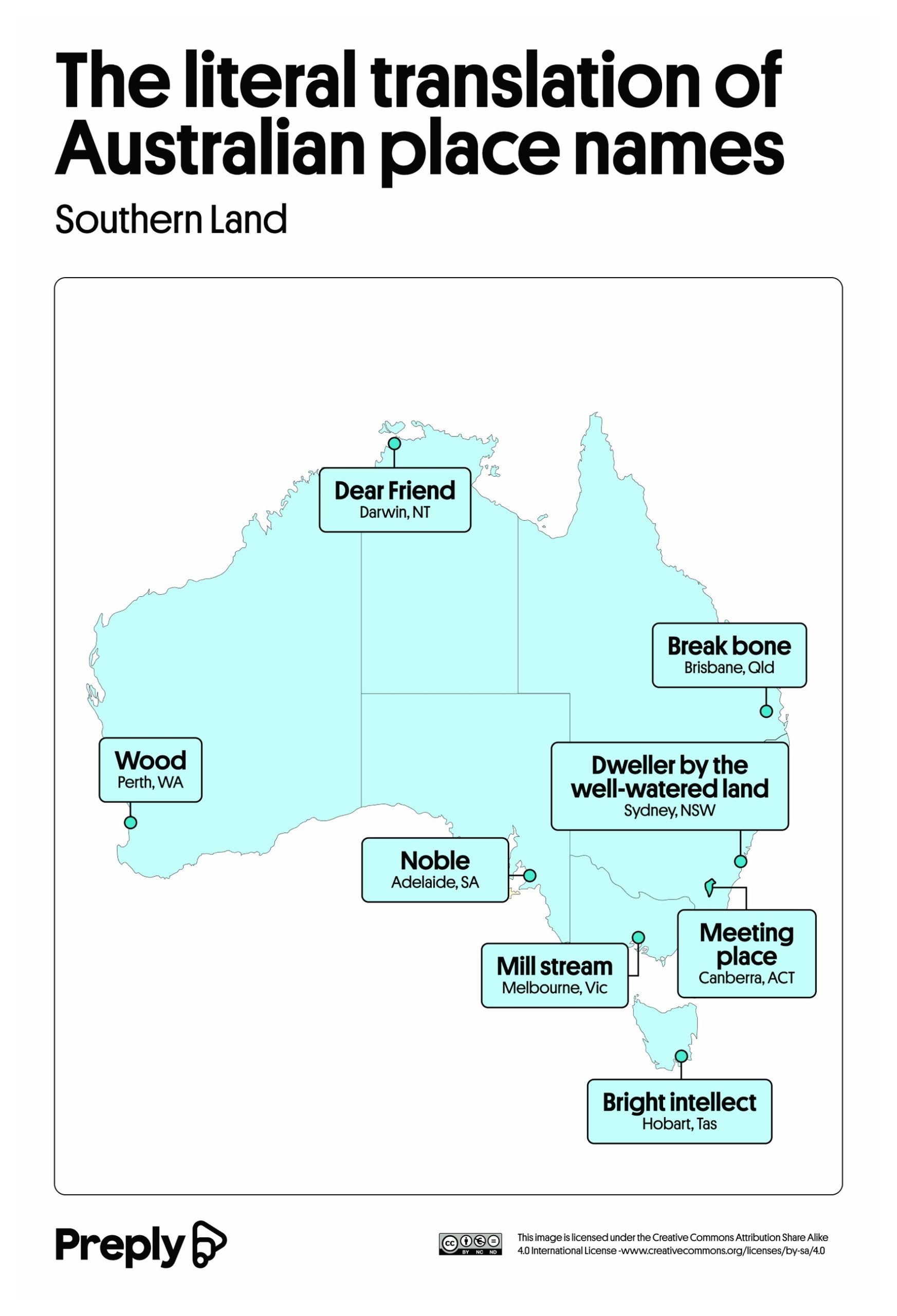
In 1803, English explorer Matthew Flinders named the continent “Australia” during his circumnavigation, replacing the earlier designation “New Holland.” This prior name had been used by European mapmakers following Dutch navigator Abel Tasman’s exploration of the continent’s west coast in 1644. It wasn’t until 1817, however, that “Australia” gained widespread acceptance, thanks to the endorsement of Governor Macquarie.
Aboriginal and Torres Strait Islander cultures encompass a rich tapestry of diverse groups, each with unique languages and customs. The accompanying map of Indigenous Australia highlights the general regions where these larger communities reside, along with the traditional names of their lands. This visual representation not only showcases the cultural diversity but also honors the deep connections these groups have with their ancestral territories.
The term ‘Australia’ first appeared in a 1545 astronomy publication, originating from the Latin words ‘Terra’ and ‘Australis,’ which translate to ‘southern land.’ This rich historical context inspired the iconic Australian rock band Icehouse in their 1982 hit, “Great Southern Land.” The song’s shimmering guitar soundscapes beautifully capture the essence of the country’s heat and isolation, creating a vivid auditory experience.

Learn a language with personalised 1-on-1 classes with our expert tutors from all over the world
French lessons online
Spanish lessons online
New South Wales
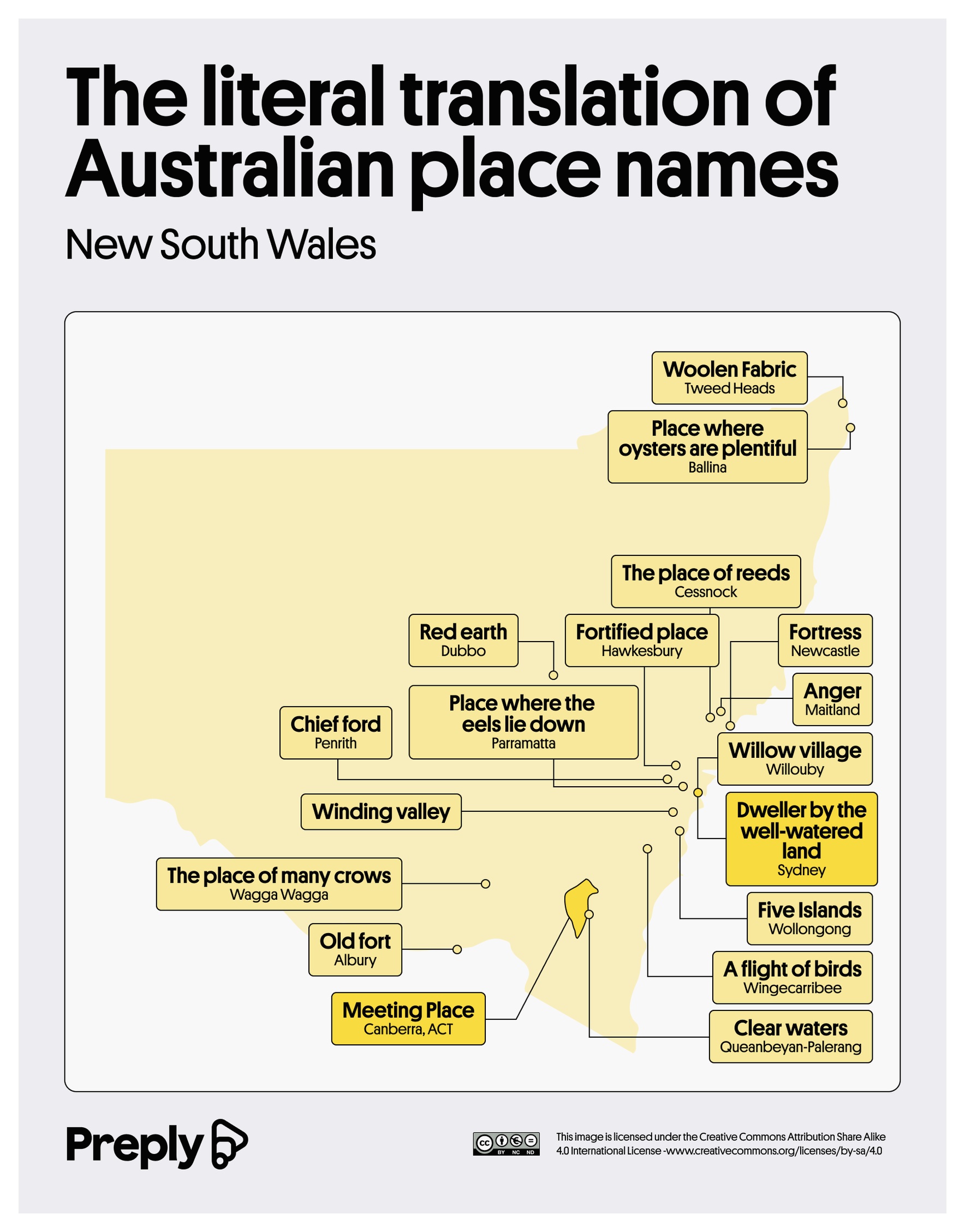
New South Wales, originally referred to as ‘New Wales’ in early records, was named by the British explorer and naval officer Captain James Cook. During that era, it was common for British explorers to honor their discoveries by naming them after European countries. However, the reason behind Cook’s specific choice of Wales remains an intriguing mystery.
Sydney, one of Australia’s most iconic cities, was named by Captain Arthur Phillip, the leader of the First Fleet and the colony’s first governor. He chose the name ‘Sydney’ to pay tribute to Thomas Townshend, the British politician who proposed the idea of transporting convicts to Australia. Townshend held the esteemed title of 1st Viscount Sydney, reflecting his noble status in British society.
The name ‘Sydney’ (or ‘Sidney’) has its roots in Old English, derived from the words ‘ssid’ meaning ‘side’ and ‘ieg’ meaning ‘island’. Together, they translate to ‘dweller by the well-watered land’, reflecting a rich connection to nature and geography.
New South Wales is rich in place names rooted in Aboriginal languages, such as Wingecarribee, Ballina, Dubbo, Wollongong, and Wagga Wagga. Many of these names, however, have undergone changes in spelling and pronunciation, often due to English settlers misinterpreting the original Aboriginal terms. For instance, ‘Ballina’ likely comes from the Bundjalung word ‘bullenah,’ meaning ‘place where oysters are plentiful,’ reflecting the deep connection between these names and the land’s cultural heritage.
Queensland
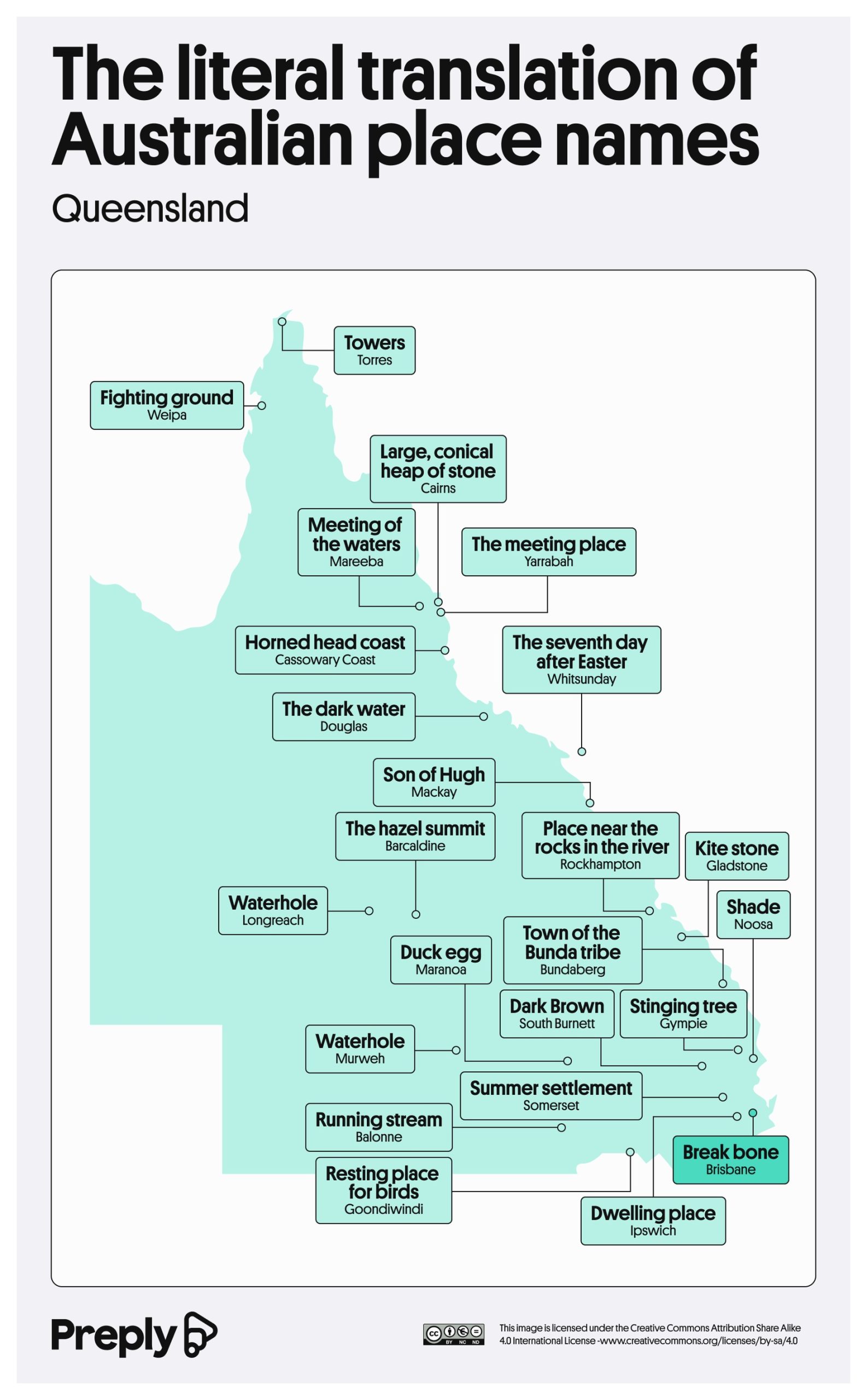
Brisbane, the vibrant capital of Australia’s Sunshine State, is named after Sir Thomas Makdougall Brisbane, who served as the Governor of New South Wales from 1821 to 1825. The name ‘Brisbane’ has Scottish roots and comes from an Anglo-Norman background, tracing back to the Old French word “briser,” meaning ‘to break,’ and the Middle English word “bane,” meaning ‘bone.’ Thus, the intriguing literal translation of Brisbane is ‘break bone.’
Queensland is rich in history, with many locations featuring names rooted in Aboriginal languages. Take Weipa, a coastal town whose name comes from “waypa” or “waypundun,” signifying a ‘fighting ground’ in the Anhathangayth language. Similarly, the Balonne Shire in South West Queensland derives its name from the Balonne River, believed to originate from an Aboriginal term meaning ‘water’ or ‘running stream.’ These names reflect the deep connection between the land and its Indigenous heritage.
The Whitsunday Islands got their name from Captain Cook during his late 1700s voyage north on the Endeavour, a British Royal Naval Research vessel. As he sailed, Cook spotted the islands and believed it was the seventh day after Easter, a Christian holiday called ‘Whit Sunday.’ Unbeknownst to him, crossing the international date line at the 180th meridian meant it was actually Monday, making the accurate name ‘Whitmonday.’
Learn a language online with our free learning materials.
Learn English online
Learn French online
Western Australia
European explorers first discovered Australia in 1606 when Dutch navigator Willem Janszoon charted the Cape York Peninsula in Queensland. Just a decade later, in 1616, another Dutch explorer, Dirk Hartog, made history as the first European to land on Australia’s western coast. This period in the 17th century led to the continent being referred to as ‘New Holland.’ Today, Dirk Hartog Island, situated off the Gascoyne coast of Western Australia, commemorates his legacy.
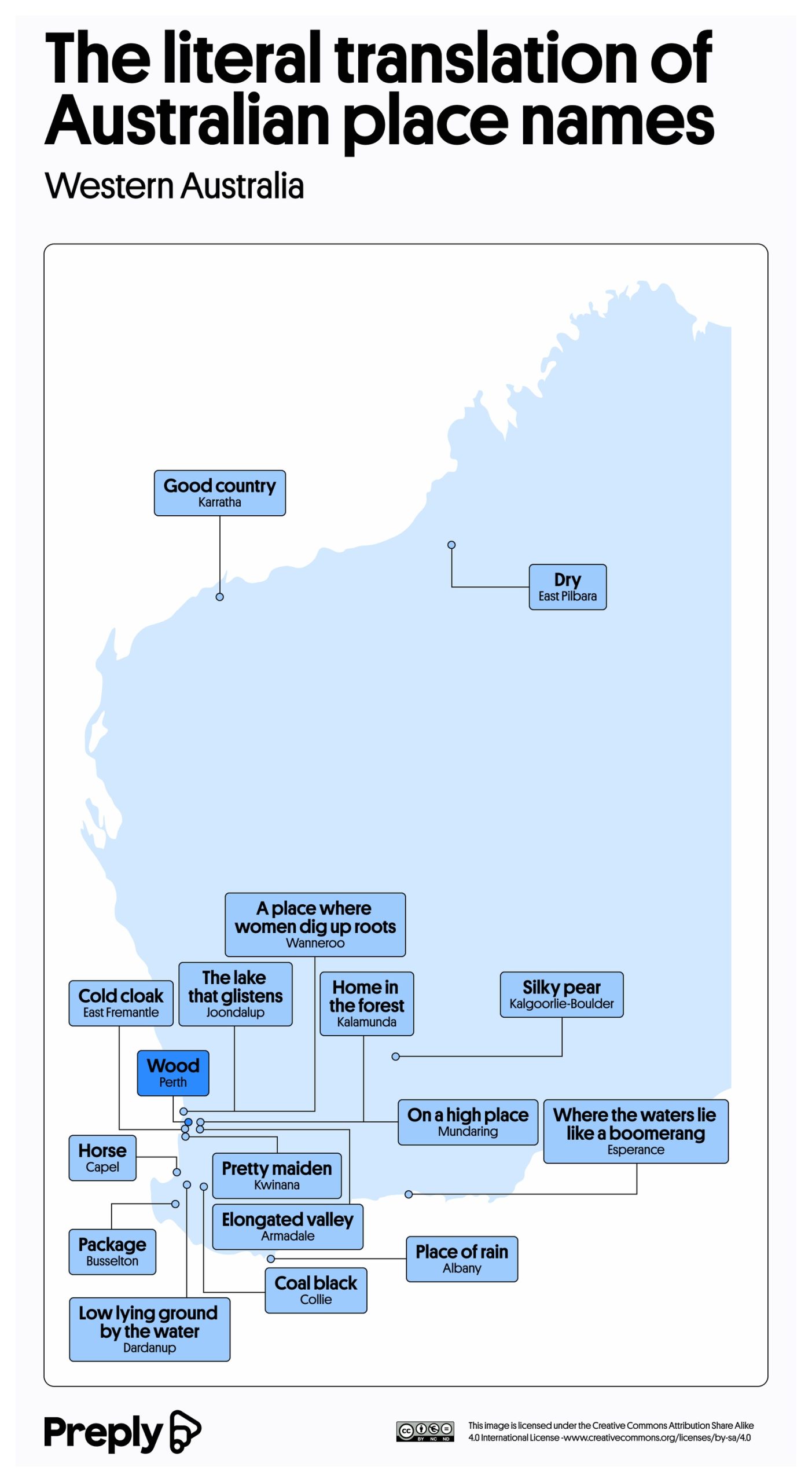
In 1829, Captain Cook officially claimed the west coast of Australia for Britain, naming the city of Perth after a Scottish town. This practice of assigning European names to Australian locations often leads to interesting contrasts, as many bear little resemblance to their counterparts. The name “Perth” itself is derived from the Pictish word “bertha,” meaning “wood,” adding a layer of historical significance to the Australian city.
In Western Australia, many cities proudly reflect the rich heritage of their First Nations inhabitants through names that have deep meanings. For example, Karratha translates to ‘good country’ or ‘soft earth,’ while Kalgoorlie is believed to stem from the Wangkathaa word “karlkurlah,” which means ‘silky pear.’ Additionally, the name Pilbara is thought to derive from a term in the Kariyarra language that signifies ‘dry’ or ‘dried out.’ These names serve as a testament to the enduring connection between the land and its original custodians.
Northern Territory
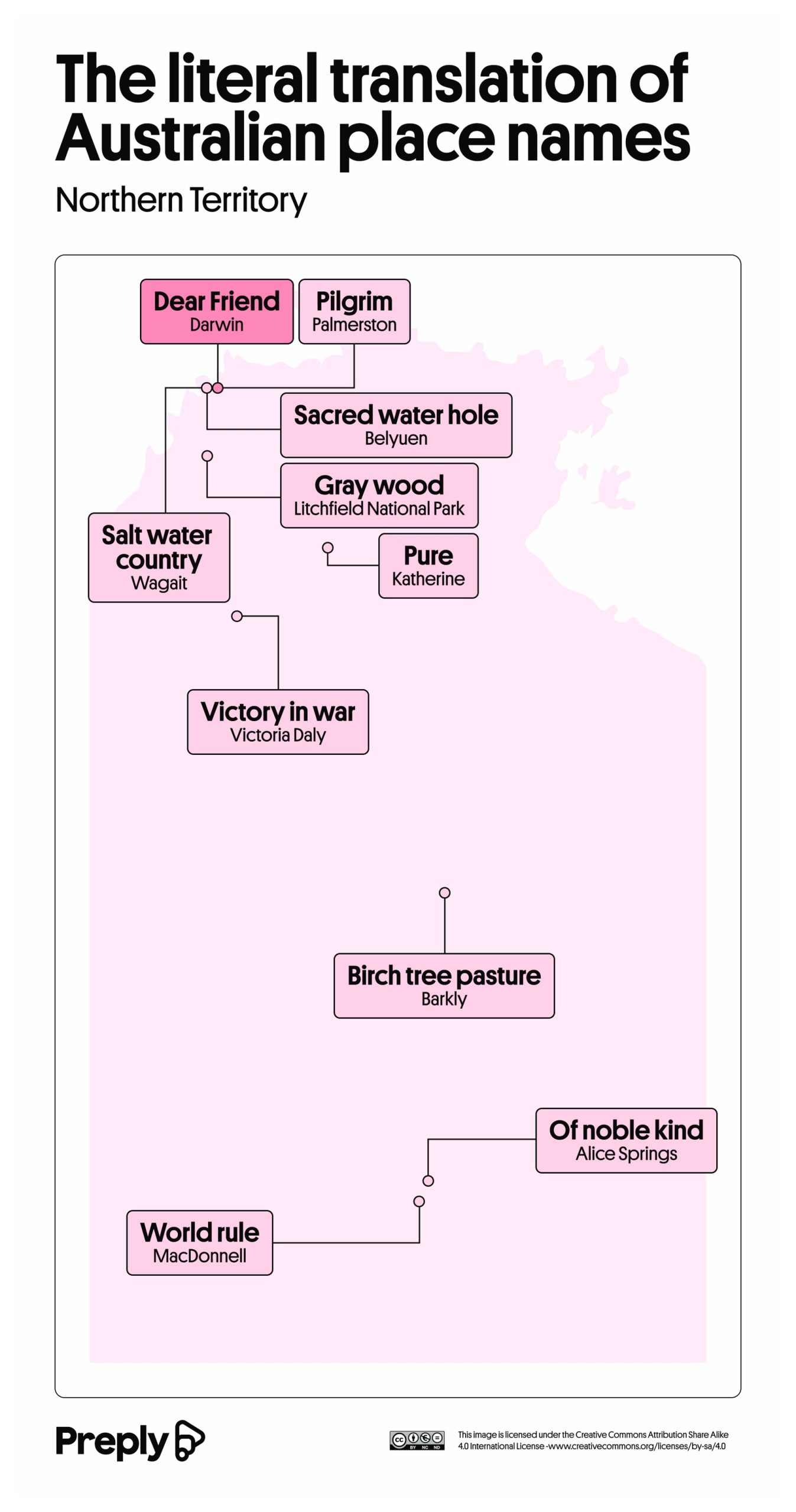
Trivia alert! Here’s a fun fact: Darwin, the capital of the Northern Territory, is named after the famous English naturalist Charles Darwin, even though he never set foot there. The name was chosen by Lieutenant John Lort Stokes, who honored his friend after they met during a sailing expedition. Interestingly, the name “Darwin” translates to “dear friend” in Old English, specifically from the term “deorwine.”
Alice Springs derives its name from the wife of Sir Charles Todd, who was instrumental in building the Overland Telegraph Line that connects Adelaide to Darwin. The name “Alice” itself has roots in the Old French word “aliz,” which translates to “of noble kind.”
Before 1975, the community now known as Belyuen was referred to as ‘Delissaville,’ a name assigned by European settlers. The name ‘Belyuen’ comes from an Aboriginal term meaning ‘sacred water hole.’ The Indigenous inhabitants of Belyuen include the Wadjiginy, Emmiyangal, and Mendheyangal peoples, who communicate in their traditional languages: Batjamalh, Emmi, and Mendhe.
Victoria
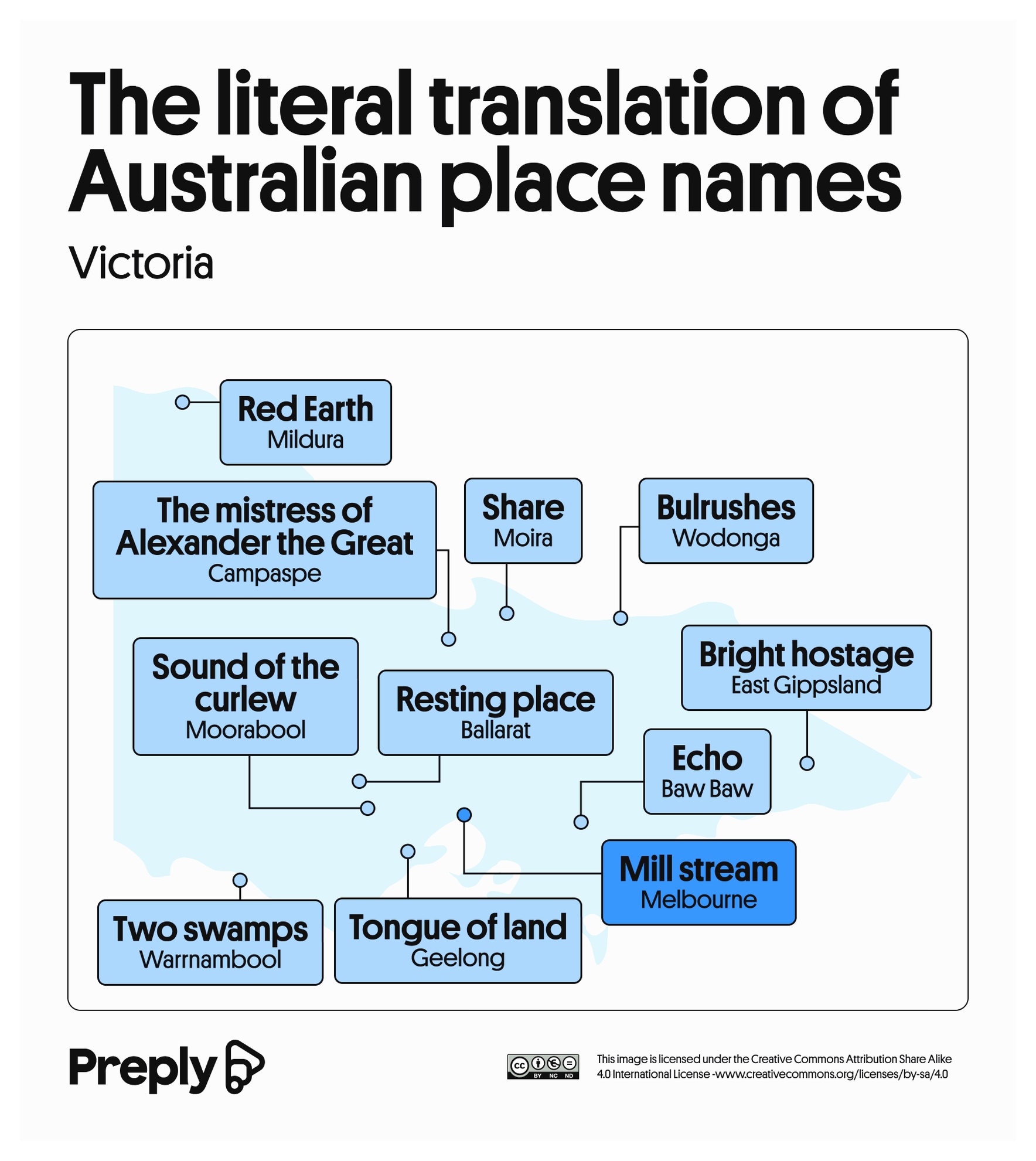
In its early days, the city we now call Melbourne went by several unofficial names, such as Barebrass, Bearport, Dutergalla, Bareheep, the Settlement, and Batmania. It wasn’t until March 1837 that Governor Sir Richard Bourke officially named it “Melbourne,” paying tribute to the British Prime Minister William Lamb, the 2nd Viscount Melbourne.
Nestled in Derbyshire, England, Melbourne Hall is a historic estate that once belonged to William Lamb. The name “Melbourne” derives from the Old English term “mileburne,” which translates to ‘mill stream.’ Interestingly, Melbourne is also noted as the third most mispronounced location in Australia, based on our recent research.
Nestled in northern Victoria, the Shire of Campaspe derives its name from the Campaspe River, a title bestowed by Major Sir Thomas L. Mitchell in 1836. Interestingly, Mitchell chose to honor Campaspe, the mistress of Alexander the Great, with this name, leaving us to ponder the reasons behind his intriguing choice.
South Australia
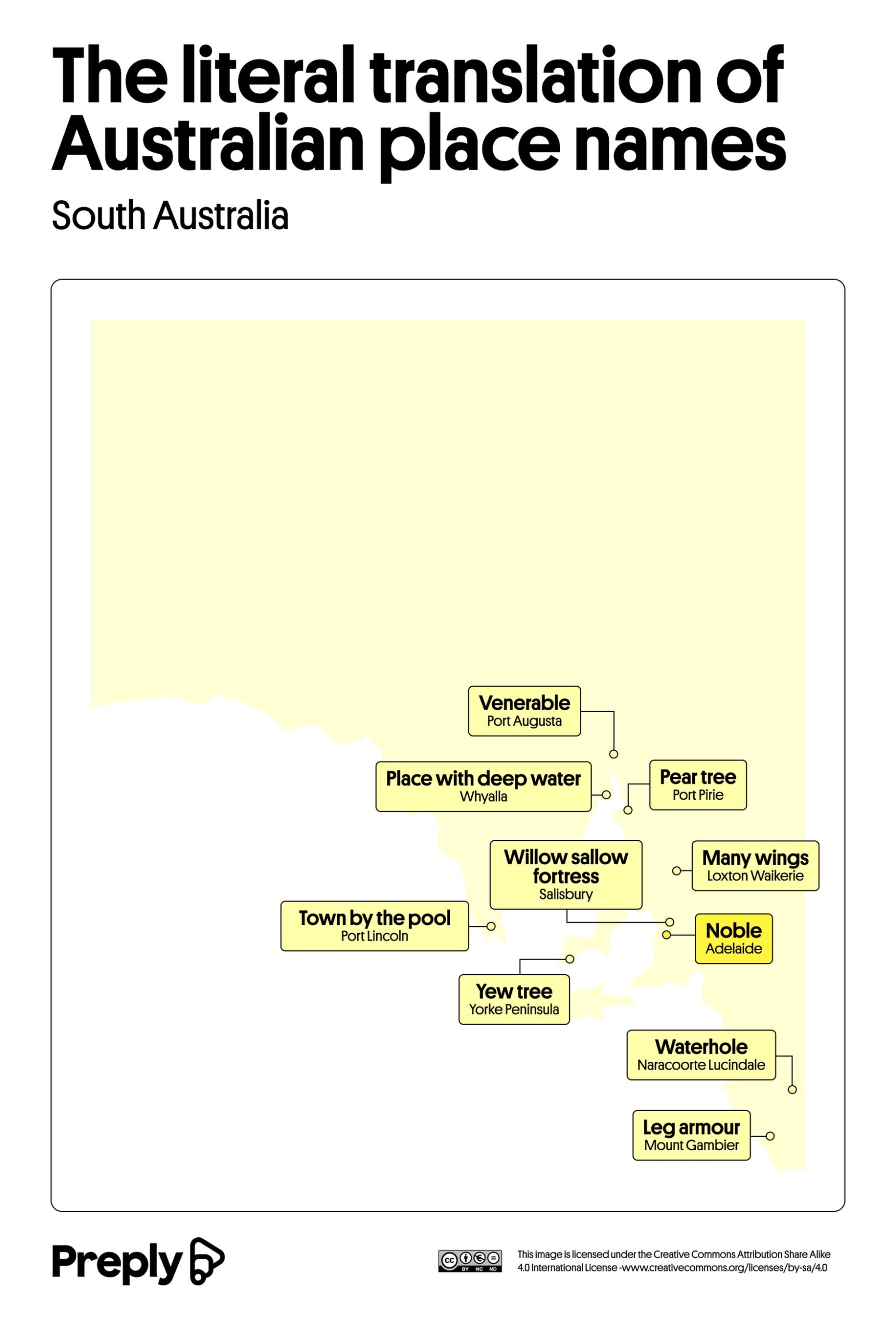
The Kaurna people, the traditional custodians of the Adelaide region, refer to this area as Tarntanya, meaning “red kangaroo place.” In 1836, when British settlers arrived, King William IV designated the name “Adelaide” in honor of his wife, Queen Adelaide. The name itself has roots in both French and German, signifying “noble.”
Naracoorte Lucindale offers a fascinating glimpse into the blend of Aboriginal and English languages that shape uniquely Australian place names. The name ‘Naracoorte’ originates from an Aboriginal term meaning ‘waterhole,’ reflecting the area’s natural features. In contrast, ‘Lucindale’ honors Lady Lucinda, the wife of Anthony Musgrave, a former Governor of South Australia. Interestingly, ‘Lucinda’ itself is derived from the Latin word for ‘light,’ adding another layer of meaning to this charming locale.
Renowned for its breathtaking landscapes, Whyalla derives its name from a Barngarla word meaning “place with deep water.” Similarly, Waikerie has Aboriginal roots, with its name translating to “many wings,” inspired by the majestic giant swift moth known as ‘wei kari.’
Tasmania
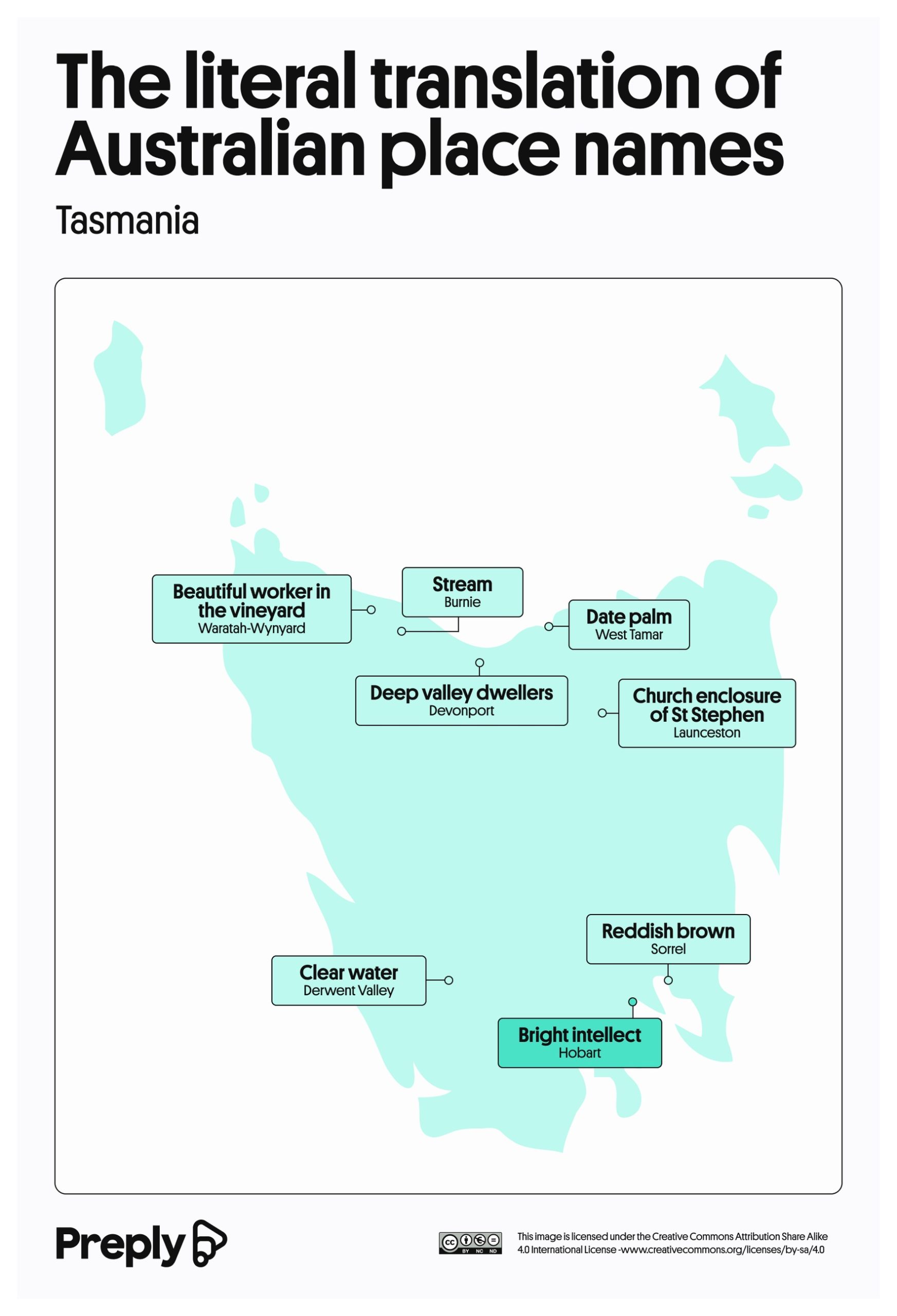
Finally, Tasmania owes its name to Dutch explorer Abel Tasman, who navigated the island’s west coast in 1642. He originally named it Van Diemen’s Land in honor of his superior, Anthony Van Diemen. However, in 1856, the name was officially changed to Tasmania. The island is also known as Lutruwita by the Aboriginal Palawa people, reflecting its rich indigenous heritage.
Many of Tasmania’s place names have English roots. For example, Devonport derives its name from the County of Devon in Southern England, with “Port” added due to its harbor. Likewise, Launceston honors the birthplace of Philip Gidley King, the third Governor of New South Wales.
Hobart, the vibrant capital of Tasmania, draws its name from the fourth Earl of Buckinghamshire, Lord Hobart. Interestingly, the name ‘Hobart’ translates to ‘bright and shining intellect,’ reflecting a rich heritage that blends history with a touch of brilliance.
Better your understanding of Australian English
If you’re eager to dive into Australian language and culture, our local English teachers are here to guide you through engaging lessons. By learning Australian English, you’ll not only connect with the local lingo but also expand your worldview. Plus, mastering a new language boosts your confidence and sharpens your cognitive abilities, offering a wealth of benefits along the way.
If you’re an Australian gearing up for an international adventure, we provide online classes in a variety of languages to help you get ready. Explore our engaging Spanish and French lessons to enhance your travel experience!
Methodology
We gathered insights from a diverse range of sources such as the State Library of South Australia, the State Library of New South Wales, the National Capital Authority Government Archive, the Online Etymology Dictionary, and local news reports to explore the rich history and origins of 130 Australian place names.
The research for this project was completed in March and April 2024.
Sources & references: Find out more about the origin of these names here.
Frequently Asked Questions
What is the significance of Aboriginal and Torres Strait Islander cultures in Australia?
They represent the world’s oldest civilization, with rich cultures that have thrived for tens of thousands of years.
What were some impacts of British colonization on Aboriginal languages?
It led to a sharp decline in Aboriginal languages, resulting in Australia hosting the highest number of critically endangered languages in the world.
How did the name ‘Australia’ originate?
The name ‘Australia’ was first used by English explorer Matthew Flinders in 1803, replacing ‘New Holland’ and gaining widespread acceptance in 1817.
What are some examples of place names in New South Wales with Aboriginal roots?
Examples include Wingecarribee, Ballina, Dubbo, Wollongong, and Wagga Wagga, though many have undergone changes in spelling and pronunciation.
What is the origin of the name ‘Darwin’ in the Northern Territory?
Darwin is named after English naturalist Charles Darwin, with the name translating to ‘dear friend’ in Old English.