
- What’s the difference between por and para?
- When to use por
- Motivation or reason for an action
- Duration and time
- Costs and prices
- Location and movement
- Mode of travel or communication
- Show who’s doing the action in the passive voice
- When to use para
- Destination
- Goals
- Recipients
- Deadlines
- Expressing an opinion
- Expressing a disparate idea
- Common expressions and idioms
- Expressions that use para
- Expressions that use por
- Practice exercise
- Speak Spanish like a native speaker
- Frequently Asked Questions
- What is the main difference between ‘por’ and ‘para’?
- When should I use ‘por’?
- What are some common uses of ‘para’?
- How can I remember when to use ‘por’?
- What resources can help me master ‘por’ and ‘para’?
The Spanish words “por” and “para” often puzzle learners since both translate to “for” in English. To complicate matters, they can also convey meanings similar to other English prepositions like “by” or “to.” Additionally, these terms frequently appear in essential Spanish expressions that every learner should master.
To clarify any confusion, this post delves into the distinctions between “por” and “para,” providing detailed explanations and examples to illustrate when to use each term effectively.
What’s the difference between por and para?
Por and para are Spanish prepositions similar to “for” and other prepositions in English.
For example, por can mean:
- For
- Because of
- In
- By
- Around
- Through
- Along
Para can mean:
- For
- To
- In order to
- By

To better understand these two prepositions, consider their nuances: “por” suggests a vague direction, while “para” indicates a direct destination. For instance, you might stroll around the park (caminar por el parque), but when you’re heading to the park, you use “para” (ir para el parque).
It’s important to note that there are no strict rules when it comes to translating “por” and “para” from Spanish to English. Although guidelines can provide some assistance, these two words have a wide range of meanings and their usage heavily relies on context and convention. Understanding their nuances is key to mastering their translation.
When to use por
Here are several examples showcasing the diverse applications of “por.” Unlike “para,” which typically indicates a specific destination, “por” is more ambiguous and often suggests a process or journey rather than a final goal.
| Situation | Example | Translation |
| Motivation or reason for an action | The plane arrived late because of the rain. | El avión llegó tarde por la lluvia. |
| Duration and time | I’m going out for a few hours. | Voy a salir por unas horas. |
| Costs and prices | Gas costs $4.50 per gallon. | La gasolina cuesta $4.50 por galón. |
| Location and movement | We walked through downtown. | Caminamos por el centro. |
| Mode of travel or communication | I talked to him on the phone. | Hablé con él por teléfono. |
| Show who’s doing the action in the passive voice | The letter was written by a lawyer. | La carta fue escrita por una abogada. |
Motivation or reason for an action
“Por” is a versatile preposition that conveys the motive, cause, or reason behind an action, much like the English prepositions “for,” “because of,” or “due to.” For instance:
- I am going to the supermarket for bread. Voy al supermercado por pan.
- We can’t leave now because of the traffic. No podemos ir ahora por el traffico.
- I started exercising for my health. Empecé a hacer ejercicio por mi salud.
A great tip for remembering this usage is to pose a question about the reason behind an action. For instance, ask yourself, “Why am I going to the store?” If your answer includes “for something” or specifies a particular reason, then you should use “por.”
Duration and time
Por can be used to show approximate time or duration or events that happen regularly on a schedule. For example:
- He prefers not to go out at night. El prefiere no salir por la noche.
- She’s going to Panama for three weeks. Ella va a Panamá por tres semanas.
- I go to the gym in the morning. Voy al gimnasio por la mañana.
To grasp the meaning of this word, think about duration by asking yourself a question. For instance, consider, “How long will you be working?” If your answer includes a specific timeframe, then you should use “por.”
Costs and prices
Porcan serves as a valuable tool for analyzing the costs and prices of goods and services. It effectively illustrates rates, exchanges, and substitutions, making it a versatile resource for understanding economic transactions.
- I bought the car for $5,000. Compré el auto por $5,000.
- Broccoli costs $2 per (for a) pound. Bróccoli cuesta $2 por libra.
- I was driving 50 miles per (for an) hour. Yo manejaba 50 millas por hora.
To grasp the meaning better, consider asking questions like “how much?” or “how fast?” If the response involves a price or rate, the appropriate preposition to use is likely “por.”
Location and movement
Por can denote a general location or signify movement through an area, similar to the English terms “around” or “by.”
- Sara lives around here. Sara vive por aquí.
- Let’s walk through the garden. Caminemos por el jardín.
- I need to stop by the store on the way. Necesito pasar por la tienda en el camino.
When inquiring about a movement or location, if the response includes words like “by,” “through,” or “around” a specific place, the appropriate preposition to use is likely “por.”
Mode of travel or communication
Por can be used similarly to “by” to show a method of travel or communication.
- I communicated with him by email. Me comuniqué con él por correo electrónico.
- The boxes arrived by ship. Las cajas llegaron por barco.
- She sent me the book by mail. Ella me envió el libro por correo.
When inquiring about how something was communicated, if the response includes “by” or “via,” the appropriate term to use is likely “por.”
Show who’s doing the action in the passive voice
In Italian, “porcan” functions similarly to “by” in English, emphasizing the individual or entity responsible for the action in passive constructions. In these sentences, the usual subject—the doer of the action—comes after the verb, shifting the focus away from them.
- The child was saved by a policewoman. El niño fue salvado por una policía.
- The game was won by Argentina. El juego fue ganado por Argentina.
- The house was destroyed by a storm. La casa fue destruida por un tornado.
To grasp this usage better, consider who or what performed the action on the subject at the start of the sentence. For instance, if you find yourself asking “by what” or “by whom,” the appropriate choice is likely “por.”

When to use para
Generally, “para” is used in a more straightforward and specific manner than “por.” It typically conveys a distinct destination, recipient, deadline, or purpose. Below, we outline the main contexts in which “para” is commonly employed.
| Situation | Example | Translation |
| Destination | I am going home/to my house. | Me voy para mi casa. |
| Goals | She changed jobs to make more money. | Cambió de trabajo para ganar más dinero. |
| Recipients | This gift is for Sam. | Este regalo es para Sam. |
| Deadlines | I need it by/for Tuesday. | Lo necesito para el jueves. |
| Expressing an opinion | For me (in my opinion), Peruvian food is the best. | Para mi el mejor comida es peruana. |
| Expressing a disparate idea | It’s a very cold day for summer. | Es un día muy frío para el verano. |
Destination
“Para” is used to indicate a specific destination or place that someone or something is moving toward. Unlike “por,” which suggests passing through or being near a location, “para” clearly points to the ultimate goal of the journey.
- This plane is going to Chile. Este avión va para Chile.
- She’s headed to school. Ella se va para la escuela.
- We’re going to the mountains on Friday. Nos vamos para las montañas el viernes.
Goals
“Para” can also indicate a purpose, goal, or objective. While this may seem similar to expressing motivation or reason with “por,” it’s important to note that “para” is always followed by an infinitive verb (the “to” form of a verb).
- He went to college to get a better job. Fue a la universidad para conseguir un mejor trabajo.
- She goes to yoga to improve her flexibility. Ella hace yoga para mejorar su flexibilidad.
- We moved to another country to have a better life. Nos mudamos a otro país para tener una vida mejor.
Recipients
“Para” serves to specify the recipient of an action or the intended object, making it a more direct choice than “por.” This clarity highlights the focus on who or what is affected by the action, providing a straightforward understanding of the relationship involved.
- I bought this mug for you. Compré esta taza para ti.
- The new desk is for the office. El nuevo escritorio es para la oficina.
- That letter is for my best friend. Esa carta es para mi mejor amiga.
Deadlines
Para can also show a deadline or time limit. English speakers often express this by using the preposition “by.”
- My boss wants this by today. Mi jefe quiere esto para hoy.
- Can you have this project ready by Monday? ¿Puedes tener este proyecto listo para el lunes?
Expressing an opinion
You can use para to express an opinion, similar to “for me” or “to me.”
- Watching tennis is very interesting to me. Ver tenis es muy interesante para mí.
- For me, Spain is one of the best countries to visit. Para mí, España es uno de los mejores países para visitar.
- Having friends is important for everyone. Tener amigos es importante para todos.
Expressing a disparate idea
You can employ the concept of juxtaposition to contrast two opposing ideas within a sentence, effectively emphasizing something significant or providing a compelling comparison to widely held expectations.
- The price is very expensive for such a small apartment. El precio es muy caro para un apartamento tan pequeño.
- He’s very strong for being such a small dog. Es muy fuerte para ser un perro tan pequeno.
- Despite its low prices, the restaurant offers excellent food quality.
Common expressions and idioms
The tips mentioned above offer valuable guidance for using “por” and “para,” but it’s important to remember that these rules are not set in stone. You might encounter “por” and “para” used in various contexts that don’t strictly adhere to the typical distinction between process and end point.
Here are some frequently used expressions for both “por” and “para.” It might be easier to memorize these phrases instead of delving into the complexities of their usage. As you engage more with the Spanish language—through listening and speaking—these expressions will become second nature. For instance, after using “gracias por…” repeatedly, it will soon roll off your tongue without a second thought!
Expressions that use para
- Estar para: To be about to
- Para entonces: By that time
- Para que: So that, in order that
- Para siempre: Forever
- Para variar: For a change
Expressions that use por
- Día por día: Day by day (or paso por paso: step by step)
- Gracias por: Thanks for
- Por ahora: For now
- Por casualidad: By luck or by chance
- Por Dios: For heaven’s sake (or OMG)
- Por eso: Therefore, that’s why
- Por ejemplo: For example
- Por favor: Please
- Por fin: Finally
- Por lo menos: At least
- Por suerte: Luckily
- Por supuesto: Of course
Por and para also appear in a few idioms, which you may also want to remember – if only for fun.
- Dar gato por liebre: To take someone for a ride (literally, to give a cat for a hare)
- Ser tal para cual: To be two of a kind (literally, to be such for which)
- Decirlo de labios para fuera: To say something you didn’t mean (literally, to say it from the lips outward)
- Tirar la casa por la ventana: To spare no expense (literally, to throw the house out of the window)
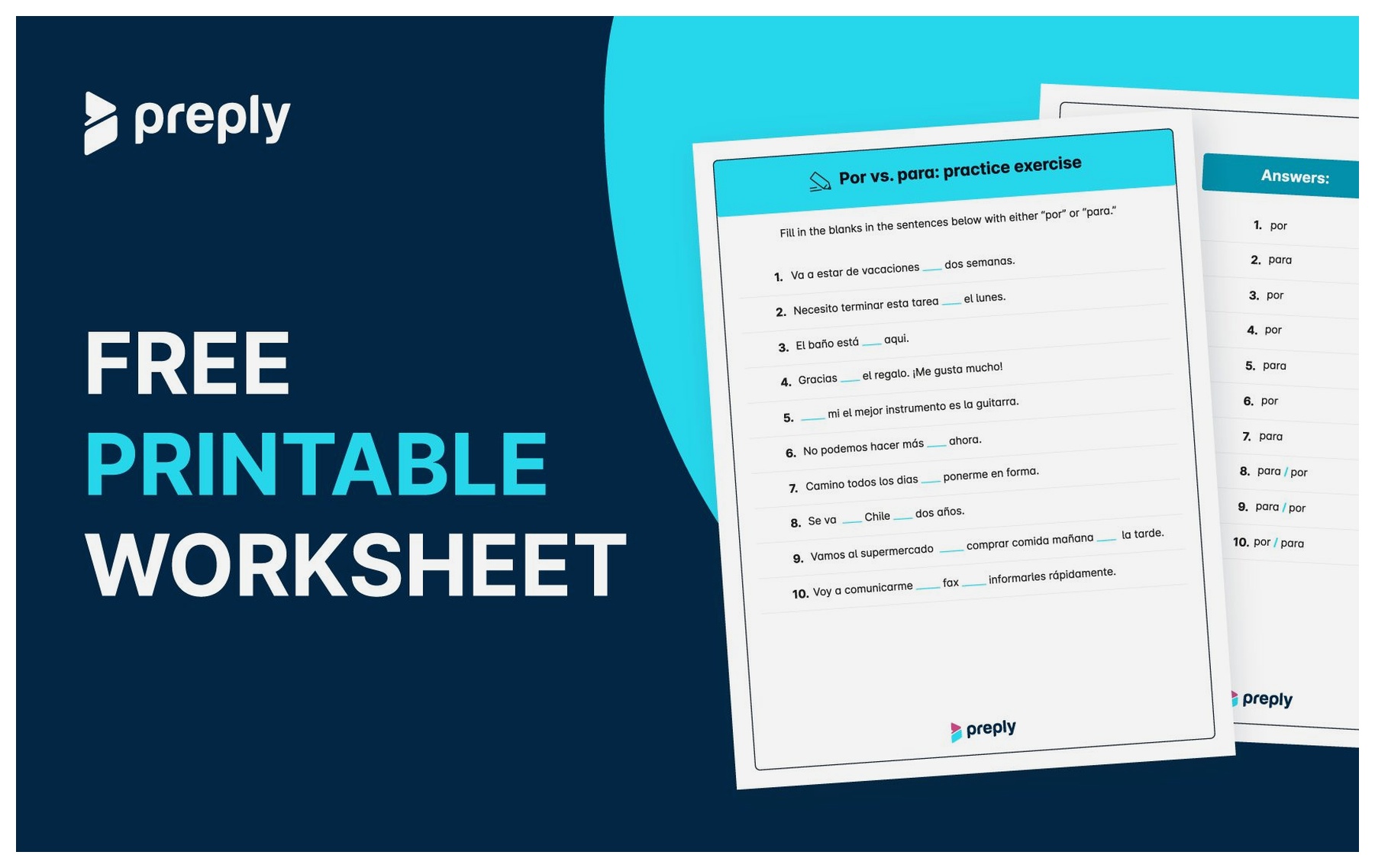
Practice exercise
Feeling confident about what you’ve learned? Let’s put your knowledge to the test! Complete the blanks with the correct terms, ‘por’ or ‘para,’ based on your understanding.
- Va a estar de vacaciones ____ dos semanas. (por)
- Necesito terminar esta tarea ____ el lunes. (para)
- El baño está ____ aqui. (por)
- Gracias ____ el regalo. ¡Me gusta mucho! (por)
- _____ mi el mejor instrumento es la guitarra. (para)
- No podemos hacer más ____ ahora. (por)
- Camino todos los dias ____ ponerme en forma. (para)
- Se va ____ Chile ____ dos años. (para/por)
- Vamos al supermercado _____ comprar comida mañana ____ la tarde. (para/por)
- Voy a comunicarme _____ fax _____ informarles rápidamente. (por/para)
Speak Spanish like a native speaker
While “por” and “para” are fundamental Spanish words, mastering their usage takes considerable practice. Language learners often find them confusing because they can both translate to “for” in English, much like the distinction between “ser” and “estar.” Understanding the nuances of these terms is key to becoming proficient in Spanish.
Although you can learn basic guidelines for effective usage, the most effective way to master Spanish is through online lessons. Engaging with a LingualNeeds tutor, for instance, can provide you with valuable support to:
- Explain the grammatical rules and answer your questions
- Show you the meaning of these words with examples that apply directly to your life
- Help improve your pronunciation
- Teach you expressions, idioms, and slang that native speakers actually use
- Use por and para like a native speaker!
Start your language learning journey today by signing up for an online tutoring session!
Frequently Asked Questions
What is the main difference between ‘por’ and ‘para’?
‘Por’ suggests a vague direction, while ‘para’ indicates a direct destination.
When should I use ‘por’?
‘Por’ is used for motivation, duration, costs, location, mode of travel, and to indicate who is doing an action in the passive voice.
What are some common uses of ‘para’?
‘Para’ is used for specific destinations, goals, recipients, deadlines, and expressing opinions.
How can I remember when to use ‘por’?
Ask yourself questions related to reason, duration, costs, location, or mode of communication.
What resources can help me master ‘por’ and ‘para’?
Engaging with a tutor or taking online lessons can provide explanations, examples, and support for mastering these terms.


