- Is Japanese or Korean easier to learn?
- Writing system
- Japanese
- Korean
- Pronunciation
- Japanese
- Korean
- Grammar
- Vocabulary
- Honorifics
- Learn Korean or Japanese with LingualNeeds
- Frequently Asked Questions
- What are the key writing systems used in Japanese?
- How does Korean pronunciation differ from Japanese pronunciation?
- What is the primary sentence structure for both Korean and Japanese?
- What role do honorifics play in Korean and Japanese cultures?
- How can I effectively learn Korean or Japanese online?
If you’re thinking about picking up a new language, you might want to explore an Asian option like Chinese, Korean, or Japanese. Your choice will largely hinge on your personal goals and how challenging you find each language.
Mastering a new alphabet can be challenging, but various other factors also play a crucial role in determining the ease or difficulty of learning a language.
In this article, we’ll explore the key differences and similarities between Korean and Japanese to help you decide which language is the best fit for you: Japanese or Korean?
Is Japanese or Korean easier to learn?
Determining which language presents fewer challenges is difficult, as Korean and Japanese share many similarities.
The U.S. Department of State categorizes both languages as Category IV, indicating that they present significant challenges for native English speakers. Achieving intermediate proficiency in either language may require a commitment of up to 1.5 years, totaling around 2,200 classroom hours.
If we had to summarize which parts are more complex in each language, we could say:
- Writing system: Japanese
- Pronunciation: Korean
- Grammar: Both
- Vocabulary: Both
- Honorifics: Both
Don’t be discouraged! Learning Korean or Japanese can be an incredibly rewarding journey. As you expand your vocabulary and grasp new concepts, you’ll see tangible progress that will inspire you to keep going. Embrace the challenge and enjoy the satisfaction that comes with each new word you learn!
Now, let’s go section by section to compare Korean and Japanese.
Writing system
Japanese
The Japanese language uses three writing systems:
- Kanji: Simplified Chinese characters that are commonly used in Japanese writing
- Hiragana: Native writing system used for everyday Japanese words and grammar
- Katakana: Alphabet used for writing foreign words, onomatopoeia sounds, and loan words
We can also incorporate romaji, the Romanized representation of Japanese sounds. This system is especially useful for typing in Japanese on computers or mobile devices, making it easier for non-Japanese speakers to engage with the language.
Hiragana and Katakana each have 46 characters formed by a consonant and a vowel.
For example:
- か is “ka” in Hiragana
- す is “su” in Hiragana
- ホ is “ho” in Katakana
Each symbol corresponds to a syllable, which makes it straightforward to write names in this format. For example, to spell “Laura,” you would break it down into the syllables “ラ” (ra), “ウ” (u), and “ラ” (ra), resulting in the combined form “ラウラ.”
In contrast, Kanji consists of thousands of characters, but fear not! Mastering just 2,136 of these characters is enough to grasp everyday Japanese conversations and texts.
The main challenge of reading Japanese is that you must learn the corresponding Kanji characters. Without this knowledge, deciphering the meaning of words will be nearly impossible.
Korean
The Korean alphabet, called Hangul, is a unique writing system made up of 24 basic characters: 14 consonants and 10 vowels. It also features 27 additional complex letters created by combining these base characters. Occasionally, the Roman alphabet, known as “로마자” (romaja), is employed alongside Hangul for various purposes.
The Korean writing system is designed with simplicity in mind: by combining individual letters, you can easily create syllables. Remarkably, you can master the Korean alphabet and its usage in just a single day!
To illustrate, the word “밤” (bam) is formed by blending the consonant “ㅂ” (b) with the vowel “ㅏ” (a) and ending with the consonant “ㅁ” (m). This combination showcases the phonetic structure of the Korean language.
Fortunately, mastering the Korean alphabet allows you to read any written text, even if the meanings of the words remain unfamiliar to you.
Pronunciation
Japanese
The Japanese language features 15 distinct consonant sounds and 5 vowel sounds. By incorporating diacritic marks like (゛) and (゜), you can create voiced sounds, form unique syllables, and indicate long vowel sounds, enhancing the richness of pronunciation.
For instance, if we combine syllables and diacritic marks, we can create these sounds:
- か (ka) would become が (ga)
- す (su) would become ず (zu)
- ホ (ho) would become ポ (po)
In Japanese, words are pronounced just as they are written, making it simpler to learn and accurately read the language. By mastering the sounds of Japanese, you’ll enhance your ability to communicate effectively and confidently.

Korean
Korean pronunciation can pose a greater challenge for English speakers compared to Japanese. This difficulty arises from the presence of unique sounds in Korean that are not found in English.
The Korean language features 14 consonants and 10 vowels, many of which have similar sounds. In addition, there are 27 more intricate letters that can pose a greater challenge for pronunciation.
The Korean writing system constructs syllables by blending letters together. Interestingly, when two consonants appear side by side, their sounds can shift. To master Korean, it’s essential to familiarize yourself with these pronunciation nuances and exceptions.
This is the case for words such as:
- 닭: In this word, the combination of “ㄹ” and “ㄱ” makes the “ㄹ” silent, resulting in the pronunciation “dak” instead of “dalk.”
- **Pronunciation Note:** In the word “연락,” the combination of “ㄴ” and “ㄹ” changes both sounds to “ㄹ,” resulting in the pronunciation “yeollak” instead of “yeonrak.”
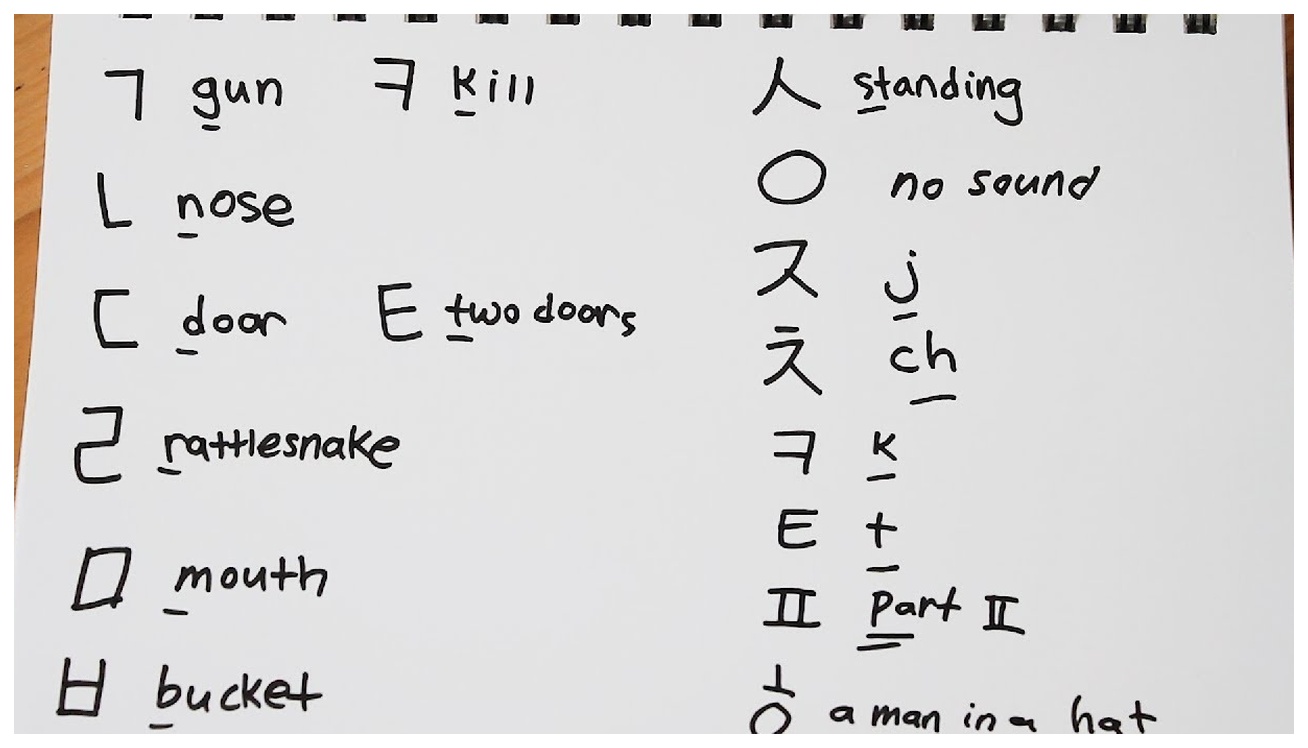
You can watch the video below to learn the correct pronunciation of Hangul and to identify some pronunciation exceptions.
Grammar
Japanese and Korean grammar exhibit notable similarities, particularly in their sentence structure, which follows a subject-object-verb order. Additionally, both languages utilize suffixes attached to root words to convey various grammatical meanings, enhancing their expressive capabilities.
For example, if we compare the sentence “I study English in the library” in Japanese:
私は図書館で英語を勉強します
(“Watashi wa toshokan de eigo o benkyō shimasu”).
With its equivalent in Korean:
저는 도서관에서 영어를 공부해요
(“Jeoneun doseogwan-eseo yeong-eoreul gongbuhaeyo”).
We can see a few things:
- Both follow a subject-object-verb order, so the equivalent in English would be: “I in the library English study.”
- Both languages utilize particles following nouns to specify the subject, object, and location. In Japanese, these particles include “は” (wa), “で” (de), and “を” (o), while Korean uses “는” (neun), “에서” (ese), and “를” (reul).
- Both verbs consist of a root word (“勉強” for Japanese and “공부” for Korean) combined with the present tense suffixes (“-します” for Japanese and “-해요” for Korean).
- Japanese words are normally written together, while Korean uses spaces.
Vocabulary
Determining which language has the more challenging vocabulary can be tricky, as both incorporate numerous Chinese words. This shared linguistic influence creates a resemblance in sound, despite their distinct writing systems.
Here is a list of similar words between the two languages:
|
English |
Korean |
Japanese |
|
picture |
사진 (sajin) |
写真 (shashin) |
|
bag |
가방 (kabang) |
かばん (kaban) |
|
promise |
약속 (yaksok) |
約束 (yakusoku) |
|
furniture |
가구 (kagu) |
家具 (kagu) |
|
singer |
가수 (kasu) |
歌手 (kashu) |
|
city |
도시 (doshi) |
都市 (toshi) |
Honorifics
In both Korean and Japanese cultures, using honorifics is essential for expressing respect. These linguistic markers are typically appended to a person’s name and vary based on your relationship with them. Depending on whether you are speaking to someone close or a figure of authority, you’ll choose between casual or formal honorifics to convey the appropriate level of respect.
In Japanese, the common honorific is “-さん” (san):
- スミスさん (“Smith-san”)
While in Korean, the most common honorifics are “-님” (nim) and “-씨” (shi):
- 스미스씨 (“Smith-shi”) or 스미스님 (“Smith-nim”)
Learn Korean or Japanese with LingualNeeds
Is Korean or Japanese easier to learn? The answer depends on what aspect you focus on.
Explore various websites dedicated to learning Japanese and Korean to discover which language resonates with you the most. This research will help you make an informed decision about your language-learning journey.
Once you’ve selected the language that excites you, enrolling in online Korean courses or personalized 1-on-1 Japanese lessons can significantly enhance your learning experience. These options provide tailored guidance to help you progress more effectively on your language journey.
When enrolling in online classes, the key to success lies in finding a tutor who truly understands your unique learning needs. A personalized approach can make all the difference, ensuring that the course is tailored specifically to help you thrive.
To enhance your learning experience while on the move, consider exploring the top apps for learning Korean alongside your online classes. Additionally, to supplement your Japanese studies, immerse yourself in Japanese anime during your free time. These engaging resources can significantly boost your language skills!
Frequently Asked Questions
What are the key writing systems used in Japanese?
Japanese uses three writing systems: Kanji, Hiragana, and Katakana.
How does Korean pronunciation differ from Japanese pronunciation?
Korean pronunciation can be more challenging for English speakers due to unique sounds and pronunciation shifts that don’t exist in English.
What is the primary sentence structure for both Korean and Japanese?
Both languages follow a subject-object-verb sentence structure.
What role do honorifics play in Korean and Japanese cultures?
Honorifics are essential for expressing respect and vary based on the relationship with the person being addressed.
How can I effectively learn Korean or Japanese online?
Enrolling in online courses with a personalized tutor and using language learning apps can significantly enhance your learning experience.