- Endangered languages around the world
- Regional patterns of endangered languages
- Number of speakers per endangered category
- The most endangered languages (From critically endangered to at-risk)
- Awakening languages
- Non-endangered languages with the most international growth
- 5 Endangered languages (and how you can help):
- Endangered Language: Welsh
- Primary Location: Wales
- Current Speakers: 562,000
- Status: Vulnerable
- Endangered Language Profile: Lakota (aka Teton Sioux)
- Primary Location: North and South Dakota
- Current Speakers: 2,000
- Status: Endangered
- Endangered Language: Gaelic
- Primary Location: Ireland and Scotland
- Current Speakers: 57,000
- Status: Endangered
- Endangered Language Profile: Inupiaq
- Primary Location: Alaska and Canada’s Northwest Territories
- Current Speakers: 2,000
- Status: Severely Endangered
- Endangered Language Profile: Cornish
- Primary Location: Cornwall
- Current Speakers: 557
- Status: Awakening
- Endangered Language: Louisiana French (aka Cajun French)
- Primary Location: Louisiana
- Current Speakers: 130,000
- Status: Endangered
- Louisiana French: A Rich Heritage at Risk of Vanishing
- How you can help save endangered languages:
- Methodology
- Sources
- Frequently Asked Questions
- What is the purpose of the comprehensive report on endangered languages?
- Which regions are most affected by endangered languages?
- What are some examples of endangered languages mentioned in the article?
- How can individuals help in the preservation of endangered languages?
- What factors contribute to the decline of endangered languages?
In response to the growing threat to local languages and dialects, we’ve commissioned a comprehensive report that identifies the most endangered languages. Additionally, we’ve chosen several of these languages to spotlight, aiming to spark renewed awareness and interest in their preservation.
In this exploration, we will delve into the regions of the world where endangered languages are most prevalent and identify those languages that are gaining prominence. With thousands of languages facing the threat of extinction, our focus will be on six specific languages that were once widely spoken but have experienced a significant decline in usage.
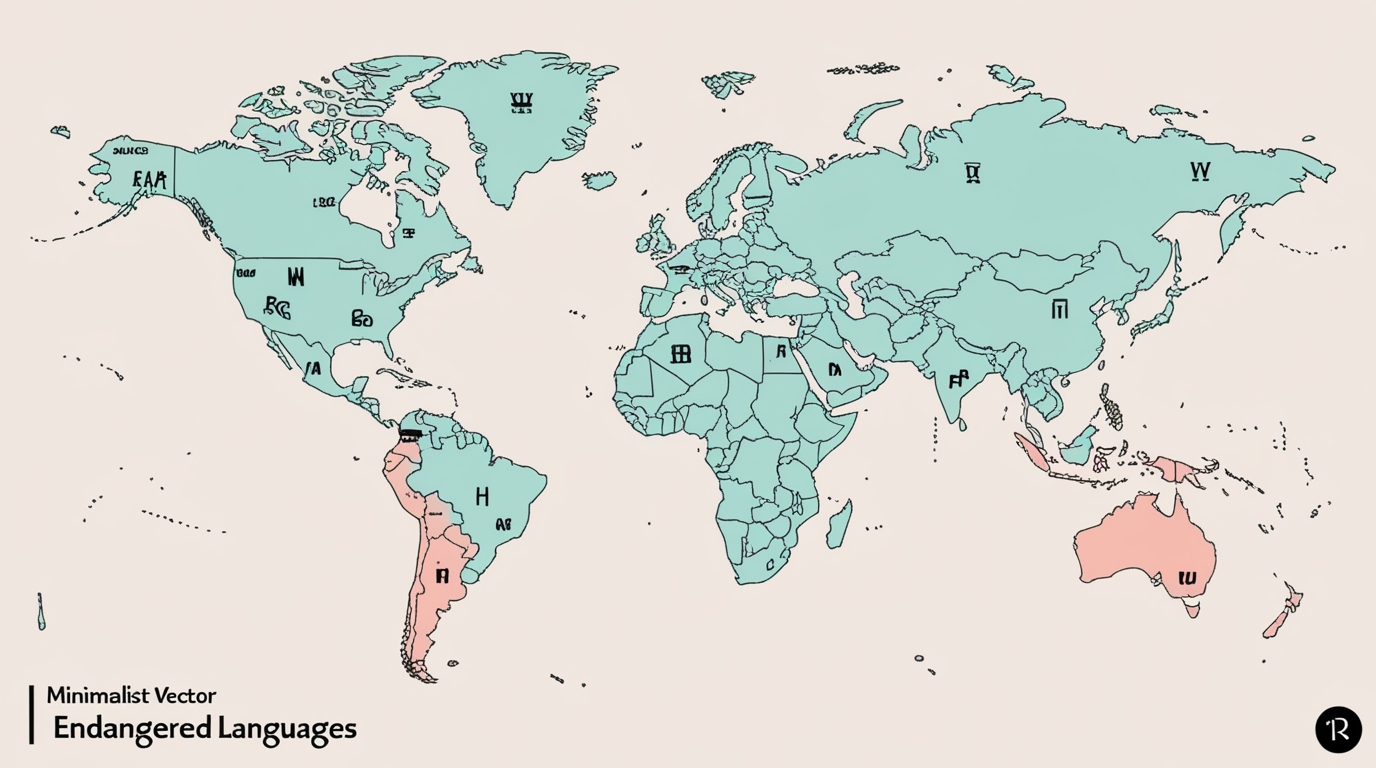
Endangered languages around the world
Before we look at individual languages, let’s take a look at trends and patterns in endangered languages.
The accuracy of data on endangered languages can differ significantly based on the country, the specific process used for data collection, and how willing individuals are to self-report their language use. As a result, some languages fall into a gray area; we recognize they are endangered, but precise numbers and trends are often elusive. However, by analyzing the broader landscape of endangered languages, we can identify key patterns that inform effective solutions and revitalization strategies for the future.
Regional patterns of endangered languages
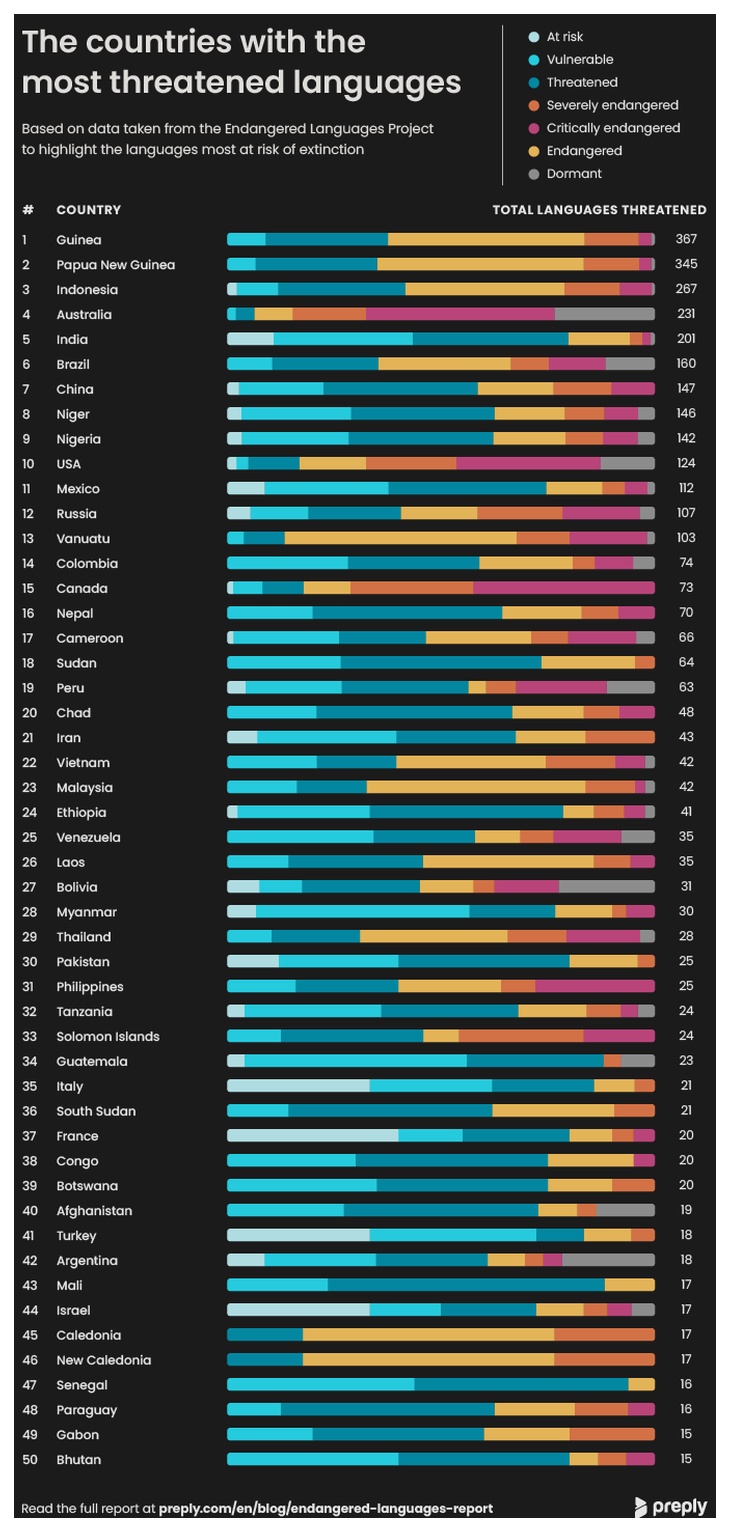
By analyzing the available language data, we can identify regions with the highest concentration of endangered languages. While each language faces unique challenges, many endangered languages are found in areas where globalization has significantly affected once-isolated communities. This trend highlights the broader impact of modern influences on linguistic diversity.
In regions where native speakers are striving to safeguard their language, socioeconomic challenges still exert a significant influence on younger and working-age individuals. Many are choosing to prioritize languages that enhance their job prospects, often sidelining the languages that connect them to their cultural heritage.
- Australia has the highest number of critically-endangered languages: 133¹
- The Pacific has the highest number of endangered languages: 250¹
- Africa has the most threatened languages: 217¹

Learn a language with personalised 1-on-1 classes with our expert tutors from all over the world
French lessons online
Spanish lessons online
Number of speakers per endangered category
To provide readers with a clearer picture of how speakers are distributed across various endangered language categories, we’ve compiled data from the Endangered Languages Project. This involves mapping each language on a spectrum and tallying the total number of speakers for each category.
The most endangered languages (From critically endangered to at-risk)
With thousands of endangered languages around the world, we’ve curated a list of the ten most threatened languages across various categories to help readers understand their differences. It’s essential to recognize that the classification of a language isn’t strictly defined by a specific population threshold. Factors such as the rate of decline, sociopolitical influences, and the age of speakers all play a crucial role in how these languages are categorized.
Learn a language online with our free learning materials.
Learn English online
Learn French online
Awakening languages
Despite the decline of many languages, there is a glimmer of hope in their potential for revival. While the number of awakened languages may not yet surpass those at risk of disappearing, they serve as a powerful reminder that, with dedicated revitalization efforts and the right resources, a language can rise from the brink of extinction.
A prime example of language revitalization is the Kaurna language from Australia, which faced extinction after the last native speaker passed away in 1929. Beginning in the 1980s, dedicated efforts to revive Kaurna included creating original songs, developing a formal dictionary, and launching official language-learning programs. These initiatives have successfully increased the number of speakers to nearly 50 in recent years, though their fluency levels vary. While the revitalization process is ongoing, it remains a careful and gradual endeavor.
Additional languages considered to be awakening, include:
- Bering Aleut
- Palawa Kani
- Barbareño
- Natchez
- Taungurung
- Soyot
- Wampanoag
- Chiquimulilla Xinka
- Siraya
Non-endangered languages with the most international growth
On the flip side, we explored how languages are emerging as dominant forces globally, driven by increased external trade among once-isolated communities and the powerful influence of social media and pop culture on younger generations.
Given the advantages of mastering English or Mandarin, especially in regions experiencing rapid population growth and enhanced quality of life due to booming international trade, it’s clear why these languages dominate the business landscape.
Although there isn’t a direct link between the rise of global languages and the decline of endangered ones, the growing dominance of widely spoken languages—often at the heart of international trade and commerce—can certainly contribute to the erosion of local dialects.
5 Endangered languages (and how you can help):
Identifying the world’s most endangered languages depends on your perspective and the criteria you use to define “endangered.” Different factors can influence this classification, making it a nuanced and subjective issue.
Why is this important? Because we can argue that either a little-known language with just a handful of speakers or a previously common language, which still boasts hundreds or even thousands of speakers but is rapidly diminishing, qualifies as the “most endangered.”
Which languages are facing the greatest risk of extinction? While every language, especially those steeped in rich cultural heritage, holds immense value, it’s simply not feasible to preserve them all. However, we’ve curated a selection of endangered languages to raise awareness and encourage you to explore ways to support and learn these languages in your community.
Endangered Language: Welsh
Primary Location: Wales
Current Speakers: 562,000
Status: Vulnerable

The Welsh language has deep Brittonnic roots, though its exact origins remain elusive. Its evolution is distinctly marked by several key stages: beginning with Primitive Welsh (exact dates unknown), it progressed to Old Welsh between the 9th and 11th centuries, followed by Middle Welsh from the 12th to the 14th centuries, and ultimately evolving into Modern Welsh, which has been in use since the 16th century.
Despite its vulnerability to extinction, there is a promising outlook for the revitalization of the Welsh language. Over the past century, census data reveals a paradox: while Wales’ overall population has increased, the proportion of Welsh speakers plummeted from 50% in 1901 to just 20.7% in 1971. However, this figure has stabilized at around 19-20% for over 50 years. Unlike many endangered languages, fluency in Welsh enhances job prospects and is regarded as a positive attribute, reflecting educational attainment rather than a lack of it. Conservation efforts are crucial for curbing the decline of the Welsh language, but it is education programs—especially those in Welsh-medium schools—that have been pivotal in fostering its resurgence among younger generations.
Currently, 30% of children aged 3 to 15 are fluent in Welsh, compared to just 10% of adults aged 55 to 64. This disparity highlights the language’s vulnerability, yet it also offers hope for its future. Encouragingly, the Welsh government has set an ambitious target: to achieve 1 million fluent Welsh speakers by 2050. With ongoing efforts, there’s potential for fluency to flourish in the years ahead.
Endangered Language Profile: Lakota (aka Teton Sioux)
Primary Location: North and South Dakota
Current Speakers: 2,000
Status: Endangered

Lakota, also known as Teton Sioux, is a variant of the Sioux language that historically served as the main language of the Lakota people. Today, despite a community of 170,000 individuals who identify as Lakota, only about 2,000 people are fluent in the language, highlighting a significant cultural and linguistic challenge.
The decline of the Teton Sioux language was a significant aspect of the U.S. government’s efforts in the 1800s to integrate Native Americans into the dominant non-Native culture. At Indian residential schools, Lakota children faced harsh punishments, including beatings and food deprivation, for speaking their native language. Adults were similarly pressured to abandon Lakota, as English proficiency increased their job opportunities. Despite attempts by the Lakota community to preserve their language within families and cultural gatherings, it wasn’t until the late 1960s and mid-1970s that organized revitalization initiatives began to emerge, aiming to prevent the language’s extinction.
Since then, the Lakota community has initiated various programs aimed at promoting Lakota language education, notably the Lakota Language Education Program. This initiative focuses on training new language teachers to pass on the Lakota language to future generations and the current population in Teton Sioux. Despite these efforts, only about 1% of the Lakota people currently speak the language, highlighting the significant challenges that lie ahead in safeguarding it from extinction.
Endangered Language: Gaelic
Primary Location: Ireland and Scotland
Current Speakers: 57,000
Status: Endangered

The term “Gaelic” can vary in meaning based on your location. It may specifically denote the Scottish Gaelic language, or it can serve as a broader term encompassing a group of related languages, including Irish, Scottish Gaelic, and Manx. These languages have developed around Ireland, Scotland, and the Isle of Man, and they all face varying degrees of endangerment.
In this discussion, we will concentrate on a specific group of languages that, as of 2011, had a combined total of only 57,000 speakers. This marks a slight decline from the 59,000 speakers recorded in the 2001 census. Notably, in 2011, an extra 20,000 individuals indicated they could understand Gaelic but were unable to speak, read, or write it. This highlights a significant challenge: the lack of formal education and ongoing support for Gaelic languages, which poses a threat to their survival.
Irish and Scottish Gaelic have experienced a boost in conservation initiatives, primarily through legislation that recognizes both Gaelic and English as official state languages. However, these efforts pale in comparison to the more structured and well-funded campaigns aimed at revitalizing other languages globally.
Manx faced a near extinction when the last native speaker passed away in 1974. However, thanks to dedicated preservation efforts, the language has been kept alive. Despite these initiatives, the prospect of reviving it as a native tongue remains limited.
Endangered Language Profile: Inupiaq
Primary Location: Alaska and Canada’s Northwest Territories
Current Speakers: 2,000
Status: Severely Endangered

Inupiaq, a member of the Inuit language family, is primarily spoken along the northern coast of Alaska and in Canada’s Northwest Territories. Unfortunately, it is considered one of Canada’s most endangered languages, highlighting the urgent need for preservation efforts.
Like the Lakota language, Inupiaq faced a sharp decline due to assimilation efforts by the United States and Canada aimed at integrating First Nations communities into English-speaking culture. English-only residential schools pressured Inuit youth to abandon their Inupiaq language. Additionally, throughout the 1900s, job opportunities in Alaska and the Northwest Territories predominantly required English fluency, offering no advantages for those who spoke Inupiaq. As a result, many adults in the Inuit community experienced a significant drop in their language fluency over the years.
Today, Inupiaq is classified as “extremely endangered” due to an aging population of fluent speakers. As of 2007, there were only 2,144 individuals who spoke Inupiaq, within a community of about 20,000 Inupiat people. While organized efforts to preserve the language are currently taking place, they are primarily driven by local communities. Although there has been notable progress, revitalizing Inupiaq will require a substantial increase in fluency among younger Inuit individuals.
Endangered Language Profile: Cornish
Primary Location: Cornwall
Current Speakers: 557
Status: Awakening

Like Welsh, the Cornish language has its origins in Brittonic and flourished for almost a millennium, boasting around 39,000 speakers in the 13th century. However, social and religious pressures over the next 200 years severely hindered its widespread use and acceptance.
A significant milestone in the evolution of the English language occurred in 1549 with the enactment of England’s Act of Uniformity. This legislation designated the English Book of Common Prayer as the sole authorized text for worship, effectively banning worship in other languages. The act sparked the Prayer Book Rebellion, a violent uprising that year, resulting in the tragic loss of 4,000 protesters’ lives.
The loss left non-English speakers feeling demoralized and anxious about potential reprisals, prompting many Cornish individuals to distance themselves from their native language as a way to demonstrate loyalty to England. This shift contributed to a continued decline, ultimately leading to the official extinction of the Cornish language in the 1800s.
Despite having a small number of speakers at its peak, Cornish has benefited from dedicated revitalization efforts. These initiatives have successfully standardized the Cornish alphabet and harmonized its various dialects, culminating in the establishment of a Standard Written Form in 2008. Though Cornish still faces the threat of extinction, it is now recognized as an awakening language, requiring continued support for revitalization in the years to come.
Endangered Language: Louisiana French (aka Cajun French)
Primary Location: Louisiana
Current Speakers: 130,000
Status: Endangered
Louisiana French: A Rich Heritage at Risk of Vanishing
By the mid-1800s, various dialects had merged to form Louisiana French. However, as language protections weakened, this unique dialect began to decline gradually, a trend that intensified dramatically after 1921, when French was banned from schools. This ban had profound consequences: it not only dissuaded children from learning Louisiana French but also stigmatized the language, linking it to notions of unrefinement and inadequate education.
Despite resistance from some French speakers, the implementation of strict measures—including corporal punishment against French-speaking children and social stigmas against French-speaking adults—led to a dramatic decline in the use of Louisiana French. The number of speakers plummeted from over 1 million in the late 1960s to approximately 130,000 by 2011.
In 1968, the establishment of The Council for the Development of French in Louisiana (CODOFIL) marked a pivotal moment for organized conservation efforts aimed at preserving the French language in the state. This initiative has made strides in slowing the decline of French-speaking communities, yet many of its programs focus on teaching standard French. As a result, the unique Louisiana French dialect remains endangered, despite a resurgence of support for French-speaking populations in recent years.
How you can help save endangered languages:
Wondering how you can make a difference? The paths to preserving endangered languages are as diverse as the languages themselves. Your involvement can contribute to a multitude of creative solutions!
While custom solutions may be necessary in specific situations, we’ve compiled some straightforward ways for you to get involved and help breathe new life into a language that holds significance for you:
- As a non-native speaker, educate yourself about endangered languages in your region and support preservation efforts through your time or financial contributions. If no endangered languages are present, consider learning a new language like Spanish, French, English, or Japanese. This investment will enhance your understanding of the importance of preserving endangered languages.
- As a native-speaking parent, immerse your children in your language early on and explore local organizations focused on language revitalization.
- Educational institutions should incorporate these languages into their curriculum or extracurricular clubs to facilitate connections between language learners and structured coursework.
- Government bodies and politicians should provide support programs for newcomers to learn local languages, fund language-learning initiatives, and promote revitalization efforts.
As globalization and international trade grow, endangered languages encounter increasing challenges that threaten their survival. To combat this decline, raising awareness and implementing structured educational initiatives have emerged as effective strategies for revitalization. However, these efforts must be tailored to address the unique reasons and circumstances that have contributed to each language’s endangerment.
It is crucial for conservationists to take proactive measures, especially since many native speaker populations are aging. Training younger generations to become fluent in these languages requires significant time—time that many of these languages may not have.
Methodology
Leveraging insights from the Endangered Languages Project, we identified the languages facing the greatest threat of extinction. Furthermore, we explored specific regions to gather fascinating information about local languages and global trends, shedding light on the intricate landscape of linguistic diversity.
Determining the precise number of speakers for any endangered language is challenging due to several factors. Most countries conduct census surveys only once every decade, and some have even less frequent or no formal census processes at all. This lack of regular data collection makes it hard to track the vitality of these languages accurately.
Finally, we enhanced our research by integrating up-to-date information from local government sources, which provided data more frequently than the typical decennial updates.
Sources
- Data Collected from: https://www.endangeredlanguages.com/#/4/47.513/-1.473/0/100000/0/low/mid/high/unknown.
- https://www.endangeredlanguages.com/lang/5871
- https://www.endangeredlanguages.com/lang/10429
- https://www.endangeredlanguages.com/lang/2052
- https://www.scotlandscensus.gov.uk/census-results/at-a-glance/languages/
- https://www.endangeredlanguages.com/lang/2369
- https://www.endangeredlanguages.com/lang/4050
- https://www.endangeredlanguages.com/lang/10931
- https://www.lingq.com/en/learn-english-online/courses/20988/the-cornish-language-22141/
- https://academickids.com/encyclopedia/index.php/Prayer_Book_Rebellion
- https://www.celtictitles.com/blog/celtic-language-statistics-2022/
Frequently Asked Questions
What is the purpose of the comprehensive report on endangered languages?
The report aims to identify the most endangered languages and spark renewed awareness and interest in their preservation.
Which regions are most affected by endangered languages?
Regions with the highest concentration of endangered languages include Australia, the Pacific, and Africa.
What are some examples of endangered languages mentioned in the article?
Examples of endangered languages include Welsh, Lakota, Gaelic, Inupiaq, and Louisiana French.
How can individuals help in the preservation of endangered languages?
Individuals can educate themselves about endangered languages, support preservation efforts, immerse their children in native languages, and advocate for educational initiatives.
What factors contribute to the decline of endangered languages?
Factors include globalization, socioeconomic challenges, historical assimilation policies, and a lack of formal education and support for these languages.