- How to learn Arabic: a few introductory facts
- Why learn Arabic: political and cultural aspects
- Arabic in literature
- Arabic’s role in religion
- Arabic’s influence on politics
- Is Arabic hard to learn?
- Myth 1. Tricky pronunciation
- Myth 2. Difficult-to-conjugate verbs
- Myth 3. Word order is crucial for understanding
- Myth 4. Arabic has a huge vocabulary
- How long does it take to learn Arabic?
- How to learn Arabic fast?
- Step 1. Start with the basics:learntheArabic alphabet
- Step 2.Learnhowto read Arabic
- Step 3.Learnhowto write Arabic
- Step 4.Learnhowto speak Arabic
- Step 5. Immerse yourself in daily practice
- What’s next?
- Frequently Asked Questions
- Why should I learn Arabic?
- What are the main forms of Arabic?
- How long does it take to learn Arabic?
- What is the best way to start learning Arabic?
- Can I learn Arabic online?
Are you passionate about languages and eager to expand your horizons while enhancing your career prospects? Learning Arabic could be your perfect opportunity! As one of the top five most spoken languages globally, Arabic boasts over 274 million speakers, ranking just behind Spanish and ahead of French, which is currently in seventh place. This vibrant community is growing every year, making Arabic a valuable skill in today’s interconnected world.
The Arabic language boasts a rich history and distinct characteristics that set it apart. Its profound impact can be seen in Latin and Greek, and many words in Portuguese and Spanish are borrowed from Arabic. Embarking on the journey to learn Arabic opens the door to transformative experiences that can enrich your life in unexpected ways.
Are you excited to begin this journey? We have some crucial tips to help you kick off and achieve impressive results. Keep reading for valuable insights, or dive right in by taking your first online Arabic class with LingualNeeds!
How to learn Arabic: a few introductory facts
Before diving into sentences, vocabulary, and other aspects of the Arabic language, it’s essential to explore its rich origin and history. A deeper understanding of where Arabic comes from will enhance your overall learning experience and help you discover the most effective strategies for mastering the language.
Arabic is part of the Afro-Asiatic language family, the most extensive in northern Africa. As a macrolanguage, it encompasses 30 distinct dialects, but two main forms stand out. Classical Arabic is the formal, standardized version taught in schools and universities, and it holds significant religious importance as the language of the Quran, the holy book of Islam.
Modern Standard Arabic serves as the unifying language across the Arab world, playing a crucial role in media and contemporary literature. However, you’ll rarely encounter someone who speaks it in its pure form, as it is shaped by various regional dialects from key Arabic-speaking areas, including Syria, Egypt, Iraq, and North Africa.
Wondering which Arabic dialect to learn? Your choice should be guided by your goals and the specific countries you plan to live in or visit. If you’re feeling uncertain, consider seeking assistance from experts. For example, LingualNeeds offers personalized 1-on-1 lessons with native Arabic tutors from diverse regions. This means you can connect with a tutor who specializes in the dialect you need. Plus, you can conveniently study online via video chat from anywhere in the world. Discover the flexibility of language learning by finding your ideal tutor today!
Find my Arabic tutor now
Why learn Arabic: political and cultural aspects
Since the era of the Islamic Empire, Arabic has profoundly shaped various languages, cultures, and political landscapes. Today, its significance continues to thrive, reflecting a strong demand and widespread popularity across the globe.
Arabic in literature
Arabic literature boasts a rich history that dates back to the 5th century. The Quran, the first major literary work in Arabic, stands out for its unique blend of prose and poetry. With its intricate structure comprising 114 suras (chapters) and over 6,000 verses, it continues to captivate linguists and scholars alike.
One of the most captivating works of Arabic literature is “Arabian Nights,” a rich tapestry of prose romance filled with enchanting tales and legendary figures like Aladdin, Ali Baba, and Sinbad the Sailor. These stories have significantly influenced Western folklore and imagination. Additionally, Arabic writers played a pivotal role in the evolution of philosophical literature and science fiction, producing some of the earliest novels in these genres.
Arabic’s role in religion
Arabic is essential for grasping the nuances of Islam and its foundational text, the Quran. A unique aspect of this language is “Quran Arabic,” which offers a deep dive into the cultural and religious context of the Quran. While it shares many similarities with Modern Standard Arabic, there are subtle distinctions in grammar and punctuation that set it apart. For those eager to explore Arabic culture, learning Quran Arabic can be a rewarding experience.
Arabic’s influence on politics
Arabic is widely spoken across the Arabian Peninsula, as well as in various regions of the Middle East and North Africa. Learning this language not only enhances your understanding of the region’s complex political landscape but also provides a significant advantage in your career. Additionally, it broadens your cultural perspective and facilitates smoother travel throughout the Middle East.
Is Arabic hard to learn?
Arabic frequently ranks among the most challenging languages to learn, but is it truly as daunting as many believe, or is this just a common misconception? Here, we debunk several prevalent myths to help you approach learning Arabic with greater confidence.
Myth 1. Tricky pronunciation
As a language learner, you might have encountered some unique aspects of Arabic pronunciation. Fortunately, there are only a couple of sounds that tend to be challenging for non-native speakers. Once you master these distinct sounds, you’ll find it easy to navigate the rest of Arabic phonetics, as the language is largely phonetic—words are spelled exactly how they sound.
Myth 2. Difficult-to-conjugate verbs
When it comes to irregular verbs, Arabic is simpler than English, featuring only a small group known as “weak” verbs, which adhere to regular conjugation patterns. Generally, Arabic verbs are conjugated based on the subject, tense, and mood. To simplify this process, tools like ACON, an online Arabic conjugator, are available, making it easier for learners to master verb conjugation.
Myth 3. Word order is crucial for understanding
The World Atlas of Language Structures highlights that Arabic is classified as a minority language, accounting for just 7% of global languages, with a typical Verb-Subject-Object (VSO) word order. Interestingly, Arabic offers flexibility in its syntax, allowing speakers to rearrange sentences to a Subject-Verb-Object (SVO) structure, much like English, without altering their meaning.
Myth 4. Arabic has a huge vocabulary
Arabic operates like a fascinating puzzle, where most words are constructed from a shared root. This root typically comprises a set of consonants, and by adding various sounds and vowels around it, you can create entirely different words.
How long does it take to learn Arabic?
Estimating the time it takes to learn a foreign language can be quite challenging. While some individuals may invest years in formal education and still struggle to converse fluently, others can pick up vocabulary, grammar, and pronunciation in just a few months with focused effort. Ultimately, your success hinges on your motivation, commitment, and learning strategies.
How to learn Arabic fast?
Begin by choosing the type of Arabic you want to learn. If you don’t have a specific region in mind, Modern Standard Arabic is your best option. This form of Arabic is widely used across Arabic-speaking countries, primarily in formal contexts such as media, education, and literature.
Classical Arabic is even more formal and literary than Modern Standard Arabic (MSA). If you’re interested in exploring the Qur’an or delving into the rich history of the Arabic Golden Age, studying Classical Arabic is the perfect choice for you.
Colloquial Arabic includes a rich array of dialects and varieties crucial for effective communication in Arabic-speaking countries. For example, if your travels take you to Egypt, mastering Egyptian Arabic will enhance your experience. If you’re looking to establish a business in Lebanon, then learning Lebanese Arabic is essential. And for those who frequently visit Jordan, Israel, or Turkey, picking up Levantine Arabic will be immensely beneficial.
With your choice of Arabic dialect in hand, you’re ready to embark on your journey toward mastering the language. Let’s dive into the steps that will lead you to real understanding and proficiency.
Step 1. Start with the basics: learn the Arabic alphabet
Like any language, Arabic begins with its own unique alphabet, quite different from what most of us are familiar with. Here are some intriguing facts about it:
- Each letter stands for a consonant or a long vowel;
- Short vowels are defined with distinctive vowel marks or omitted;
- Many letters change their form depending on the place they take in a word;
- Some letters are always joined both in the printed and handwritten alphabet.
It might be tempting to skip ahead and start transcribing words in Arabic without first mastering the alphabet, especially since the characters can seem daunting. However, this approach is not advisable. With just 28 letters in the Arabic alphabet, why not take on the challenge and lay a solid foundation for your learning journey? Embracing the alphabet will ultimately enhance your understanding and enjoyment of the language.
Step 2. Learn how to read Arabic
One of the most challenging aspects of reading Arabic is remembering that certain letters take on different shapes depending on their position within a word. Here’s how a letter appears at the beginning, middle, and end of a word:
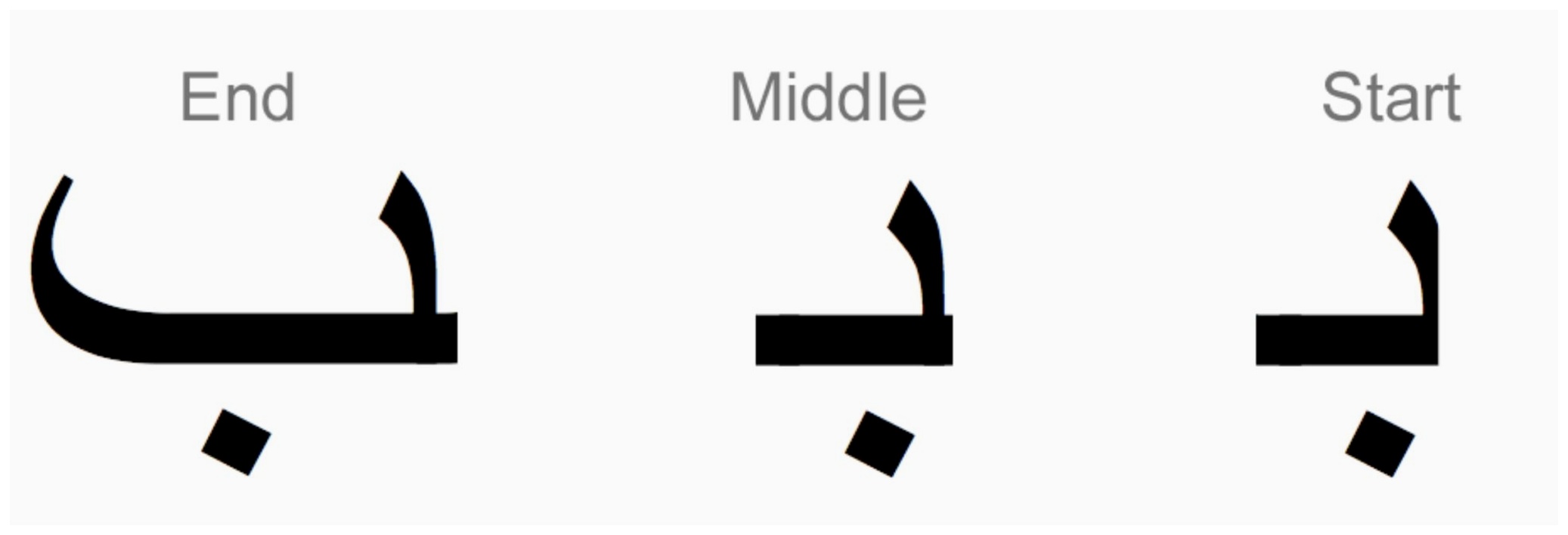
The fascinating aspect of this letter is that it shares the same pronunciation! It might sound a bit perplexing, but there’s no need to worry! To familiarize yourself with the Arabic writing system and its sounds, try listening to Arabic podcasts or using language-learning apps like Duolingo and Rosetta Stone. Additionally, you can find excellent books for learning Arabic available online.
Step 3. Learn how to write Arabic
The Arabic script is uniquely crafted, flowing from right to left in an elegant cursive style where most letters connect seamlessly. Instead of upper and lowercase forms, each letter has four variations based on its position within a word, enhancing the script’s fluidity. To help you begin writing Arabic effectively, here are some valuable tips:
- Try not to lift the pen when writing — smoothly move it from one letter to another without interruption;
- Practice consistently by repeatedly writing each letter with precision, focusing on the smallest details to improve your fingertip control.
- Practice writing from right to left to develop new muscle memory.
Sounds challenging? Once you get the hang of Arabic writing, you’ll see how easy it is!
Step 4. Learn how to speak Arabic
Communication is the primary motivation behind learning a new language. Embrace the opportunity to speak, even if your grammar isn’t flawless or you only know a handful of words. Allow your thoughts to flow naturally, without worrying about making mistakes. Remember, the goal is to connect, not to achieve perfection!
Finding a conversational partner can be challenging without an Arabic-speaking friend, but modern technology offers a solution. You no longer need to travel abroad to practice speaking with a native speaker. Online tutors are readily available to help you gain confidence in your Arabic skills and provide valuable feedback on your progress. To explore more options, check out our guide to the best language exchange apps of 2020!
Step 5. Immerse yourself in daily practice
The key to quick learning is consistent practice. Fortunately, there are numerous study tools and resources at your fingertips, allowing you to study anytime, anywhere. To boost your vocabulary and grammar skills on the move, consider downloading educational apps on your smartphone.
As a beginner, a great way to enhance your language skills is by watching children’s TV shows. They offer simple language and clear storytelling, making it easier to grasp the basics. As you progress, challenge yourself with Arabic movies or YouTube videos that include English subtitles. With continued practice, you’ll soon find you can switch off the subtitles and still comprehend the dialogue!
What’s next?
You’re embarking on an exciting journey, filled with challenges and opportunities for growth. Embrace the role of a patient yet proactive learner. While mastering the language might take years, you can significantly enhance your speaking skills in a shorter time frame if you commit to consistent practice.
Are you excited to embark on your language learning adventure? Dive into Arabic online with platforms like LingualNeeds, where you can practice with experienced native tutors. You’ll receive a customized study plan tailored to your proficiency and learning objectives. To kick off your journey, browse through a diverse selection of expert tutors and book a trial lesson at a time that works best for you.
Frequently Asked Questions
Why should I learn Arabic?
Learning Arabic can enhance your career prospects and allow you to connect with a vibrant community of over 274 million speakers.
What are the main forms of Arabic?
The two main forms are Classical Arabic, which is formal and religious, and Modern Standard Arabic, which is used in media and literature.
How long does it take to learn Arabic?
The time it takes varies greatly; some may take years while others can learn basic skills in a few months with focused effort.
What is the best way to start learning Arabic?
Begin by mastering the Arabic alphabet, then progress to reading, writing, and speaking with consistent practice.
Can I learn Arabic online?
Yes, you can take online classes with native Arabic tutors, which allows for flexible and personalized learning.