
- A guide to English language levels
- 1. Beginner: CEFR Level A1
- What you need to know about A1 level English
- What you can do at A1 level
- Tips to reach A1 level
- 2. Pre-Intermediate: CEFR Level A2
- What you need to know about A2 level English
- What you can do at A2 level
- Tips to reach A2 level
- 3. Intermediate: CEFR Level B1
- What you need to know about B1 level English
- What you can do at B1 level
- Tips to reach B1 level
- 4. Upper-Intermediate: CEFR Level B2
- What you need to know about B2 level English
- What you can do at B2 level
- Tips to reach B2 level
- 5. Advanced: CEFR Level C1
- What you need to know about C1 level English
- What you can do at C1 level
- Tips to reach C1 level
- 6. Mastery: CEFR Level C2
- What you need to know about C2 level English
- What you can do at C2 level
- Tips to reach C2 level
- Achieving your English proficiency goals
- Frequently Asked Questions
- What does it mean to be ‘basically fluent’ in English?
- What is the CEFR and how does it categorize English proficiency?
- How many words should a learner know at the A1 level?
- What study hours are typically needed to reach B2 proficiency?
- What is a recommended strategy for advancing from A2 to B1 level?
“I’m basically fluent in English.”
Have you ever found yourself wondering about the phrase “basically fluent”? What does it really imply? Does it suggest that you’ve attained a C2 proficiency level, having reached the pinnacle of language mastery? Let’s explore what “basically fluent” truly means in the context of language learning.
Did you know that English “fluency” starts well before reaching the C2 level? This insight comes from the Common European Framework of Reference for Languages (CEFR), an international standard for assessing language proficiency. The CEFR categorizes language skills on a scale from A1 for beginners to C2 for advanced speakers, providing a clear roadmap for learners at all levels.
Discover a variety of free online tests to assess your CEFR level in English. For a more official evaluation, consider taking recognized language proficiency exams like the IELTS. These tests provide certified proof of your English skills, which can enhance your credentials for employers, colleges, and universities.
This guide will assist you in evaluating your skills against various English proficiency levels and provide an estimate of the time required to reach each one. Additionally, you’ll discover valuable tips to help you progress toward your next language milestone.
A guide to English language levels
Wondering where your English skills stand? Try our quick and easy placement test designed for all language learners! It’s a fantastic way to evaluate your proficiency and discover areas for improvement.
1. Beginner: CEFR Level A1

“I am Groot”
– Groot, Guardian of the Galaxy and A1 English user.
What you need to know about A1 level English
At the A1 level, often referred to as “super-beginner,” your understanding of English is quite basic. However, you can navigate everyday situations using common phrases and vocabulary, particularly if the context is familiar. This means you can explore cities like London, Vancouver, or Los Angeles, though you might find yourself relying heavily on Google Translate and facing some awkward exchanges. A1 learners tend to speak slowly and pause frequently as they search for the right words, so native speakers may need to exercise a bit of patience for a meaningful conversation.
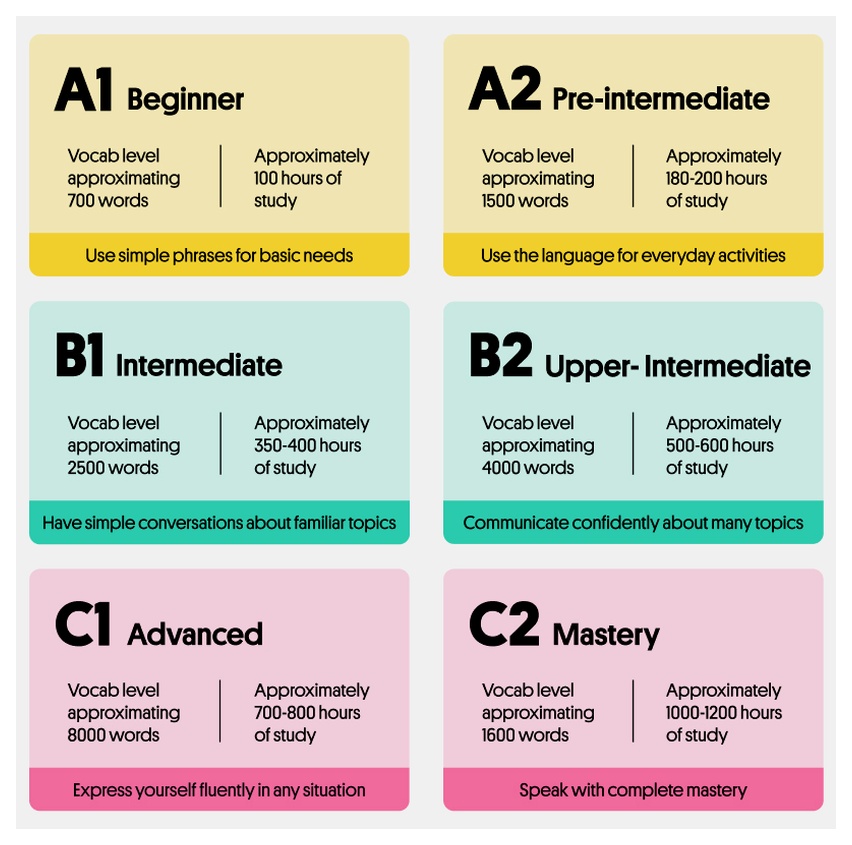
At this level, learners are expected to grasp around 700 words. While this may seem substantial, it’s actually quite a restricted vocabulary. To successfully pass the A1 Cambridge examination, you’ll need about 100 hours of dedicated study with the English language.
What you can do at A1 level
At A1 level, English learners can:
- Introduce themselves simply, using basic greetings and conversation starters (such as the weather).
- Understand very basic directions from natives.
- Get around cities by reading simple signs, posters and notices.
- Write very simple descriptions of their hobbies and interests.
Tips to reach A1 level
To achieve A1 proficiency, the key is to start learning and remain committed! Every skill begins with a foundational step, and the journey often includes challenges, particularly in maintaining focus and motivation. Embrace the initial embarrassment and the inevitable mistakes; they are essential for your growth in English. For beginners, user-friendly apps like Duolingo can be invaluable. They cater specifically to novices but may become less effective once you progress to A2 level. As you learn new vocabulary, consider creating your own flashcards to reinforce your knowledge and track your advancement.
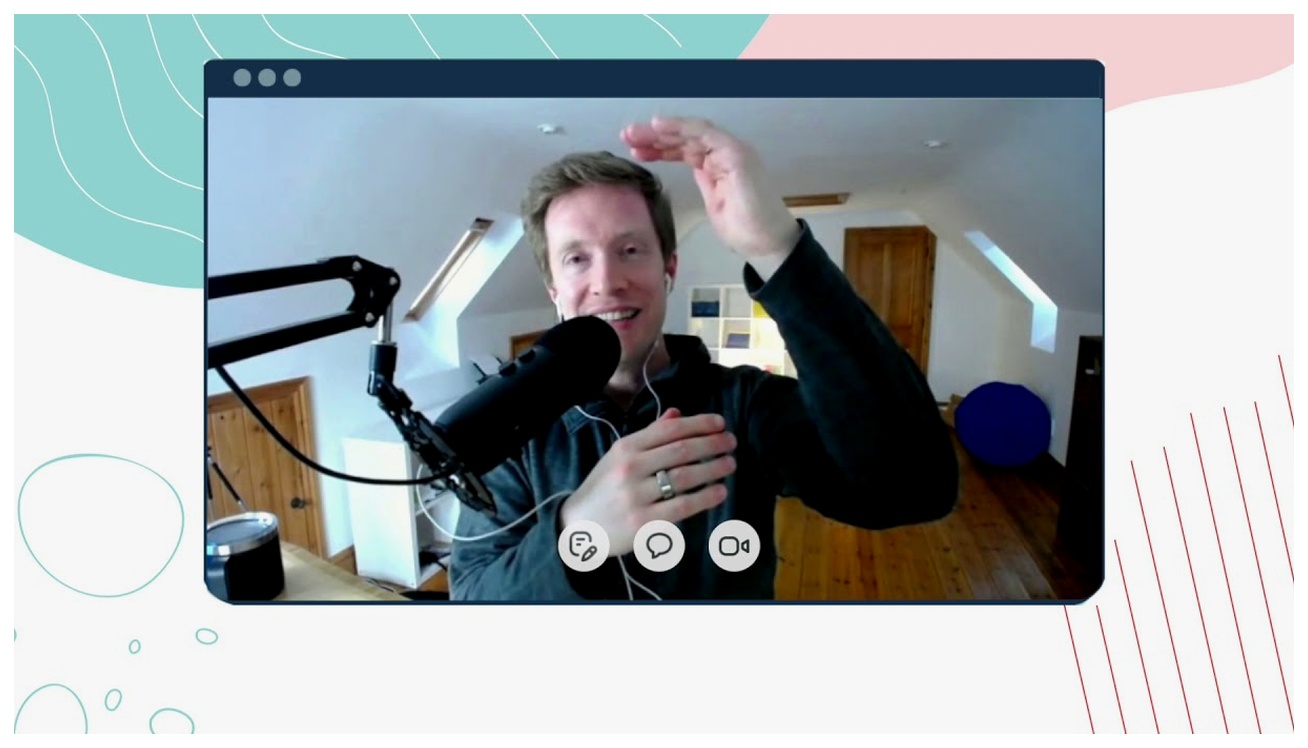
Finding good content when you’re at a beginner level is difficult, so here’s Olly Richards with some advice:
2. Pre-Intermediate: CEFR Level A2

“Try not. Do or do not. There is no try.”
– Yoda, Jedi Master and A2 English speaker.
What you need to know about A2 level English
At the A2 proficiency level, often referred to as “Elementary,” you can engage in simple conversations and share your opinions on familiar topics. This stage marks an exciting time as you begin exploring past and future tenses, allowing you to discuss your history (“Before I came here, I lived in Italy”) and aspirations (“In the next 5 years, I plan to start my own company”). While your exchanges may still be brief and you might rely on a native speaker to guide the dialogue, interacting with you will be much easier for them compared to an A1 learner!
At the A2 level, you will have a practical vocabulary of around 1,500 words along with a strong grasp of grammar. To prepare for the A2 Cambridge examination, you can expect to invest about 180 to 200 hours in studying English.
What you can do at A2 level
At A2 proficiency level, English learners can:
- Talk with English speakers, and network with English-speaking colleagues on familiar topics.
- Understand slow, frequently used expressions in areas such as shopping, family, and employment.
- Write about matters of immediate need in simple terms, and basic descriptions of family and friends.
- Read short, simple texts containing high frequency vocabulary and shared international expressions.
Tips to reach A2 level
While A2 is classified as “beginner level,” reaching this stage requires significant effort. At this point, you should be able to engage in simple conversations! A helpful strategy is to focus on practical conversation topics that you’re likely to encounter in everyday life—essentially, learning “survival English.” Consider creating a “cheat sheet” or journal that includes key phrases you might want to use in basic conversations, such as information about yourself, your hobbies, and restaurant recommendations. Additionally, take the time to study verb conjugation and familiarize yourself with past and future tenses to enhance your communication skills.
3. Intermediate: CEFR Level B1

“‘Grey Worm’ fills me with pride; it’s a name of fortune. The name I was born with was a curse,” reflects Grey Worm, the Unsullied warrior who, by the end of Season 8, has mastered his English to a B1 level.
What you need to know about B1 level English
The transition from A2 to B1 is a significant milestone, marking a newfound confidence in your English skills. At this level, you can confidently navigate clothing stores and restaurants, easily making requests from staff. However, while you can discuss familiar topics, your responses may still come slowly, and you may face some challenges in expressing yourself. Although you’ve moved beyond the basics, you’re not yet ready to work or study exclusively in English. Nevertheless, you can effectively handle everyday situations, such as joining unplanned conversations or addressing issues that come up while traveling.
At the B1 level, you can expect to have a vocabulary of around 2,500 words, with the ability to quickly recall about half of them. To successfully pass the B1 Cambridge examination, you’ll need to invest roughly 350 to 400 hours of language study.
What you can do at B1 level
At B1 proficiency level, English learners can:
- Describe experiences and desires.
- Listen to and understand English TV shows, but you still need English subtitles on.
- Follow the plot in fairly simple English stories and understand what’s going on in the news.
- Write simple texts on topics that are familiar or of personal interest.
Tips to reach B1 level
To elevate your English skills to an intermediate level, it’s crucial to adopt a serious approach to your learning and establish a consistent study routine. While dedicating 10 minutes a day is a start, aiming for 30 minutes can yield much faster and more rewarding progress. To bridge the gap from beginner to intermediate, focus on identifying and addressing your recurring mistakes one at a time. Engaging with a native speaker, such as an online English tutor, can provide valuable feedback and help create a tailored plan to overcome these challenges. Additionally, enhance your vocabulary by incorporating phrases into your language repertoire. Learning “blocks” of English—like complete sentences, collocations, and phrasal verbs—will make your conversations much smoother and more natural.
Need help staying motivated and sticking to a schedule?
Read our guide and create your perfect study plan.
4. Upper-Intermediate: CEFR Level B2

“Offend Dobby? Dobby is aware of your remarkable reputation, sir… yet, he has never been invited to sit alongside a wizard as an equal.” – Dobby, the House Elf, speaking in B2 English.
What you need to know about B2 level English
Welcome to the world of basic English fluency! At the B2 level, you’ve developed a strong foundation and confidence in your speaking, writing, listening, and reading skills. This proficiency enables you to thrive in English-speaking workplaces, schools, and colleges. You can construct complex sentences and engage naturally in everyday conversations. While you may have your own unique accent and might not be ready to discuss Kantian philosophy just yet, you possess the essential language skills needed to navigate life and work comfortably in an English-speaking environment.
Upon reaching the B2 level, you should possess a vocabulary of around 4,000 words. To successfully pass the B2 Cambridge examination, you will need to invest roughly 500 to 600 hours of study in the language.
What you can do at B2 level
At B2 proficiency level, English learners can:
- Take an active part in discussions in familiar contexts, and provide relevant explanations and arguments.
- Understand standard speech spoken at a normal speed, provided the topic is reasonably familiar.
- Understand the main ideas when reading a complex text, as well as contemporary literary prose, articles, and reports.
- Write clear, detailed texts on subjects related to their interests or area of expertise.
Tips to reach B2 level
As you reach a high intermediate level in English, you may notice your progress begins to plateau—often referred to as the language learning plateau. To advance to a B2 proficiency level and enhance your skills, it’s crucial to step out of your comfort zone. Challenge yourself by discussing unfamiliar topics, writing articles in English, and deepening your understanding of the language. Pay close attention to how native speakers express themselves naturally, including their use of idioms and ability to tackle complex subjects. Seek feedback on your language use to identify areas for improvement. Remember, the key to overcoming this plateau is to focus more intently on your mistakes than ever before!
5. Advanced: CEFR Level C1

“Confident individuals possess a unique demeanor that naturally draws others in,” shares Sofia Vergara, renowned actress and C1-level English speaker.
What you need to know about C1 level English
C1 represents a high level of English proficiency. At this stage, speakers can engage in conversations effortlessly and grasp the language’s complexities almost entirely. You’ll be able to discuss a variety of topics, even those you’re not familiar with, and read longer texts with ease. Whether for business or academic pursuits, you can navigate everyday English while employing specialized vocabulary. While B2 is often seen as “fluent,” C1 takes fluency to the next level, allowing for a deeper understanding and appreciation of nuances. You’ll even catch subtle humor and express yourself using vibrant, native expressions.
Upon achieving a C1 level, you’ll possess a vocabulary of around 8,000 words—nearly twice as many as at the B2 level! To successfully pass the C1 Cambridge examination, you can expect to invest about 700 to 800 hours of dedicated language study.
What you can do at C1 level
At C1 proficiency level, English learners can:
- Express ideas fluently, and make presentations in the language.
- Understand subtle jokes and implicit meanings within a conversation.
- Understand a wide range of demanding, longer texts.
- Write extensively on a diverse range of topics, and approach unfamiliar ones with ease.
Tips to reach C1 level
To elevate your English proficiency to a C1 level, consider using the language as a tool to acquire new skills! Enroll in a course that aligns with your career or personal ambitions, allowing you to enhance both your expertise and your English simultaneously. This approach not only helps you master a new skill but also enriches your vocabulary with terminology relevant to your field. To make the most of this learning experience, jot down five phrases you encounter during the course in a notebook or flashcard app. Then, challenge yourself to use each phrase in five different contexts. This will transform those expressions into an integral part of your active vocabulary, making you a more dynamic learner!
6. Mastery: CEFR Level C2

Angela Merkel, the German Chancellor, once remarked, “I’ve heard that some people believe my speech will lead to significant reforms in Europe that will meet various British demands. Unfortunately, I think they are setting themselves up for disappointment.”
What you need to know about C2 level English
C2 proficiency represents the pinnacle of English language mastery, signifying a command of the language akin to that of a native speaker, though not quite identical. Individuals at this level exhibit remarkable confidence and control, allowing them to engage in discussions on any topic with nuanced expression and coherent communication. They can effortlessly read and understand complex texts and spoken language without barriers. Achieving C2 proficiency means you face virtually no limitations in using English for everyday activities, and you feel exceptionally at ease in academic or professional environments.
Achieving a C2 level in a language means you’ll possess a vocabulary of around 16,000 words. To prepare for the C2 Cambridge examination, you can expect to dedicate roughly 1,000 to 1,200 hours of study and practice with the language.
What you can do at C2 level
At C2 proficiency level, English learners can:
- Express themselves with spontaneity and fluency, and deal with hostile questioning confidently.
- Write coherently and concisely, with the ability to summarise information to construct comprehensive arguments.
- Understand everything they hear within the language with ease.
- Read complex, technical texts at speed.
Tips to reach C2 level
To achieve C2 proficiency in English, it’s essential to fully immerse yourself in the language. Engaging with it daily and conversing with native speakers will accelerate your journey to fluency. Step outside your comfort zone by participating in spontaneous discussions, whether at debates, social events, or even on dates. Over time, you’ll find that you no longer need to pre-plan your conversations. A more immersive approach could involve relocating to an English-speaking country where your native language isn’t an option, compelling you to adapt quickly. If a major move feels too drastic, consider scheduling regular sessions with a native-speaking tutor for consistent practice.
Achieving your English proficiency goals
The CEFR English proficiency levels serve as an excellent framework for assessing your language skills. It’s important to remember that the figures mentioned in this article—such as study hours and vocabulary size—are averages. Your progress may vary; you might advance more quickly or slowly depending on your exposure to the language and the time you invest in studying.
No matter your starting point, improving your English skills requires time, a thoughtful strategy, and the right resources—there are no quick fixes. If you’re looking for support, aLingualNeeds offers tailored tutoring, corporate English training, and business English courses for all levels—beginner, intermediate, or advanced. These options can help you develop a personalized learning plan, providing the guidance and practice needed for faster progress. Plus, before your first lesson, you can take a 30-minute assessment to determine your current English proficiency. This allows your tutor to customize your lessons and better assist you in achieving your goals.
While learning English may seem challenging, it’s an exhilarating adventure that can transform your life. Mastering this language enhances your cognitive abilities, equips you with a valuable career skill, and deepens your appreciation for diverse cultures. So why wait? Start your journey today!
Frequently Asked Questions
What does it mean to be ‘basically fluent’ in English?
‘Basically fluent’ implies a level of proficiency that allows for basic communication but may not reach the higher C2 level of mastery.
What is the CEFR and how does it categorize English proficiency?
The Common European Framework of Reference for Languages (CEFR) categorizes language skills from A1 (beginner) to C2 (advanced), providing a clear roadmap for learners.
How many words should a learner know at the A1 level?
At the A1 level, learners are expected to grasp around 700 words.
What study hours are typically needed to reach B2 proficiency?
To successfully pass the B2 Cambridge examination, learners need to invest roughly 500 to 600 hours of study.
What is a recommended strategy for advancing from A2 to B1 level?
To advance from A2 to B1, focus on practical conversation topics, address recurring mistakes, and engage with native speakers for feedback.


