

- 1. Tongue twister exercises
- Peter Piper
- Fuzzy Wuzzy
- A Proper Cup of Coffee
- Woodchuck
- 2. Consonant exercise
- Consonant board game
- 3. Vowel exercise
- Morning vowel warm-up
- 4. Commonly mispronounced words exercise
- Mispronounced words worksheet
- 5. Homograph exercise
- Pancake Panic online game
- 6. Similar words pronunciation exercise
- Minimal pairs game
- 7. Syllable stress exercise
- Syllable stress practice table
- 8. Reduced sounds exercise
- Schwa Song
- 9. Rhyming exercise
- Rhyming memory flashcard game
- 10. Shadow speaking exercise
- Interpreter exercise
- General tips to improve English pronunciation
- Read out loud and record yourself
- Watch movies and TV shows in English
- Sing songs in English
- Find a native speaker for weekly chats
- Speak slowly
- Conclusion
- Frequently Asked Questions
- What are tongue twisters and how do they help with pronunciation?
- What is the role of the International Phonetic Alphabet (IPA) in pronunciation practice?
- How can reduced sounds enhance English pronunciation?
- What is shadow speaking and why is it useful?
- How can singing songs improve English pronunciation?

Are you looking to refine your English accent or tackle those challenging pronunciation hurdles? Our fun exercises and engaging printables are designed to boost your confidence and help you sound more like a native speaker, all while enhancing your pronunciation skills quickly and effectively.
1. Tongue twister exercises
Tongue twisters are tricky, but they can force you to enunciate similar sounding words to make each phrase intelligible.
For instance, the tongue twister “Peter Piper” is an excellent tool for mastering consonant enunciation, particularly the letter “P.” Similarly, “A Proper Cup of Coffee” not only highlights the P and F sounds but also incorporates a rich mix of vowel sounds, making it a fun way to improve your pronunciation skills.
There’s no need to rush at the beginning. Take your time during your initial attempts and gradually increase your pace. Follow along and make sure to practice on your own to build your confidence.
Peter Piper
Peter Piper picked a peck of pickled peppers
A peck of pickled peppers Peter Piper picked
If Peter Piper picked a peck of pickled peppers
Where’s the peck of pickled peppers that Peter Piper picked?
Fuzzy Wuzzy
Fuzzy Wuzzy was a bear,
Fuzzy Wuzzy had no hair,
Fuzzy Wuzzy wasn’t very fuzzy, was he?
A Proper Cup of Coffee

Woodchuck
How much wood would a woodchuck chuck if a woodchuck could chuck wood?
He would chuck, he would, as much as he could, and chuck as much wood
As a woodchuck would if a woodchuck could chuck wood.
2. Consonant exercise
Consonants are fascinating speech sounds produced by obstructing airflow in the mouth. They can be formed by pressing your lips together or by placing your tongue against your teeth or the roof of your mouth. This variety of articulation creates the diverse range of consonant sounds we use in speech.
ESL learners often face challenges in mastering consonants like ‘p’, ‘t’, and ‘k’, as these sounds may not be present in all languages. Additionally, certain consonant combinations, including ‘ch’, ‘sh’, and ‘th’, produce distinct sounds that can further complicate pronunciation.
The International Phonetic Alphabet (IPA) is a powerful tool for accurately representing spoken language in written form. Developed in the late 19th century, it is more commonly utilized in Europe than in America. Mastering the IPA can significantly enhance one’s ability to tackle challenging pronunciations, making it a valuable component of English as a Second Language (ESL) classes.
Consonant board game
Get ready for a fun and interactive experience with our downloadable consonant board game, designed for two or more players! All you need is a single die and place markers—like coins or buttons—for each participant. On their turn, players roll the die and move forward the number of spaces indicated. It’s a simple yet engaging way to enhance your consonant skills while enjoying friendly competition!
In this exciting game, players start by saying a consonant blend aloud, followed by a word that includes that blend. For instance, if you land on /d/, you would pronounce “d” and then think of a word like “dog.” The first player to reach the end of the board claims victory!
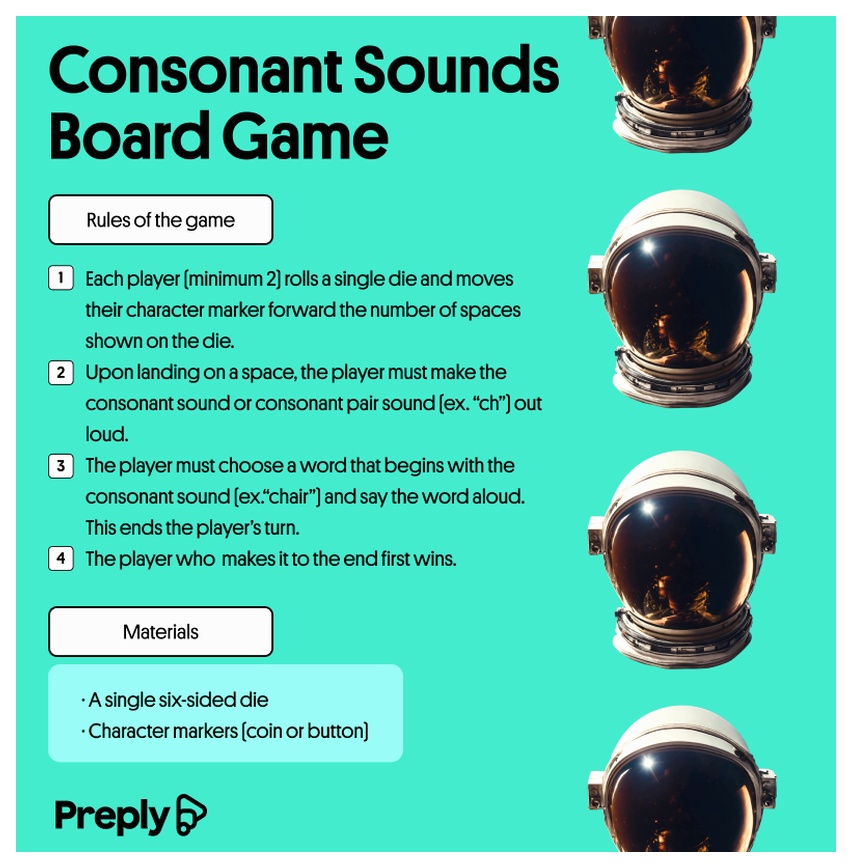
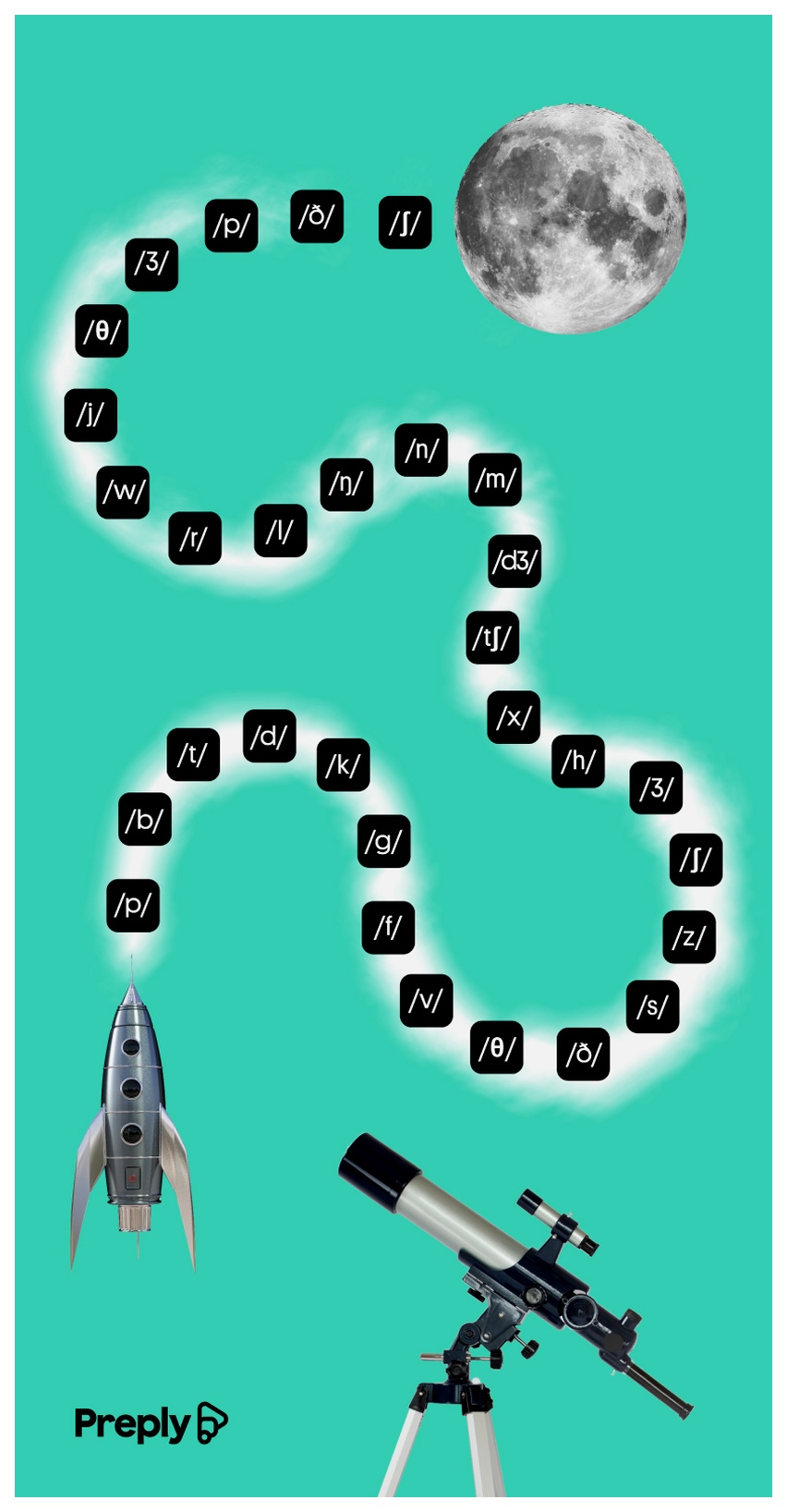
Download the consonant board game
3. Vowel exercise
Vowels are the sounds produced when air passes freely through the mouth, unobstructed by the tongue, teeth, or lips. They come in various forms, such as “long” and “short” sounds, adding richness to our speech. Interestingly, some vowels can be completely silent, like the “ue” in the word “tongue.”
The combination of vowels can often lead to confusion in pronunciation. For instance, the double “o” in “cool” sounds like a prolonged “u,” while the “ei” in “vein” produces a long “a” sound, resembling the pronunciation of “lay” and “plane.”
Engaging in sound repetition exercises, beginning with the fundamental long sounds of the five vowels, can significantly aid ESL students in recognizing and articulating the various English vowel sounds accurately.
Kick off your morning with an engaging vowel warm-up that can be done solo or in a classroom. If you’re working with a group, guide your students to practice each vowel together, in pairs, or individually. This quick exercise serves as an effective and enjoyable way to ease into your lesson.
Morning vowel warm-up
Pick a time that fits into your daily routine and spend just 5-10 minutes practicing your vowel sounds in front of a mirror. As you watch yourself, pay attention to how your mouth forms each vowel and the roundness of your lips. You might feel a bit goofy, but this exercise is effective for extending each vowel sound and honing in on the phonetic qualities of A, E, I, O, and U.
- A as in ape
- E as in easy
- I as in eye
- O as in over
- U as in usually
For instance, stretch the long “a” sound to say “ayy.” Aim to hold each vowel sound for 5-10 seconds, similar to sustaining a musical note. After mastering one, move on to the next vowel. Challenge yourself to see how many times you can complete all five!
Once you feel at ease with the sounds, enhance your practice by increasing your speed. Try pronouncing the vowels more quickly while reducing the duration for which you hold each one.
4. Commonly mispronounced words exercise
Even native English speakers can find similar sounds tricky! Take the common mix-up of “should of” and “could of,” which are often mistakenly used instead of the correct “should have” and “could have.” Additionally, some people drop syllables or consonants, saying “probly” instead of “probably” or “pitcher” instead of “picture.” These little errors highlight the nuances of spoken English.
Many people often mistakenly add an “S” to the end of “anyway” or confuse “accept” with “except.” By focusing on mastering these commonly mispronounced words—even those that trip up native speakers—you can significantly improve your pronunciation and speaking skills.
Mispronounced words worksheet
Our downloadable worksheet is designed to assist ESL students in mastering the pronunciation of frequently mispronounced words. It engages learners by challenging them to identify the correct pronunciation from multiple options.
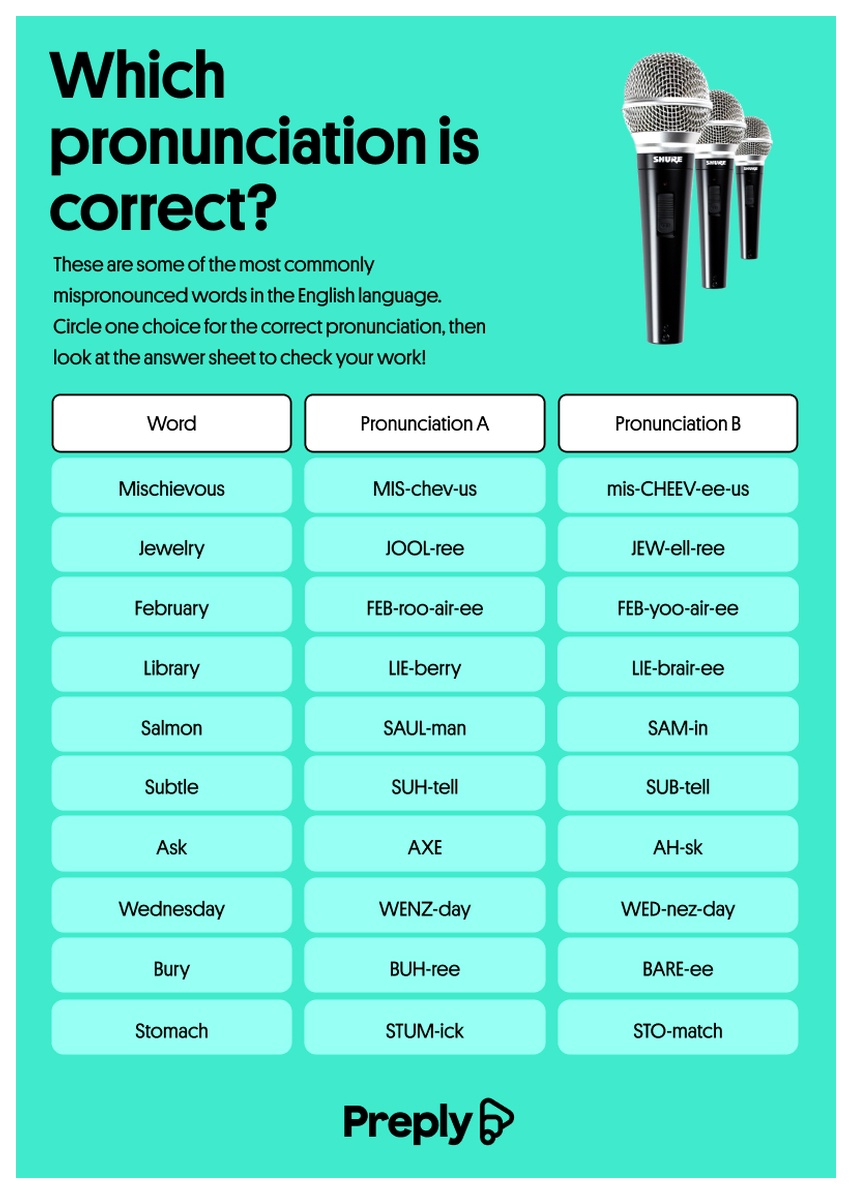
Download mispronounced words worksheet
5. Homograph exercise
Homographs are fascinating words that share the same spelling but boast different meanings—and often different pronunciations. Take “bow,” for example: you can either “bow” before royalty (pronounced “ow”) or use a “bow” (pronounced “oh”) to shoot an arrow. Similarly, the word “entrance” with the emphasis on the first syllable refers to a way in, while “to entrance,” stressing the second syllable, means to delight or captivate.
It’s important to distinguish between homographs and homophones. While homophones sound alike, like “two,” “to,” and “too,” homonyms take this a step further. A homonym is a word that is pronounced the same as another but has a different meaning. For instance, the word “spring” can refer to a coiled metal piece, the season of renewal, a natural water source, or the action of jumping forth. Understanding these differences can enhance your grasp of the English language and its nuances.
Pancake Panic online game
Simple games can be incredibly effective for reinforcing concepts. In **Pancake Panic**, players engage in matching homographs and homophones while testing their memory. They can either build a towering stack of pancakes by matching words or flip them over to uncover different terms, making learning both fun and interactive.
Here are a few common homographs and homophones that students can practice before playing Pancake Panic:
- bear and bare
- ad and add
- peace and piece
- stair and stare
- close and close
6. Similar words pronunciation exercise
English is rich in homophones—words that sound alike but have different meanings—which can be particularly confusing for language learners. Even native speakers sometimes trip up, mixing up terms like “their,” “they’re,” and “there” in their writing. This highlights the importance of context in understanding and using these words correctly.
Engaging in practice is essential for English learners to master the nuances of the language. It aids in distinguishing between words that sound alike but have different spellings and meanings, such as “shoot” versus “chute” and “colonel” compared to “kernel.” Additionally, it highlights the subtle distinctions between pairs like “accept” and “except” or “boy” and “buoy,” enhancing their overall comprehension and communication skills.
Minimal pairs game
This game is designed to enhance your listening skills in English, allowing you to better understand the language as it’s spoken. You can enjoy it solo or team up with a partner for added fun!
To engage in a fun activity with a partner, start by having them read aloud a word from the worksheet. As they do, circle or highlight the word you hear. Afterward, take a moment to compare your answers and see if you matched!
To play solo, read each word out loud while focusing on the nuances of their pronunciations. Take your time, enunciating each syllable clearly to enhance your understanding and mastery of the words.
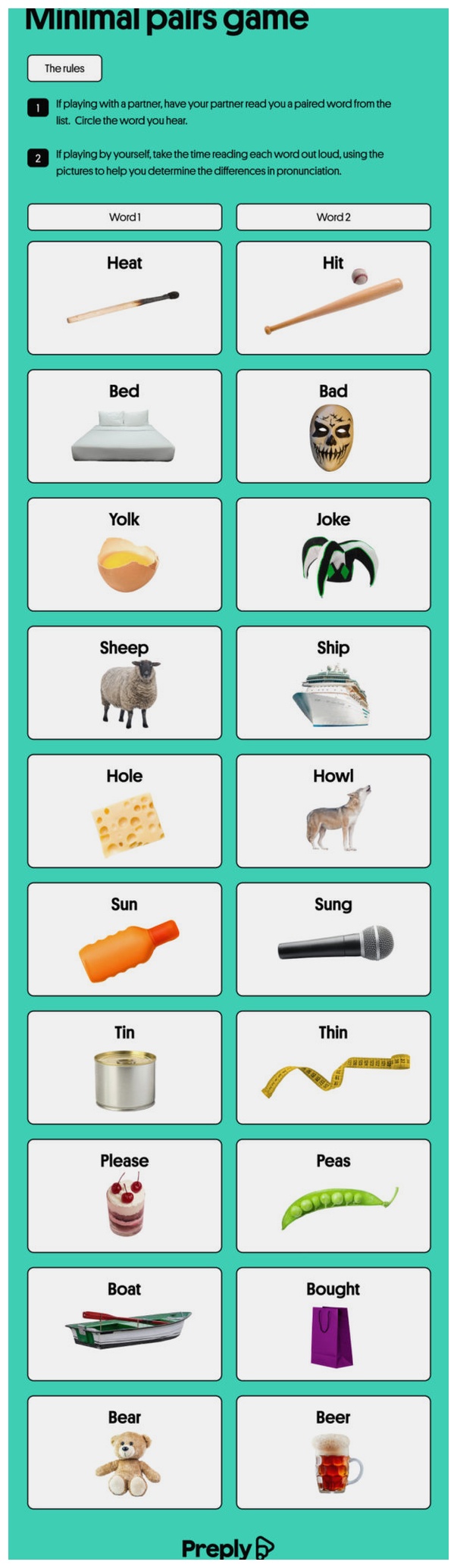
Download minimal pairs worksheet
7. Syllable stress exercise
A syllable is a fundamental unit of speech that includes a vowel, either standing alone or paired with one or more consonants. Words can contain single or multiple syllables, and when pronounced, multi-syllable words highlight one specific syllable with greater emphasis. For example, in the word “engage,” the stress is on “gage,” while in “architect,” it’s on “ar.” This emphasis is known as syllable stress.
Pronunciation exercises that emphasize syllable stress are invaluable for ESL students. By concentrating on the stressed syllable, learners can enhance the clarity of their speech and achieve more accurate pronunciation.
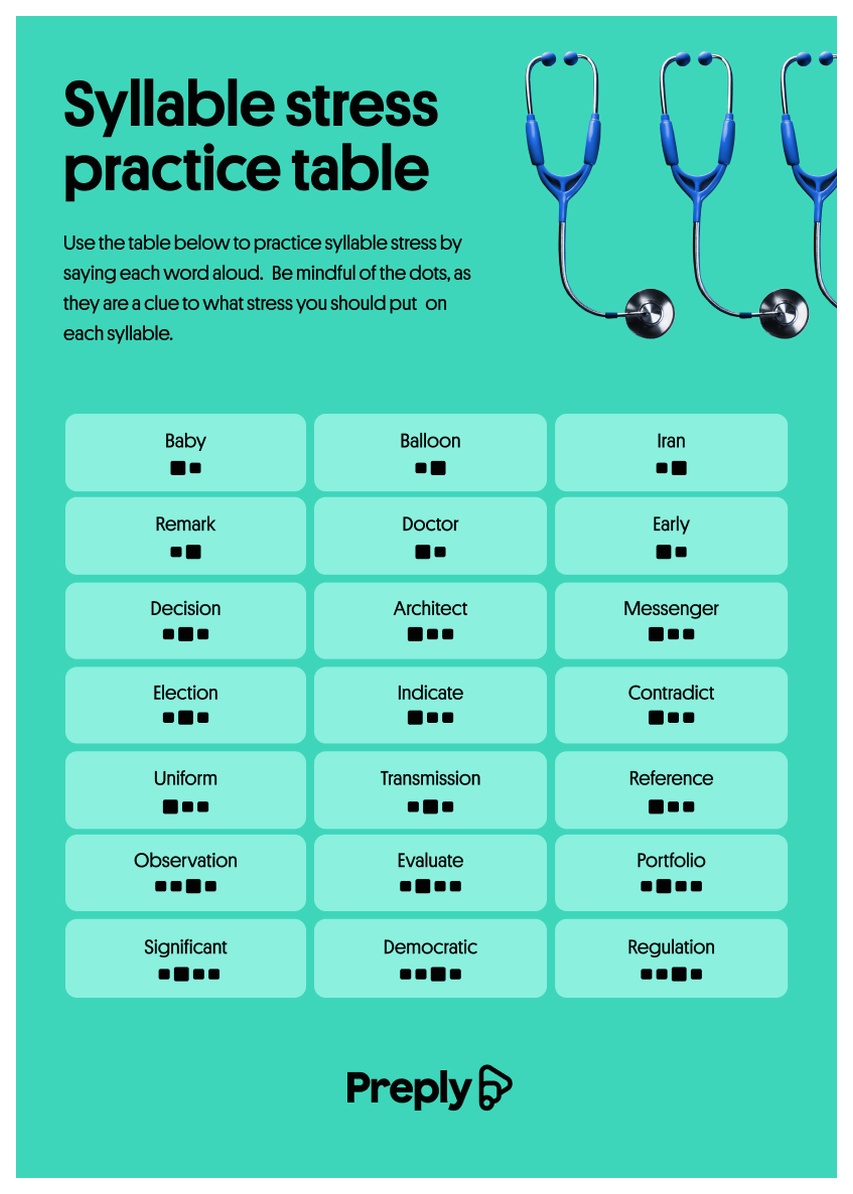
Syllable stress practice table
Enhance your understanding of syllable stress with our downloadable worksheet! This resource lets you effortlessly practice words with two, three, and four syllables. Each section features a word accompanied by a series of dots—two for two syllables, three for three syllables, and so on—guiding you to pronounce each English word with the correct emphasis.
Download syllable stress practice table
8. Reduced sounds exercise
In English, certain syllables carry more emphasis, while others are shorter and less distinct. Notably, there are two reduced vowel sounds: the barred “i” found in words like “monitor,” and the schwa sound, often represented as “uh” and denoted as Ə in the International Phonetic Alphabet. Understanding these sounds can enhance your pronunciation and comprehension of spoken English.
The schwa sound is an unstressed vowel that sounds like “uh.” You can hear it in the “e” of “problem” or the first “a” in “again.” It’s a common sound in English, often found in unaccented syllables!
Mastering the schwa sound is crucial for achieving a natural-sounding American English accent, as it enables speakers to emphasize the correct syllables. Consequently, pronunciation exercises aimed at minimizing specific sounds can greatly benefit ESL students in their language journey.
Schwa Song
The Schwa Song is an entertaining tool for teaching speakers about the schwa sound in everyday language. By showcasing the “uh” sound in words like “about,” “around,” “pizza,” and “sofa,” it helps singers recognize and become comfortable with this commonly used vowel sound.
(To the tune of “The Wheels on the Bus”)
The Schwa sound is in pizza and sofa,
Pizza and sofa,
Pizza and sofa,
The Schwa sound is in pizza and sofa,
Do you hear an uh?
9. Rhyming exercise
Engaging in rhyming exercises and games can greatly benefit English learners by exposing them to words that share similar sounds. Through repetition of these words and sounds, learners can enhance their fluency and develop a more natural speaking style over time.
Rhyming memory flashcard game
Flashcards are a powerful tool for mastering word usage and pronunciation through consistent repetition. Engaging in memory games enhances visual recognition, enabling learners to identify subtle details and differences in language. This practice fosters a deeper understanding of the nuances of communication. Additionally, flashcards can significantly boost your English reading skills.

Download rhyming words flashcards
10. Shadow speaking exercise
Shadow speaking is an effective language learning technique that enhances pronunciation and fluency. It involves listening closely to a speaker and then immediately repeating their words with minimal delay. Often used with audio recordings, this method allows learners to mimic common phrases and vocabulary. By practicing in this way, language learners can significantly improve their ability to pronounce challenging sounds and phrases accurately.
Students can enhance their shadow speaking skills by engaging in the classic childhood game of telephone. In this fun activity, one person whispers a message to their neighbor, who then passes it along by repeating what they heard. This continues down the line, often leading to amusing misinterpretations. For those learning online, our interpreter exercise serves as an effective tool to develop this valuable skill.
Interpreter exercise
Enhance your shadow speaking skills through interpretation exercises! Partner up with someone who can share a story or explain a concept. After they finish, your task is to rephrase their words and repeat them back. For instance:
- Speaker: “To toast, ensure the toaster is plugged in, then select your item, like bread or a bagel.”
- Interpreter: “Before you can make toast, check to see if the toaster is plugged in, then get bread.”
- Speaker: “Adjust the toaster dial to your preferred setting, then insert the bread into the slots.”
- Interpreter: “Adjust the toaster’s setting and then put the bread in.”
This exercise aims to help English learners develop their listening and speaking skills by encouraging them to interpret and repeat what they hear using familiar vocabulary. The speaker’s role is to articulate their words slowly and clearly, ensuring that the interpreter can follow along easily. Meanwhile, the interpreter should strive to convey the essence of the story or instructions to the rest of the class as accurately as possible, based on their understanding.

General tips to improve English pronunciation
You don’t have to rely on formal exercises to enhance your English pronunciation. Everyday conversations and various forms of spoken English offer valuable opportunities for practice. Here are some effective examples to help you improve.
Read out loud and record yourself
Try reading sentences and phrases out loud while recording yourself. When you listen to the playback, you’ll gain insight into how you sound to others. By comparing your pronunciation with that of native speakers, you can identify both similarities and differences. This awareness allows you to adjust your speech accordingly, and it can also enhance your understanding of English grammar.
Watch movies and TV shows in English
Television shows and movies are fantastic resources for learning how people communicate. They offer a rich variety of dialogue that allows you to hone your listening skills and practice mimicking the speech patterns you hear. Plus, you’ll encounter diverse accents, from the distinctive New York accent to the charming Southern drawl, enriching your understanding of language variation.
If you’re in an area known for its distinct accents, consider watching local shows that feature those unique speech patterns. This will not only help you immerse yourself in the accent but also enhance your speaking skills to match those of your regional peers.
In today’s digital era, a wealth of resources is at your fingertips to help you learn English. Explore news websites, music platforms, and interactive word game sites for engaging content. Whether you prefer studying on your PC or using mobile apps, there are countless options available to enhance your language skills.
Sing songs in English
Music serves as a universal language, making it an excellent tool for learners to grasp English vocabulary and pronunciation. Songs not only entertain but also provide a fun and effective way to enhance language skills.
Enhance your pronunciation skills by singing along to “ABC” by the Jackson 5, which helps with letter and number recognition. For a fun way to learn the days of the week, try “Friday I’m in Love” by The Cure. Additionally, “My Favorite Things” from The Sound of Music is a fantastic choice for practicing rhymes, consonant alliteration, and expanding your vocabulary.
Many songs feature rhyming phrases that can enhance familiarity with word pronunciations. Children’s songs, in particular, serve as an excellent resource for this purpose.
Find a native speaker for weekly chats
A fluent English-speaking friend can greatly enhance your language learning journey in various ways. If you don’t have such a friend, think about hiring an ESL tutor for targeted practice. You can also ask your friend if you can engage in shadow speaking, where you mimic their conversation to build your skills. If you struggle with specific words, don’t hesitate to ask them for help; they can provide valuable feedback and support.
Inquire about your progress and ask your friend for their insights on areas where you could improve. They can track your development and provide constructive feedback on your English conversation skills, helping you grow more effectively.
Speak slowly
Children practice sounding out words syllable by syllable, and this technique is beneficial for English learners as well. It not only enhances pronunciation but also encourages clearer communication in conversation. By taking your time and speaking slowly, you make it easier for others to understand you, whether English is your first language or you’re just starting to learn it.
Conclusion
Mastering a new language can be quite challenging, and English ranks among the toughest to learn. However, the effort is worthwhile. Although English is just one of many languages spoken in America and around the globe, it is the most widely used. For those eager to learn English as a second language, numerous resources are available, including online tools and ESL tutors, making it easier than ever to enhance your skills.
From singing and watching movies to chatting with native speakers or practicing formal exercises, there are countless ways to enhance your English fluency and pronunciation. Engaging in these activities will help you feel at home in any English-speaking environment.
Frequently Asked Questions
What are tongue twisters and how do they help with pronunciation?
Tongue twisters are tricky phrases that force you to enunciate similar-sounding words, improving clarity and pronunciation skills.
What is the role of the International Phonetic Alphabet (IPA) in pronunciation practice?
The IPA represents spoken language in written form and helps learners accurately tackle challenging pronunciations.
How can reduced sounds enhance English pronunciation?
Understanding reduced sounds, like the schwa, helps speakers emphasize the correct syllables, resulting in a more natural-sounding accent.
What is shadow speaking and why is it useful?
Shadow speaking involves listening to a speaker and immediately repeating their words, enhancing pronunciation and fluency.
How can singing songs improve English pronunciation?
Singing songs helps learners grasp vocabulary and pronunciation through rhythm and repetition, making it a fun learning tool.


