- Key findings
- America’s favorite love languages to express
- America’s favorite love language to receive
- The hardest love languages to express
- Love languages preferred by different genders and generations
- How love languages affect relationships
- Conclusion
- Frequently Asked Questions
- What are the five love languages identified by Dr. Gary Chapman?
- Which love language do Americans prefer to receive the most?
- What percentage of people find gift-giving difficult as a love language?
- How do love languages influence relationships?
- Do love languages change over time?
Love is a universal emotion, yet the ways in which individuals express and interpret love can vary greatly. One effective approach to understanding these differences is through the concept of “love languages.” This framework helps identify how people prefer to give and receive affection, making it easier to connect with one another in meaningful ways.
The idea of love languages was introduced by Dr. Gary Chapman, who identifies five distinct ways people express and receive love: words of affirmation, quality time, physical touch, acts of service, and receiving gifts. Understanding these languages can enhance relationships by improving communication and connection.
At LingualNeeds, we understand the vital role language plays in our lives. With the season of love approaching, we explored the love languages favored by Americans across the nation. To do this, we surveyed over 2,000 individuals to uncover their preferences regarding the ways they express and receive love. Additionally, we offer engaging online French lessons to help you connect more deeply with others.
Key findings
- Quality time is America’s favorite love language to receive.
- Acts of service is America’s favorite love language to express.
- Receiving gifts is the least popular love language overall.
- Throughout their life, 65% say preferred love languages change.
- In relationships that didn’t work out, 41% say love languages were not understood.

Learn a language with personalised 1-on-1 classes with our expert tutors from all over the world
French lessons online
Spanish lessons online
America’s favorite love languages to express
Consider the ways you express your love. Do you surprise your partner with thoughtful gifts for no special reason? Or perhaps you frequently share your appreciation for them?
To uncover the most popular love language in each state, we analyzed the national average responses for all five love languages and identified which ones stood out significantly above the average for each state.
In one out of every five states, people show their affection through physical touch, ranging from a gentle hand on the shoulder to a soothing massage. Close behind is the love language of acts of service, where nine states prioritize expressing their love by taking on chores or running errands for their partners.
The map below shows what love language is particularly popular to give in each state.

America’s favorite love language to receive
According to Chapman’s concept of love languages, everyone has a primary love language that resonates with them the most. This means that even if you genuinely care for someone, expressing your affection in a way that aligns with their love language is crucial for them to truly feel loved. Without this understanding, your message of love may not come across as intended.
Our nationwide survey found that the love language most cherished by Americans is quality time. This means that people value moments spent together, where they can fully engage and focus on one another, strengthening their connections.
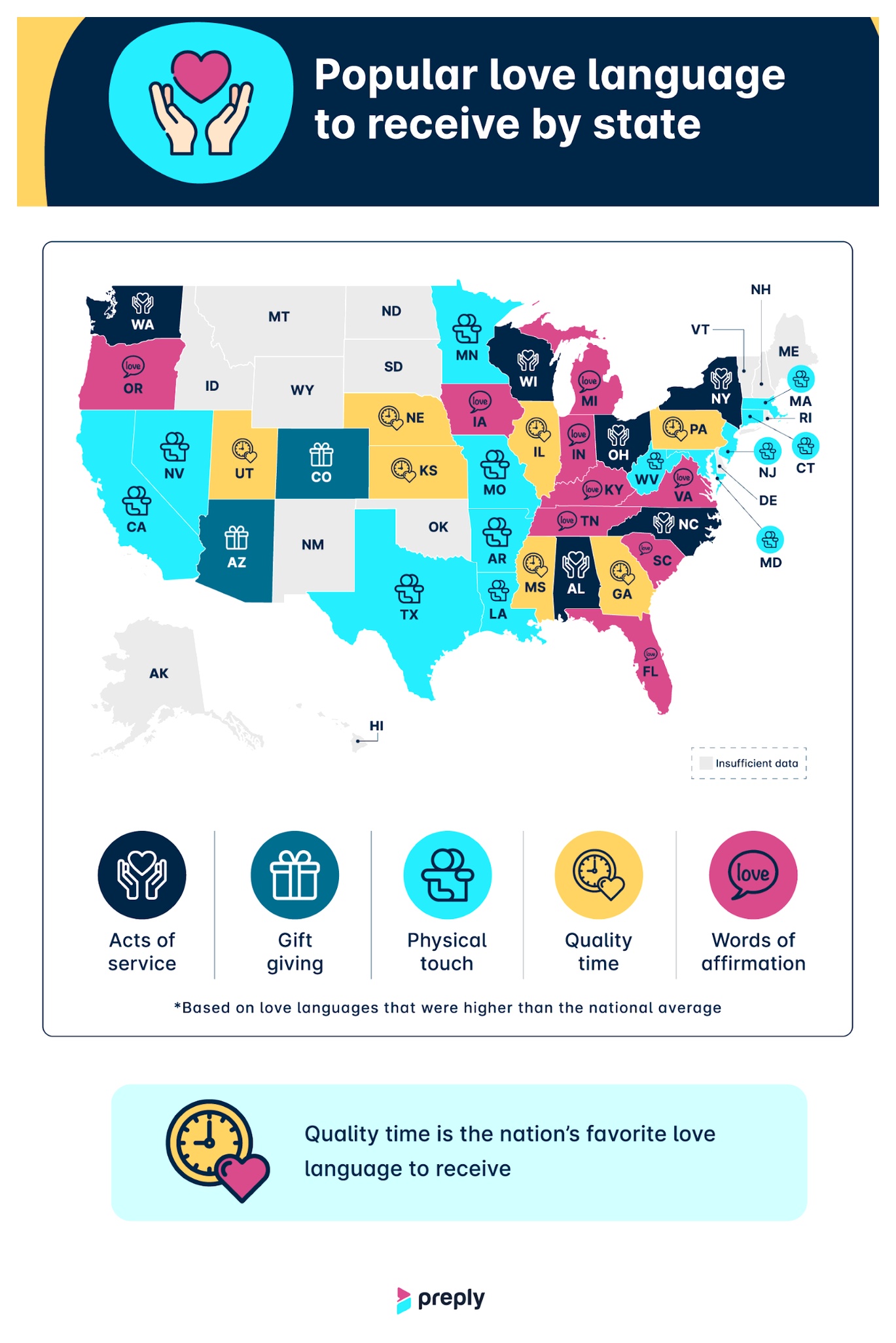
Interestingly, Americans often express love differently than they prefer to receive it. However, there are exceptions. The chart below highlights the states where the ways people give and receive love align perfectly.
|
States who like to express and receive the same love language |
|
|
Colorado |
Gift giving |
|
Connecticut |
Physical touch |
|
Kentucky |
Words of affirmation |
|
Maryland |
Physical touch |
|
Minnesota |
Physical touch |
|
Mississippi |
Quality time |
|
Missouri |
Physical touch |
|
Nevada |
Physical touch |
|
New York |
Acts of service |
|
North Carolina |
Acts of service |
|
Ohio |
Acts of service |
|
West Virginia |
Physical touch |
Learn a language online with our free learning materials.
Learn English online
Learn French online
The hardest love languages to express
Expressing a specific love language can be challenging for various reasons. You might have encountered negative experiences related to it, or it could feel completely foreign if it’s vastly different from your own preferred love language.
We surveyed Americans about which love language they find most challenging to express, and the results are intriguing. If you’ve ever wandered through a store, pondering the perfect gift for someone special, you might identify with the 28% of respondents who struggle with gift-giving as a way to show love. Close behind in difficulty is the love language of words of affirmation.
The rankings reveal that quality time and acts of service are the most easily expressed love languages among Americans. This aligns perfectly with the findings that these are also the preferred methods for expressing and receiving love in the U.S.
|
Love language that is hardest to express |
Percentage of people who struggle with it |
|
Gift giving |
28% |
|
Words of affirmation |
27% |
|
Physical touch |
21% |
|
Acts of service |
12% |
|
Quality time |
12% |
We surveyed people to gauge their perceptions of how well Americans express love, and the results were revealing. Surprisingly, nearly half of the respondents believe that Americans find it challenging to prioritize quality time with one another. Additionally, about 30% indicated that expressing words of affirmation is also a significant struggle.
|
Love languages people think others struggle to express |
|
|
Quality time |
43% |
|
Words of affirmation |
29% |
|
Acts of service |
20% |
|
Physical touch |
6% |
|
Gift giving |
2% |
Love languages preferred by different genders and generations
Expressions of love differ widely among various states and demographics, often influenced by generational factors. Our survey highlights the preferred love languages of each generation, revealing a fascinating trend: individuals tend to express love in one way while desiring a different form in return. Discover how these preferences vary across generations and what they reveal about our connections with one another.

If you find it hard to connect with your generation, you might discover a strong bond with your gender instead. Our survey highlights some intriguing differences in how love is expressed: women often show their affection through acts of service, while men typically lean towards physical touch as their preferred love language.
Here’s a breakdown of how different genders prioritize their preferred love languages. Interestingly, the love language that ranks highest for one gender tends to be the lowest for the other, highlighting a fascinating contrast in their preferences.
- Female’s favorite love languages to receive
1. Quality time
2. Acts of Service
3. Words of affirmation
4. Gift giving
5. Physical touch
- Males’ favorite love languages to receive
1. Physical touch
2. Gift giving
3. Words of affirmation
4. Acts of service
5. Quality time
How love languages affect relationships
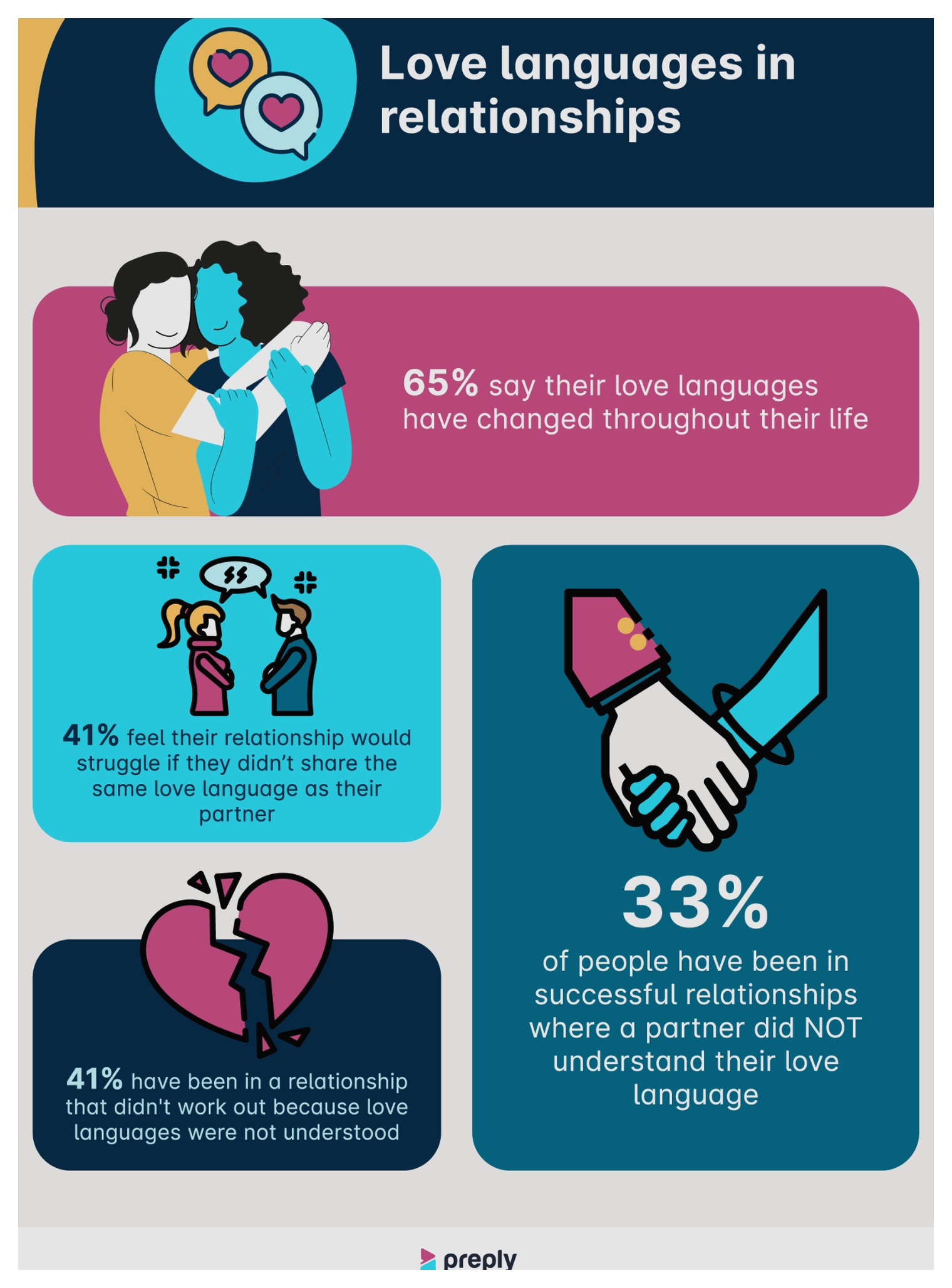
No matter your gender or age, understanding and embracing your partner’s preferred love language can significantly enhance your relationship. Although some argue that couples with different love languages can thrive together, a notable 41% believe that such differences could lead to challenges in the relationship. Embracing love languages can create deeper connections and foster mutual understanding.
Embracing change is essential, as your preferred love language today might differ from what you cherished in the past. In fact, 65% of our respondents reported that their love languages have evolved over the years.
Understanding love languages plays a crucial role in the success of relationships. Surprisingly, 41% of individuals report that they have experienced a breakup due to a lack of understanding of each other’s love languages. This highlights the significance of recognizing and appreciating how we express and receive love.
Struggling to understand your partner’s love language? You’re not alone! In fact, 33% of individuals have successfully navigated their relationships without fully grasping their partner’s love language. And if you’re also finding it tough to learn French, consider joining our online French classes at LingualNeeds—it’s a fantastic way to kickstart your language journey!
Conclusion
Whether it’s a personal or professional relationship, understanding the love language of another can help strengthen your connection.
Navigating communication in love or any language can be challenging without a solid grasp of the language involved. While LingualNeeds doesn’t offer guidance on mastering someone’s love language, we specialize in fulfilling your other language learning needs. Whether you’re interested in online Japanese lessons or other languages, we can connect you with a skilled tutor to help you on your journey.
Methodology:
Between January 16 and January 24, 2023, we conducted a survey involving 2,016 Americans nationwide to explore their preferred love languages for both giving and receiving. States with insufficient data, including Alaska, Delaware, Hawaii, Idaho, Maine, Montana, New Hampshire, New Mexico, North Dakota, Rhode Island, South Dakota, Vermont, and Wyoming, were not included in the findings. Our respondents, aged 18 to 76, comprised 54% female, 44% male, and 2% nonbinary individuals.
Frequently Asked Questions
What are the five love languages identified by Dr. Gary Chapman?
The five love languages are words of affirmation, quality time, physical touch, acts of service, and receiving gifts.
Which love language do Americans prefer to receive the most?
Quality time is America’s favorite love language to receive.
What percentage of people find gift-giving difficult as a love language?
28% of respondents struggle with gift-giving as a way to show love.
How do love languages influence relationships?
Understanding and embracing a partner’s preferred love language can significantly enhance relationships and foster deeper connections.
Do love languages change over time?
Yes, 65% of respondents reported that their preferred love languages have changed over the years.