- Key findings
- New subtitle trends among Americans
- Why subtitles are growing in popularity
- Subtitles are becoming increasingly preferred on TikTok and YouTube videos
- Rick and Morty and Bridgerton among the hardest-to-understand TV shows
- Go beyond subtitles with LingualNeeds
- Frequently Asked Questions
- What percentage of Americans watch content with subtitles most of the time?
- Which generation is leading in subtitle usage?
- How do subtitles impact comprehension of accents?
- What role do subtitles play in online video platforms like TikTok and YouTube?
- What is the main reason viewers find subtitles helpful?
In today’s digital landscape, we are inundated with mesmerizing audiovisual content—3.7 million videos are uploaded to YouTube every day! Subtitles have transformed beyond mere translation; they now play a crucial role in enhancing our viewing experiences. Whether it’s aiding comprehension of audio or facilitating language learning, subtitles have become an invaluable tool for audiences everywhere.
In our recent survey, we explored the evolving landscape of subtitle usage among Americans. Building on our findings from last year, we gathered insights from over 1,500 individuals to uncover how their habits have shifted in 2023. Our focus was particularly on how Americans leverage subtitles while enjoying online content.
Key findings
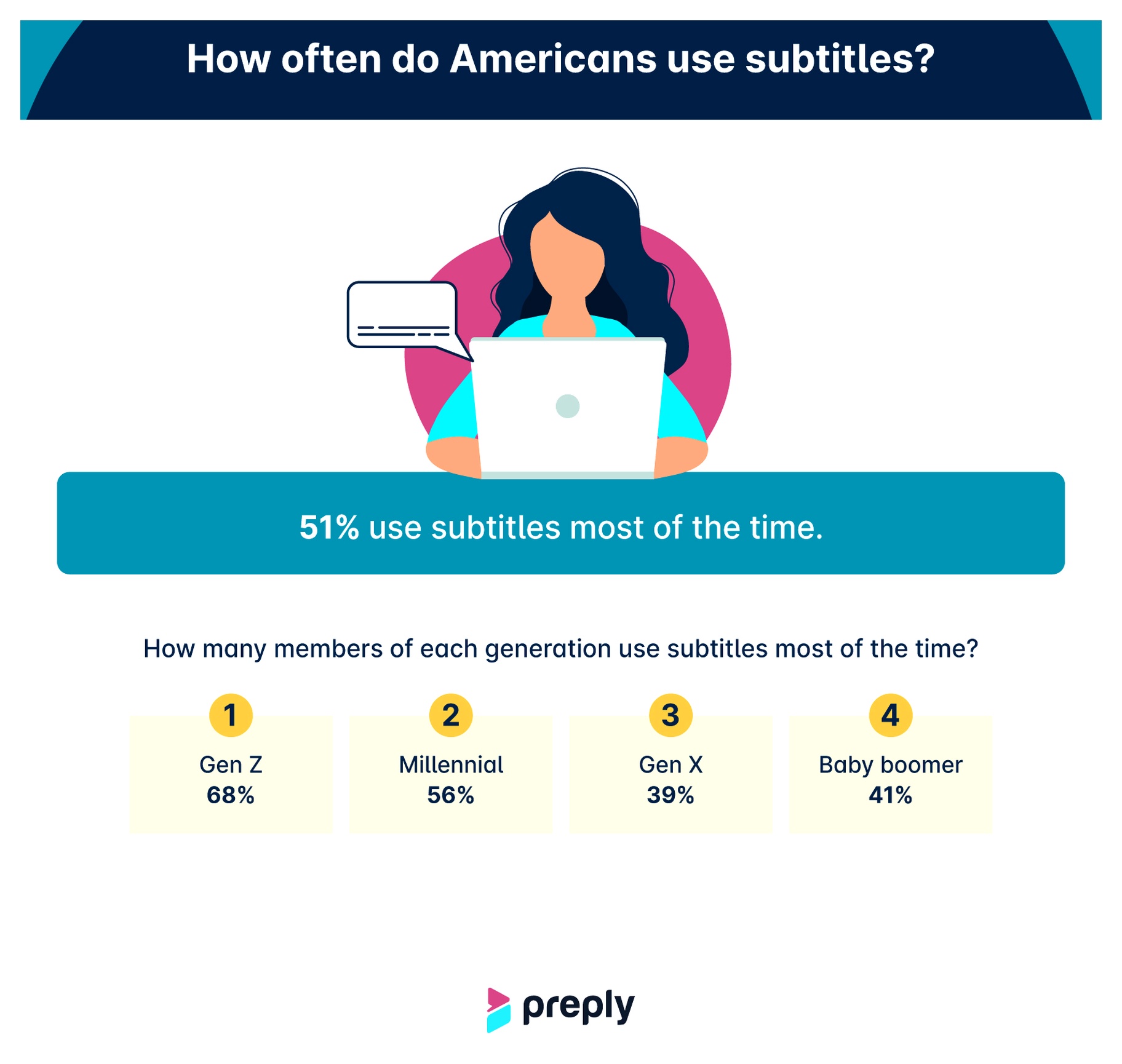
- 51% of Americans watch content with subtitles most of the time.
- 61% of viewers report that background music makes dialogue in shows and movies harder to hear than in the past.
- A large majority (70%) of Americans use subtitles to better understand actors with accents.
- Mikayla Nogueira is the hardest TikTok creator for Americans to understand.

Learn a language with personalised 1-on-1 classes with our expert tutors from all over the world
French lessons online
Spanish lessons online
New subtitle trends among Americans
Our research shows a notable trend: 58% of viewers are now using subtitles more frequently than before, marking a 5% increase since 2022. This shift underscores the growing importance of accessibility and viewer preference in media consumption.
An impressive 51% of people now rely on subtitles most of the time. Notably, women are leading this trend, with 61% reporting increased subtitle usage compared to 54% of men.
The survey revealed that almost 25% of viewers keep subtitles activated all the time. Notably, Gen Z leads the trend, with an astonishing 96% opting for subtitles, a remarkable increase from 70% just a year ago.
A recent analysis of subtitle usage across various platforms reveals that Netflix is the clear frontrunner. Over half of Americans (52%) say they use subtitles more often on Netflix than anywhere else, highlighting the platform’s strong influence and seamless subtitle features that enhance the viewing experience.
Subtitles serve a purpose beyond solo viewing—about 1 in 3 people prefer using them when watching TV with others. This highlights how subtitles enhance group viewing, making it easier for everyone to stay engaged and understand the content together.
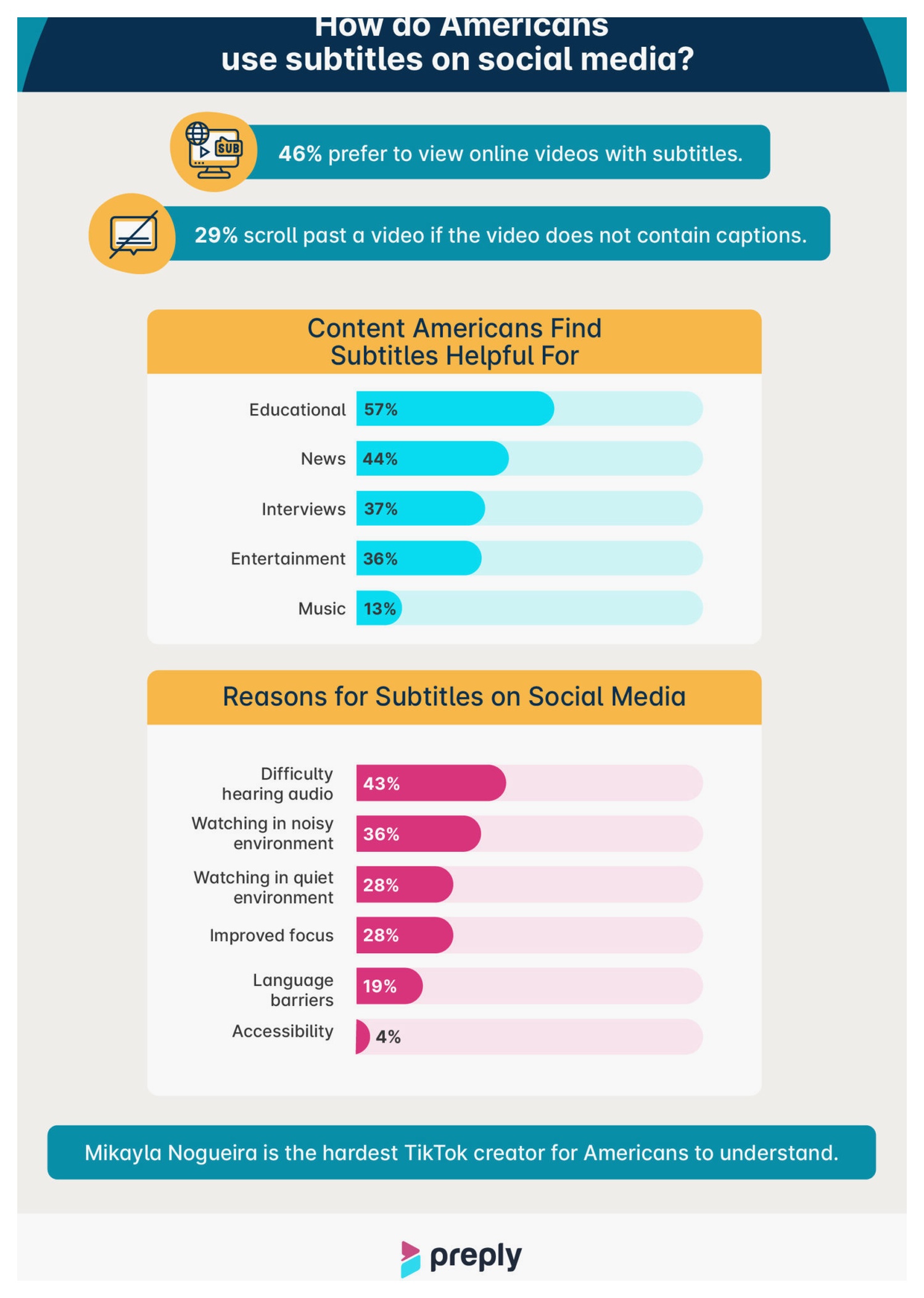
Subtitles have become an essential feature in online videos, especially on popular platforms like YouTube and TikTok. In fact, a notable 46% of viewers now choose to watch videos with subtitles, marking a 5% rise from the previous year. This trend highlights the growing demand for accessibility and engagement in digital content.
Why subtitles are growing in popularity
This year, a significant 61% of Americans feel that it’s increasingly challenging to catch the dialogue in movies and shows due to distracting background music, up from 55% last year.
Instead of causing distractions, a striking 81% of viewers find that subtitles enhance their understanding of the content. This insight likely explains why the majority of Americans appreciate this feature, with only 7% choosing to forgo subtitles altogether.
A significant 70% of Americans now rely on subtitles to grasp accents, a notable increase from last year’s 57%. Among various accents, the Scottish dialect stands out as the most challenging for American audiences to understand.
Subtitles are instrumental in language learning and education, with approximately 25% of people acknowledging their helpfulness in acquiring a new language. Moreover, an impressive 44% of individuals have utilized subtitles to better grasp new concepts or study material.
We spoke with Martin, a seasoned English tutor from LingualNeeds with over 17 years of experience, to uncover effective strategies for using subtitles as a language-learning tool. He recommends starting by watching a movie without subtitles to challenge yourself to guess any unfamiliar words. Next, jot down the timecodes for moments when you struggle to catch certain words, then revisit those sections with subtitles to enhance your understanding. This method not only sharpens listening skills but also reinforces vocabulary retention.
Students can enhance their language skills by repeating phrases and expressions they encounter in movies. Watching films exposes them to authentic dialogue, and mimicking these phrases helps deepen their understanding of natural language use.
In today’s streaming era, where most movies are easily accessible, students can enhance their learning by pausing during dialogue scenes. This allows them to predict how one character will respond, making the viewing experience more interactive and engaging.
This approach enhances students’ awareness of potential scenarios in their target language, and it can significantly boost their confidence when their predictions turn out to be accurate.

Learn a language online with our free learning materials.
Learn English online
Learn French online
Subtitles are becoming increasingly preferred on TikTok and YouTube videos
The popularity of online video platforms, such as YouTube and TikTok, is driving a surge in demand for subtitles. Remarkably, 46% of viewers choose to watch videos with subtitles, and a substantial 61% indicate that subtitles play a significant role in enhancing their social media viewing experience.
A significant 54% of women prefer watching content with subtitles online, in contrast to just 36% of men. When it comes to generational preferences, half of Gen Z viewers favor subtitles, closely trailed by 49% of millennials, 44% of Gen X, and 35% of Baby Boomers.
Subtitles play a crucial role in enhancing viewer engagement, far beyond just personal choice. In fact, almost half of American viewers (49%) indicate they are more inclined to watch a video featuring someone speaking when captions are included.
Moreover, almost 1 in 6 viewers choose to watch videos without sound, highlighting the importance of captions. In fact, 29% of viewers say they would skip over a video if it lacks captions, underscoring their essential role in engaging an audience.
TikTok viewers are increasingly highlighting the importance of subtitles for better comprehension. A survey of American audiences reveals that the creators they find most challenging to understand are Mikayla Nogueira (45%, @mikaylanogueira), Addison Rae (25%, @addisonre), and the duo Max and Harvey (14%, @maxandharveyofficial).
Integrating captions into content on social media platforms can greatly improve viewer understanding and engagement. Research highlights the transformative power of subtitles, which not only enrich the viewing experience but also help content creators expand their audience and increase accessibility.
Rick and Morty and Bridgerton among the hardest-to-understand TV shows
Understanding accents can sometimes be a barrier to fully enjoying a film or show, with some celebrities frequently recognized as particularly hard to decipher. Among male actors, Tom Hardy has earned the reputation of having the most difficult accent for American audiences to comprehend.
Close behind are Arnold Schwarzenegger and Colin Farrell, whose unique vocal styles and accents often present a challenge for viewers to understand.
Sofía Vergara stands out among female celebrities, as her accent is the most challenging for American audiences to comprehend. Close behind her are British singer-songwriter Adele and American rapper Cardi B, both of whom bring distinctive accents that further enrich the listening experience while also posing a challenge for some.
Many popular television shows have puzzled audiences with their intricate dialogue. Leading the pack is *The Crown*, known for its period-specific British accents that can prove challenging for some American viewers to decipher.
“Rick and Morty,” known for its rapid-fire dialogue and complex sci-fi concepts, claims the second position. Meanwhile, the historical drama “Bridgerton,” rich with British accents and set in the Regency era, secures third place.
Our research reveals that while distinctive accents can enhance the character and authenticity of performances, they may also pose challenges for understanding. This highlights the important role subtitles play in ensuring clarity and accessibility for audiences.
We spoke with language expert Sylvia Johnson about the intriguing variations in subtitle usage and effectiveness across different languages and dialects. She explained, “Subtitles can differ significantly based on linguistic nuances, cultural contexts, and technical considerations.”
Subtitle translation and formatting are influenced by various factors, including sentence structure, cultural nuances, reading speed, character limits, and localization challenges. Translators face the crucial task of making decisions that preserve the dialogue’s overall context and meaning while effectively adapting it to resonate with the target audience.
“Translating subtitles can be tricky, as some languages need adjustments in sentence length and timing. Additionally, idiomatic phrases and cultural nuances can complicate achieving accurate translations.”

Go beyond subtitles with LingualNeeds
Subtitles serve as a powerful tool for enhancing language comprehension in various contexts. They can improve your understanding of accents in your favorite TV shows, clarify the message in social media videos, and even assist in learning new languages.
Combining listening to speech with the visual reinforcement from subtitles can create a comprehensive and engaging language learning experience.
However, real life has its limitations, and subtitles are nowhere to be found. If you’ve ever attempted to communicate in a foreign language, you can relate to the frustration of being in a room full of fluent speakers while struggling to understand even a single word. Wouldn’t it be great if we had subtitles to guide us?
Until this dream becomes reality, LingualNeeds tutors are here to help.
Experience personalized, one-on-one lessons with LingualNeeds’s online language tutors. Focus on crucial aspects of language learning, including fluency in speaking, vocabulary expansion, and building confidence, all tailored to your individual needs.
If you’re finding it challenging to master a specific accent or are preparing for a move to a new country, consider selecting a LingualNeeds tutor tailored to your goals. Your tutor will create realistic scenarios for practice, helping you build the confidence you need for your next conversation with a fluent speaker.
Partnering with a LingualNeeds tutor can accelerate your language learning journey far more effectively than relying solely on subtitles. Discover the ideal tutor for your needs today and embark on the path to achieving your language goals!
Methodology
We aimed to survey at least 1,000 individuals, as this larger sample size enhances the accuracy of our findings and allows us to generalize the results to a broader population. By minimizing the margin of error, we can make more informed conclusions from the data. A substantial sample provides numerous data points for analysis, boosting the reliability and validity of our results. This ultimately empowers us to draw more robust insights into public perceptions of subtitles.
On May 2, 2023, we conducted a survey involving 1,503 Americans to explore their experiences with subtitles in entertainment across streaming services and online content. The participants, aged 18 to 76, included a diverse demographic: 49% identified as female, 50% as male, and 1% as nonbinary.
Frequently Asked Questions
What percentage of Americans watch content with subtitles most of the time?
51% of Americans watch content with subtitles most of the time.
Which generation is leading in subtitle usage?
Gen Z is leading in subtitle usage, with an astonishing 96% opting for subtitles.
How do subtitles impact comprehension of accents?
70% of Americans now rely on subtitles to grasp accents, a notable increase from last year’s 57%.
What role do subtitles play in online video platforms like TikTok and YouTube?
46% of viewers choose to watch videos with subtitles, highlighting their importance for accessibility and engagement.
What is the main reason viewers find subtitles helpful?
81% of viewers find that subtitles enhance their understanding of the content.