
- Key findings
- Passive-aggressive email trends
- Nearly half of Americans receive passive-aggressive emails from their superiors
- Americans deal with belligerent emails by sending more of them
- Passive-aggressive emails affect productivity
- Conclusion
- Frequently Asked Questions
- What is passive-aggressive communication in the workplace?
- What percentage of employees receive passive-aggressive emails from their superiors?
- Which phrase is considered the most passive-aggressive in emails?
- How does passive-aggressive communication affect workplace productivity?
- What are some common phrases that indicate passive-aggressive behavior?
In today’s workplace, where casual conversations in the break room have largely been replaced by a flurry of emails and instant messages, a new communication style has surfaced: passive-aggressive communication. This subtle yet impactful form of expression can significantly shape our work environment and influence relationships among colleagues.
We wanted to explore how passive aggression manifests in the language and communication styles of the American workplace. Does it come across as sarcasm, reveal itself through a negative tone, or lurk in the unsaid words?
What constitutes passive-aggressive behavior in writing? Perspectives vary widely—some people may view unnecessary reminders as passive-aggressive, while others see them as helpful. Similarly, overly formal language can be interpreted by some as a subtle jab, while others consider it simply a professional tone. Understanding these nuances is key to effective communication.
To uncover the prevalence of passive aggression in the workplace, LingualNeeds conducted a survey with 1,000 Americans. Join us as we delve into this fascinating facet of contemporary workplace communication.
Key findings
- A significant 42% have received a passive-aggressive email from their superior.
- “Per my last email” is the most passive-aggressive email phrase.
- While many coworkers appear friendly in person, 65% exhibit passive-aggressive behavior in email communications.
- Nearly half (47%) have had coworkers escalate minor issues by cc’ing managers in emails.
- Passive-aggressive communication from colleagues have caused 23% to quit their jobs.

Learn a language with personalised 1-on-1 classes with our expert tutors from all over the world
French lessons online
Spanish lessons online
Passive-aggressive email trends
In today’s workplace, passive-aggressive communication is on the rise, with an alarming 83% of employees indicating they frequently encounter subtly hostile messages in their interactions. Moreover, half of these workers have noticed a significant increase in this type of communication since the onset of the Covid-19 pandemic in 2020.
Each week, passive-aggressive communication slips into the inboxes of one in four people. Delving into the specifics, a striking 76% of these subtle yet hostile exchanges happen via email, while the remaining 24% take place on messaging apps.
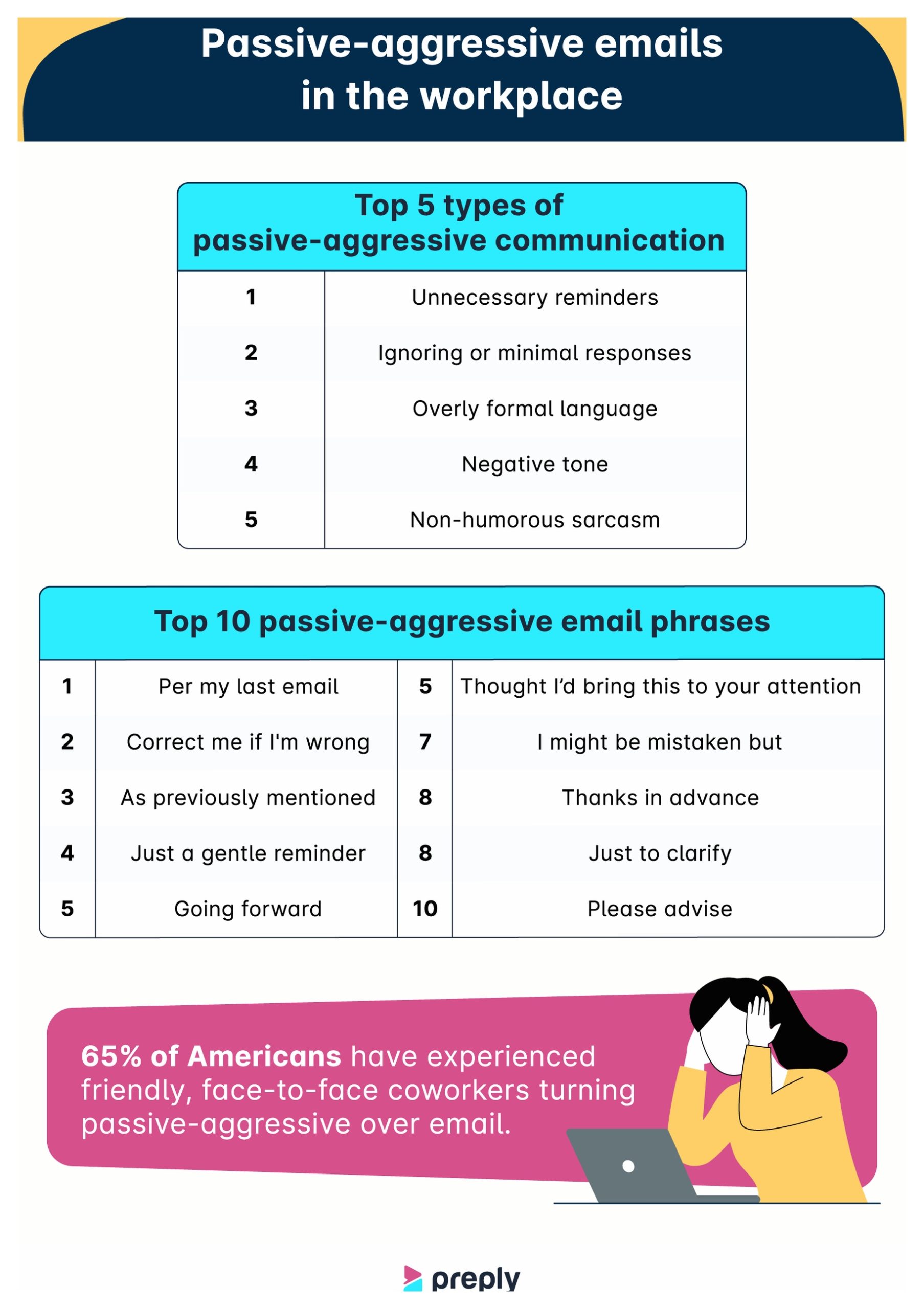
With an increasing number of American workers encountering passive-aggressive emails, specific phrases and behaviors have become particularly notable. Among them, “Per my last email” is considered the most quintessential passive-aggressive remark, according to survey respondents. Additionally, unwarranted reminders frequently characterize this subtle form of communication.
Surprisingly, 44% of American employees admit to having sent passive-aggressive messages at work, revealing that they aren’t just victims of this behavior. When we look at the data by generation, it turns out that 43% of Gen X and millennials have engaged in this practice, while 36% of Gen Z and 29% of baby boomers have done the same.
Our research reveals that passive-aggressive communication can create a tense atmosphere in the workplace. Surprisingly, 65% of employees report encountering colleagues who alternate between sending passive-aggressive emails and then acting friendly in person. This inconsistency can lead to confusion and strain team dynamics.
Moreover, a striking 47% of employees have experienced instances where colleagues included their supervisors in emails about trivial matters. This behavior highlights a troubling trend of unnecessary escalation in the workplace, reminiscent of “tattle-taling” and contributing to a cycle of passive-aggressive communication.
To delve into the nature of passive-aggressive language, we consulted Sylvia Johnson, a language expert at LingualNeeds. She explained that various factors drive people to communicate in this way, often stemming from their difficulty in expressing frustration openly and directly.
- A prime example is the phrase “per my last email,” which implies, “I previously emailed you about this; did you overlook it?”
- The phrases “as previously mentioned,” “correct me if I’m wrong,” and “I might be mistaken” suggest that the writer is confident in their accuracy and implies that any disagreement lies with the recipient.
- “While ‘Just a gentle reminder’ may seem polite, it often implies urgency, signaling a request for prompt action on previous tasks.”
- “These seemingly polite phrases conceal the writer’s frustration, exemplifying passive-aggressive language.”
Nearly half of Americans receive passive-aggressive emails from their superiors
A significant number of American workers, 42%, indicate that they frequently receive passive-aggressive emails from their bosses, outpacing the 36% of similar messages sent by colleagues. This highlights a notable trend in workplace communication dynamics.
These observations highlight the crucial role that power dynamics play in shaping communication styles within the workplace. This trend likely stems from the fundamental nature of managerial positions, which typically require delivering feedback and making important assessments.
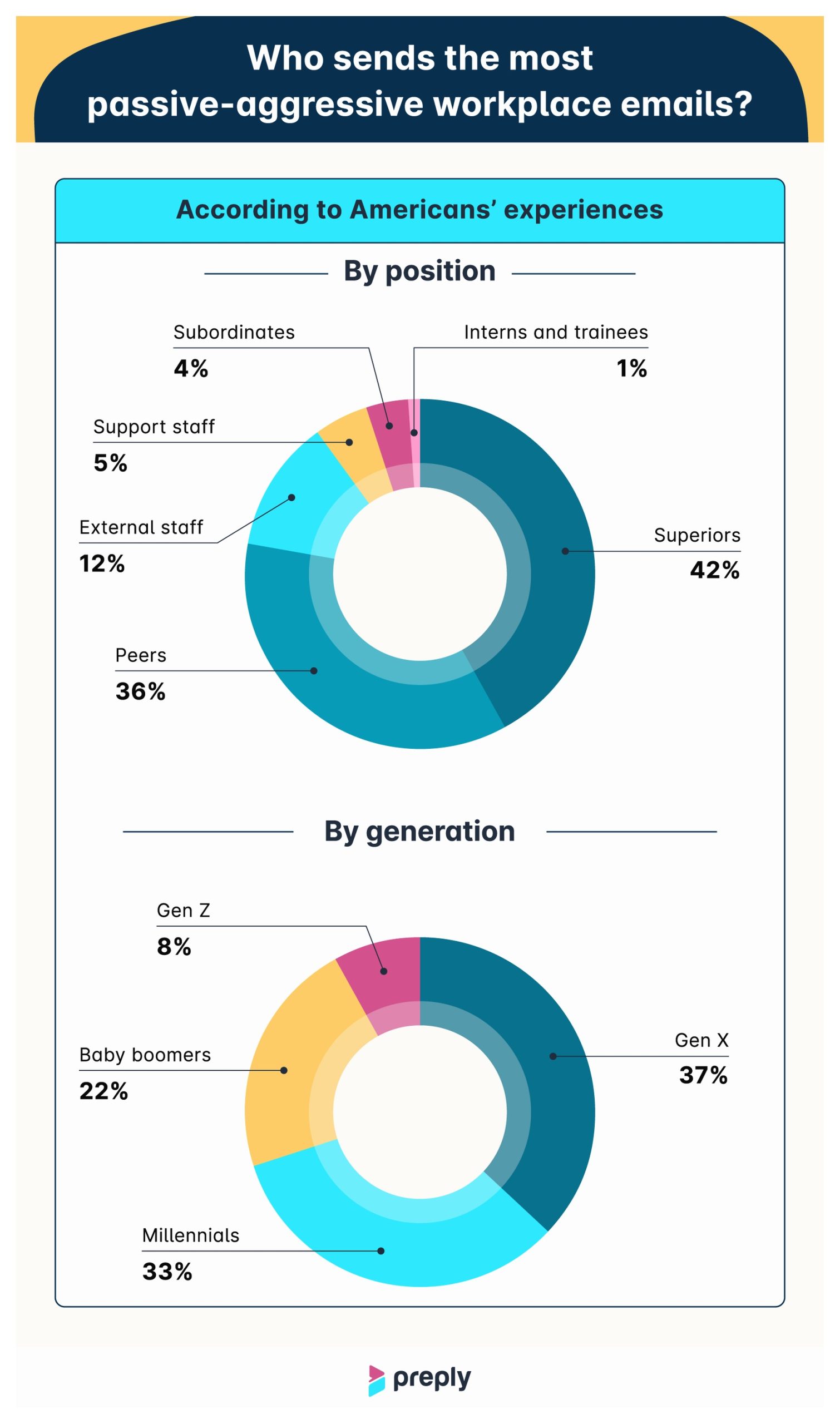
It’s intriguing to note that Generation X and millennials, who frequently hold positions of responsibility and influence, are viewed by their peers as the ones who send the most passive-aggressive emails.
An impressive 94% of employees feel that the stress or anxiety of the sender plays a significant role in their use of passive-aggressive language. This suggests that external factors, like workplace pressure, can greatly impact how we communicate with one another.
Learn a language online with our free learning materials.
Learn English online
Learn French online
Americans deal with belligerent emails by sending more of them
In the American workplace, passive aggression creates a cycle that’s hard to break. Surprisingly, 80% of employees admit they avoid confronting their passive-aggressive coworkers. Additionally, half of the workforce acknowledges that they often respond in kind, mirroring the same passive-aggressive behavior when faced with it.
Interestingly, the primary motivation behind Americans sending passive-aggressive emails is often a reaction to experiencing the same behavior from others. This highlights a tit-for-tat dynamic that frequently occurs in workplace communication.

Stress significantly influences how we communicate. When feeling stressed, people often struggle to express themselves with the same thoughtfulness they usually demonstrate.
A striking 18% of people acknowledge that they’ve sent passive-aggressive emails to their boss, and among them, a remarkable 89% admit they chose their words deliberately.
Analyzing our survey data by generation reveals that Gen X leads the way in sending emails to their superiors, with 21% of respondents in this group doing so. Millennials follow closely behind at 17%, while Gen Z and baby boomers contribute 14% and 11%, respectively.
While effective communication is essential, certain patterns can have negative consequences. Alarmingly, 23% of respondents indicate that passive-aggressive behavior from colleagues influenced their choice to leave a job. This highlights how communication styles are crucial factors in employee retention and overall job satisfaction.
Passive-aggressive emails affect productivity
Passive-aggressive communication doesn’t just strain workplace relationships; it significantly undermines productivity as well. Research shows that 66% of employees experience heightened anxiety from these interactions, which can seriously hinder their work performance.
The anxiety caused by passive-aggressive emails highlights a striking generational divide. A significant 69% of Gen Z reports feeling this stress, closely followed by 65% of millennials. In contrast, only 55% of Gen X feels the impact, while baby boomers experience the least anxiety at 44%.
Our observations reveal that baby boomers are the least affected by passive-aggressive emails when it comes to their productivity. This intriguing insight suggests that as we grow older, we may develop a greater resilience to the influence of others’ words, indicating that our ability to navigate workplace dynamics strengthens with age.
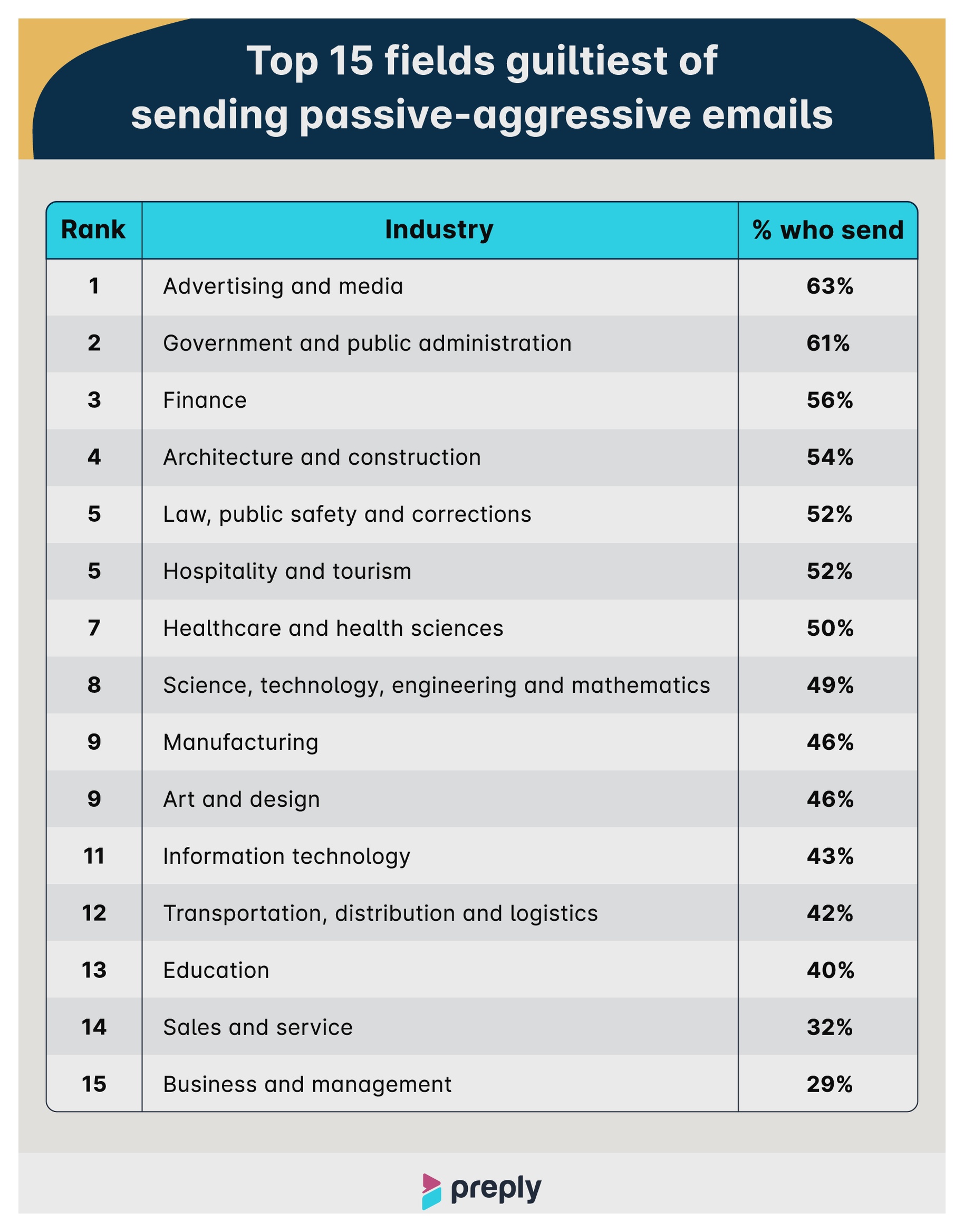
A recent analysis reveals that more than 60% of professionals in the leading sectors—advertising and government—acknowledge sending passive-aggressive emails. This trend may indicate rising stress levels prevalent in these fields, shedding light on the pressures faced by workers in these high-stakes environments.
Notably, sectors like STEM, IT, and manufacturing occupy a unique position in the communication spectrum. Unlike many people-oriented fields, these industries tend to use less passive-aggressive language. This distinction could reflect the varying communication styles that characterize different sectors.
Conclusion
Passive-aggressive communication in American workplaces reveals the complex nuances of language and highlights how tone and word choice can significantly affect interpersonal relationships.
Language expert Sylvia Johnson emphasizes the importance of clear communication in the workplace, stating, “Since we spend at least 40 hours each week with our colleagues, why complicate things with ambiguous remarks? Viewing passive-aggressive behavior as unexpressed frustrations can erode trust, hinder open dialogue, and create a toxic work atmosphere.”
Keep in mind that passive-aggressive language often hides true intentions and lacks clarity—qualities that can undermine team dynamics. Instead, promoting a culture of open, honest, and direct communication nurtures trust among team members, ultimately enhancing both productivity and efficiency.
“Please feel free to correct me if I’m mistaken (though I’m confident I’m not!). As I mentioned earlier, it’s important to express your thoughts clearly so that others can understand and adjust their behavior accordingly.”
These dynamics highlight the fact that language is a vibrant, ever-evolving force. This understanding is especially important in the realm of language learning.
Johnson emphasizes the value of having a tutor, stating, “A tutor can guide you in mastering the subtleties of language, helping you convey your message clearly and avoid the traps of passive-aggressiveness. With their support, you’ll receive instant feedback on your tone, ensuring your communication is both effective and impactful.”
Navigating a multicultural environment can be challenging, but connecting with a native speaker can greatly enhance your understanding of diverse communication styles. Our online language tutors are here to help you unlock the wealth of intercultural insights. For example, taking Spanish lessons or signing up for an online Spanish class for adults can significantly improve your interactions with Spanish-speaking colleagues. Likewise, our business English course is tailored to sharpen your professional communication skills, empowering you to thrive in international business contexts.
Methodology
We aimed to survey at least 1,000 individuals, as this larger sample size offers a more precise reflection of the overall population. By gathering data from a diverse group, we can minimize the margin of error and enhance the reliability of our findings, leading to better-informed decisions.
By utilizing a larger sample size, we gain a wealth of data points for our statistical analysis, enhancing the reliability and validity of our findings. This allows us to make more robust inferences about how the entire population perceives passive aggression in the workplace.
On June 22, 2023, we conducted a survey of 1,006 Americans to explore their experiences with passive-aggressive emails in the workplace. The participants were diverse, ranging in age from 18 to 76, and included 49% women, 50% men, and 1% nonbinary individuals.
Frequently Asked Questions
What is passive-aggressive communication in the workplace?
Passive-aggressive communication is a subtle yet impactful form of expression that can shape work environments and influence relationships among colleagues, often manifesting through sarcasm, negative tones, or unsaid words.
What percentage of employees receive passive-aggressive emails from their superiors?
A significant 42% of employees have received passive-aggressive emails from their superiors.
Which phrase is considered the most passive-aggressive in emails?
‘Per my last email’ is identified as the most passive-aggressive email phrase.
How does passive-aggressive communication affect workplace productivity?
Passive-aggressive communication can significantly undermine productivity, with 66% of employees experiencing heightened anxiety from these interactions.
What are some common phrases that indicate passive-aggressive behavior?
Common phrases include ‘As previously mentioned,’ ‘Correct me if I’m wrong,’ and ‘Just a gentle reminder,’ which often conceal frustration and imply urgency.


