

- Corporate jargon: The top 10 most misunderstood terms
- Corporate acronyms: Top 10 most misunderstood terms
- Upgrade your workplace communication skills
- Methodology
- Frequently Asked Questions
- What is the purpose of LingualNeeds?
- What are some of the most misunderstood corporate jargon terms?
- Why is the term ‘synergy’ disliked in corporate discussions?
- What does ‘KPI’ stand for and why is it confusing?
- How does LingualNeeds identify misunderstood terms and acronyms?
Have you ever nodded in agreement during a meeting with your boss, all while struggling to decode the corporate jargon being tossed around? You’re definitely not alone. Many people experience this frustrating situation, which can leave you feeling confused, anxious, and unfocused.
At LingualNeeds, we specialize in private English lessons tailored for the workplace, and we are dedicated to keeping abreast of the latest corporate jargon to empower our students in their professional journeys. To enhance our teaching methods, we conducted research on the most frequently searched corporate terms on Google, including their definitions and acronyms. This analysis offers crucial insights into the terms that Australians find most perplexing, shedding light on the current language trends in corporate Australia.
Corporate jargon: The top 10 most misunderstood terms

We were intrigued to find that some timeless terms topped our list, with the classics “ad hoc” and “stakeholder” claiming the first and second spots. This trend may stem from younger employees, who are more familiar with modern jargon like “circle back” and “lean in,” not having the same exposure to Latin as their older counterparts. For context, “ad hoc” is a Latin expression meaning “for this specific situation,” and it typically refers to something that is spontaneous or unplanned.
Securing the third spot is the term “iteration,” which has gained traction following Forbes Magazine’s association of it with workplace success. At its core, iteration refers to the process of repeating actions, but in the business context, it emphasizes continuous improvement. This concept is especially prevalent in software development, where “iterative development” signifies a method of consistently refining and enhancing products.
Landing in sixth place on our list is the term “synergy,” a corporate buzzword that emerged in the 90s and shows no signs of fading away. While it is intended to convey the idea of “working better together,” its overuse has led it to become a staple in discussions about the most disliked business jargon. Our study highlights its prominence among the least favored corporate phrases in America.
At the tenth spot, we find “artificial intelligence,” a term that garners significant attention on Google. A recent study reveals that 70% of ChatGPT users belong to Gen Z, hinting that the majority of searches for “artificial intelligence” likely come from older generations. This trend highlights the evolving language in the workplace and the shifting nature of corporate buzzwords. Despite the increasing prevalence of artificial intelligence in businesses, many Australians still perceive it as complex jargon, indicating a gap in understanding its true meaning.

Learn a language with personalised 1-on-1 classes with our expert tutors from all over the world
French lessons online
Spanish lessons online
Corporate acronyms: Top 10 most misunderstood terms
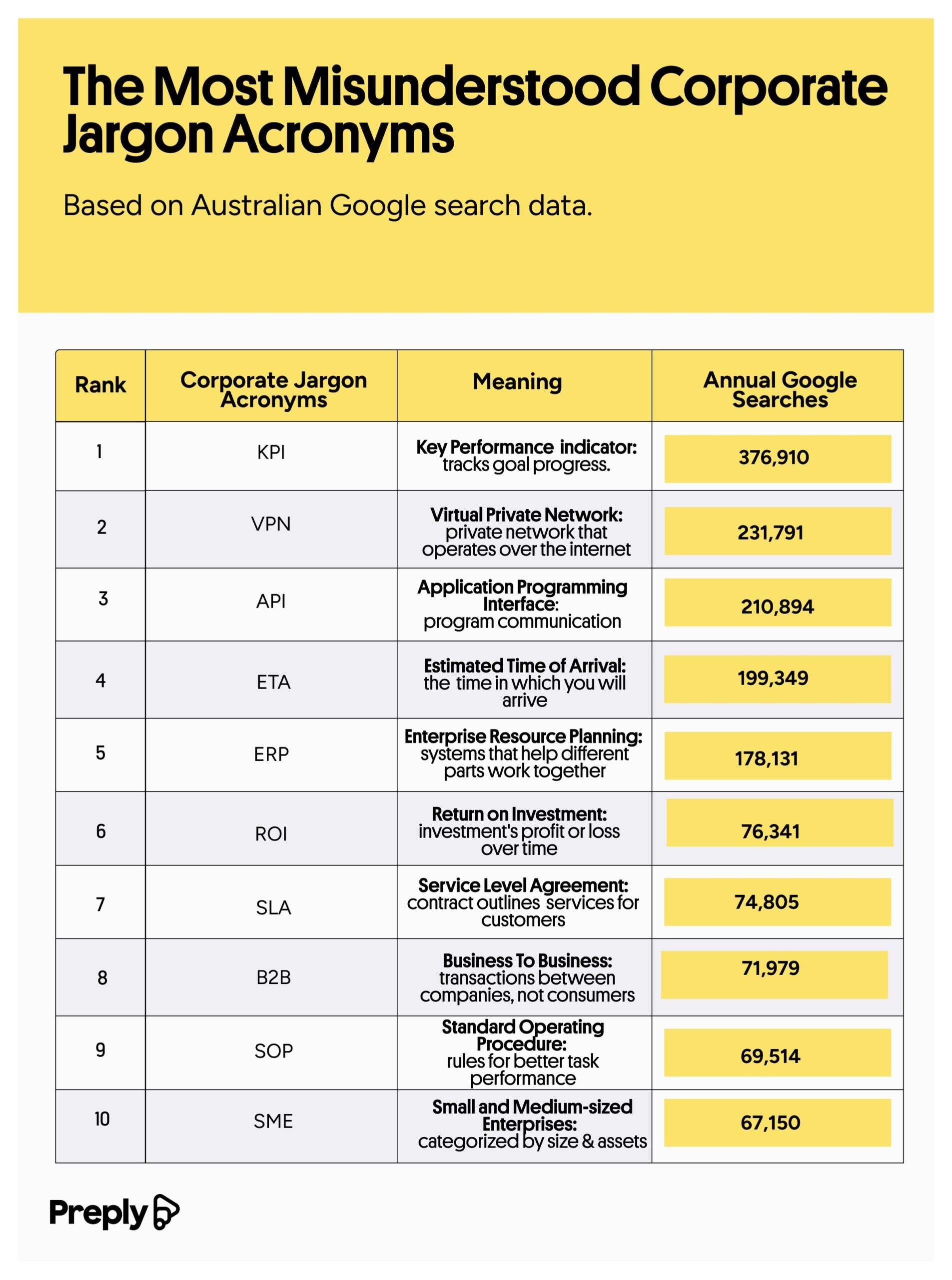
Our research explored the corporate acronyms that perplex Australian workers, with “KPI” or “Key Performance Indicator” emerging as the most confusing. Highlighted in Forbes’ list of buzzwords to steer clear of in pitches, “KPI” has become so overused that it often raises eyebrows and skepticism among employees.
In Australia, “VPN,” short for “Virtual Private Network,” ranks as the second most searched corporate acronym. VPNs are essential tools for internet users who want to safeguard their privacy, especially when connecting to public networks. They also allow users to bypass geographic restrictions, enabling activities like streaming American Netflix from other countries. A recent study revealed that 31% of global internet users rely on VPNs, with “enhanced security” being the primary motivation for their use.
Considering its widespread use, we were intrigued to find “ETA” (short for “Estimated Time of Arrival”) ranking fourth. This might reflect a disconnect with younger employees who may not fully grasp the term’s origins. Initially coined in the aviation sector, “ETA” has since infiltrated the corporate arena. So, when your boss requests an “ETA on that,” they’re simply inquiring about the timeline for completion. If you’re in a light-hearted mood, you could cheekily respond with “it’s an iterative process,” which essentially translates to “not anytime soon.”
Upgrade your workplace communication skills
Effective communication with colleagues and stakeholders is a crucial skill, particularly for leaders. If your job involves travel or relocating for a new position, taking the time to learn the local language can help you navigate potential communication pitfalls and respect workplace etiquette.
Are you looking to elevate your professional communication skills? Our conversational English courses at LingualNeeds are designed just for you! With personalized one-on-one tutoring, you’ll gain confidence in the workplace and expand your vocabulary. Explore our selection of Australian English teachers online to find the perfect tutor who can help you delve deep into your professional communication, address any challenges, and strengthen your core competencies—all essential for achieving career success.
Methodology
LingualNeeds embarked on an in-depth exploration of corporate jargon by gathering more than 300 terms and acronyms from popular platforms like ChatGPT, Quora, and Reddit. Using Google’s Keyword Planner, they analyzed this extensive list to identify the top 10 most misunderstood corporate jargon terms and acronyms in Australia.
By leveraging the Keyword Planner’s search volume insights, the campaign effectively pinpointed and organized the terms with the highest nationwide search interest. This analysis focused on popular queries such as “[word] meaning,” “what does [word] mean,” “what is [word],” and “define [word].”
In February 2024, we collected data on keyword search volumes, analyzing trends from February 2023 through January 2024.
The terms and acronym meanings in the tables referenced were sourced from Cambridge Dictionary online and condensed using ChatGPT.
Frequently Asked Questions
What is the purpose of LingualNeeds?
LingualNeeds specializes in private English lessons tailored for the workplace to help students navigate corporate jargon.
What are some of the most misunderstood corporate jargon terms?
The top misunderstood terms include ‘ad hoc’, ‘stakeholder’, and ‘iteration’.
Why is the term ‘synergy’ disliked in corporate discussions?
Despite meaning ‘working better together’, ‘synergy’ has become overused and is often included in discussions about disliked business jargon.
What does ‘KPI’ stand for and why is it confusing?
‘KPI’ stands for ‘Key Performance Indicator’ and is often overused in pitches, leading to confusion and skepticism among employees.
How does LingualNeeds identify misunderstood terms and acronyms?
They analyze search volume data from platforms like Google using tools like Keyword Planner to pinpoint the most searched corporate terms and acronyms.


