

- Key takeaways
- Contents
- What do employees think of using business jargon in the workplace?
- Key takeaway: More than 1 in 5 people said they dislike corporate buzzwords
- Why do people use business buzzwords?
- Most popular business jargon and corporate buzzwords
- Key takeaway: The most widely recognised business buzzword is “win-win”
- The least common corporate buzzwords
- Key takeaway: The least common buzzword is “Sweep the floors” (it means to win convincingly)
- Gender and generational differences in business jargon
- Worst business jargon and corporate buzzwords
- Key takeaway: The most annoying business buzzword is “new normal”
- What do employees think of using business jargon in job descriptions?
- Key takeaway: 1 in 5 people saw jargon in a job description as a “red flag”, or warning sign
- What is classified as business jargon?
- What is another name for business jargon?
- What is the purpose of business jargon?
- What are the benefits of using business jargon in the workplace?
- What are examples of business jargon?
- 10 Examples of business jargon
- 1.Close/end of play
- 2. On the same page
- 3. ASAP
- 4. Low-hanging fruit
- 5. Ducks in a row
- 6. Outside the box
- 7. Heads up
- 8. Circle back
- 9. Back burner
- 10. Rain-check
- Corporate jargon phrases – by category
- Jargon in conversation
- Jargon in writing
- How to learn business jargon
- How to use jargon in business writing
- How to use business jargon in a sentence
- Final thoughts
- Methodology
- Frequently Asked Questions
- What is business jargon?
- Why do people dislike corporate buzzwords?
- How does business jargon impact job applications?
- What are some examples of popular business jargon?
- What are the benefits of using business jargon?
Regardless of your fluency in English, navigating the business world can present challenges. Both non-native and native speakers may encounter terms and expressions that can be perplexing. Understanding these nuances is essential for effective communication in a professional setting.
Business jargon, often referred to as corporate speak, is a blend of buzzwords and phrases that carry dual meanings—both literal and within the context of the business world.
When utilized effectively, these tools can facilitate communication and bolster your credibility. However, if misused or misinterpreted, they can have the opposite effect, undermining your message and trustworthiness.
While learning a new layer of workplace language might feel overwhelming, mastering these expressions is essential for sounding professional when communicating with corporate colleagues, clients, and suppliers globally. Understanding and using this language effectively can enhance your professional interactions significantly.
We conducted a survey with 1,551 participants and discovered that 20% of them expressed a dislike for business buzzwords, yet they still use them for specific reasons. Here’s what our findings revealed:
Key takeaways
- Over 20% of individuals dislike corporate buzzwords, yet 40% hear them daily, and 70% admit to using them themselves.
- “Win-win” emerged as the most popular business buzzword, while “new normal” ranked as the least favored among survey participants.
- 70% of survey respondents indicated that business jargon in job descriptions impacted their decision to apply, with 20% viewing jargon as a red flag.
Contents
- Business jargon: a survival guide for the office
- What do employees think of using business jargon in the workplace?
- Most popular business jargon and corporate buzzwords
- Worst business jargon and corporate buzzwords
- What is classified as business jargon?
- What is the purpose of business jargon?
- What are examples of business jargon?
- Corporate jargon phrases – by category
- How to learn business jargon
- How to use jargon in business writing
- How to use business jargon in a sentence
- Final thoughts
What do employees think of using business jargon in the workplace?
Key takeaway: More than 1 in 5 people said they dislike corporate buzzwords
In our research exploring attitudes toward workplace jargon, we surveyed 1,551 individuals and discovered some intriguing insights. Over 20% of respondents expressed a dislike for corporate buzzwords. Despite this, nearly 40% reported encountering these terms daily, and a striking 70% admitted to using them themselves.
Why do people use business buzzwords?
Why do we often resort to corporate jargon, even when it isn’t universally liked or understood? According to recent research, over 75% of respondents feel that using this language enhances professionalism. In fact, nearly the same percentage admits that this perception is why they adopt corporate speak in their own communication.

Most popular business jargon and corporate buzzwords
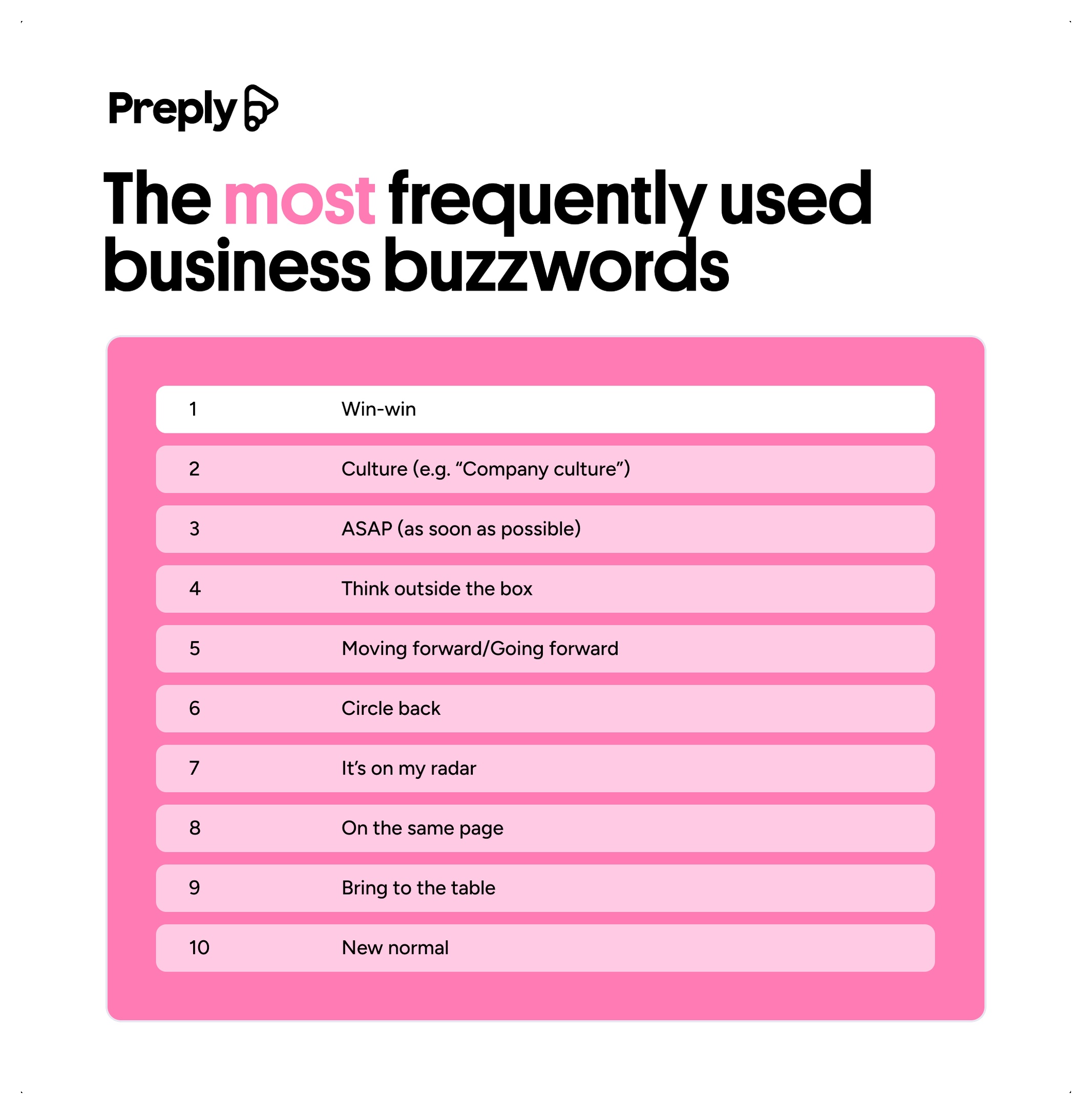
Key takeaway: The most widely recognised business buzzword is “win-win”
Certain phrases resonate more with people than others. Among them, “win-win” stands out as the most widely recognized, with 63% of respondents identifying it as a term for a mutually beneficial solution or arrangement.
Following closely behind was the term “culture,” selected by 61% of respondents. This refers to “company culture,” encompassing the shared values, goals, and practices that define an organization. Other popular phrases included “ASAP” at 58%, “think outside the box” at 57%, and “moving forward” at 56%.
 The least common corporate buzzwords
Key takeaway: The least common buzzword is “Sweep the floors” (it means to win convincingly)
Among the various buzzwords discussed, “sweep the floors” was the least recognized, with only 11% of respondents claiming familiarity. Similarly, just 12% were aware that “SMB” stands for small and medium-sized business, and a mere 13% knew the term “ideate,” which means to generate ideas.
Other less familiar terms were “blue sky thinking,” followed by “B2C” (business-to-consumer) at 14% and 18% respectively.

Gender and generational differences in business jargon
Research shows that individuals identifying as men are 10% more likely to use jargon compared to those identifying as women, with usage rates at 76% for men and 66% for women.
Generational differences in communication styles are striking. A notable 74% of millennials embrace jargon in their conversations, reveling in modern expressions and slang. In contrast, baby boomers lean towards straightforward language, with only 61% incorporating jargon into their speech.
Worst business jargon and corporate buzzwords
Key takeaway: The most annoying business buzzword is “new normal”
Business writing often faces criticism for its excessive use of jargon. Our research reveals that 43% of respondents find the phrase “new normal” particularly irritating, likely due to its frequent use during the pandemic.
The term “culture” sparked frustration among many, reflecting that a company’s attitudes can often be less than positive. Similarly, the phrase “circle back” tends to elicit eye-rolls, signaling a familiar annoyance. Additionally, the military-derived expression “boots on the ground” also faced disapproval from 42% of respondents, hinting at the tough challenges that lie ahead.
In fact, 41% of individuals expressed annoyance when asked to “give 110%,” considering it an unrealistic expectation for effort.
In contrast, the phrase “at the end of the day” emerged as the least annoying buzzword, with a remarkable 90% of respondents expressing that they don’t find it bothersome at all.
Next came the term “debrief,” which seemed to annoy only 12% of respondents. Meanwhile, phrases like “sweep the floors,” “SMB,” and “table this” attracted just 14% of reactions.
What do employees think of using business jargon in job descriptions?
Key takeaway: 1 in 5 people saw jargon in a job description as a “red flag”, or warning sign
Does the use of jargon in job descriptions enhance or diminish your chances of attracting the right candidates? Our survey revealed some intriguing insights: 70% of respondents indicated that the wording significantly affected their decision to apply for a position.
One in five individuals view jargon in job descriptions as a significant “red flag,” indicating potential issues within the role. This confusion often discourages them from applying for the position altogether.
Here are some of the terms to avoid:
While the term “Rockstar” may have a trendy appeal, it’s worth noting that 53% of job seekers view it as a warning sign. This suggests that it often implies an unrealistic expectation for extraordinary performance in high-pressure positions.
The phrase “wear many hats” didn’t sit well with nearly half of the respondents, likely signaling concerns about vague job roles or a team that’s too small to handle the workload. Close behind, 48% expressed discomfort with the term “thick skin,” which may suggest a potentially toxic company culture.
The phrase “Work hard, play hard” raises eyebrows, as nearly 47% of survey respondents view it as a red flag.
A significant 44% expressed dissatisfaction with the “Schedule TBD” option. It’s no surprise—candidates typically seek clarity on their working hours and the commitment expected of them.
Conversely, the majority of respondents showed little concern regarding the term “leverage,” with only 11% expressing annoyance at its usage. Similarly, the inclusion of “perks and benefits” was well-received, as just 12% viewed it as a potential red flag—highlighting the value of offerings like corporate English training or business English courses in enhancing language skills. Additionally, the phrase “proven track record” was considered a red flag by only 12% of participants, indicating a general acceptance of these terms in professional settings.
“Proactive” and “empower”, were seemingly harmless buzzwords – only 9% of respondents were unimpressed with these.
Overall, the survey showed that buzzwords with positive connotations were mostly considered to be okay by our respondents.
If you’re just starting to navigate the world of corporate jargon, this guide is your ultimate survival tool. It provides a comprehensive breakdown of commonly used buzzwords, their meanings, the contexts in which they arise, and tips on how to use them effectively. With this resource at your fingertips, you’ll be well-equipped to communicate confidently in any corporate setting.
What is classified as business jargon?
Certain jargon is unique to specific professions, like the technical terms employed by doctors, lawyers, or plumbers. However, a significant amount of jargon is prevalent throughout the corporate landscape. This encompasses metaphors, abbreviations, and acronyms—terms formed from the initial letters of commonly used phrases.
Numerous business buzzwords have their roots in sports, adding a dynamic flair to professional communication. Take the phrase “touch base,” for instance. Originating from baseball, it signifies the act of catching up or connecting with someone in a work environment. This crossover not only enriches our language but also fosters a sense of familiarity and teamwork.
Many terms have transitioned from the tech world into everyday language. One notable example is the term “bandwidth.” Originally used to describe the capacity of an internet connection, it has evolved to denote an individual’s available time or focus. So, when someone inquires, “Do you have the bandwidth for this?” they are essentially asking if you have the capacity to handle the task or issue at hand.
What is another name for business jargon?
Business jargon, often referred to as “corporate-speak,” “corporate lingo,” or “bizspeak,” encompasses the specialized vocabulary used in the business realm. This unique terminology allows professionals within a particular industry or organization to convey ideas, concepts, and processes clearly and efficiently.
What is the purpose of business jargon?
Buzzwords serve as efficient shortcuts for conveying intricate ideas, saving both time and effort. For instance, saying, “Let’s take a rain check” is much quicker and easier than saying, “Let’s postpone this meeting and reschedule it for a more convenient time for both of us.”
But it is only clear if everyone understands the term’s meaning in a corporate, as well as literal sense.
Research from Columbia Business School, featured in the Harvard Business Review, reveals that jargon can hinder effective communication. The key takeaway is to master the art of using jargon judiciously to enhance understanding rather than obscure it.
According to the research, using the right jargon in the appropriate contexts can enhance your clients’ confidence in your expertise and establish your credibility with professional peers.
What are the benefits of using business jargon in the workplace?
Using jargon in the workplace offers several benefits:
- Efficiency: Jargon allows colleagues with shared expertise to communicate complex ideas quickly and concisely, streamlining discussions and decision-making processes.
- Clarity: Specialized terminology ensures a clear and precise understanding of technical concepts, reducing misunderstandings and improving communication.
- Credibility: Utilizing jargon demonstrates knowledge and experience, enhancing individuals’ credibility and expertise within their respective fields.
- Time-Saving: By avoiding lengthy explanations, jargon saves time during meetings and exchanges, boosting productivity.
- Inclusivity: Shared jargon fosters a sense of belonging and camaraderie among employees in the same industry, team, or organization.
- Networking: Using jargon with peers helps build connections and relationships, facilitating professional networking and collaboration.
- **Knowledge Transfer:** Jargon acts as a repository of industry-specific knowledge, facilitating the efficient transfer of essential information to new employees and colleagues.
- Problem-Solving: Jargon can aid in analyzing and addressing challenges efficiently, promoting effective solutions.
- Project Management: In fields like engineering or technology, jargon helps coordinate complex projects and ensures precise communication between team members.
- Professional Development: Learning and using jargon enhances employees’ skills and keeps them up-to-date with the latest developments in their field.
What are examples of business jargon?
Let’s explore some frequently used business jargon, breaking down what these terms truly signify in straightforward language.
10 Examples of business jargon
1.Close/end of play
When someone asks for something by the ‘close of play’—a term borrowed from sports that indicates the end of a match—they’re essentially requesting it by the end of the workday. You might also hear them refer to it as ‘COP’ in conversation, spelling out the letters for clarity.
For example: ‘I’ll get the report to you by close of play, Jared.’
2. On the same page
When you ask if you are “on the same page,” you’re essentially checking to see if both of you have a shared understanding or perspective regarding the issue at hand.
For example: ‘We need to get on the same page ahead of this meeting or we’ll never get this contract.’
3. ASAP
Whether you say it as “ay-sap” or write it out as “as soon as possible,” this acronym conveys a sense of urgency, calling for immediate action or response.
For example: ‘We have a coffee machine emergency, call me ASAP!’
4. Low-hanging fruit
This phrase refers to “easy wins,” which are straightforward problems or achievable goals that can be tackled with minimal effort. By focusing on these quick successes, you can clear the path for more challenging tasks ahead, ultimately maximizing your overall productivity and success.
For example: ‘We know the conference-goers are low-hanging fruit, let’s get as many of them to sign up as possible.’
5. Ducks in a row
This phrase highlights the importance of organization and preparation. When a manager says, “We need to get all our ducks in a row,” it emphasizes the necessity of having everything in order before moving forward with any plans or actions.
For example: ‘Don’t call the client before we have our ducks in a row, or they’ll think we’re fools.’
6. Outside the box
The phrase “think outside the box” encourages us to break away from conventional thinking and explore innovative solutions to challenges. It urges us to move beyond traditional methods and consider unique, creative approaches that may not have been tried before.
For example: ‘This is not a problem we’ve seen before, we’re really going to have to think outside the box.’
7. Heads up
When someone gives you a “heads up,” they’re providing you with an important alert about the way a situation or plan is unfolding—information that you should be aware of to stay informed and prepared.
For example: ‘Just a heads up, Maria returns from maternity leave in 2 weeks.’
8. Circle back
The phrase “Let’s circle back to this” indicates a desire to temporarily set aside the current topic, with the intention of revisiting it later.
For example: ‘We’ve lots of other things to cover, let’s circle back to this once we’ve made the big decisions.’
9. Back burner
The phrase “putting a task on the back burner” originates from the kitchen, where a pan is moved to a smaller burner at the back of the stove. This expression means to temporarily set aside a task while you focus on more urgent priorities.
For instance, “Regrettably, the entire project has been delayed, meaning our trip to Japan in July is no longer happening.”
10. Rain-check
Originally, the term “rain check” described a ticket issued for a sports event that was postponed because of inclement weather. In a business context, however, “taking a rain check” signifies the need to delay a scheduled meeting or activity to a later date.
“Thank you for inviting me! I truly enjoy visiting model train museums, but could we possibly reschedule? I have quite a bit on my plate this weekend.”
Corporate jargon phrases – by category
Numerous expressions, abbreviations, and acronyms exist, with some appearing more frequently in written or spoken communication. To enhance your understanding, we’ve organized them into categories for easier navigation and clarity.
Jargon in conversation
In meetings, it’s common to encounter phrases that can make it challenging to grasp someone’s intended meaning, especially compared to one-on-one conversations. This can lead to misunderstandings and miscommunication.
Next time you are in a meeting, listen carefully and see how many of these you hear:
- Jump in – join in or (politely) interrupt a conversation.
- Hard stop – a specific time when a meeting or discussion needs to end
- Silver bullet – a simple and effective solution to a problem
- In the loop – involved in a discussion
- Drill down – thoroughly investigate
- Reach out – communicate or contact
- Move the goalposts – change a target or objective
- Gain traction – become popular or credible
- Wheelhouse – area of key strength or expertise
- Sweet spot – the perfect balance between cost and benefit
- Play it by ear – wait to see how something develops
- Raise the bar – set higher expectations
Jargon in writing
In written communication, especially in emails and internal memos, abbreviations and acronyms are commonly used. They can save time when typing, but if read literally, they might lead to confusion.
- FAQs (frequently asked questions)
- ASAP (as soon as possible)
- E.g. (for example)
- BAU (business as usual)
- COP (close of play)
- POC (point of contact)
- BTW (by the way)
- FYI (for your information)
- N/A (not applicable)
- TBC/D (to be confirmed/determined)
- MOM (minutes of meeting)
- PSA (please see attached)
end HubSpot Call-to-Action Code
How to learn business jargon
Grasping business jargon is just the first step; the real challenge lies in confidently using it in your conversations and writing. If you’re eager to master this specialized language, consider enrolling in a language learning program designed for business terminology. In addition, here are some helpful tips and exercises to kickstart your journey:
How to use jargon in business writing
When communicating with colleagues in the same field, like sending an internal memo to the marketing team or reaching out to a long-term client, using industry-specific jargon is not only acceptable but often anticipated.
When communicating with a broader audience, like in a customer newsletter or with new contacts, it’s wise to clarify any unfamiliar terms. Doing so helps avoid confusion and ensures your message is clearly understood.
How could you explain these jargon-filled sentences more clearly, in a way that anyone could understand?
- I’m not sure I have the bandwidth for this, but it might be in John’s wheelhouse.
- Just a heads up – I need everyone to think outside the box on this one.
- Shall we circle back to this tomorrow, to make sure we’re all on the same page?
- There’s a long list of targets to hit but some obvious low-hanging fruit.
- Can you drill down into this report and get me a ballpark figure by COP?
Model answers
- I’m not sure I have enough time or resources for this, but John is an expert in this area.
- Please be aware – I need everyone to be really creative on this one.
- Shall we review this again tomorrow, to make sure we all know what we are doing and agree?
- There’s a long list of targets to hit but some obvious easy first targets
- Can you look in more detail at this report and get me an estimated figure by the end of the working day?
Conversely, how could you use a piece of corporate jargon to convey these sentences more effectively?
- I think it’s key that we get all our goals and schedules well organized before involving the design agency.
- The project is deprioritized for now; we’ll revisit it later.
- Let’s monitor the situation, but it’s crucial to raise our expectations for the team in the coming month.
- It’s essential we implement industry-leading methods and techniques to accomplish this task.
- Please make sure you keep me involved in any further developments or discussions on this matter.
Model Answers
- I think it’s key that we get all our ducks in a row before involving the design agency.
- That project is being put on the back burner – let’s circle back on this next month.
- Let’s play it by ear, but I think we really need to raise the bar for our team over the next month.
- It’s essential we implement best practices to accomplish this task.
- Please make sure you keep me in the loop.
How to use business jargon in a sentence
Try matching these examples of corporate lingo with their most likely meaning:
- Ballpark figure
- Move the needle
- Blue-sky thinking
- Leverage
- Best practice
- Make a noticeable change
- Use something for maximum advantage
- Coming up with ideas without worrying about practicalities or limitations
- The most beneficial method or approach
- An estimation of a number or cost
[Answers: 1e, 2a, 3c, 4b, 5d]
And then fill in the blank, using the correct jargon (1-5) to complete the following sentences:
- This is not just ____________, this is a proposal that could work in the real world.
- It’s essential to use company _____________ in order to complete this task.
- How can we ____________ this exposure to increase our market share?
- I know it may vary, but could you give me a __________, so we can budget accordingly?
- Here’s our plan to _____________ on our sales targets
[Answers: 3, 5, 4, 1, 2]
Did you get the answers right?
We certainly hope you succeed, but if you don’t, don’t worry! Remember, practice leads to improvement. A great way to enhance your understanding and application of these phrases is to incorporate them into a writing exercise. Give it a try!
Here’s another practice activity you can try if you made any mistakes:
Compose an email in English to a colleague (but remember, don’t hit send just yet!). Make sure to incorporate all the jargon terms that you didn’t successfully identify in the previous activities. Here’s a sample to inspire you, utilizing the relevant terms:
- Ballpark figure
- Move the needle
- Blue-sky thinking
Dear Martina,
Thank you for the meeting today. The project will definitely require some blue-sky thinking and we’re all very excited about that.
We’re certain that we can move the needle once we’ve decided on all the details together.
We would be happy to provide you with a quote! To help us tailor it to your needs, could you please share your budget range? This will ensure we align our proposal with your financial expectations.
Kind regards,
Rebecca
By jotting down your new business English vocabulary, you’ll gain a deeper understanding of how these terms are applied in context. Be sure to share your notes with your tutor; their feedback will be invaluable in refining your skills!
HubSpot Call-to-Action Code [if lte IE 8]>
<div id=”hs-cta-ie-element”></div>
<![endif] end HubSpot Call-to-Action Code
Final thoughts
Jargon has its place, but overusing it can give the impression that you prioritize sounding impressive over clear and accurate communication. When employed thoughtfully, however, jargon can elevate your business English and enhance your message.
Methodology
This survey gathered insights from 1,551 Americans across all 50 states, encompassing both office and remote workers.
The average age of respondents was 38 years, with 54% identifying as male, 45% as female, and 1% as non-binary.
In terms of education:
- 59% had a bachelor’s degree
- 6% completed high school or less
- 8% completed some college
- 6% had an associate’s degree
- 21% had a master’s degree
- 2% had a doctorate.
A breakdown of professional seniority is as follows:
- 14% were entry-level employees
- 38% were individual or senior individual contributors
- 43% were managers
- 3% were directors
- 1% were VPs
- 1% were C-Suite
Frequently Asked Questions
What is business jargon?
Business jargon, often referred to as corporate-speak, is a specialized vocabulary used in the business realm, consisting of buzzwords and phrases that can have dual meanings.
Why do people dislike corporate buzzwords?
Over 20% of individuals expressed a dislike for corporate buzzwords, often finding them irritating or vague, yet many still use them to enhance professionalism.
How does business jargon impact job applications?
70% of survey respondents indicated that jargon in job descriptions affected their decision to apply, with 20% seeing it as a red flag.
What are some examples of popular business jargon?
Popular business jargon includes terms like ‘win-win’, ‘ASAP’, ‘think outside the box’, and ‘low-hanging fruit’.
What are the benefits of using business jargon?
Using business jargon can enhance efficiency, clarity, credibility, and networking, while also facilitating knowledge transfer and problem-solving.


