- Key findings
- Where do people learn slang?
- Why do we use slang?
- What is the most popular Gen Z slang in Singapore?
- What is the most annoying Gen Z slang in Singapore?
- A beginner guide to Singlish: The most popular Singlish slang
- Who uses the most Gen Z or Singlish slang in Singapore?
- Attitudes towards slang and its appropriate use
- Corporate buzzwords: Slang in the workplace
- Methodology
- Frequently Asked Questions
- What percentage of Singaporeans use slang in their conversations?
- What is the most popular Gen Z slang term in Singapore?
- How do most people in Singapore learn slang?
- What do Singaporeans think about using slang in the workplace?
- Which age group uses slang more frequently in Singapore?
Whether you embrace it or not, slang has woven itself into the fabric of our daily conversations. With the constant influx of new words and phrases fueled by entertainment and social media, it feels like there’s a fresh term emerging almost every day, often leaving us curious about its origins and meanings.
For language learners, slang offers a unique opportunity to connect with others through informal conversations. However, some may view slang as inappropriate or even lazy. Regardless of personal opinions, it’s undeniable that slang is an integral element of nearly every language, reflecting its dynamic nature and cultural nuances.
To gain insight into the vibrant world of slang in Singapore, we conducted a survey involving over 1,500 Singaporeans. Our goal was to uncover their genuine thoughts on slang usage, the frequency with which they incorporate it into their conversations, and the most popular slang terms that resonate across the nation.
Key findings
- 95% of Singaporeans use Singlish slang in some capacity, 33% say they do so in almost every conversation
- 30% of Singapore residents never use Gen Z slang, while 50% favor Singlish over Gen Z terminology.
- In Singapore, “Slay” tops the list as the most popular Gen Z slang, while “Alamak,” expressing dismay or shock, is the favorite Singlish term.
- One in six (15%) expats in Singapore say they use slang to fit in
- In Singapore, 85% of employees use slang at work, even though 74% believe it’s inappropriate for the office.
- 65% of Singaporeans use slang without actually knowing what it means

Learn a language with personalised 1-on-1 classes with our expert tutors from all over the world
French lessons online
Spanish lessons online
Where do people learn slang?
Singapore is a vibrant tapestry of diverse cultures, and its unique local language reflects this richness. Singlish, a distinct form of English, is shaped by influences from Mandarin, Hokkien, Teochew, Cantonese, Malay, and Tamil. As a result, in addition to the globally recognized slang used by Gen Z, Singapore boasts its own colorful slang expressions rooted in Singlish.
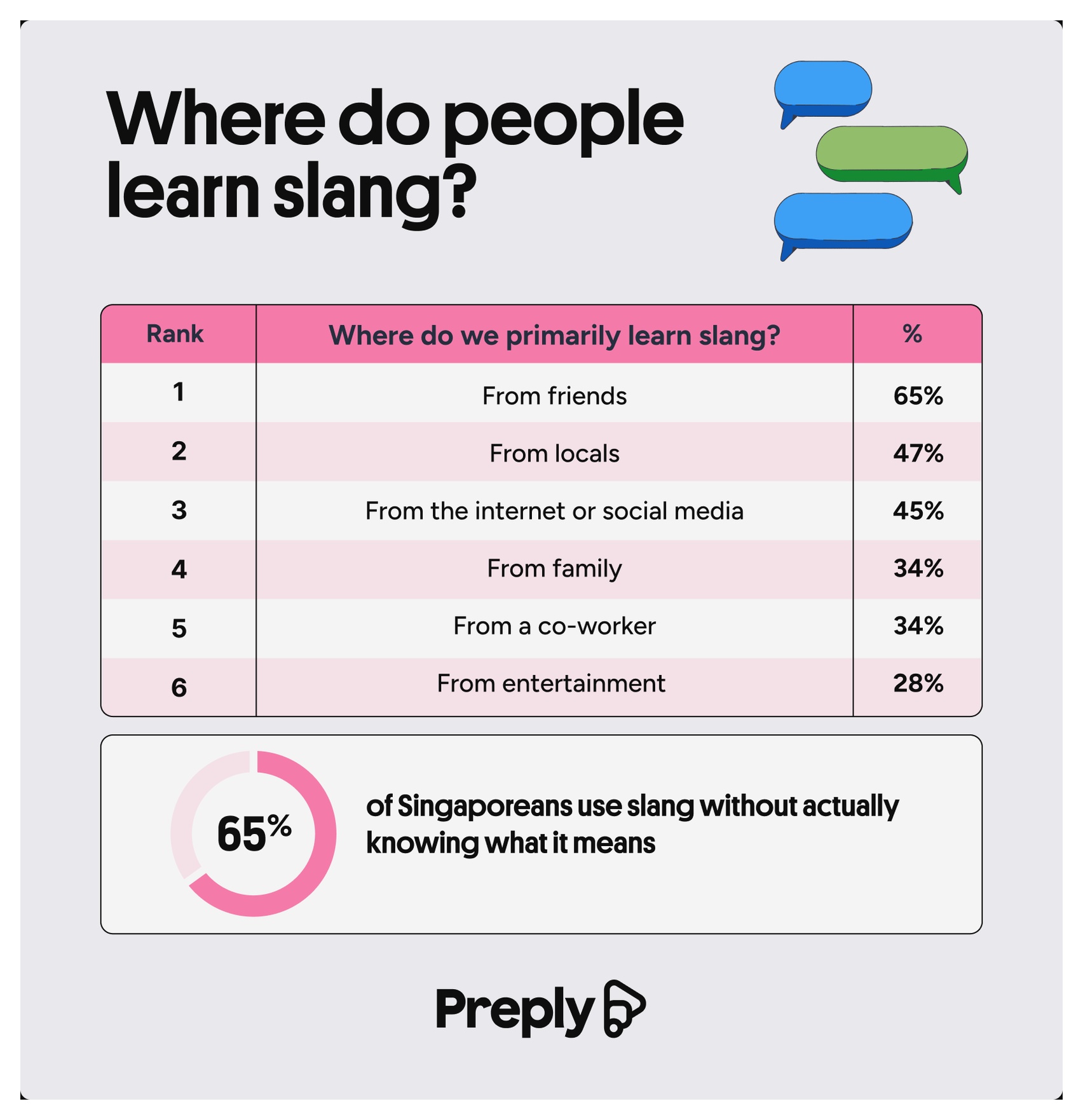
In Singapore, the primary source of slang for residents is their friends, with a significant 65% attributing their knowledge to these social interactions. Additionally, nearly half (47%) of locals report learning slang from the community around them, a figure that rises to 55% among expatriates.
Among those who reported learning slang from online sources, 45% cited the internet as their primary avenue, while 28% turned to entertainment. Notably, TikTok emerged as the leading platform for slang acquisition at 46%, closely followed by YouTube at 45%.
Why do we use slang?
An impressive 95% of Singaporeans report incorporating Singlish slang into their daily conversations, with one-third using it in most of their chats. Additionally, 70% embrace global Gen Z slang as well. This raises an interesting question: what drives our use of slang in communication?
A significant 35% of Singaporeans find that using new language trends enables them to communicate swiftly, while 19% are drawn to it due to its popularity. Additionally, another 19% appreciate how these evolving words and phrases help them express their emotions more effectively.
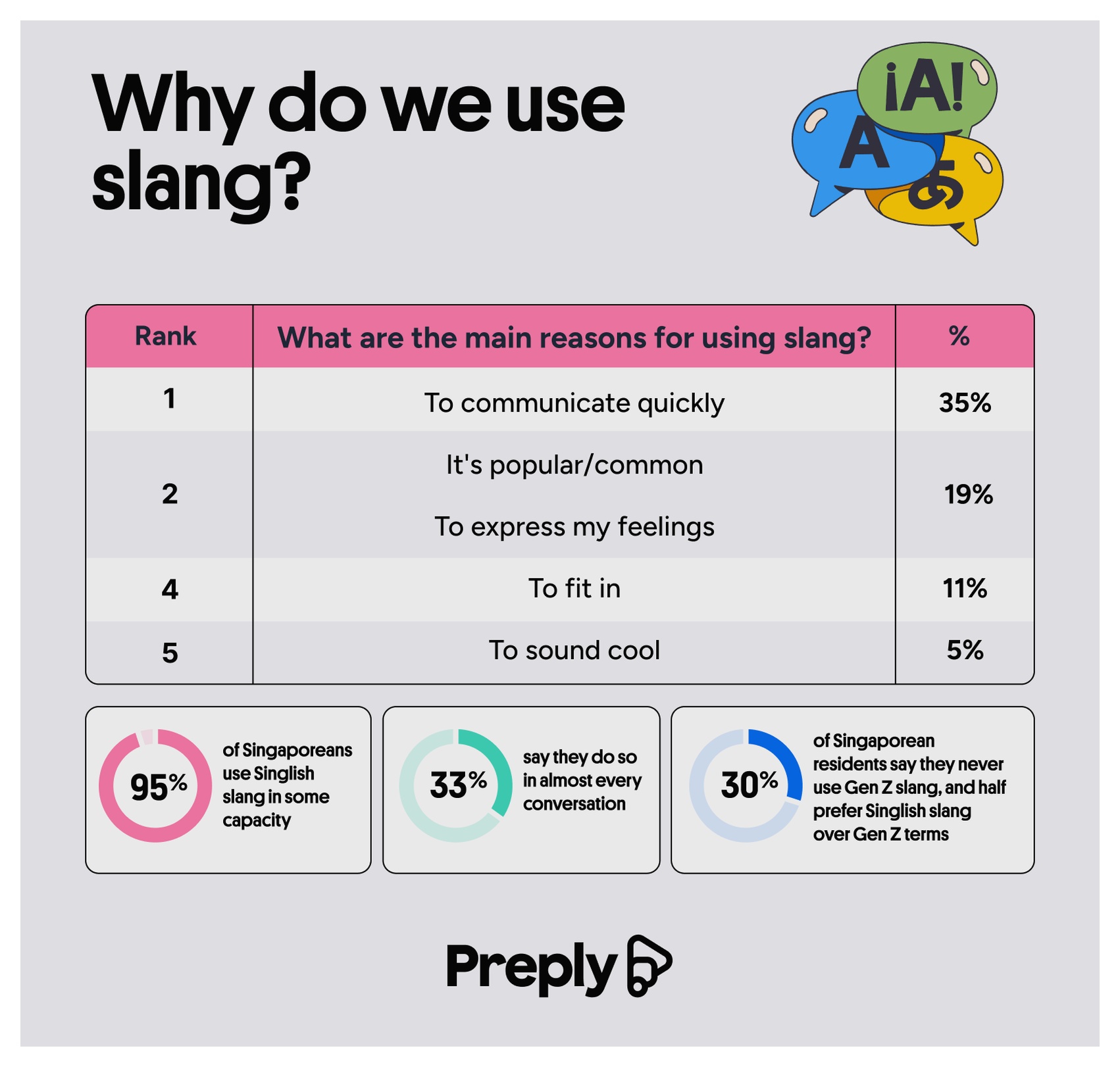
Remarkably, about one in six expats (15%) admit to using local slang to blend in, highlighting the significance of mastering regional expressions when relocating to a new area.
Learn a language online with our free learning materials.
Learn English online
Learn French online
What is the most popular Gen Z slang in Singapore?
While 21% of people find it irritating when slang is used in conversation, it’s clear that slang is a permanent fixture in our language. To explore the most popular Gen Z slang terms in Singapore, we surveyed respondents to find out which phrases they could effortlessly incorporate into their everyday discussions.
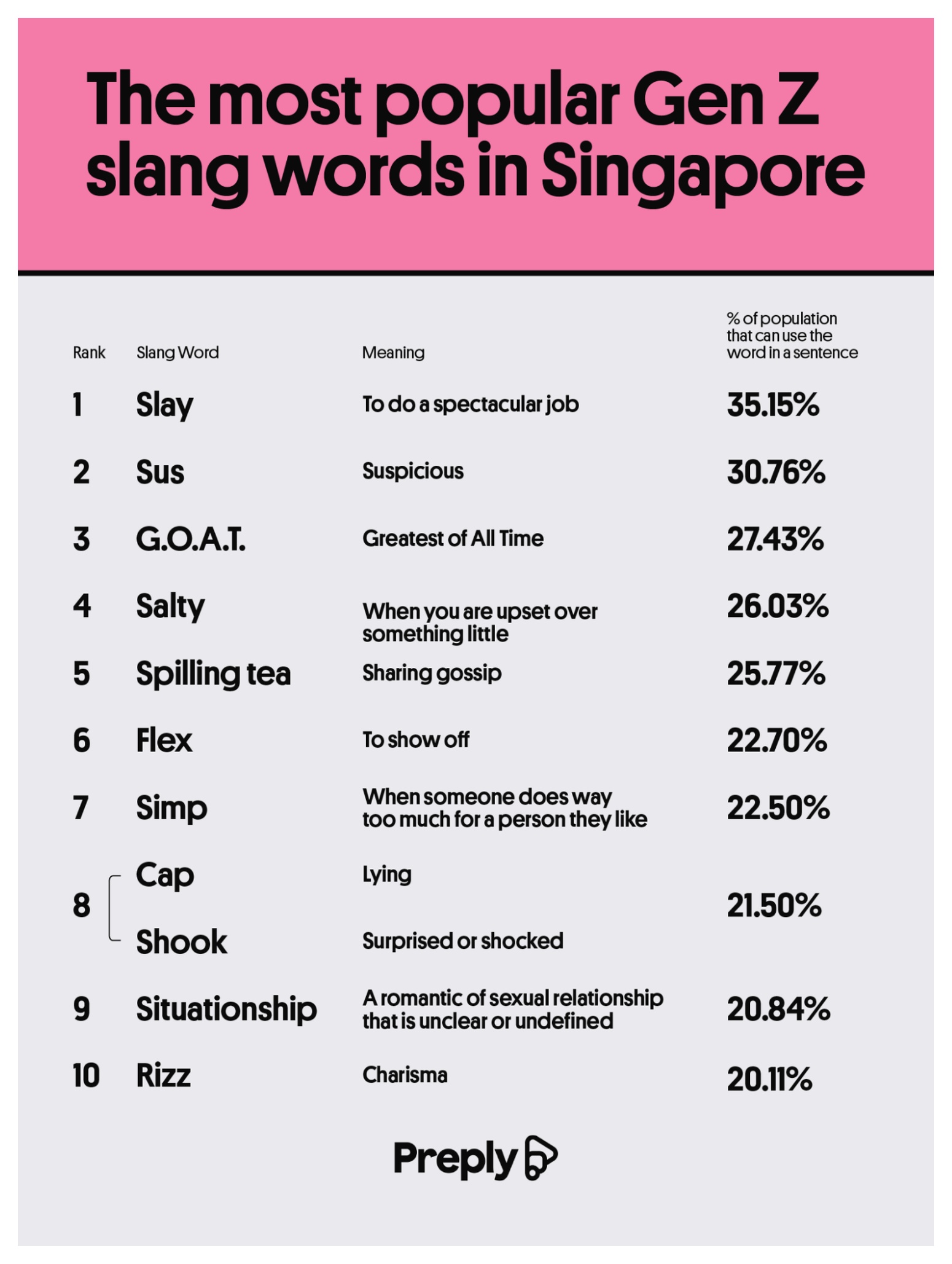
The term “slay” emerged as the favorite, with 35% of respondents claiming familiarity with it. Popularized by RuPaul’s Drag Race, “slay” conveys the idea of excelling or performing exceptionally well.
In Singapore, 31% of residents recognize the term “sus,” which stands for suspicious, while 27% are familiar with the acronym “G.O.A.T,” meaning ‘greatest of all time.’
If you’re eager to delve into the nuances of Singaporean slang, consider enhancing your language skills through online English lessons or by working with a local tutor in Singapore who can help you expand your vocabulary effectively.
What is the most annoying Gen Z slang in Singapore?
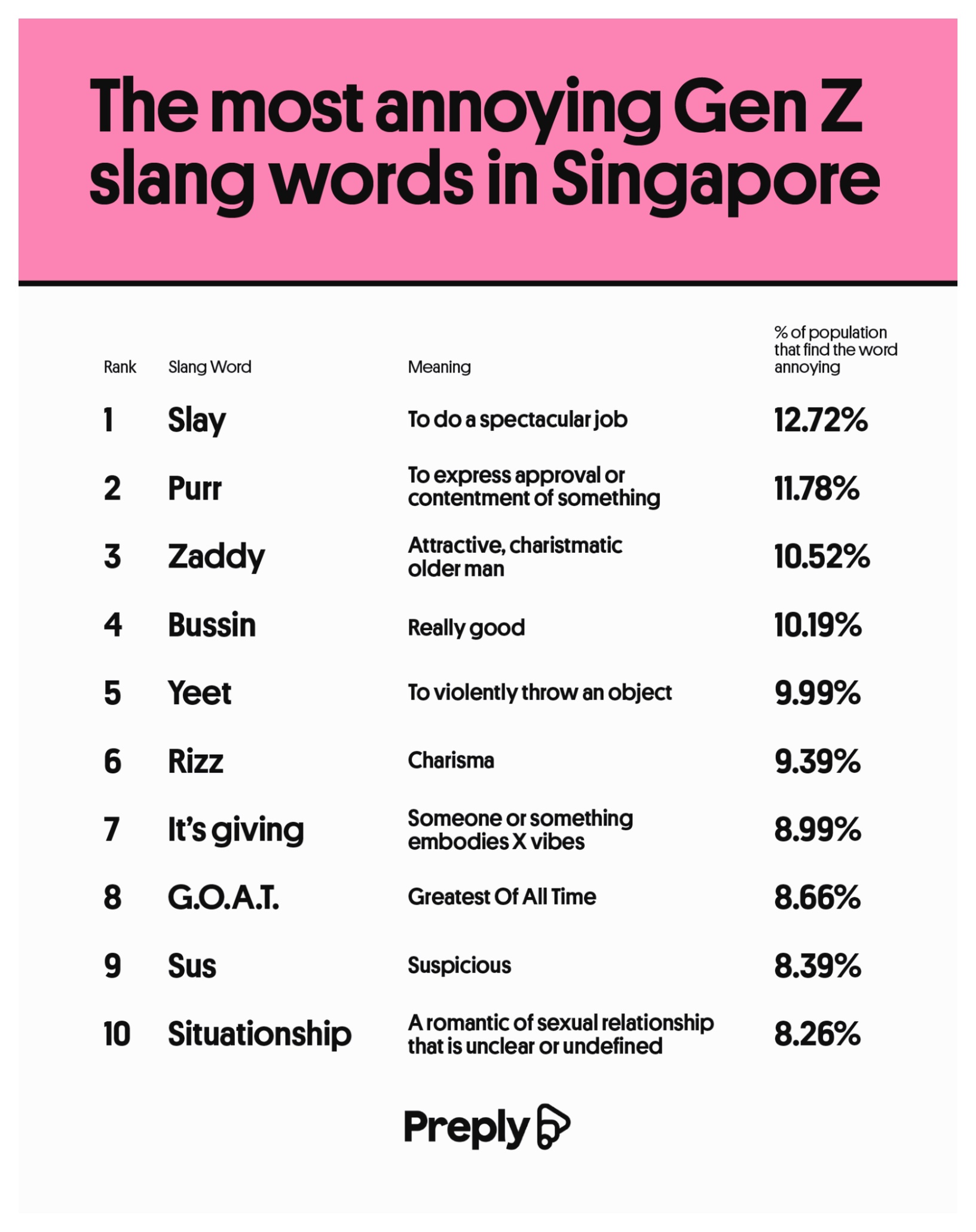
We surveyed individuals about the slang terms they find most irritating, and the results were intriguing. The term “slay” emerged as a polarizing favorite—it’s either adored or despised. In fact, it ranks as the most annoying Gen Z slang in Singapore, with 13% of respondents expressing their irritation towards it.
The term “purr,” which conveys a sense of contentment, ranks second with 12% usage, while 11% of people find the term “zaddy”—referring to an appealing older man—particularly annoying.
A beginner guide to Singlish: The most popular Singlish slang
A recent survey reveals that 50% of Singaporeans favor using Singlish over Gen Z slang. Intrigued by this preference, we set out to uncover the most popular Singlish terms among locals.

The phrase “Alamak” has emerged as the most popular expression, with 66% of respondents indicating they can use it in a sentence. This versatile term conveys feelings of dismay, shock, or alarm. However, it also sparks debate; 17% of Singaporeans find it annoying, highlighting its polarizing nature in everyday conversation.
“Makan,” which means ‘to eat,’ ranks as the second most popular term, with 61% of individuals recognizing it. Additionally, 58% of people are familiar with the expressions “Lah,” “Lor,” “Leh,” and “Meh,” all of which serve to emphasize statements in conversation.
Who uses the most Gen Z or Singlish slang in Singapore?
Slang often emerges from the creative expressions of youth, which explains why it’s much more prevalent among younger generations in Singapore than their older counterparts.
When we look at the two ends of the age spectrum, about 36% of individuals aged 16 to 24 incorporate Singlish slang into most of their conversations, with a quarter of them using it in every discussion. In contrast, only 22% of those over 55 report using Singlish slang infrequently.
In Singapore, Gen Z slang has become increasingly popular among 16 to 24-year-olds, with 32% reporting that they incorporate it into most of their conversations. In contrast, a significant 61% of individuals over 55 have never used this trendy language, highlighting a generational divide in communication styles.
Singlish is thriving in Woodlands, where every resident—100%—uses these colorful colloquialisms in their daily conversations. Close behind are Tampines and Punggol, with an impressive 99% of their residents embracing this unique form of expression.

When it comes to Gen Z slang, Geyland leads the way with an impressive 86% usage, closely followed by Tampines at 80%. This indicates that Tampines residents have a strong affinity for slang, embracing it regardless of its source.
Expats in Singapore are embracing the local culture by utilizing Singlish slang more than global Gen Z terms. A striking 91% of expats incorporate Singlish into their conversations, while 20% admit they never use Gen Z slang. Additionally, 67% of expats report picking up new slang since relocating, highlighting their desire to connect with the local community. This trend underscores the importance of language in fostering a sense of belonging.
Attitudes towards slang and its appropriate use
We’ve explored the contexts in which people commonly use slang, identifying the situations where it feels most suitable—or least appropriate—to incorporate it into their conversations.

Slang is predominantly used in relaxed environments, with 84% of people using it when chatting with friends and 60% when interacting with family. This trend aligns with the belief that 65% of individuals find slang most suitable for home settings. Interestingly, 61% of Singaporeans also use slang as a way to bond with their children.
To gain deeper insights into perceptions of slang, we surveyed individuals about their thoughts on people who use it in conversation. The results revealed a mixed bag of opinions: over a third (37%) indicated they don’t form any specific assumptions, while 35% believe it suggests the person is young. Additionally, 20% felt that using slang makes someone appear cool. However, not all responses were positive, as 15% of participants considered slang users to be cringey.
Corporate buzzwords: Slang in the workplace
While many individuals believe that using slang is perfectly acceptable in social settings, opinions shift when it comes to the workplace. Surprisingly, 74% of people feel that slang is unsuitable for an office environment. Yet, a significant 85% admit to using slang at work, though only 16% incorporate it into their communication regularly.
The likelihood of using slang in the workplace often hinges on your audience. According to a recent survey, 47% of respondents reported using slang with colleagues, yet only 12% felt comfortable using it in front of their boss.
When it comes to slang in the workplace, a notable 39% of individuals believe that neither Singlish nor Gen Z slang is suitable for professional environments. In contrast, 40% report that their coworkers often use corporate jargon and buzzwords, creating a lexicon that can seem like a foreign language. Terms like “touch base” and “circle back” have become commonplace, adding to the complexity of workplace communication.
One valuable asset in the workplace is the ability to speak a second language. Research indicates that being bilingual in Singapore can significantly enhance your salary potential.
According to our language expert Sylvia Johnson, attitudes toward slang can differ greatly among different generations and contexts. However, its significance in language and culture is undeniable. Mastering local slang is essential for anyone learning a language, as it helps you connect with the community and shows both linguistic skill and cultural awareness. Yet, it’s important to tread carefully; slang phrases often carry subtle cultural meanings that may be challenging for outsiders to grasp. When used appropriately, slang fosters connections, but misuse can lead to misunderstandings.
Our research indicates that a significant 79% of people are concerned about misusing slang, while 65% admit to using slang without fully understanding its meaning. Given this, collaborating with an online English teacher can be an excellent way to keep up with the latest linguistic trends and cultural nuances, no matter where you are in the world.
Methodology
LingualNeeds conducted a comprehensive online survey involving 1,500 Singapore citizens aged 16 and older to explore their attitudes towards popular slang terms. This research provides valuable insights into the evolving language dynamics within the nation.
Frequently Asked Questions
What percentage of Singaporeans use slang in their conversations?
95% of Singaporeans use Singlish slang in some capacity.
What is the most popular Gen Z slang term in Singapore?
‘Slay’ tops the list as the most popular Gen Z slang.
How do most people in Singapore learn slang?
The primary source of slang for residents is their friends, with 65% attributing their knowledge to social interactions.
What do Singaporeans think about using slang in the workplace?
74% of people feel that slang is unsuitable for an office environment, yet 85% admit to using it at work.
Which age group uses slang more frequently in Singapore?
Individuals aged 16 to 24 incorporate Singlish slang into most of their conversations more than older generations.