- Key findings
- How we measured intelligence among executives
- The most intelligent CEO is DeepMind’s Demis Hassabis
- Think emotional intelligence, think Progressive
- Karen S. Lynch of CVS Health is the most team-focused CEO
- Retail and e-commerce industries have the most customer- focused CEOs
- Pinterest, Disney, and Target among the most positivity-focused CEOs
- Language as a leadership tool
- Methodology
- Frequently Asked Questions
- Who are the top three most intelligent CEOs according to the analysis?
- What criteria were used to measure the intelligence of the executives?
- Which CEO demonstrated the highest emotional intelligence?
- What common trait do the most customer-focused CEOs share?
- How does language mastery contribute to effective leadership?
Language use is one of the most telling signs of a person’s intelligence. A rich vocabulary, skillful use of nuanced expressions, and intricate sentence structures reveal the depth of their thought and comprehension. Mastery of language serves as a powerful reflection of their cleverness and capability.
While we often admire captivating characters like Logan Roy and Dr. Spencer Reid on our screens, it’s worth exploring who these real-life inspirations might be. Who are the influential figures that mirror their brilliance in the real world?
To explore this topic, we analyzed conversations from 100 American executives, identifying key linguistic patterns that reveal which CEOs consistently demonstrate exceptional intelligence in their communication. This post offers an insightful look into the thoughts and dialogues of some of America’s brightest business leaders.
Key findings
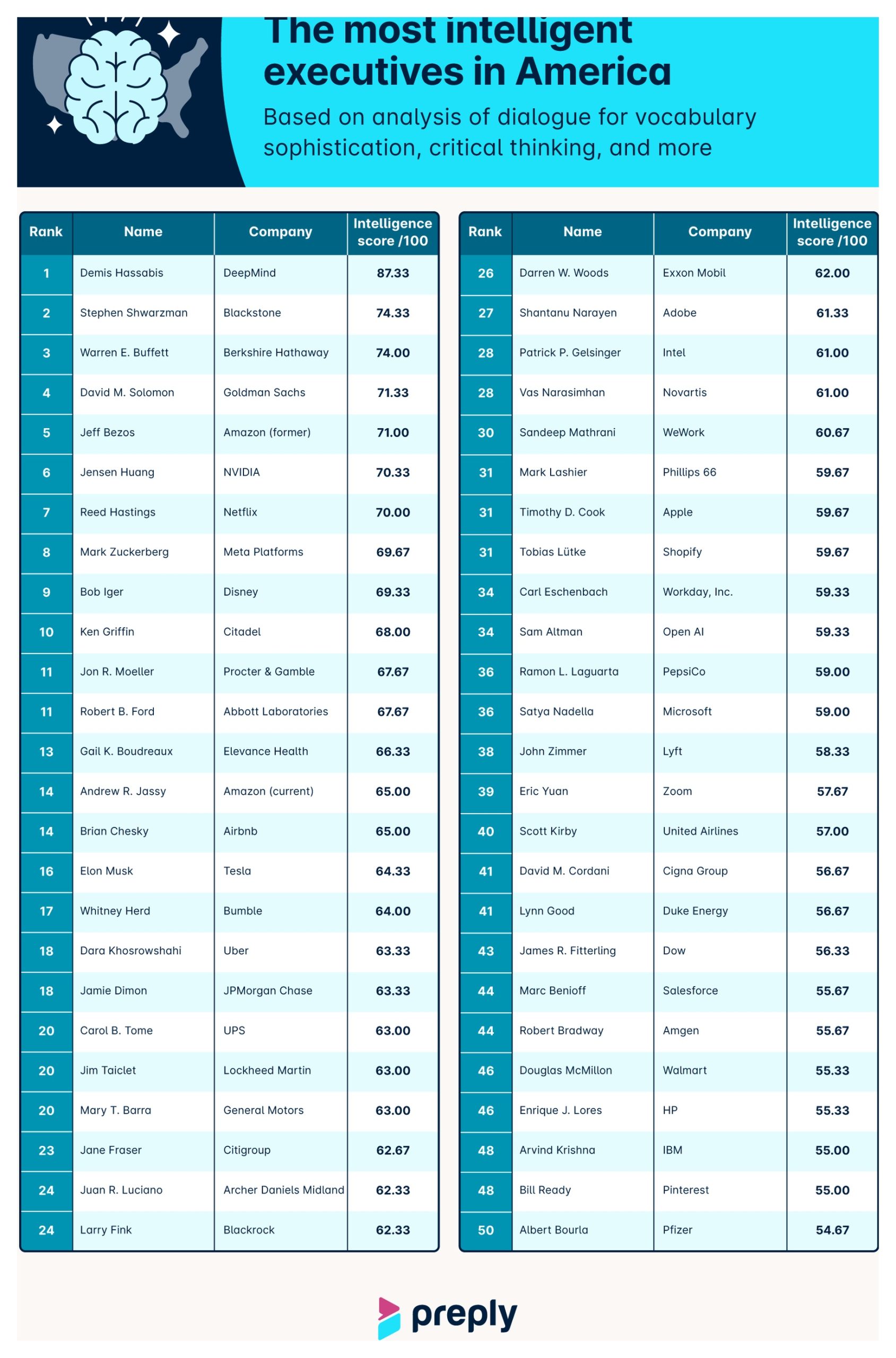
- Demis Hassabis, Stephen Shwarzman, and Warren E. Buffett are the most intelligent executives in America.
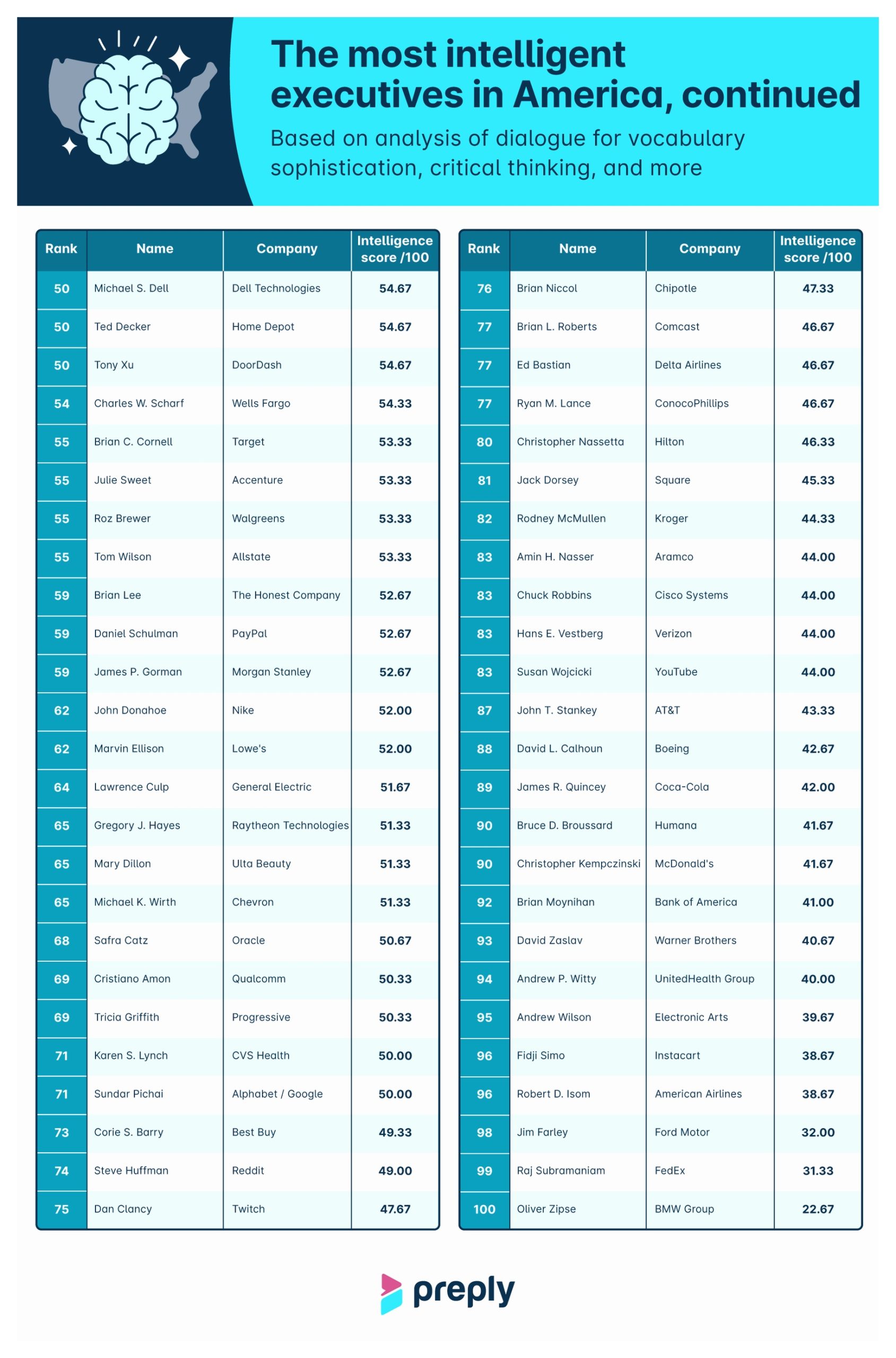
- CEOs from BMW, FedEx, and Ford Motor rank lowest on our intelligence list.
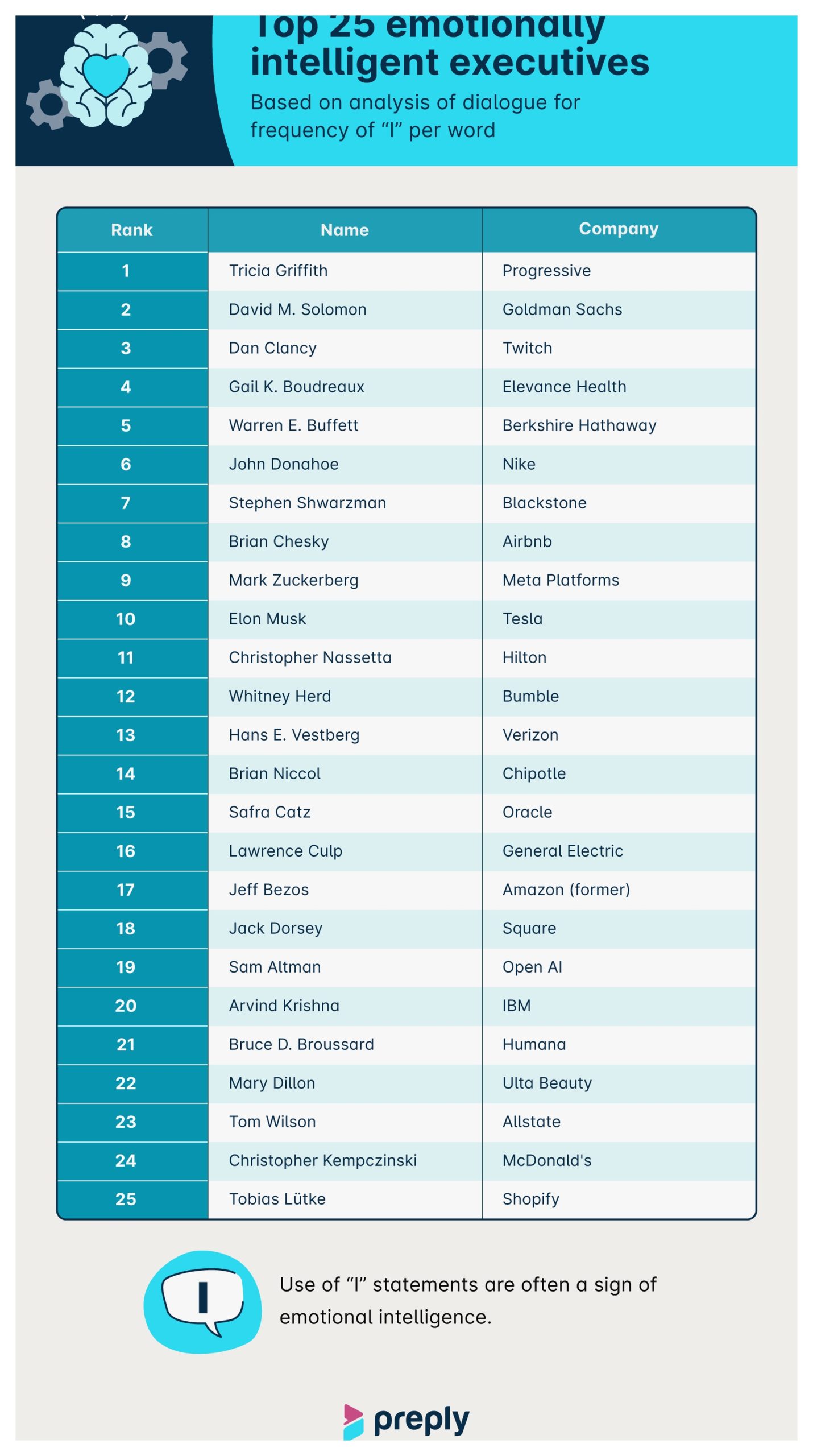
- Tricia Griffith, David M. Solomon, and Dan Clancy demonstrate high emotional intelligence through their use of “I” statements.
- CEOs from BMW Group, Warner Brothers, and Pinterest rank as the most positive.

Learn a language with personalised 1-on-1 classes with our expert tutors from all over the world
French lessons online
Spanish lessons online
How we measured intelligence among executives
We undertook a comprehensive analysis of transcripts from public appearances by various chief executives, evaluating each one on a scale of 100 points. These transcripts, sourced from YouTube, featured dialogues ranging from 60 to 180 minutes for each leader.
To create intelligence rankings, we analyzed the dialogue using five essential criteria. We began by examining vocabulary breadth, which gauges the variety of words employed. Following that, we assessed vocabulary sophistication, which highlights the intricacy of the selected terms.
Furthermore, we evaluated textual readability by examining the complexity of sentence structures and the richness of ideas conveyed. We also emphasized critical thinking, analyzing the strength of arguments, their breakdown, and the depth of analysis provided.
Finally, we considered the speaker’s ability to connect their conversation to larger themes and weave in insights from various disciplines, highlighting their contextual relevance.
With these criteria, we aimed to provide a comprehensive understanding of each executive’s communication and analytical abilities.
The most intelligent CEO is DeepMind’s Demis Hassabis
At the forefront with an outstanding score of 87.33 is Demis Hassabis from DeepMind. Renowned for his dual background as both an AI researcher and a neuroscientist, Hassabis brings a captivating mix of insights to his public discussions, enhancing the conversation around artificial intelligence with his extensive expertise.
Following closely behind is Stephen Schwarzman of Blackstone, who achieved an impressive score of 74.33. Not far behind him, the legendary investment strategist Warren E. Buffett from Berkshire Hathaway earned a score of 74.00, showcasing his enduring prowess in the financial world.
Davis M. Solomon of Goldman Sachs, scoring 71.33, and Jeff Bezos at 71.00, complete the top five list of America’s most intelligent CEOs. Notably, Bezos has revolutionized Amazon from a simple online bookstore into a powerhouse of global e-commerce. His exceptional leadership is evident through his vision, adaptability, and the valuable insights he shares in his discussions.
While these leaders excelled according to our criteria, it’s essential to acknowledge notable figures who ranked lower. However, it’s crucial to emphasize that intelligence, as measured in our study, isn’t the only factor that contributes to a company’s success.
Every leader featured on this list, regardless of their ranking, has showcased unique leadership traits and made significant impacts in their fields.
Oliver Zipse of the BMW Group achieved an impressive score of 22.67. His lifelong commitment to BMW reflects not only his extensive expertise but also a profound loyalty to the company, showcasing his deep-rooted passion for the brand.
Under Zipse’s leadership, BMW has adeptly navigated shifting market landscapes by prioritizing flexibility in its production processes. This strategic focus empowers the brand to swiftly adapt to changes in the industry, ensuring its continued success and relevance.
Raj Subramaniam, the leader of FedEx, received a score of 31.33. While this score may seem low, it doesn’t overshadow his commitment to innovation and visionary leadership. Subramaniam has played a crucial role in keeping FedEx at the cutting edge of global delivery and supply chain solutions.
Jim Farley of Ford Motor may have achieved a score of 32.00, but his impressive credentials highlight his exceptional capabilities. With a wealth of experience and a track record of leadership in various roles within the company, he has consistently demonstrated his versatility and expertise.
Farley’s profound knowledge of the automotive sector, combined with his strategic leadership, has continually enhanced both Ford’s storied legacy and its aspirations for the future.
In conclusion, Robert D. Isom of American Airlines and Fidji Simo of Instacart both achieved a notable score of 38.67. Isom, leading one of the world’s major airlines, has successfully steered the company through the intricate challenges of the aviation sector, particularly during the upheaval caused by the global pandemic.
Fidji Simo, at the helm of Instacart, has transformed the grocery delivery landscape by embracing the on-demand economy and harnessing technology to elevate customer convenience.
Both CEOs, though hailing from different industries, exemplify outstanding leadership and have made remarkable strides in their fields. Their unique contributions highlight the impact of effective leadership across various sectors.
Learn a language online with our free learning materials.
Learn English online
Learn French online
Think emotional intelligence, think Progressive
We assessed emotional intelligence by tracking the frequency of “I” statements in communication. These statements, which express personal feelings, thoughts, or emotions using the pronoun “I,” have been linked to higher emotional intelligence in various studies. By focusing on these expressions, we gain insight into an individual’s self-awareness and emotional insight.
Notable leaders who truly embody this trait include Tricia Griffith from Progressive, David M. Solomon of Goldman Sachs—also recognized on the list of the most intelligent individuals—Dan Clancy of Twitch, Gail K. Boudreaux of Elevance Health, and Warren E. Buffett of Berkshire Hathaway, who likewise appears on that esteemed list.
We spoke with language expert Sylvia Johnson about the power of “I” statements in enhancing communication. She explains, “Using ‘I’ statements in the workplace allows you to express your thoughts, feelings, and needs more clearly, fostering better understanding and collaboration among colleagues.”
Here are some examples:
- Instead of accusing with “You never meet deadlines,” try a more constructive approach: “I’ve observed that deadlines are occasionally missed, impacting our team’s progress. Can we discuss ways to improve timeliness?”
- Instead of stating, “Your report is unclear,” consider saying, “I found certain sections of the report difficult to follow. Clarifying these parts would greatly assist me.”
- Rephrase “You’re a terrible boss” to “I struggle to grasp your expectations and priorities. Regular check-ins would help us align on goals.”
- Rephrase “Your idea won’t work” to “I have some concerns about this idea. Can we discuss them to find a solution that considers both our viewpoints?”
Johnson emphasizes that using “I” statements can significantly enhance conflict resolution and tackle challenges more effectively. By fostering constructive conversations, this approach not only improves problem-solving but also strengthens working relationships between colleagues and managers.
Shifting our focus, it’s impressive to see the technology sector taking the lead in emotional intelligence. Industry frontrunners like Twitch, Meta, Oracle, OpenAI, IBM, Square, and Shopify are at the forefront of this movement. Their success underscores the tech industry’s commitment to fostering genuine connections in a world increasingly shaped by digital interactions.
Karen S. Lynch of CVS Health is the most team-focused CEO
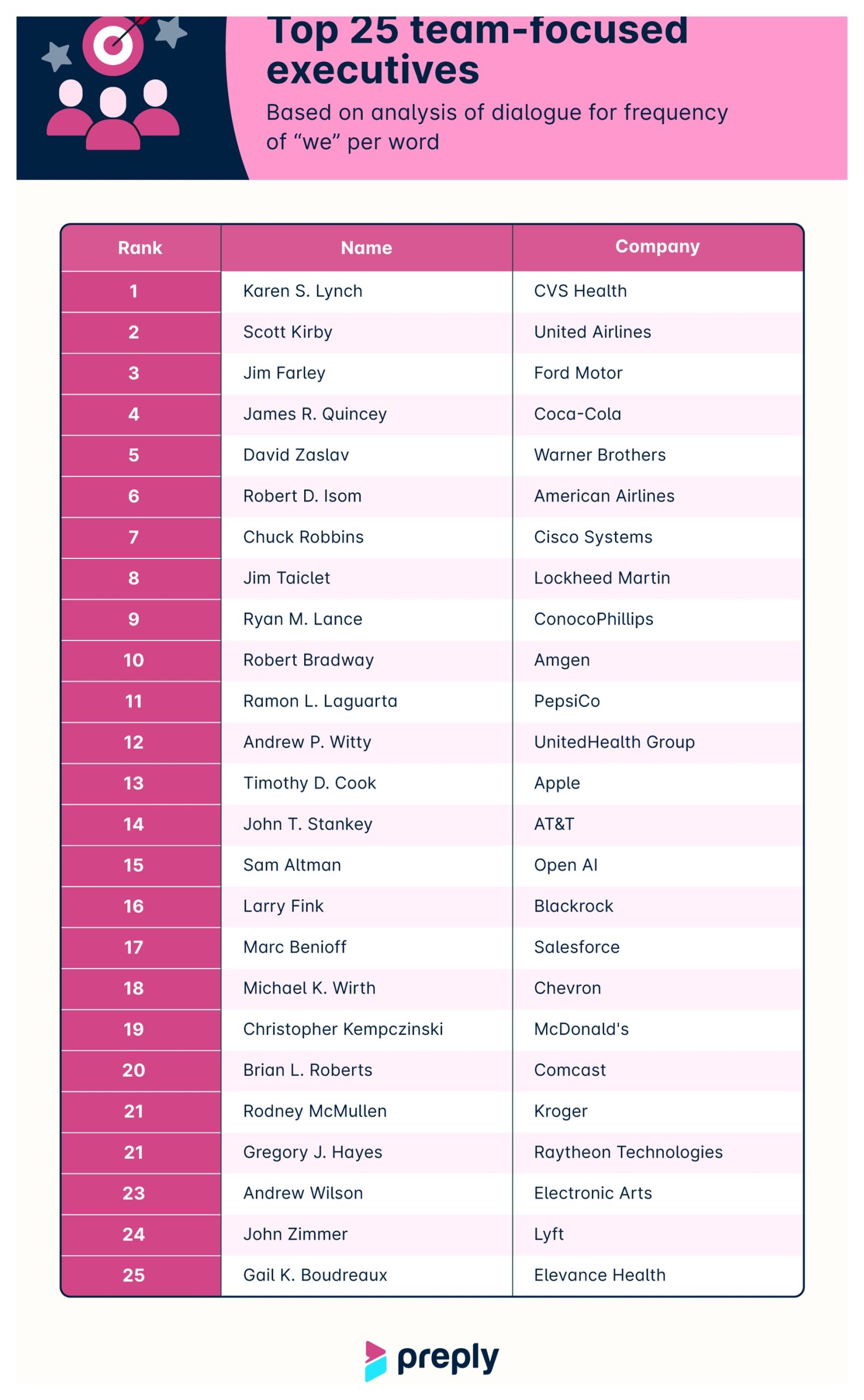
As we delve into team-oriented communication, Karen S. Lynch, CEO of CVS Health, emerges as a leader who truly embodies a collaborative spirit. Our assessment highlights the prevalence of “we” statements in her executive messaging, which reflect a strong commitment to inclusive leadership and teamwork.
Leading the charge for a team-first approach are five prominent executives: Karen S. Lynch of CVS Health, Scott Kirby of United Airlines, Jim Farley of Ford Motor (notably featured on our most intelligent list), James R. Quincey of Coca-Cola, and David Zaslav of Warner Bros. Their commitment to fostering collaboration sets a powerful example in the corporate world.
Looking at the wider industry landscape, it’s fascinating to see the technology sector leading the way in team-centered leadership. Prominent companies like Cisco Systems, Apple, OpenAI, Salesforce, and Electronic Arts exemplify this collaborative approach. This trend highlights the tech industry’s commitment to fostering teamwork in our increasingly digital world.
Retail and e-commerce industries have the most customer- focused CEOs
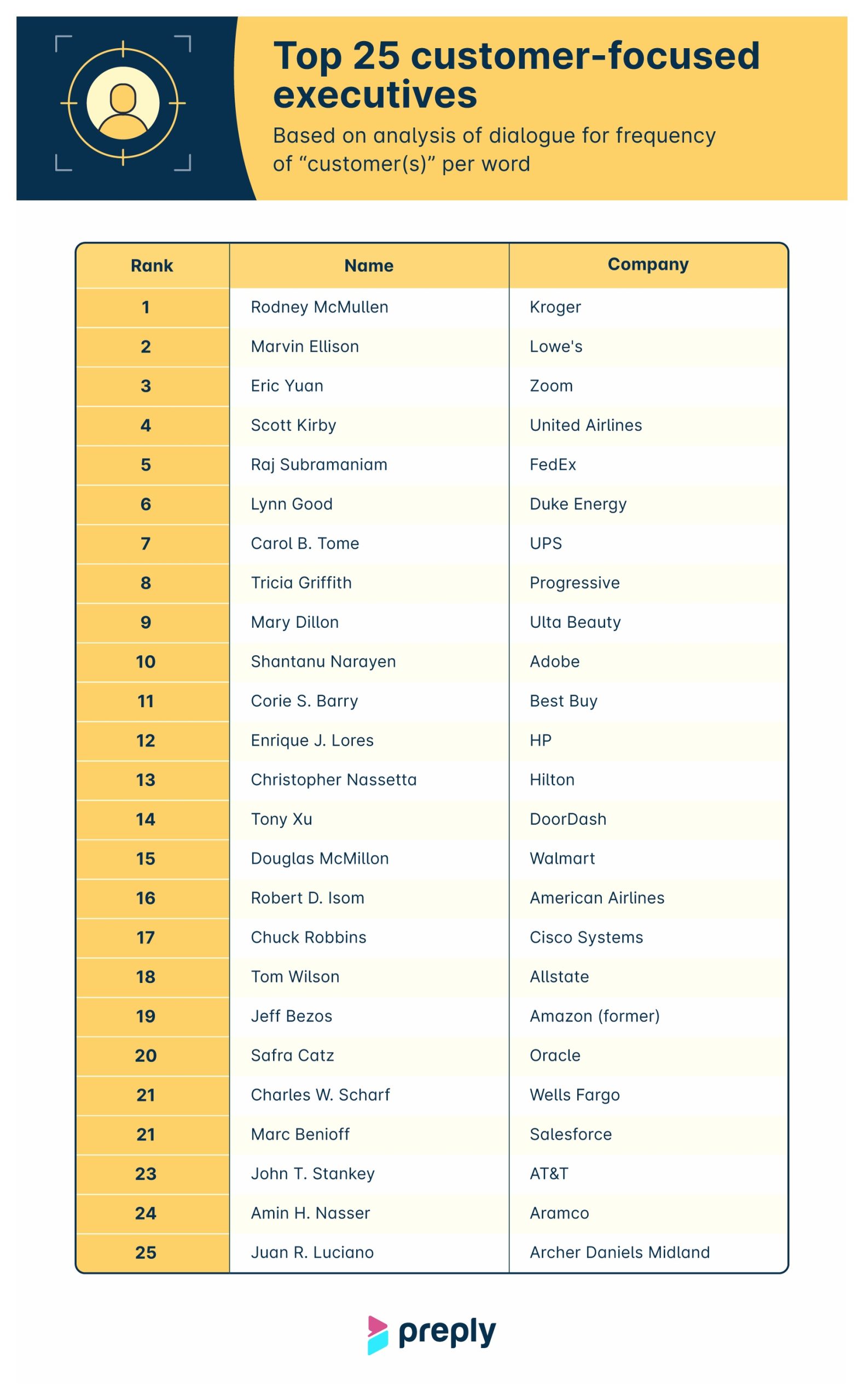
Our approach to identifying customer-oriented executives involved tracking how often they referenced “customer(s)” in their conversations. This focus illustrates their commitment to understanding and meeting consumer needs and preferences.
Leading our ranking of the most customer-centric CEOs are Rodney McMullen of Kroger, Marvin Ellison of Lowe’s, Eric Yuan of Zoom, Scott Kirby of United Airlines, and Raj Subramaniam of FedEx. These leaders consistently prioritize customer needs, demonstrating their dedication to enhancing satisfaction and delivering exceptional service.
When exploring industry specifics, retail and e-commerce emerge as frontrunners in customer-centricity. Prominent brands like Kroger, Lowe’s, Ulta Beauty, Best Buy, Walmart, and Amazon exemplify this trend, demonstrating a strong commitment to prioritizing customer needs in their strategies and operations.
Pinterest, Disney, and Target among the most positivity-focused CEOs
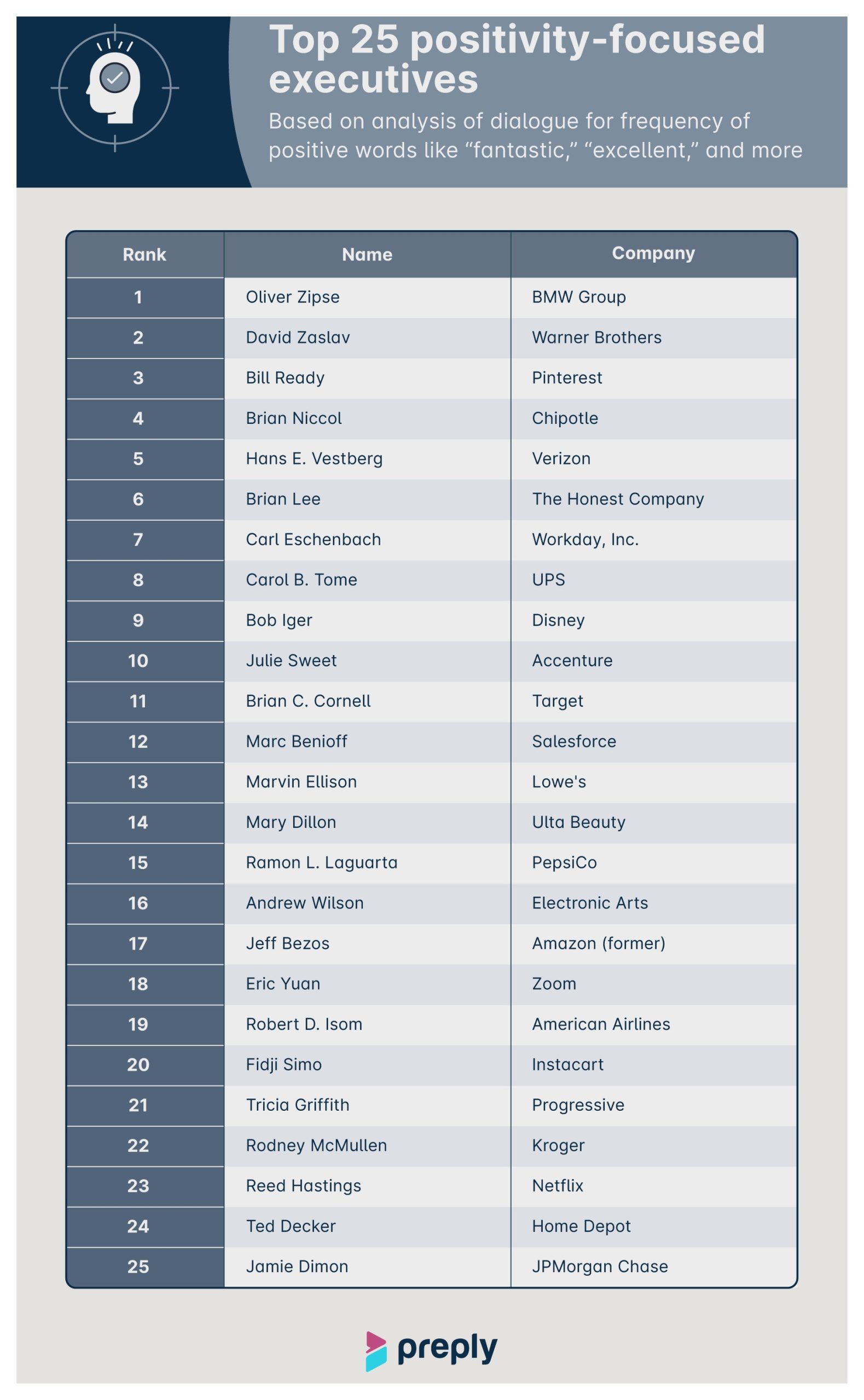
To identify the most positivity-driven executives, we analyzed the prevalence of uplifting words in their communications. We specifically looked for terms like “great,” “good,” “fantastic,” “excellent,” “happy,” “nice,” and “love” to gauge their positive outlook.
Several leaders stand out for their optimistic communication style, most notably Oliver Zipse of BMW. Despite being the most positive voice in our analysis, he ranked lowest on our “most intelligent” list. He is joined by David Zaslav from Warner Brothers, Bill Ready of Pinterest, Brian Niccol of Chipotle, and Hans E. Vestberg of Verizon. Their frequent use of uplifting language highlights their commitment to inspiring and motivating their teams and stakeholders.
We were excited to see Bob Iger of Disney recognized among the CEOs championing positivity. This accolade highlights Disney’s dedication to its mission of creating enchanting experiences and nurturing meaningful connections with its audiences.
Taking a broader look at industry trends, the retail and e-commerce sectors stand out as shining examples of optimism. Leading brands like The Honest Company, Target, Lowe’s, Ulta Beauty, Amazon, Kroger, and Home Depot demonstrate a strong commitment to fostering a positive customer experience. This focus on positivity not only enhances their brand image but also helps build trust and strengthen relationships with consumers.
Language as a leadership tool
In our increasingly interconnected world, businesses now operate beyond traditional geographical boundaries. Global giants like BMW Group, Disney, and Amazon have a profound influence that spans the globe, shaped by a rich tapestry of diverse cultures and languages.
Language serves as a vital cultural code, unlocking a deeper understanding of the diverse worldviews and perspectives that shape our global society. By mastering multiple languages, you enhance your ability to communicate effectively, forge meaningful connections, and cultivate understanding among varied audiences. These skills are essential for strong leadership and informed strategic decision-making.
In today’s diverse landscape of industries, spanning retail to technology, effective communication is key. At LingualNeeds, we are your dedicated ally in mastering language skills. Whether you’re enhancing your conversational English or taking advantage of our free business courses, each interaction is a chance to captivate and make an impact.
Methodology
In August 2023, we conducted a thorough analysis of the transcripts from public appearances by various executives. These events, all available on YouTube, provided us with a wealth of material, allowing us to examine between 60 to 180 minutes of dialogue for each individual.
To determine our intelligence rankings, we analyzed dialogue based on the following five characteristics:
- Vocabulary breadth: The extent of word diversity
- Vocabulary sophistication: The complexity of words used
- Textual readability: The complexity of sentence structures and ideas
- Critical thinking: The quality of argument construction, deconstruction, and analysis
- Contextual relevance: The speaker’s ability to interconnect the dialogue with broader contexts or other fields
Frequently Asked Questions
Who are the top three most intelligent CEOs according to the analysis?
The top three most intelligent CEOs are Demis Hassabis, Stephen Schwarzman, and Warren E. Buffett.
What criteria were used to measure the intelligence of the executives?
The criteria included vocabulary breadth, vocabulary sophistication, textual readability, critical thinking, and contextual relevance.
Which CEO demonstrated the highest emotional intelligence?
Tricia Griffith, David M. Solomon, and Dan Clancy are noted for demonstrating high emotional intelligence through their use of ‘I’ statements.
What common trait do the most customer-focused CEOs share?
The most customer-focused CEOs frequently reference ‘customer(s)’ in their conversations, illustrating their commitment to understanding consumer needs.
How does language mastery contribute to effective leadership?
Mastering multiple languages enhances the ability to communicate effectively, forge meaningful connections, and cultivate understanding among diverse audiences.