
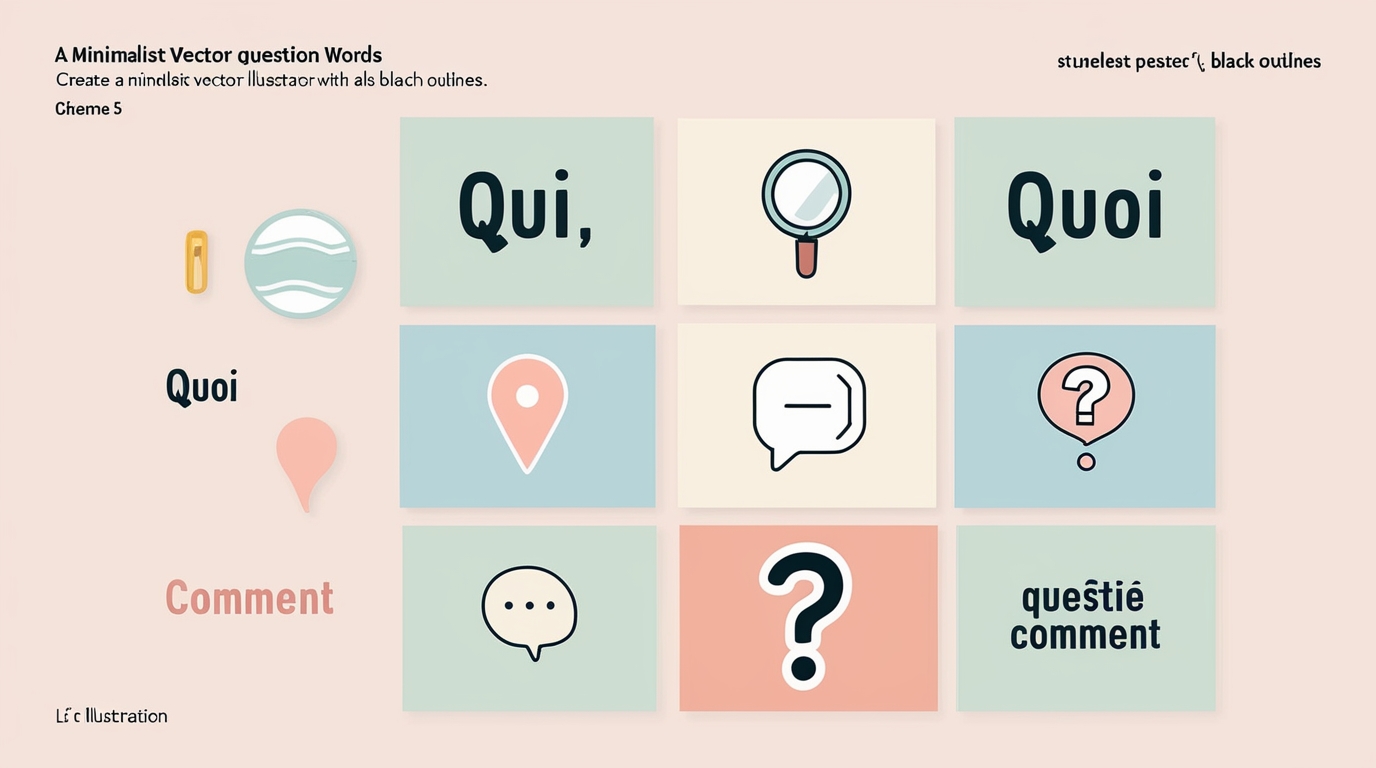
- How to ask a question using a French question word?
- Main french question words + questions in French examples
- Here are the main French question words:
- Qui – Who?
- Que/Quoi – What?
- À Qui – Whose?
- À Quoi – What (about/of)?
- Lequel, Laquelle – Which one, which of them?
- Où – Where?
- Quand – When?
- Pourquoi – Why?
- Comment – How?
- Quel/quells/quelle/quelles – Who/Which ?
- Combien – How much/How many?
- How to practice French question words
- How to form questions using French question words
- 1. Use question words with “est-ce que” (registre courant)
- 2. Question words by inverting the word order (registre formel)
- 3. Replace the complement by a question word (registre familier)
- Ready to Start Practicing French Question Words?
- Frequently Asked Questions
- What are the main French question words?
- How can I ask a question in French using ‘qui’?
- What is the difference between ‘que’ and ‘quoi’ in French questions?
- How do you form questions using French question words?
- What is a bonus tip for practicing French question words?
Human communication is vibrant and complex, making it nearly impossible to have a conversation without eventually asking a question. Questions play a crucial role in dialogue. When learning a foreign language, mastering how to ask questions in that language is essential. If you’re curious about how to learn French, you’ll find that there are various ways to frame questions, with some being more appropriate for casual settings and others for formal situations.
In French, you can ask a question simply by raising your voice at the end of a statement. Alternatively, you can also form a question by inverting the order of the verb and the pronoun.
This post presents an essential list of French question words designed to enhance your language learning experience. By the end, you’ll be equipped to engage in genuine French conversations and explore your curiosity with confidence.
Here’s a curated list of essential French question words that are crucial for engaging in conversations. To enhance your language learning experience, we’ve also included practical examples of questions in French.
Armed with these French question words and essential vocabulary, you’ll be well-prepared to dive into real-world conversations and confidently showcase your French speaking skills!

How to ask a question using a French question word?
In English, questions begin with a question word, which is then followed by the verb—either an auxiliary verb or the main verb if no auxiliary is present. This structure often leads to a rearrangement known as “subject inversion,” where the subject comes after the verb rather than before it.
For example:
- Qui est déjà allé à Londres ? (Who’s already been to London?)
- Quand partez-vous en vacances ? (When are you going on holiday?)
- Comment te sens-tu ? (How are you feeling?)
In informal situations, the subject can be used before the verb.
For example:
- Comment tu t’appelles ? (What’s your name?)

Main french question words + questions in French examples
In this section, we’ll walk you through each French question word and provide real-world examples of questions in French.
What are question words?
Question words are interrogative pronouns, adverbs or adjectives which are usually placed at the start of a question.
In English, we use question words such as “who,” “where,” “why,” and “what” to gather information. Similarly, in French, you’ll find “que,” “qui,” “pourquoi,” and “combien” serving the same purpose.
Here are the main French question words:
- Qui (who)
- Que/quoi (what)
- À qui (whose)
- À quoi (of what)
- Lequel, laquelle (which one)
- Où (where)
- Quand (when)
- Pourquoi (why)
- Comment (how)
- Combien (how much/how many)
- Quel/quels/quelle/quelles (who/which)
Qui – Who?
“Qui” refers to people, and means “who” or “whom”. “Qui” can, therefore, be a subject or object.
- Qui as a subject: Qui mange avec nous ce soir ? (Who’s eating with us tonight?)
- Qui as an object: Qui entendez-vous ? (Whom do you hear?)
Bonus tip: The word qui is also often used after the prepositions avec, pour or de.
Example:
- Pour qui est le cadeau ? (For whom is the gift ?)
- Avec qui allons-nous au cinéma ce soir ? (Who are we going to the cinema with this evening?)
- De qui tu parles ? (Who are you talking about?)

Que/Quoi – What?
“Que” refers to objects (everything except people), and means “what”. It’s almost always the object of a sentence.
Let’s say you’re in a French shop. You might want to ask questions like:
- Que vendez-vous ici ? (What do you sell here?)
- Que pouvez-vous me recommander ? (What can you recommend me?)
When “que” is used at the end of a question with intonation, it changes to “quoi”:
- Que voyez-vous ? -> Vous voyez quoi ? (What do you see?)
Note: “Que” cannot be used after a preposition; you have to use “quoi” instead:
- À quoi penses- tu?
À Qui – Whose?
“À qui” refers to people, and means “to whom”.
- À qui parles-tu ? “(To whom are you talking?/Who are you talking to?)
Note: À qui is sometimes translated as “whose”, depending on the context.
- À qui appartient ce livre? (Whose book is this?)
French question words are often used with prepositions such as à, de and pour.
- D’où viens-tu ? (Where are you from?)
- À qui avez-vous écrit? (To whom did you write?)
- Elle travaille pour qui?
In French, we group the preposition with the interrogative expressions (question words).

À Quoi – What (about/of)?
The term “à quoi” translates to “what (about/of)” and is used to refer to objects. Officially, “quoi” serves as a replacement for an indirect object, meaning it typically follows prepositions and should never come directly after a verb.
Keep in mind that in casual, everyday French, it’s perfectly normal to hear phrases like “Tu fais quoi ce weekend?” (What are you doing this weekend?), even if they don’t strictly follow grammatical rules. This reflects the natural flow of conversation among friends and family.
- À quoi penses-tu ? (What are you thinking about?)
- À quoi servent les pronoms interrogatifs ? (What are interrogative pronouns used for?)
Lequel, Laquelle – Which one, which of them?
“Lequel”, “laquelle” (plural: lesquels, lesquelles) refer back to people or objects that have been previously mentioned, implied, or designated.
For example:
- Voici dix modèles. Lesquels préférez-vous ? (Here are ten designs. Which ones do you prefer?)
- Laquelle de ces robes est la plus belle ? (Which of these dresses is the most beautiful?)
- Which bus should I take to Lyon?
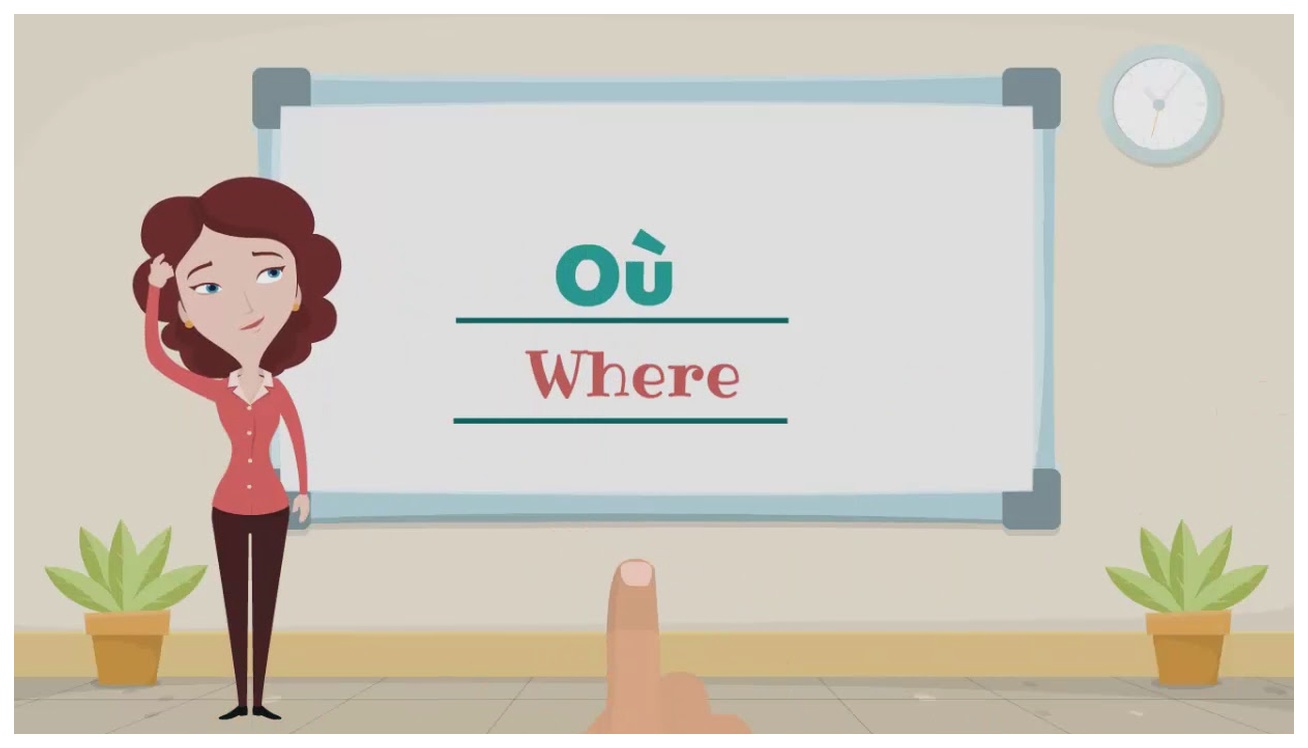
Où – Where?
“Où” refers to place, and means “where”.
Let’s say you’re meeting a friend for a meal.
You might want to ask them:
- Où veux-tu manger ? (Where do you want to eat?)
When they mention their family that lives abroad, you might ask:
- Où est-ce qu’ils habitent ? (Where do they live?)
Say you’re at a train station, you could ask the train station staff:
- Où va ce train ? (Where is this train going?)
Or
- Où sont les toilettes, s’il vous plaît ? (Where are the toilets, please?)
Bonus tip: Be careful not to mix up “où”, which means where, and “ou” (without an accent), which means or.

Quand – When?
“Quand” refers to time, and means “when”.
- Quand reviendras-tu ? (When will you be back?)
- Quand iras-tu en vacances ? (When are you going on holiday?)
Note: “Quand” is frequently expanded to “Quand est-ce que”.
- Quand est-ce qu’il va neiger ? (When will it snow?)
- Quand est-ce que votre cours commence ? (When does your class start?)
Pourquoi – Why?
“Pourquoi” refers to cause or reason, and means “why”.
- Pourquoi as-tu décidé d’étudier la médecine ? (Why did you decide to study medicine?)
- Pourquoi aimez-vous apprendre les langues ? (Why do you like learning languages?)
- Pourquoi sont-elles anxieuses ? (Why are they anxious?)
Comment – How?
“Comment” refers to method or means, and means “how”.
- Comment fait-elle ce gâteau ? (How does she make this cake?)
- Comment va ta grand-mère ? (How is your grandma?)
- Comment s’est passé ton entretien ? (How did your interview go?)

Quel/quells/quelle/quelles – Who/Which ?
You’ve just struck up a conversation with someone at a cozy coffee shop in France! However, there’s a challenge ahead—making new friends can be tough, particularly in an unfamiliar setting.
Here are some questions you can ask others to start getting to know them:
- Quels sont tes chanteurs préférés ? (Who are your favorite singers?)
- Quel est ton passe-temps préféré ? (What’s your favorite hobby)
- Quelles étaient vos matières préférées à l’école ? (What were your favorite subjects at school?)
Combien – How much/How many?
This sentence will be your best friend as you’re navigating designer shops or “boulangeries” (bakeries) in France.
- Combien ça coûte ? (How much does this cost?)
Imagine you’re catching up with a friend and you want to find out how much time they have to enjoy a café crème (a delightful coffee with cream).
- Combien de temps as-tu ? (How much time do you have?)
You might be having a dinner with your partner’s well-travelled uncle, so you ask:
- Combien de pays avez-vous visités ? (How many countries have you visited?)
Now that you know the main French question words, let’s look at how they can be used and practiced.
Bonus tip: Remember that when followed by a noun, “combien’’ requires the preposition “de”.

How to practice French question words
In his insightful book, *The Third Ear*, Chris Lonsdale shares effective language learning strategies that enabled him to master Mandarin Chinese in just six months. He emphasizes the importance of prioritizing vocabulary that resonates with your personal interests and encourages learners to start communicating in the language from day one.
He highlights the concept of “comprehensible input,” which suggests that we learn a language unconsciously when we grasp its meaning. Similar to how children pick up speaking skills, the more we expose ourselves to understandable language, the more our brains will naturally absorb and process it.
Immersing yourself in French is crucial for language learning. Consider switching your phone’s language to French, revisiting your favorite childhood books in the language, adding French subtitles to your beloved Netflix shows, and discovering top French podcasts. These simple changes can significantly enhance your familiarity and fluency with the language!
Finding content that matches your skill level can be a challenge. If it’s too basic, you risk losing interest, while overly complex material can lead to frustration. Striking the right balance is key to maintaining engagement and fostering learning.
Engaging in conversations with French teachers and native speakers is incredibly beneficial. These interactions allow you to practice your speaking skills with experienced communicators while receiving tailored support that matches your proficiency level. This personalized approach ensures you receive the perfect amount of understandable input, enhancing your learning experience.

How to form questions using French question words
1. Use question words with “est-ce que” (registre courant)
- Qu’est-ce que c’est ? (What is it?)
- Quand est-ce que tu vas partir ? (When are you going to leave?)
- Qui est-ce qui a appelé ? (Who called? Lit. Who is it that called?)
Note: “Quoi + est-ce que” becomes “qu’est-ce que”.
2. Question words by inverting the word order (registre formel)
- Comment as-tu oublié ? (How did you forget?)
- Pourquoi est-elle venue ? (Why did she come?)
3. Replace the complement by a question word (registre familier)
- Tu vas où ? (Where are you going? Lit. You go where?)
- Elle part quand ? (When is she leaving? Lit. She goes when?)
- C’est quoi ? (What is it?)
To understand these three main ways better, let’s take a look at one sentence formed in three ways:
- Qu’est-ce que vous faites ?
- Que faites-vous ?
- Vous faites quoi ?
Bonus tip: In casual French conversation, you’ll often hear questions beginning with phrases like “qu’est-ce que,” “où est-ce que,” or “quand est-ce que.” These phrases serve to highlight that a question is being posed, adding clarity and emphasis to the inquiry!
When questions are formed using “qu’est-ce que” or a similar expression, there is no inversion of subject and verb.
Example: Instead of “Qu’aimez-vous ?,” you’d say “Qu’est-ce que vous aimez ?”
Ready to Start Practicing French Question Words?
We trust this will serve as an excellent foundation for exploring the use of French question words. Now, it’s your turn to venture into the world and apply your French skills in real-life situations—if you haven’t done so already!
Remember to stay curious, have fun, and enjoy the journey. Happy learning!
Frequently Asked Questions
What are the main French question words?
The main French question words include qui (who), que/quoi (what), à qui (whose), où (where), quand (when), pourquoi (why), comment (how), and combien (how much/how many).
How can I ask a question in French using ‘qui’?
You can ask a question using ‘qui’ as a subject by saying ‘Qui mange avec nous ce soir ?’ (Who’s eating with us tonight?).
What is the difference between ‘que’ and ‘quoi’ in French questions?
‘Que’ refers to objects and is almost always the object of a sentence, while ‘quoi’ is used at the end of a question or after prepositions.
How do you form questions using French question words?
Questions can be formed using ‘est-ce que’, by inverting the word order, or by replacing the complement with a question word.
What is a bonus tip for practicing French question words?
A bonus tip is to immerse yourself in French by changing your phone’s language, watching French media, and engaging in conversations with native speakers.


