- Key takeaways
- Occasionally confusing connections
- To cowabunga or not to cowabunga?
- Far out slang words and where to find them
- Learning the language of TikTok
- The art of slang-slinging
- Methodology
- Fair use statement
- Frequently Asked Questions
- What are some popular vintage slang terms mentioned in the article?
- Which state is most interested in new slang?
- How do different generations perceive slang?
- What platforms do different generations use to learn new slang?
- What are some slang terms specific to Generation Z?
Have you ever caught yourself using terms like “FOMO” and “chill” since they first became trendy? Today, retro slang is making a resurgence, outshining even the return of baggy jeans and claw clips!
To uncover the hottest trending slang, we analyzed Google Trends data alongside insights from over 1,000 survey respondents. Join us as we explore a dynamic mix of timeless classics and the freshest TikTok lingo, showcasing the slang that continues to dominate conversations today.
Key takeaways
- Hawaii is the state most interested in new slang, while Washington is the most interested in vintage slang.
- “FOMO” and “ghosted” are the most popular vintage and trending slang words in the U.S., respectively.
- Over half of baby boomers struggle to understand what their children and grandchildren are saying.
- Gen X struggles the most to understand their co-workers.
- Younger family members are the most popular source of new slang for baby boomers and Gen X.

Learn a language with personalised 1-on-1 classes with our expert tutors from all over the world
French lessons online
Spanish lessons online
Occasionally confusing connections
Recognizing the significant differences in slang across generations, we surveyed participants to explore how these linguistic variations influence their ability to connect with people from other age groups.
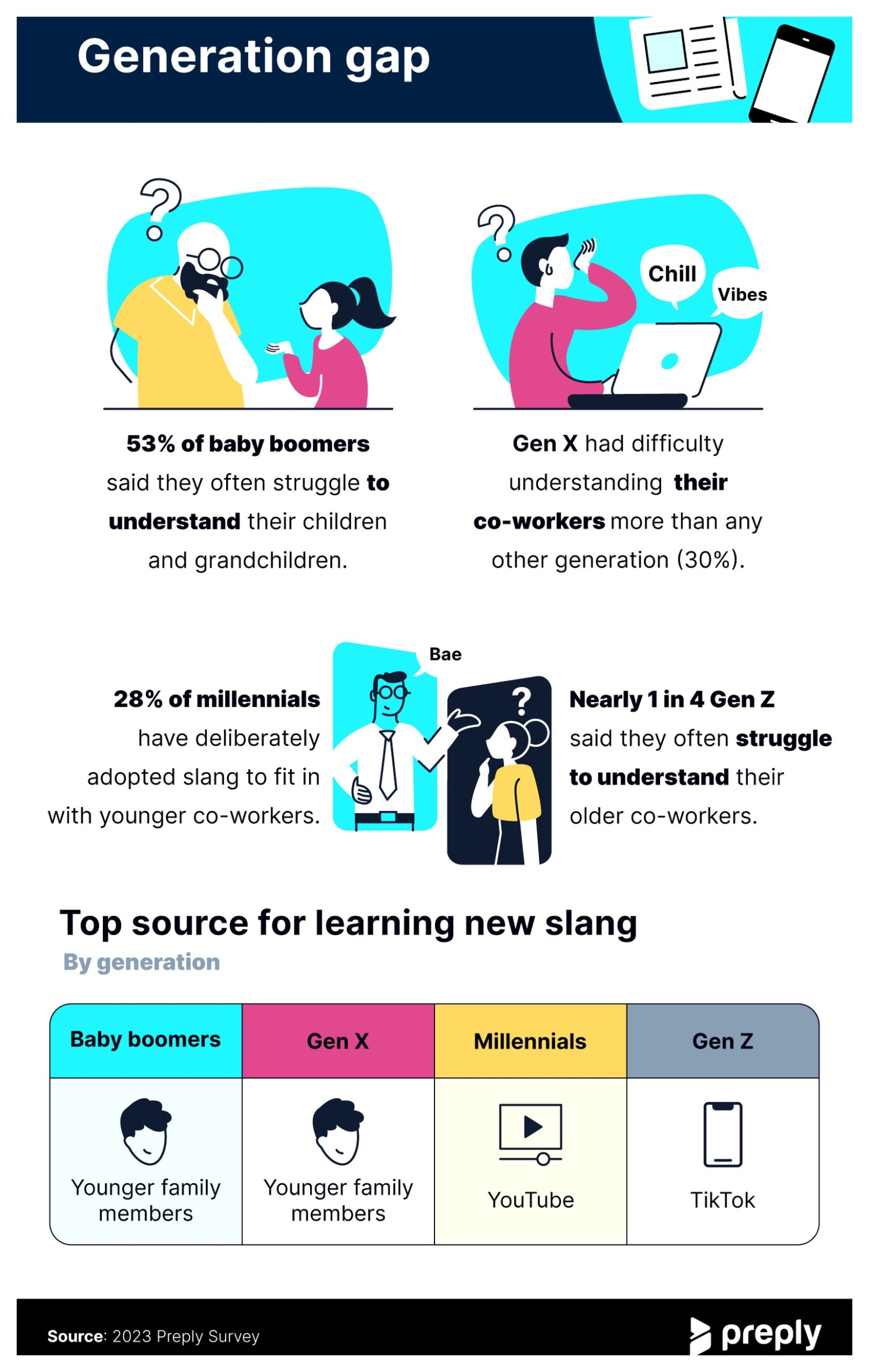
Slang significantly contributes to the widening generation gap. A striking 53% of baby boomers admit to feeling confused by the slang used by their children and grandchildren, while 30% of Gen Xers struggle to comprehend the language of their younger colleagues. This disconnect highlights the evolving nature of language and communication across generations.
On the flip side, 25% of Gen Z admitted that they found it challenging to relate to their older colleagues. To bridge this generational divide, more than a quarter of millennials are actively picking up new slang to better connect with the younger workforce.
Curious about where to pick up the latest slang? Baby boomers and Gen X often turned to younger relatives for a crash course, while millennials found their go-to source in YouTube. Meanwhile, Gen Z has embraced TikTok as their platform of choice for staying updated on the freshest lingo.
Many respondents found that younger friends and TV shows were excellent sources for learning slang. If you’re looking to enhance your understanding of English slang, consider booking a private, one-on-one lesson with an online English tutor. This personalized approach can help you connect better with both your grandkids and colleagues.
To cowabunga or not to cowabunga?
Every generation has its own distinctive slang, from the “slammin’” phrases of baby boomers to the vibrant “lit” expressions of Gen Z. What slang terms resonate most with each generation, and which ones do they wish would vanish into obscurity? Let’s explore the linguistic trends that define these age groups!
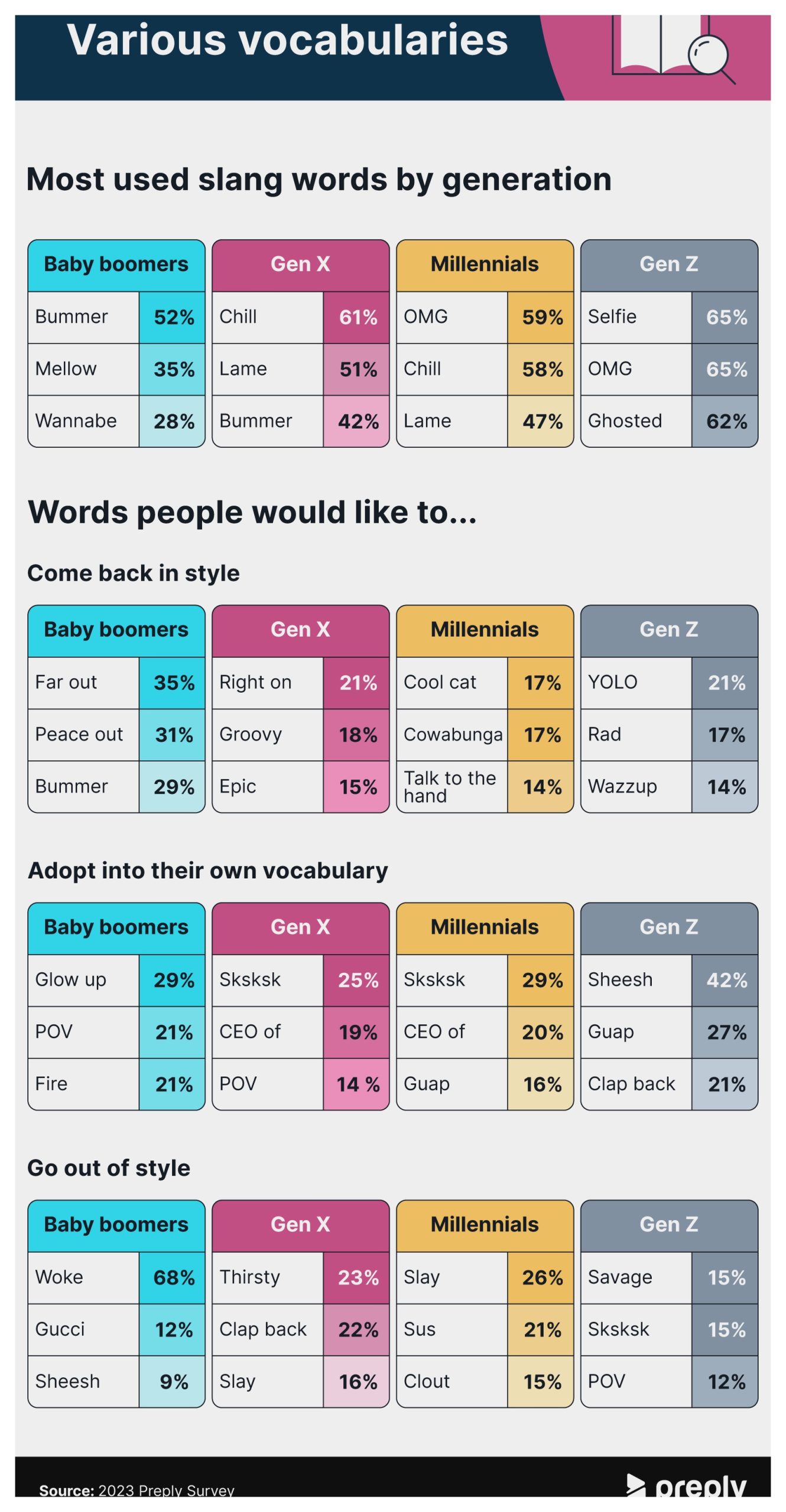
Our research uncovered an intriguing trend: certain slang terms have transcended generational boundaries. For instance, the word “bummer” is still popular among baby boomers (52%) and Gen X (42%), while “chill” resonates with Gen X (61%) and millennials (58%). Additionally, millennials and Gen Z connect through the lively expression “OMG,” showcasing how language evolves yet remains intergenerational.
Other terms were more specific to age groups, like Gen Z’s “selfie” or baby boomers’ “wannabe.”
Slang often sparks a sense of envy across different generations. Baby boomers are eager to embrace terms like “glow up” and “fire,” while Gen X and millennials are keen to assert themselves with phrases like “CEO of.” Meanwhile, Gen Z is excited to incorporate the iconic “sheesh” into their everyday language.
Some generations are grappling with what we might call “slang regret.” Take Gen Z’s use of “sksksk,” which first gained popularity through VSCO girls. While 25% of Gen X and 29% of millennials embraced the term, a surprising 15% of Gen Z—its original creators—wish it would simply fade away.
Learn a language online with our free learning materials.
Learn English online
Learn French online
Far out slang words and where to find them
While some slang from past generations has faded into obscurity, others have stood the test of time. We’ve explored the most enduring vintage slang terms that continue to resonate across the U.S. today.
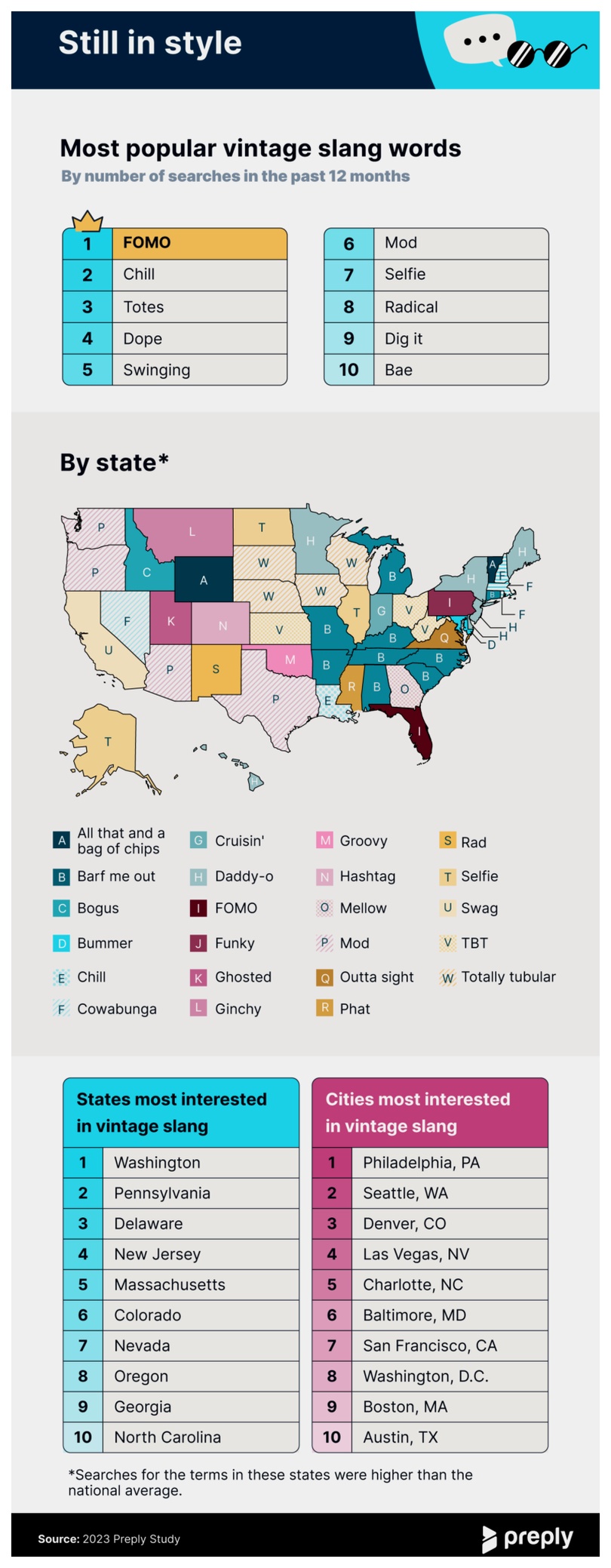
Nationwide, the iconic slang terms “FOMO” and “chill” topped the popularity charts. Meanwhile, certain phrases gained traction in specific regions. In the Northeast, there was a notable resurgence of the retro term “daddy-o,” while the Midwest eagerly embraced the revival of “totally tubular.”
Interestingly, certain states showed a greater enthusiasm for vintage slang than others. For instance, Washington, Pennsylvania, and Delaware are keen on keeping terms like “funky” alive, while a surprising number of states appear eager to revive expressions like “barf me out.”
Philadelphia and Seattle ranked high on the list of cities fascinated by vintage slang, joined by Denver and Las Vegas. It seems that these urbanites prefer the charm of classic expressions over the potentially dubious nature of new slang.
Learning the language of TikTok
TikTok has become a vibrant hub for anyone eager to elevate their vocabulary beyond old-school classics. Let’s dive into the trending slang on the platform and explore where users are most enthusiastic about picking up these fresh expressions.
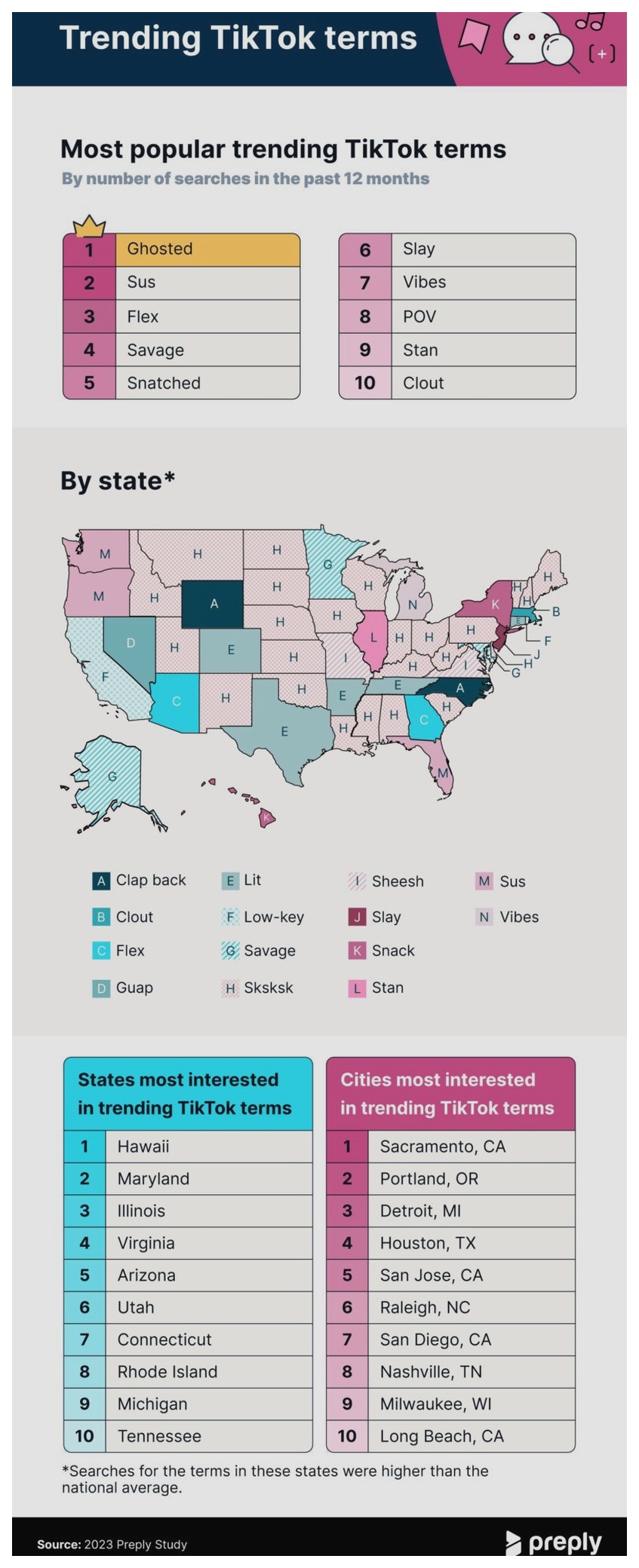
In the past year, “ghosted” and “sus” emerged as the most popular TikTok terms, capturing widespread attention. Interestingly, the search trends for these terms fluctuated based on geographical location, highlighting the diverse ways people engage with social media language.
In a lively competition among states to embrace contemporary slang, Hawaii emerged as a frontrunner. The Aloha State particularly embraced the term “snack,” which refers to an attractive person, showcasing its enthusiasm for modern language trends.
At the same time, Maryland was eagerly embracing the term “savage,” while Illinois couldn’t get enough of “stan.” Among cities, Sacramento, Portland, and Detroit emerged as the top TikTok enthusiasts, passionately following the latest trending phrases.
Regardless of whether you lean towards YouTube or TikTok, it’s clear that social media is revolutionizing the way slang spreads at an unprecedented pace. The phenomenon of viral culture is transforming our communication styles, turning the latest language trends into ever-shifting targets.
The art of slang-slinging
In today’s social media landscape, fresh slang terms are emerging at lightning speed. Exploring these new words not only enhances your understanding of a language, including your own, but also offers a fun opportunity to bridge generational gaps. You might just find new friends who share your passion for reviving phrases like “totally tubular”!
Ready to elevate your slang skills? Let LingualNeeds be your trusted companion on this journey! Our extensive network of committed tutors, covering languages from Portuguese to Japanese, will help you master conversational techniques and speak with confidence. Immerse yourself in tailored lessons, explore diverse cultures, and transform every conversation into a delightful discovery.
At LingualNeeds, learning goes beyond textbooks—it’s about building connections. Enroll in one of our engaging online English classes and embark on your language journey today. We guarantee an enjoyable and enriching experience!
Methodology
In our exploration of language trends, we examined 100 slang terms using Google Trends data from the past year. Remarkably, 70 of these terms were rooted in vintage slang, while 30 represented modern vernacular. Our analysis covered search volumes across all 50 U.S. states and the 50 largest cities, providing a comprehensive view of slang usage nationwide.
We conducted a survey with 1,043 Americans to explore their use of slang. The results revealed a diverse generational mix: 12% of respondents were baby boomers, 25% were from Generation X, a significant 52% identified as millennials, and 11% belonged to Generation Z.
Fair use statement
You’re welcome to share any of the exciting insights you’ve gained here, but please keep it non-commercial. Just remember to include a link back to this page when you share!
Frequently Asked Questions
What are some popular vintage slang terms mentioned in the article?
The most popular vintage slang terms include ‘FOMO’ and ‘bummer’.
Which state is most interested in new slang?
Hawaii is the state most interested in new slang.
How do different generations perceive slang?
53% of baby boomers and 30% of Gen X struggle to understand slang used by younger generations.
What platforms do different generations use to learn new slang?
Baby boomers and Gen X often turn to younger relatives, while millennials use YouTube and Gen Z prefers TikTok.
What are some slang terms specific to Generation Z?
Generation Z commonly uses terms like ‘selfie’ and ‘sksksk’.