- Key takeaways
- Nationwide patterns in discipline
- The states where people are most and least disciplined
- The cities where people are most and least disciplined
- The industries where people are most and least disciplined
- The impact of discipline on happiness and success
- Practice discipline with LingualNeeds
- Methodology
- Frequently Asked Questions
- What role does discipline play in language learning?
- Which states are considered the most disciplined in the U.S.?
- What are the top motivators for Americans seeking greater discipline?
- How does Generation Z compare to Baby Boomers in terms of discipline?
- What is the significance of the survey conducted by LingualNeeds?
Discipline might not be the flashiest quality, but it’s a crucial ingredient for success. Although creativity and innovation often steal the spotlight as drivers of progress in America, it’s the power of routine and consistency that truly distinguishes high achievers.
At LingualNeeds, we recognize that achieving your goals, especially in language learning, hinges on preparation and self-discipline. That’s why our online Spanish classes and private English lessons are designed to keep you accountable by pairing you with the ideal tutor to suit your individual needs. We understand the critical role discipline plays in the learning process, and we’re committed to pinpointing areas where American discipline shines and where enhancements can be made. Let us help you stay on track and maximize your language-learning potential!
We conducted a survey across the United States to assess how consistently people demonstrate discipline in 16 crucial areas of life. By analyzing their responses, we ranked states, cities, generations, and industries based on their discipline levels, using a 10-point scale to highlight the most disciplined among them.
Are you aiming to excel in a new language or enhance your conversational English skills? This survey offers intriguing insights into the role discipline plays in achieving success and happiness. Discover whether your city or state ranks as a discipline leader or needs a little extra support. How does your generation or industry measure up in terms of discipline, and what steps can you take to improve? Let LingualNeeds guide you on your journey to mastering self-control and reaching your goals!
Key takeaways
- Pennsylvania, Kentucky, and Texas are the most disciplined states in the U.S
- California, Kansas, and New York are the least disciplined
- Over half the U.S. is very disciplined in only two areas: hygiene and work punctuality
- The only area where over half of Americans have no discipline at all is screen time
- 73% of the U.S. is somewhat or not at all disciplined regarding environmental practices
- Baby boomers are the most disciplined, and Gen Zers are the least disciplined
- Most Americans (82%) want to be more disciplined, and being disciplined makes 89% feel happier
- Top motivators for the disciplined: #1 physical health, #2 mental health, #3 finances

Learn a language with personalised 1-on-1 classes with our expert tutors from all over the world
French lessons online
Spanish lessons online
Nationwide patterns in discipline

We took a closer look at the key routines and habits that shape American life, focusing on the two main aspects of discipline: hygiene and punctuality. Remarkably, more than half of Americans excel in these areas, demonstrating their commitment to being timely and maintaining cleanliness. In essence, Americans take pride in being punctual and well-groomed.
Beyond hygiene and punctuality at work, our research uncovers a significant national trend: people are increasingly focused on mastering their habits. Impressively, excelling in any of the other 14 areas we examined places you in an elite group, highlighting the value of discipline in personal development.
Screen time is a significant challenge for many Americans, with poor discipline being the norm. In fact, only 1 in 10 people manage to control their screen usage effectively, making such self-discipline as rare as a four-leaf clover. Alarmingly, more than half of Americans admit to having no self-control when it comes to their screen time at all.
America faces a pressing challenge in environmental discipline, affecting us all—our planet. Alarmingly, this issue ranks as the second worst area of self-discipline in the country, following screen time. In fact, a staggering 73% of Americans exhibit either a complete lack of discipline or only a modest commitment to sustainable living.
Skill advancement poses a significant challenge for many Americans, ranking as the third most prevalent issue in terms of discipline. While the U.S. is often criticized for its unhealthy eating habits, the struggle to enhance professional skills and competencies is even more concerning. Expanding one’s skill set is crucial for personal and career growth, yet many find it difficult to prioritize this development.
In the U.S., routine and discipline are alive and well—two out of three Americans maintain consistent habits. Leading the charge are the baby boomers, who exemplify commitment and self-discipline. This generation stands out as the true champions of sticking to routines and cultivating positive habits, inspiring others to follow suit.
Gen Z might find it interesting to note that baby boomers are often seen as the least disciplined generation. This observation resonates particularly with Gen Z, who often wish they could cultivate more discipline in their own lives. Interestingly, while baby boomers are known for their discipline, they tend to desire even less structure as they navigate their lives.
Sylvia Johnson, a language expert and head of methodology at LingualNeeds, offers valuable insights for anyone facing challenges in staying disciplined, particularly individuals with ambitious aspirations such as mastering a new language.
Johnson emphasized that it’s common to feel disheartened during periods of slow progress, particularly at the intermediate plateau. To maintain motivation, he recommends setting small, attainable goals and celebrating each achievement along the way.
It’s not only Generation Z that acknowledges the importance of discipline in their lives. Across the board, Americans are prioritizing self-control in three key areas: first and foremost, diet; followed closely by physical health; and finally, financial management.
Regardless of your aspirations—be it mastering financial management or picking up a new language—Johnson emphasizes the importance of embracing mistakes as part of the learning process.
“Many students fear making mistakes,” Johnson explained. “It’s essential to recognize that errors are a natural part of learning. Embrace them as valuable opportunities for growth.”
The states where people are most and least disciplined

Discipline in the U.S. shows distinct regional patterns, primarily centered in the South and East. Notably, Pennsylvania, Kentucky, and Texas rank as the most disciplined states, whereas California, Kansas, and New York fall at the bottom of the list.
Pennsylvania stands out not only as the most disciplined state overall but also excels in various specific areas of discipline. Residents of Pennsylvania are particularly skilled at balancing their personal time, making time for hobbies, and prioritizing family commitments.
In contrast, residents of Utah struggle the most with managing their personal time, while those in Washington are the least disciplined when it comes to prioritizing family time.
Florida stands out for its strong commitment to sleep and relaxation habits, showcasing a disciplined approach that sets a positive example. In contrast, Illinois struggles with maintaining such discipline in these areas. Additionally, Florida leads the nation in environmental practices, further establishing itself as a model for sustainable living.
New York is the least disciplined regarding mental health, while Kentucky is the best.
In the realm of screen time, Nebraska ranks as the least disciplined state in the U.S. Yet, not all screen time is detrimental. As Johnson points out, you can transform this habit into a productive routine by using it to learn a new language.
“Consistency is crucial when learning a new language,” Johnson emphasized. “Make it a habit to practice daily, whether it’s by watching a TV show or reading the news in that language. Seize every opportunity to immerse yourself!”
Learn a language online with our free learning materials.
Learn English online
Learn French online
The cities where people are most and least disciplined
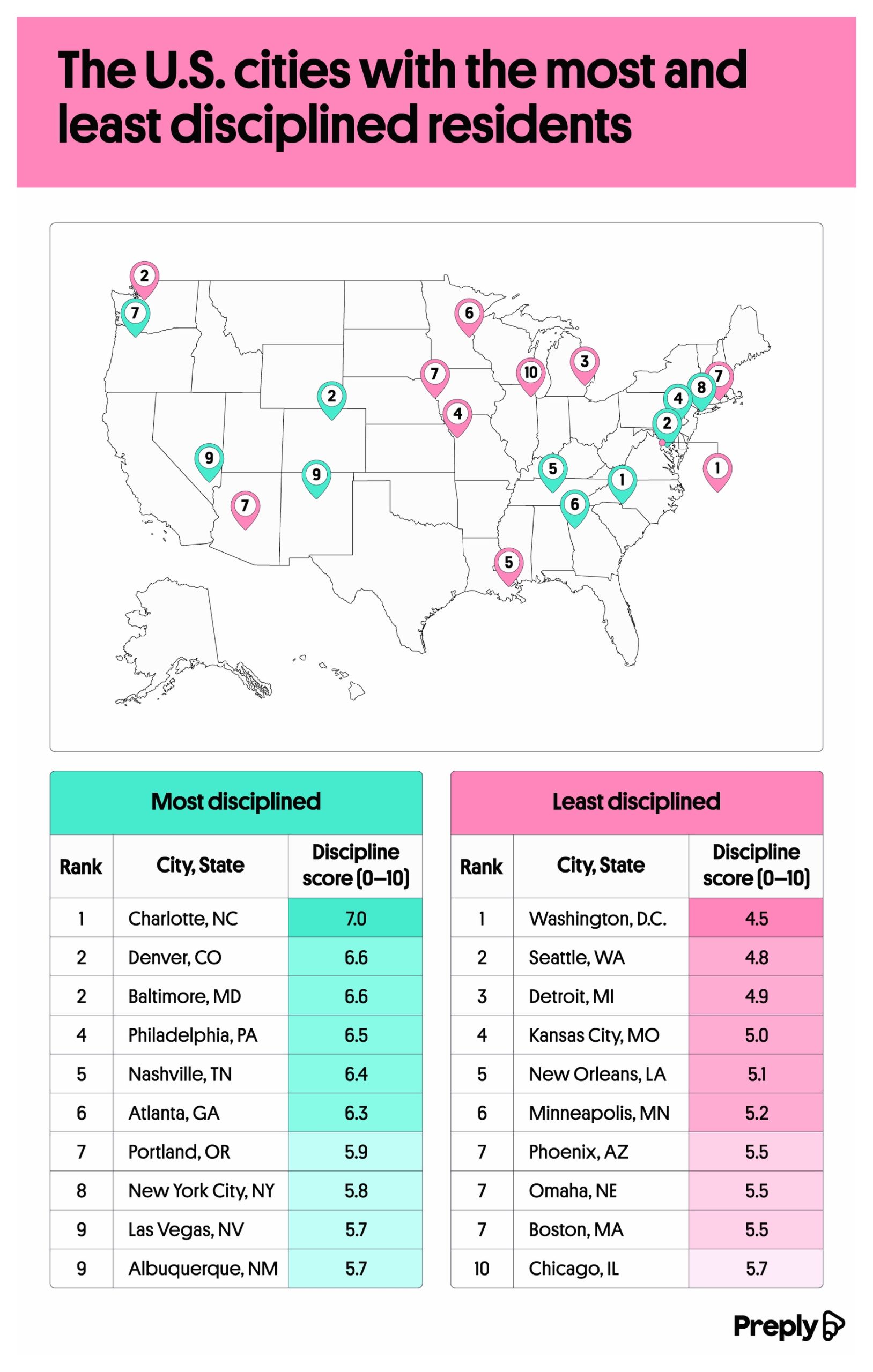
In the realm of American discipline at the city level, Charlotte, North Carolina, Denver, and Baltimore stand out as the most disciplined cities. In contrast, Washington, Seattle, and Detroit rank as the least disciplined, highlighting a varied landscape of self-control across the nation.
Seattle may rank among the least disciplined cities, but its residents wholeheartedly appreciate the impact of structured and scheduled days off on their well-being. Even with their laid-back approach, Seattleites understand that these planned breaks play a significant role in enhancing their happiness.
Phoenix residents strongly associate discipline with career satisfaction, more so than individuals in any other city. In contrast, people living in Omaha, Nebraska, and Kansas City, Missouri, are less inclined to view discipline as essential for achieving success.
Residents of New Orleans and New York City are particularly eager to establish consistent routines and positive habits, more so than those in any other city. Meanwhile, Denver stands out by reporting the highest levels of happiness linked to maintaining schedules and good habits.
The industries where people are most and least disciplined

Every industry grapples with deadlines, yet not all succeed in meeting them consistently. Achieving timely completion of tasks requires a strong sense of discipline. Notably, the construction, manufacturing, and real estate sectors boast some of the most dedicated professionals in the country. In contrast, the hospitality, advertising, marketing, and entertainment sectors often struggle with discipline among their workforce.
Discipline goes beyond merely meeting deadlines; it encompasses the establishment of routines and positive habits across various aspects of life. It’s a multifaceted quality, so we explored 16 key areas where discipline plays a crucial role, uncovering the essential components that contribute to a well-disciplined individual.
Analyzing the overall discipline scores by individual categories sheds light on why certain industries excel or struggle with discipline. In the realm of mental health, construction workers stand out as the most disciplined. Meanwhile, when it comes to punctuality and meeting deadlines, the manufacturing sector, renowned for its just-in-time (JIT) production methods, takes the lead nationally.
Next, let’s talk about sleep and relaxation—areas where real estate professionals truly excel. These individuals not only prioritize restful sleep but also demonstrate remarkable discipline in maintaining their physical health.
Leading with discipline is important, but recognizing its benefits is equally crucial. Professionals in the real estate industry understand this well; they often emphasize that discipline is essential for achieving both career success and personal fulfillment.
Our focus on individual disciplines highlights two critical areas: financial management and skill advancement. It’s no surprise that professionals in finance and economics excel in financial management. On the other hand, skill advancement ranks as the nation’s third weakest discipline. However, we can draw inspiration from the telecommunications industry, where employees are notably committed to enhancing their skills.
The impact of discipline on happiness and success

Our analysis of the most and least disciplined states, cities, sectors, and generations reveals a striking truth: many Americans crave greater discipline in their lives. They associate discipline with increased happiness and success, highlighting its significant role in their personal and professional aspirations.
To uncover the key factors behind discipline, we surveyed individuals who consistently adhere to routines and positive habits about their motivations. The leading motivators identified were physical health, mental health, and financial stability. Notably, physical health also ranks as the second most desired area for greater discipline among Americans.
A striking 82% of Americans aspire to cultivate greater discipline in their lives, with 89% acknowledging that such discipline contributes to their overall happiness. Furthermore, a significant 75% of people believe that discipline plays a crucial role in their career success, while 71% feel it enhances their job satisfaction as well.
While it’s easy to agree that discipline is beneficial and essential, putting it into practice proves to be a greater challenge, demanding both preparation and ongoing dedication. In fact, only 1 in 10 Americans consistently achieve their goals. This striking statistic underscores the importance of seeking support to help you reach your objectives.
Learning a new language can be a formidable challenge, but you don’t have to face it alone! Enter LingualNeeds, a platform designed to connect your aspirations with achievable results. With expert guidance tailored to your language learning journey, LingualNeeds empowers you to overcome obstacles and reach your goals with confidence.
Practice discipline with LingualNeeds
Mastering a new language demands significant discipline. To reach fluency, you’ll need to dedicate time and establish a consistent practice routine, which can be tough. Yet, embracing this challenge can lead to enhanced happiness; in fact, 90% of Americans report feeling this way. The best part? You don’t have to navigate this journey alone!
To truly prepare for professional success, embracing accountability in your learning process is essential. A mentor, tutor, or coach can provide invaluable support, helping you navigate and conquer the challenges of language learning.
Unlock your language potential with our expert tutors who provide personalized, one-on-one lessons tailored to your needs. Are you ready to achieve your dream of learning Spanish? At LingualNeeds, we simplify the journey and help you incorporate discipline into your daily routine. Soon, you’ll join the ranks of the 11% of American professionals who consistently reach their language goals!
Methodology
In March 2024, we conducted a survey involving 2,001 Americans across various states to gauge their levels of discipline. Our participants, aged 18 to 77, included 56% women, 42% men, and 2% identifying as nonbinary. We asked them to evaluate their consistency in maintaining positive routines and habits, focusing on 16 key areas of life often associated with self-discipline.
We assigned points based on how disciplined respondents felt in various areas of their lives—adding points for those who rated themselves as very disciplined and deducting points for those who felt undisciplined. Afterward, we averaged and normalized these scores, converting them into a 10-point scale. On this scale, a score of 10 signifies the highest level of discipline, allowing us to compare across states, cities, generations, and industries effectively.
We also invited participants to share their thoughts on how discipline influences their happiness and success, as well as how frequently they achieve their goals. Furthermore, we explored the motivations behind those who consider themselves somewhat or very disciplined, along with areas where they aspire to improve their self-discipline.
In developing our rankings, we assigned points to respondents who identified as highly disciplined and deducted points for those who indicated a lack of discipline. We then averaged and normalized these scores, converting them into a 10-point scale, where a score of 10 signifies the highest level of discipline among states, cities, generations, or industries.
Frequently Asked Questions
What role does discipline play in language learning?
Discipline is crucial for success in language learning as it helps maintain a consistent practice routine and accountability.
Which states are considered the most disciplined in the U.S.?
Pennsylvania, Kentucky, and Texas are ranked as the most disciplined states.
What are the top motivators for Americans seeking greater discipline?
The top motivators are physical health, mental health, and financial stability.
How does Generation Z compare to Baby Boomers in terms of discipline?
Baby Boomers are generally more disciplined, while Generation Z tends to be less disciplined.
What is the significance of the survey conducted by LingualNeeds?
The survey assesses discipline levels across various states, cities, generations, and industries, providing insights into how discipline affects happiness and success.