
English boasts a remarkable diversity in its vocabulary, enriched by numerous words borrowed from languages around the globe. In this article, I will explore nine intriguing words that have made their way into English from other cultures, highlighting their origins and meanings.
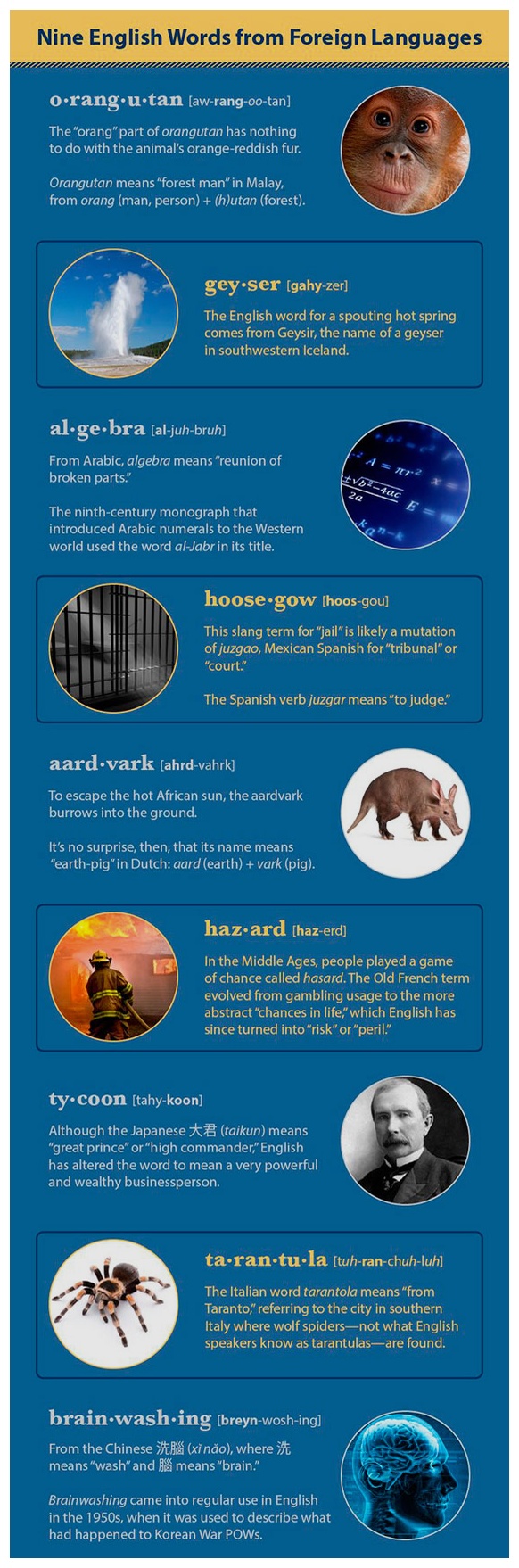
For a visual aid, we can refer to the helpful infographic.
Let’s get started!
- Orangutan
Interestingly, the term “orangutan” doesn’t refer to the reddish-orange fur of these fascinating creatures. Instead, it translates to “forest man,” derived from the Malay words “orang” (meaning man) and “hutan” (meaning forest).
Did you know that?
- Geyser
The term “geyser” is familiar to many, but its origins are quite interesting. This English word, which refers to an erupting hot spring, is derived from a specific geyser located in southwestern Iceland called Geysir. Remarkably, the name of this single hot spring has come to represent all such natural wonders around the globe. Isn’t that fascinating?
- Algebra
Did you know that the term “algebra” has its roots in Arabic? It originates from the title of a groundbreaking work by the esteemed Arab mathematician Al-Khwarizmi, called “Al-Jabr al-Muqabala.” This phrase translates to “the reunification of broken parts,” reflecting the essence of algebra as a tool for solving equations and bringing order to mathematical problems.
- Hoosegow
Few are familiar with the slang term “ahoosegow,” which refers to a prison or jail. This intriguing word likely originates from the Mexican term “juzgao,” meaning tribunal or court. In Spanish, the verb “juzgar” translates to “to condemn,” further connecting the term to its legal roots.
- Aardvark
This is an unusual word that means “African anteater.”
To escape the intense heat of the African sun, the anteater digs into the earth for shelter. This behavior is reflected in its name, which is derived from the Danish term “earthen pig,” combining the words “aar” (land) and “vark” (pig).
- Hazard
During the Middle Ages, the word for gambling was “hasar,” derived from Old French. Over time, this term transformed to encompass a broader concept of “occurrences in life.” The British later adapted it to signify “risk” and “danger,” highlighting the inherent uncertainties associated with gambling.
- Tycoon
In Japanese, this term translates to “great prince” or “commander-in-chief.” However, in English, it has evolved to signify a wealthy and powerful individual, often referred to as an “industrial tycoon.”
Doesn’t sound bad, does it?
- Tarantula
The term “tarantolo,” originating from Italy, translates to “from Taranto,” a city in northern Italy renowned for its wolf spiders, specifically belonging to the Entelegynae subgroup of araneomorph spiders. Today, English speakers commonly refer to these fascinating creatures as tarantulas.
- Brainwashing
This word doesn’t have the nicest connotation.
The term “brainwashing” originates from the Chinese phrase xǐ nǎo (洗脑), which translates directly to “wash brains,” with 洗 meaning “wash” and 脑 meaning “brains.” This concept entered the English language in the 1950s, primarily to describe the indoctrination techniques used on Korean prisoners of war.
Following the Korean War, the concept of “brainwashing” evolved significantly, encompassing a wide range of coercive persuasion techniques. This shift included the use of political propaganda and ideological conditioning, reflecting a broader understanding of how beliefs can be manipulated.
But let’s not dwell on negative things.
It’s better to read an article about how to remember words in English.
Like this article, and don’t forget to tell others about it.
Good luck in learning English!
Frequently Asked Questions
What does the term ‘orangutan’ translate to?
It translates to ‘forest man,’ derived from the Malay words ‘orang’ (meaning man) and ‘hutan’ (meaning forest).
What is the origin of the word ‘geyser’?
The word ‘geyser’ is derived from a specific geyser in Iceland called Geysir, which refers to an erupting hot spring.
Where does the word ‘algebra’ come from?
The term ‘algebra’ comes from Arabic, originating from the title of a work by mathematician Al-Khwarizmi called ‘Al-Jabr al-Muqabala,’ meaning ‘the reunification of broken parts.’
What is the meaning of the slang term ‘hoosegow’?
The term ‘hoosegow’ refers to a prison or jail and likely originates from the Mexican term ‘juzgao,’ meaning tribunal or court.
What is the origin of the word ‘brainwashing’?
The term ‘brainwashing’ originates from the Chinese phrase xǐ nǎo (洗脑), which means ‘wash brains,’ and it entered the English language in the 1950s.