
- Key Findings
- Lost in translation? How Americans are consuming foreign content
- The international subbing vs. dubbing debate
- Breaking through language barriers
- Subtitles speak volumes
- Methodology
- Data Sources
- Frequently Asked Questions
- What significant event occurred in 2020 related to foreign films?
- What percentage of Americans prefer subtitles over dubbed audio?
- How do subtitles benefit language learning?
- What is the main reason younger viewers prefer subtitles?
- Why do some viewers prefer dubbed content?
Foreign films and television have recently gained significant traction in the United States. A landmark moment occurred in 2020 when the South Korean film *Parasite* became the first non-English language movie to win the Academy Award for Best Picture. Fast forward to 2024, and we see a record-breaking three non-English language films nominated for Best Picture, highlighting their growing presence in mainstream cinema. Director Bong Joon-ho’s impactful acceptance speech emphasized this shift, stating, “Once you overcome the one-inch-tall barrier of subtitles, you’ll be introduced to so many amazing films.”
In a 2022 survey, we discovered that Americans have a strong affinity for subtitles. But when it comes to non-English language content, do they still favor subtitles, or do they lean towards audio dubbing instead?
The debate between subtitles and dubbed audio has been a hot topic since the 1980s, and it has only intensified in recent years. Fans of subtitles argue that they provide a more genuine viewing experience by preserving the original language and emotions of the film. On the other hand, supporters of dubbing appreciate its accessibility, as it makes the content easier to follow for those who may struggle with reading subtitles.
Subtitles have many benefits:
- They aid language learning by exposing viewers to natural language use and expressions.
- They enhance cultural appreciation by offering direct exposure to foreign cultures and norms.
- They increase accessibility for hard-of-hearing viewers and non-native speakers.
- The preference for subtitles also drives market expansion and diversity.
As media consumption evolves, we set out to investigate how Americans engage with foreign content and their preferences for subtitles versus dubbing. To uncover these insights, we examined publicly available data and conducted a survey of 2,000 individuals. Our aim is to emphasize the educational advantages of both subtitled and dubbed media, supporting our mission to enrich language learning experiences for students of all ages.
Key Findings
- 65% of Americans consume media in a foreign language at least monthly.
- 80% of Americans prefer subtitles over dubbed audio.
- 61% of Americans consume foreign language content on social media, and 85% use subtitles.
- 67% prefer subtitles to learn or practice a new language.
- 84% agreed that subtitles retain the cultural authenticity of the content.

Learn a language with personalised 1-on-1 classes with our expert tutors from all over the world
French lessons online
Spanish lessons online
Lost in translation? How Americans are consuming foreign content
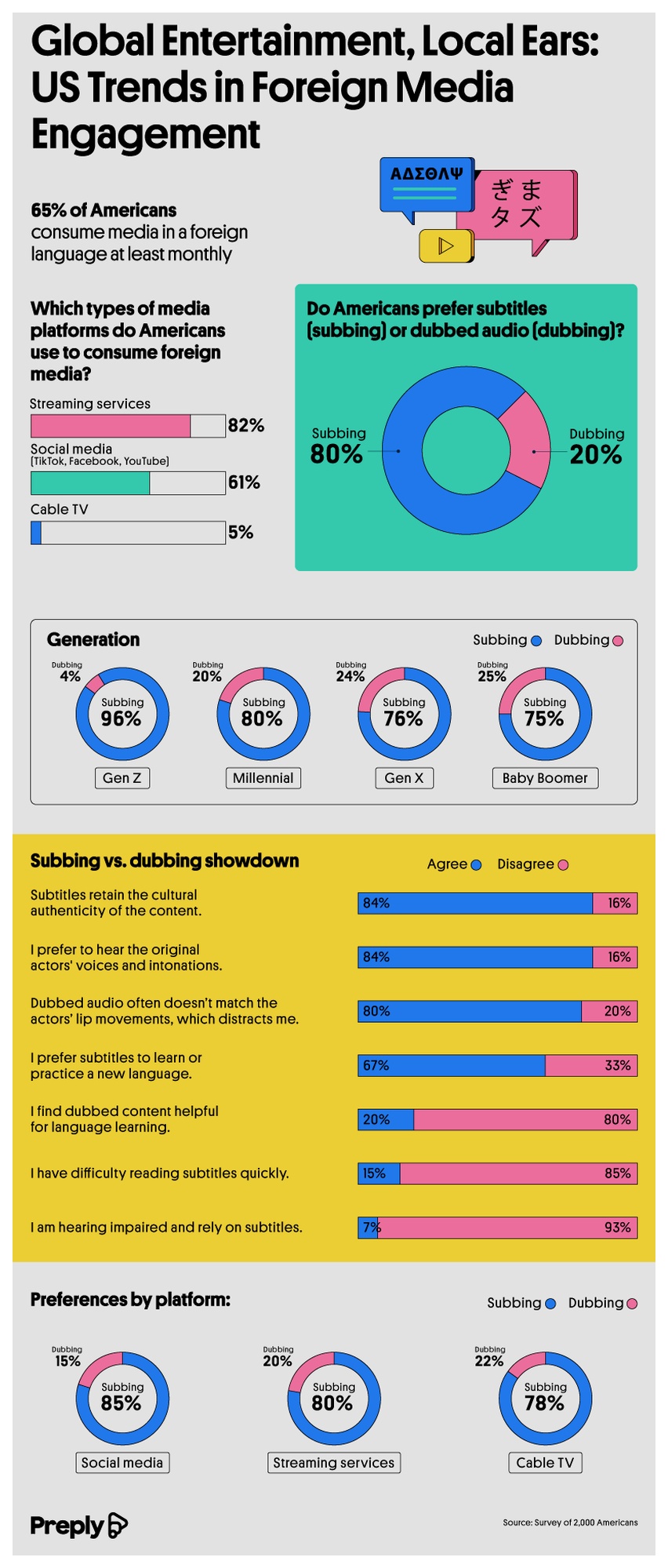
Our survey reveals that 65% of Americans engage with media in a foreign language at least once a month across various platforms, including streaming services, social media, and cable TV. Notably, a significant 82% of this foreign media consumption occurs on streaming services.
Moreover, a significant majority of Americans lean toward subtitling, with 80% favoring it over dubbing. This preference extends across various platforms: 80% choose subtitles on streaming services, 78% on cable TV, and an impressive 85% on social media.
Our survey findings reveal a clear trend among younger viewers favoring subtitles. Notably, 94% of Gen Z and 80% of Millennials choose to watch with subtitles. In our 2023 survey, an impressive 96% of Gen Z participants reported that they always use subtitles, highlighting their strong preference for this viewing option.
A significant 76% of Generation X and 75% of Baby Boomers prefer using subtitles while watching content. This trend suggests that subtitles are gaining popularity across generations, likely due to younger viewers’ increasing exposure to international programming.
In the realm of language learning, a significant 67% of participants believe that subtitles enhance the process of acquiring or practicing a new language, while the remaining 33% hold a different view. Furthermore, a striking 80% of those surveyed feel that dubbed content is not beneficial for learning a new language.
Respondents clearly recognize the importance of subtitles, with 84% expressing a preference for hearing the original voices and intonations of actors. This preference highlights how subtitles can enhance understanding, allowing viewers to catch subtle nuances that might be missed in traditional language classes.
For the majority of respondents, reading subtitles is a breeze, with 85% finding it easy to do. However, for the 15% who struggle with subtitles, dubbed content becomes an essential alternative, enhancing their viewing experience.
In the debate over translation methods, subtitles have emerged as the clear favorite, especially as global media becomes more accessible. Americans are embracing this trend, opting for subtitles to enhance their viewing experience.
“Today, a significant portion of the content we encounter is in languages other than English or delivered by speakers with pronounced accents,” explains Neil Chase, a novelist and filmmaker. “Closed captioning plays a crucial role in helping viewers comprehend the dialogue. Subtitles, usually presented one line at a time, make it easy to follow along. When information is conveyed through both sound and text, it enhances understanding, ensuring that nothing important is overlooked.”
The international subbing vs. dubbing debate
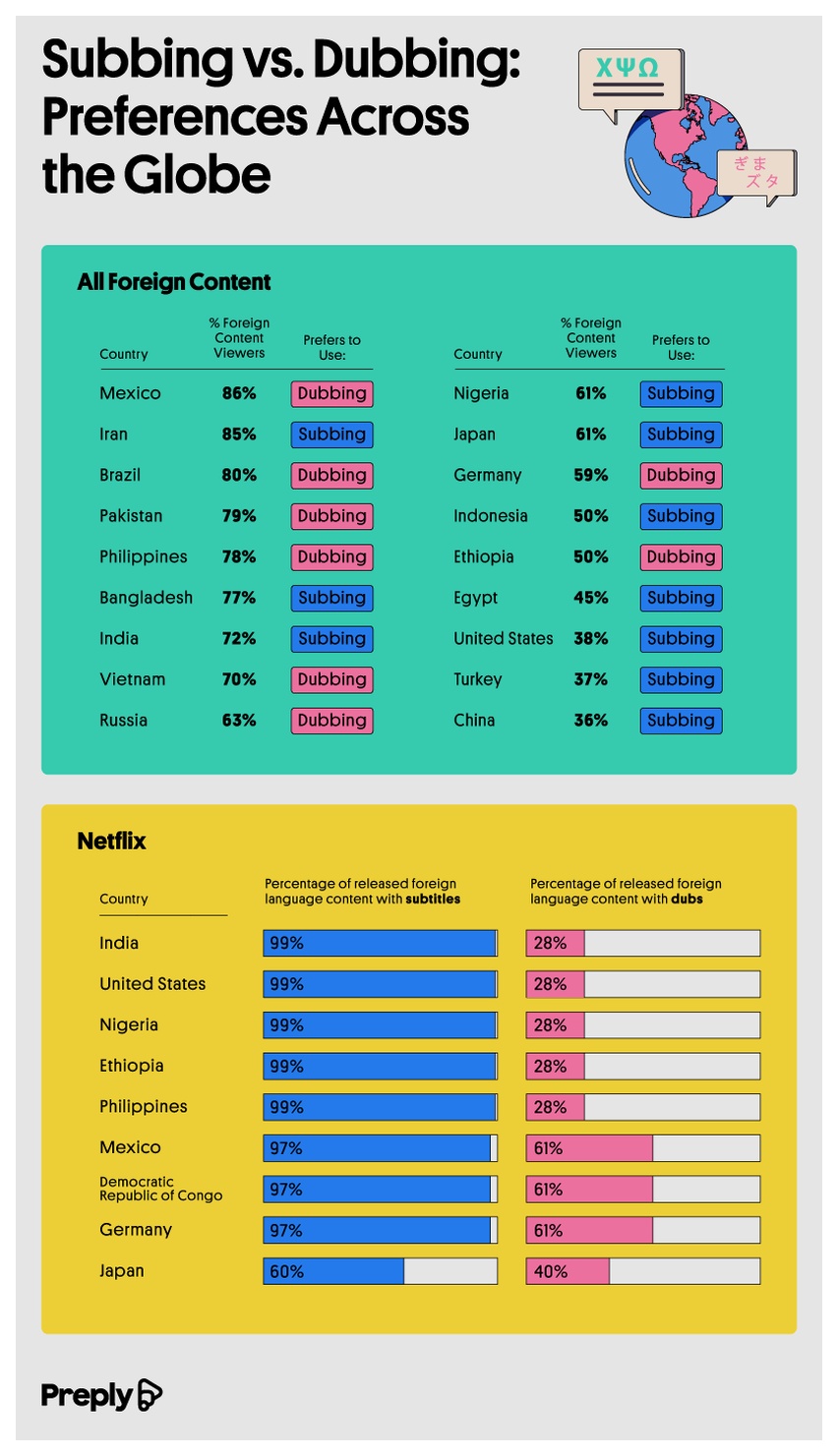
We gathered data to examine global preferences for subtitles versus audio dubbing. Out of the 20 countries we studied, half favor subtitles while the other half prefers dubbing, highlighting a fascinating divide. However, it’s worth noting that the amount of foreign content consumed varies significantly from one country to another.
We found that the countries with the most foreign content viewers are:
- Mexico (86%)
- Iran (85%)
- Brazil (80%)
- Pakistan (79%)
- Philippines (78%)
Among the five countries discussed, Iran stands out as the sole nation that favors subtitles, while the other four lean towards dubbing. Notably, even with compulsory English language education in these countries, a significant number of viewers still choose dubbed content. This trend indicates that many viewers are primarily drawn to foreign films and shows for entertainment or cultural enrichment, rather than for language acquisition. In contrast, American audiences often turn to foreign content as a tool to enhance their Spanish language studies.
On the other hand, the countries that prefer subbing are:
- Russia (86%)
- the United States (76%)
- India (68%)
- Iran (67%)
- China (66%)
These countries boast a notable proportion of viewers who prefer foreign content, highlighting their appreciation for authenticity and the performances of original actors. Additionally, with widespread English language education, audiences in these regions likely have a unique perspective on the ongoing debate between subtitles and audio dubbing.
Our research reveals that Netflix has significantly contributed to the globalization of film and television. Impressively, it offers subtitles for nearly 99% of its foreign language content across most countries we studied. Additionally, Netflix provides dubbing options in several regions, making diverse media more accessible to audiences worldwide.
The countries with the highest percentage of dubbed content on Netflix are:
- Mexico (61%)
- Democratic Republic of Congo (61%)
- Germany (61%)
- Japan (40%).
Learn a language online with our free learning materials.
Learn English online
Learn French online
Breaking through language barriers
Our survey and research reveal that viewers in countries such as Russia, the United States, India, Iran, and China have a strong preference for foreign shows and movies with subtitles. This trend likely stems from a desire to preserve the original language and performances. Additionally, many individuals in these nations possess a solid understanding of English, thanks to their educational systems, and watching with subtitles can enhance their language skills even further.
In countries like Mexico, Brazil, Pakistan, and the Philippines, audiences often gravitate towards foreign shows and movies with dubbing. While English is commonly taught in schools, many viewers find that dubbing enhances their overall experience, making it more engaging and enjoyable. Additionally, for those who are not learning the language or who have low vision, dubbing offers greater accessibility, allowing them to fully immerse themselves in the story.
Netflix is actively working to dub more international content in a bid to expand its global audience. However, our research indicates that subtitles continue to be the preferred choice for viewers. This may be due to the higher resources required for dubbing, including additional production costs, voice actors, and time. Nevertheless, grasping the subbing and dubbing preferences of different countries is crucial for content creators and distributors aiming to effectively connect with international audiences.
Subtitles speak volumes
More than ever, people are diving into foreign content, with varying levels of enthusiasm across different countries. Engaging with international media not only broadens our understanding of diverse cultures but also serves as a valuable tool for language learning. Interestingly, many Americans favor subtitles when watching foreign films and shows, as they feel this approach helps them grasp the language better while preserving the original cultural essence of the content.
Opting for subtitles allows you to immerse yourself in a language as it’s authentically spoken, helping you grasp the subtle nuances, pronunciation, tone, and rhythm that give each language its unique charm. When combined with guidance from a language tutor and a consistent practice routine, this approach can significantly accelerate your language mastery in a short period.
Methodology
In February 2024, we conducted a survey involving 2,000 U.S. residents, with a median age of 33. The demographics revealed that 42% identified as men, 56% as women, and 2% as other.
Data was collected from the sources listed below.
Data Sources
- worldometers.info. https://www.worldometers.info
- Statista. https://www.statista.com
- U.S. News & World Report. https://www.usnews.com
- YouGov. https://business.yougov.com
- LiveMint. https://lifestyle.livemint.com
- Advanced Television. https://www.advanced-television.com
- Morning Consult. https://pro.morningconsult.com
- ChinaPower. https://chinapower.csis.org
- Daffodil International University Institutional Repository. https://dspace.daffodilvarsity.edu.bd
- GlobalWebIndex. https://blog.gwi.com
- Streaming Media. https://www.streamingmedia.com
- Media Play News. https://www.mediaplaynews.com
- Motion Picture Association – Asia Pacific. https://www.mpa-apac.org
- Academia.edu. https://www.academia.edu
- Parrot Analytics. https://www.parrotanalytics.com
- The Financial Express. https://www.financialexpress.com
- BARC India. https://www.barcindia.co.in
- Entrepreneur. https://www.entrepreneur.com
- Global Issues. https://www.globalissues.org
- PR Newswire Asia. https://www.prnasia.com
- ResearchGate. https://www.researchgate.net
- SOAS Research Online. https://eprints.soas.ac.uk
- Arab Media & Society. https://www.arabmediasociety.com
- Gallup Pakistan. https://www.gallup.com.pk
- Egypt Today. https://www.egypttoday.com
Frequently Asked Questions
What significant event occurred in 2020 related to foreign films?
The South Korean film *Parasite* became the first non-English language movie to win the Academy Award for Best Picture.
What percentage of Americans prefer subtitles over dubbed audio?
80% of Americans prefer subtitles over dubbed audio.
How do subtitles benefit language learning?
Subtitles aid language learning by exposing viewers to natural language use and expressions.
What is the main reason younger viewers prefer subtitles?
Younger viewers, such as Gen Z and Millennials, prefer subtitles to preserve the original language and performances of actors.
Why do some viewers prefer dubbed content?
Some viewers prefer dubbed content for its accessibility, making it easier to follow for those who may struggle with reading subtitles.