- Key Findings
- Who is the most passive-aggressive?
- The worst passive-aggressive phrases, ranked
- Over half of Americans are passive-aggressive at work
- The most passive-aggressive things said at work
- Is passive-aggressive communication worse online?
- Conclusion
- Frequently Asked Questions
- What is passive-aggressive behavior?
- Who are the most passive-aggressive individuals according to the survey?
- What are some common passive-aggressive phrases to avoid?
- Is passive-aggressive communication more prevalent online or in person?
- What should you do if you encounter passive-aggressive behavior?
Imagine you forget to wish your friend a happy birthday. When you finally meet and apologize, they respond with a tight smile and insist, “No, I’m not mad!” Yet, their cold demeanor speaks volumes. Despite your efforts to discuss the situation, they remain closed off about their feelings. This behavior is a classic example of passive-aggressiveness, which they may not even recognize in themselves.
Passive-aggressive behavior can manifest in various ways, but it fundamentally involves individuals expressing negative feelings indirectly rather than confronting them directly. This might show up in words, like a friend insisting they’re not upset, or through actions, such as deliberately avoiding someone. Unfortunately, this type of behavior complicates effective communication and hinders the resolution of conflicts, making it challenging to address underlying issues openly.
We recently conducted a survey involving over 1,200 individuals to explore their experiences with passive-aggressive communication and behaviors. Participants also ranked the most passive-aggressive phrases commonly used in various contexts, including the workplace, casual conversations, and online interactions.
Key Findings
- The most passive-aggressive people, according to Americans, are their coworkers (20%), mothers (18%) and friends (16%).
- Top Passive-Aggressive Phrases to Avoid: “You’re too sensitive,” “Why are you upset?” and “No offense, but…”
- 73% experience passive-aggressive communication at work; and 52% of those experience it at least weekly.
- Three common passive-aggressive phrases at work include “as you no doubt are aware…,” “for future reference,” and “friendly reminder.”
- 69% think people are more passive-aggressive online than in person.

Learn a language with personalised 1-on-1 classes with our expert tutors from all over the world
French lessons online
Spanish lessons online
Who is the most passive-aggressive?
Our survey reveals that a staggering 99% of Americans have encountered passive-aggressive behavior in others. While it’s often easy to spot this behavior in those around us, recognizing it within ourselves can be more challenging. Interestingly, 82% of respondents acknowledge that they, too, have exhibited passive-aggressive tendencies. This highlights a common struggle with openly addressing difficult emotions.

According to Americans, the individuals most likely to display passive-aggressive behavior are coworkers (20%), mothers (18%), and friends (16%). Regionally, the Northeast and South are tied as the most passive-aggressive areas, with 33% of respondents noting this behavior. However, it’s important to recognize that varying communication styles can lead to misunderstandings. For instance, the South’s emphasis on politeness might come off as insincerity to someone from a different region.
Surprisingly, fake politeness tops the list of passive-aggressive behaviors, with 24% of respondents deeming it the worst. Following closely are fake innocence at 17% and weaponized kindness at 14%. The latter involves using excessive kindness as a manipulative strategy, turning genuine gestures into tools for control.
Overall, 83% of respondents indicated would end a relationship if the other party was being consistently passive-aggressive.
The worst passive-aggressive phrases, ranked
Understanding tone and context is key to identifying passive-aggressive behavior. When respondents evaluated certain phrases delivered in a passive-aggressive manner, they identified them as particularly unpleasant to hear.

The five worst passive-aggressive phrases in English are:
- “You’re too sensitive.”
- “Why are you getting so upset?”
- “No offense, but…”
- “Whatever—”
- “If that’s what you want to do…”
Participants identified several common phrases as particularly problematic. Shifting blame, exemplified by comments like “you’re too sensitive” and “why are you getting so upset?”, accounted for 26% of the negative responses. Meanwhile, being judgmental or patronizing, with phrases such as “no offense, but…” and “if that’s what you want to do…”, garnered 16%. Denying anger, represented by dismissive remarks like “whatever,” received 15%. All of these expressions, often delivered in a passive-aggressive tone, highlight a disconnect between the speaker’s words and their true feelings.
Learn a language online with our free learning materials.
Learn English online
Learn French online
Over half of Americans are passive-aggressive at work
Many Americans have taken to social media to humorously highlight the passive-aggressive tone often found in workplace communication. This tendency isn’t just due to the vague nature of common business jargon; it also stems from a culture where openly expressing anger or frustration towards clients, coworkers, or superiors is deemed unprofessional. Consequently, some colleagues resort to passive-aggressive tactics to convey their feelings without directly confronting the issue.
This might shed light on the fact that a staggering 73% of Americans report facing passive aggression in their workplaces, a phenomenon that’s far from uncommon. Among those who have dealt with it, over half—52%—experience passive aggression on a weekly basis.
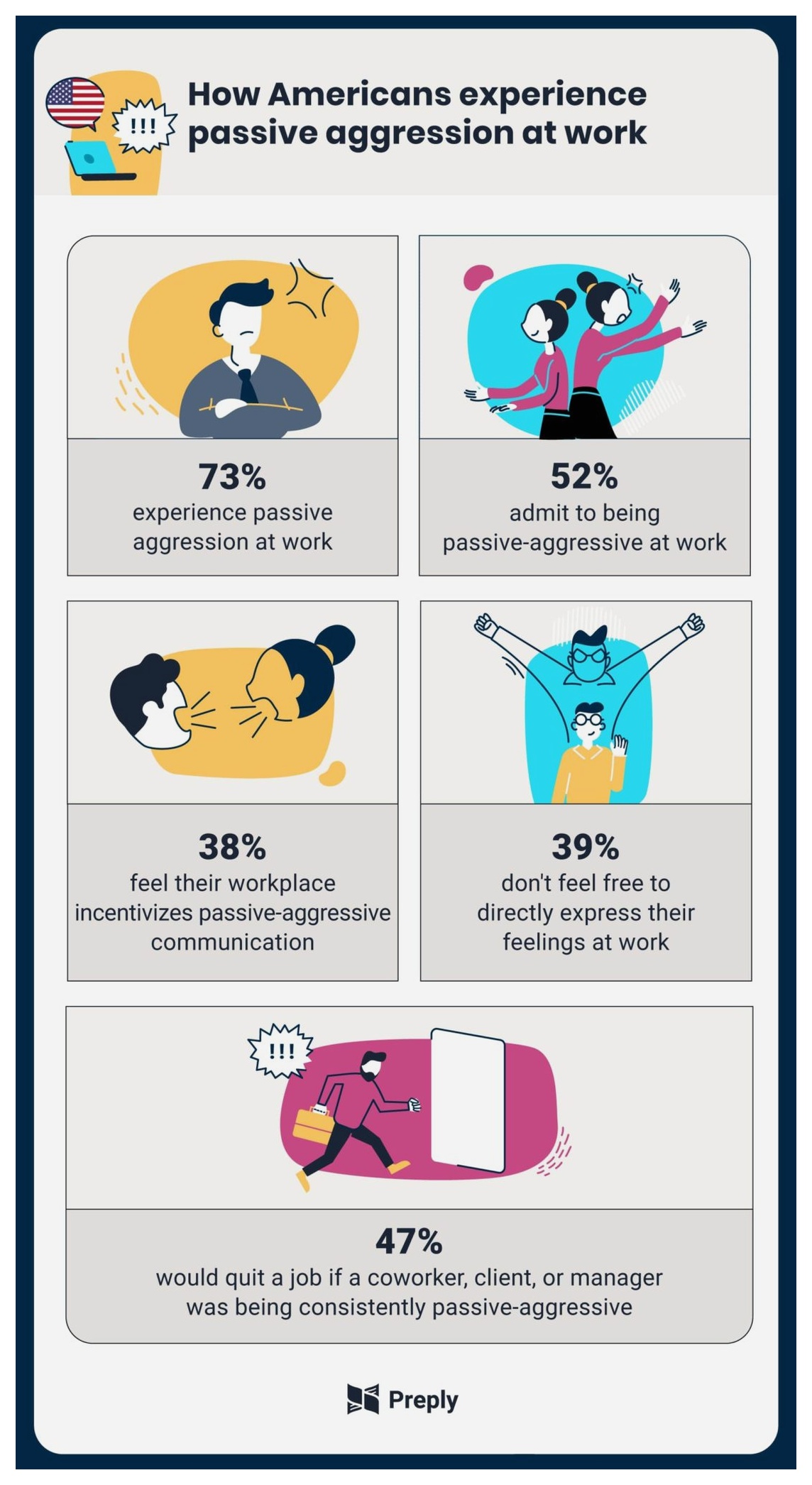
A striking 52% of Americans acknowledge they engage in passive-aggressive behavior at work. This issue may stem from the fact that 39% of individuals feel unable to openly share their emotions in the workplace. Even when they do muster the courage to speak up, their honest communication may not be welcomed. Alarmingly, 38% of employees believe their workplace encourages passive-aggressive interactions, creating a challenging environment for direct dialogue.
Dr. Melissa Baese Berk, a Professor of Linguistics at the University of Chicago and an expert with LingualNeeds, highlights the complexities of workplace communication. She explains that pragmatics—the way language is used in context—shapes specific communication norms that can differ based on factors like gender, age, location, and organizational role. Interestingly, what may come across as direct communication can sometimes be misinterpreted or seen as passive-aggressive. For those from different geographic areas or who speak a different native language, mastering these subtle norms can be particularly challenging. Understanding and adapting to these nuances is essential for effective workplace interactions.
While passive-aggressive communication is prevalent in many workplaces, it’s far from welcome. Our recent survey revealed that nearly half of Americans—47%—would consider resigning if they faced consistent passive-aggressiveness from a coworker, client, or manager. Notably, women are particularly sensitive to this issue, with 51% indicating they would leave compared to 42% of men. Additionally, younger generations are more affected; 51% of Generation Z and 48% of Millennials would quit over such behavior, while Baby Boomers and Generation X show slightly lower rates at 43% and 44%, respectively.
The most passive-aggressive things said at work
Navigating workplace communication can be challenging, but our survey reveals that certain passive-aggressive phrases are particularly off-putting in a professional environment. Here are the worst offenders that you should be mindful of.

The five worst passive-aggressive phrases at work are:
- “As you no doubt are aware…”
- “For future reference”
- “Friendly reminder”
- “CC’ing [my boss] for visibility”
- “Per my last email”
These phrases reveal an underlying sense of frustration or a lack of clarity. In professional environments, it can be challenging to articulate your feelings, especially when clients are unresponsive or when a coworker repeatedly revisits a conversation you’ve had countless times. If you catch yourself using these expressions, consider ways to communicate your feelings more openly and effectively.
Just for a bit of fun, we gathered insights from our respondents to identify the most frequently mentioned first names of passive-aggressive coworkers. The top names for men are John, Bill, and Bob, while for women, the most common names are Jen, Mary, and Heather.
Is passive-aggressive communication worse online?
Body language and tone play crucial roles in communication, making interactions in person and online significantly different. While face-to-face conversations allow for nonverbal cues, online communication often lacks these elements, creating its own unique set of challenges. This absence can lead to misunderstandings and even passive-aggressive exchanges, making it essential to choose words carefully in digital conversations.
A striking 69% of survey participants believe that individuals tend to be more passive-aggressive in digital communications—such as emails, texts, and social media—compared to face-to-face interactions. Moreover, 44% of respondents acknowledge that they, too, exhibit more passive-aggressive behavior online when reflecting on their own actions.
Texting can often lead to misunderstandings, particularly when it comes to passive-aggressive communication. In fact, a survey found that 44% of people believe one-word responses are the most passive-aggressive form of texting. Additionally, being “left on read” was seen as passive-aggressive by 28% of respondents, while 17% identified reacting to a message without replying as another subtle dig.
If you’re trying to avoid being passive-aggressive over text, consider avoiding the following most passive-aggressive texts, ranked:
- “K”
- “Nevermind”
- “???”
- “Fine”
- “Sure”
- “Yup”
- “Ha”
- “No worries”
- “IDK”

Conclusion
Addressing passive-aggressive behavior directly can be effective. Approach the person calmly and highlight the specific behaviors you’ve noticed, encouraging them to express their true feelings. If they react negatively or continue the behavior, consider reducing your interactions with them. Alternatively, seek assistance from a neutral third party, like human resources or a counselor, to help mediate the situation.
Mastering direct communication can be challenging initially, especially if it’s unfamiliar territory for you. It may feel reminiscent of learning English for the first time, but the benefits to your personal and professional relationships will be well worth the effort. If you’re a non-native English speaker, attending an English course can provide you with valuable skills and strategies to navigate these conversations confidently in the future.
If you’re encountering language challenges with your friends from abroad, consider exploring the language tutors at LingualNeeds. Our online Spanish and French lessons are designed to help you effectively communicate and navigate these situations with ease.
Methodology: Between April 23 and 24, 2022, we conducted a survey of 1,264 individuals to explore their experiences with passive-aggressive communication and behaviors. The demographic breakdown revealed that 50% identified as men, 48% as women, and 2% as nonbinary. In terms of generational representation, 14% of respondents were Baby Boomers, 25% were from Generation X, 45% were Millennials, and 16% belonged to Generation Z.
Frequently Asked Questions
What is passive-aggressive behavior?
Passive-aggressive behavior involves expressing negative feelings indirectly rather than confronting them directly.
Who are the most passive-aggressive individuals according to the survey?
The most passive-aggressive individuals are coworkers (20%), mothers (18%), and friends (16%).
What are some common passive-aggressive phrases to avoid?
Common passive-aggressive phrases include “You’re too sensitive,” “Why are you upset?” and “No offense, but…”
Is passive-aggressive communication more prevalent online or in person?
69% of survey participants believe individuals tend to be more passive-aggressive in digital communications than in face-to-face interactions.
What should you do if you encounter passive-aggressive behavior?
Address the behavior directly by calmly highlighting specific actions and encouraging the person to express their true feelings.