- What’s the history of flags?
- Flags from around the world quiz
- Spain
- Poland
- USA
- France
- Germany
- Croatia
- India
- Italy
- Brazil
- Korea
- UK
- China
- Sweden
- Greece
- Hong Kong
- Japan
- Finland
- Sri Lanka
- Netherlands
- Luxembourg
- Philippines
- Iceland
- Indonesia
- Denmark
- Canada
- Hungary
- Portugal
- Wales
- Scotland
- Ireland
- What flags are the hardest to remember?
- What’s the history behind the Sri Lankan and Philippine flags and what makes them so intricate?
- What flags are the easiest to remember?
- How do the Welsh, Scottish and Irish flag compare?
- Frequently Asked Questions
- What was the purpose of the flag sketching experiment?
- Which flags were the hardest for participants to remember?
- What historical significance do flags have?
- Which flags were the easiest for participants to remember?
- How did the flags of the UK compare in recognizability?
In an intriguing experiment to gauge national flag knowledge, we invited a group of 23 participants to sketch the flags of 30 different countries purely from memory.
We analyzed the results to uncover what aspects of each flag participants remembered best, as well as which flags posed the greatest challenges to recall and replicate. While flags often seem to embody the essence of a country or territory, many nations feature designs that closely resemble one another, leading to frequent confusion among individuals.
Before diving into the fascinating world of flags, it’s important to understand their historical significance. Why were flags created, and what led to their widespread adoption? Let’s explore the origins and evolution of these powerful symbols.
What’s the history of flags?
The fascinating history of flags stretches back thousands of years, with early examples found in ancient civilizations like China and Egypt. During the Middle Ages, knights proudly carried unique banners into battle, serving as a means to distinguish themselves and their armies on the battlefield.
During the late Middle Ages and early modern period, the rise of nation-states in Europe gave birth to national flags, which quickly evolved into powerful symbols of identity. Many countries embraced these flags as emblems of unity and independence, proudly displaying them to represent their unique nations.
During the 19th and 20th centuries, flags gained popularity and became a standard symbol for many nations. Their designs have been shaped by a variety of political, social, and cultural influences, evolving over time to mirror the changing identities of countries.
Today, flags remain essential symbols for representing nations, states, cities, and other political entities. Beyond their role in national identity, they serve various functions, including signaling, identification, and decoration, enriching our environments and communications.

Learn a language with personalised 1-on-1 classes with our expert tutors from all over the world
French lessons online
Spanish lessons online
Flags from around the world quiz
In this quiz, we tested how accurately the 23 individuals surveyed could draw 30 countries’ flags from memory.
Why not try it yourself? How many have you managed to get right?
Spain
Main language: Spanish

Poland
Main language: Polish
USA
Main language: English

France
Main language: French

Germany
Official languages: German

Croatia
Main language: Croatian
India
Main languages: Hindi, English
Italy
Main language: Italian
Brazil
Main language: Portuguese

Korea
Main language: Korean

UK
Main language: English

China
Main language: Chinese
Sweden
Main language: Swedish
Greece
Main language: Greek
Hong Kong
Main language: Chinese, English
Japan
Main language: Japanese
Finland
Main language: Finish
Sri Lanka
Main languages: Sinhala, Tamil
Netherlands
Main language: Dutch
Luxembourg
Main language: Luxembourgish, French, German
Philippines
Main language: Filipino

Iceland
Main language: Icelandic

Indonesia
Main language: Indonesian
Denmark
Main language: Danish
Canada
Main language: French, English
Hungary
Main language: Hungarian

Portugal
Main language: Portuguese

Wales
Main language: Welsh, English
Scotland
Main language: Scottish, English
Ireland
Main language: Irish, English

What flags are the hardest to remember?
Flags with intricate designs and unusual colors often pose the greatest challenge for artists. While many can easily recall flags featuring popular colors like red, blue, white, and green, those with less common hues—such as orange, mustard, or dark green—tend to be overlooked and easily forgotten.

Let’s break it down into categories:
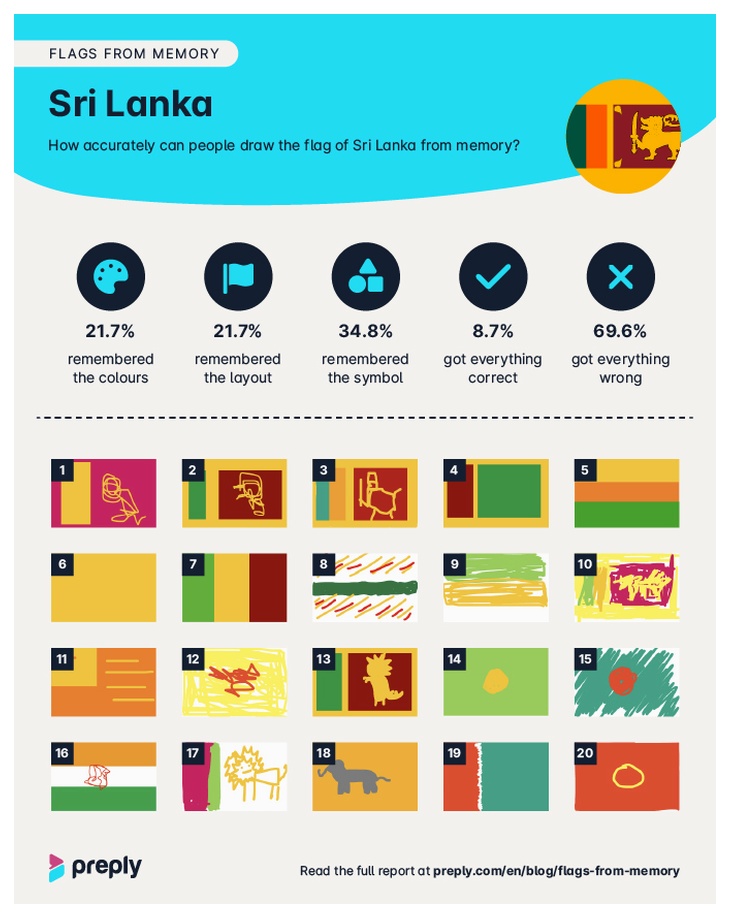
- Sri Lanka’s flag features a complex color palette of mustard, green, burgundy, and orange, making it the least memorable flag among those analyzed, with only five individuals correctly identifying its colors.
- Interestingly, the Sri Lankan flag also had the lowest percentage of people guessing both the lineup/order right.
- Only 6 people out of the 23 surveyed guessed the symbol on the Philippine flag correctly.
Learn a language online with our free learning materials.
Learn English online
Learn French online
What’s the history behind the Sri Lankan and Philippine flags and what makes them so intricate?
The Sri Lankan flag is a vibrant emblem that showcases a golden lion wielding a sword against a rich maroon backdrop, encircled by golden petals. This striking lion symbolizes the nation’s bravery and strength, while the sword signifies the sovereignty of Sri Lanka. The surrounding petals reflect the four core Buddhist teachings: morality, mental culture, wisdom, and deliverance, encapsulating the essence of the country’s cultural identity.
The flag of the Philippines is rich in symbolism. The white triangle embodies ideals of equality and brotherhood, while the sun with its eight rays represents the first eight provinces that bravely revolted against Spanish colonization. Additionally, the three stars within the triangle signify the country’s three primary island groups: Luzon, Visayas, and Mindanao.
What flags are the easiest to remember?
Some flags are more memorable than others. This can be due to a variety of reasons, such as:
- Flags with a simple design – this enables the flag to be read from a distance and instantly recognisable.
- Nationally significant flags—Flags represent a person’s home country and its neighboring nations. The colors and patterns often hold meaningful symbolism, enhancing their memorability and connection to the nation or institution they symbolize.
- Emotionally resonant flags—those that evoke strong feelings and possess significant historical or cultural importance—are more memorable.
- Flags with unique, recognizable designs tend to be more memorable than those with simpler patterns.
- Frequency of Exposure: Individuals are more likely to remember flags they encounter regularly, such as those of countries they visit often or flags displayed in their local communities.
Every participant in the survey correctly identified the flag colors of Germany, the USA, France, Spain, the UK, and Japan. Notably, studies show that red, white, and blue are the most memorable colors for people, adding to their recognition in flags.
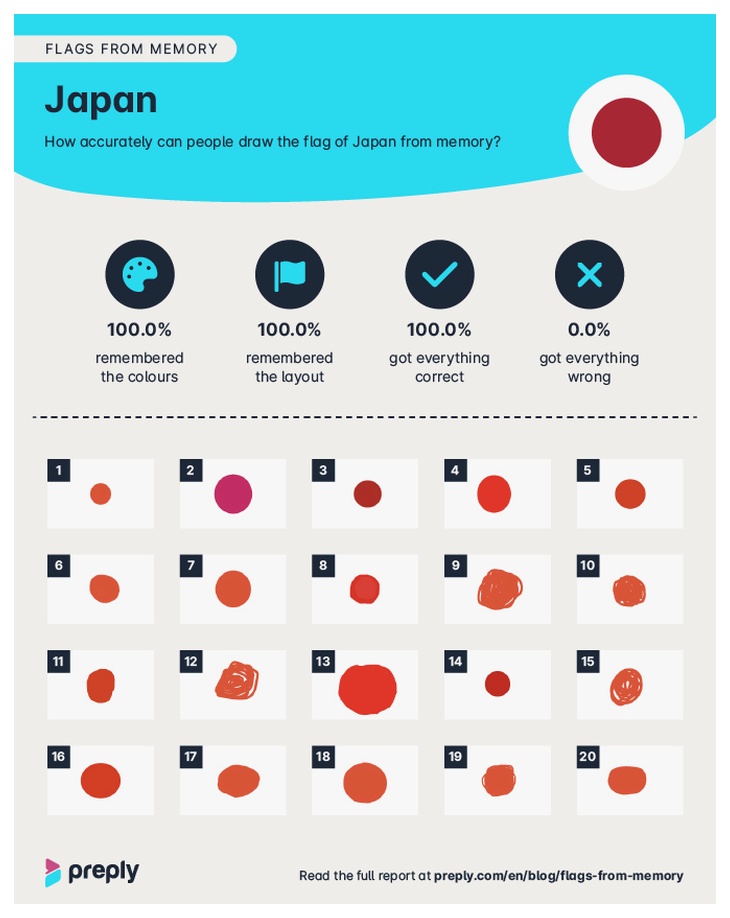
All participants in the survey accurately identified the arrangement of the Japanese flag. Its design, a harmonious mix of simplicity and uniqueness, makes it instantly recognizable. The striking red circle symbolizes the sun, while the white background represents purity and honesty.
Our survey revealed an interesting insight: no single flag symbol was accurately recalled by everyone from memory. This finding underscores the challenge many face in remembering flag symbols, which often tend to be the most commonly forgotten element.
How do the Welsh, Scottish and Irish flag compare?
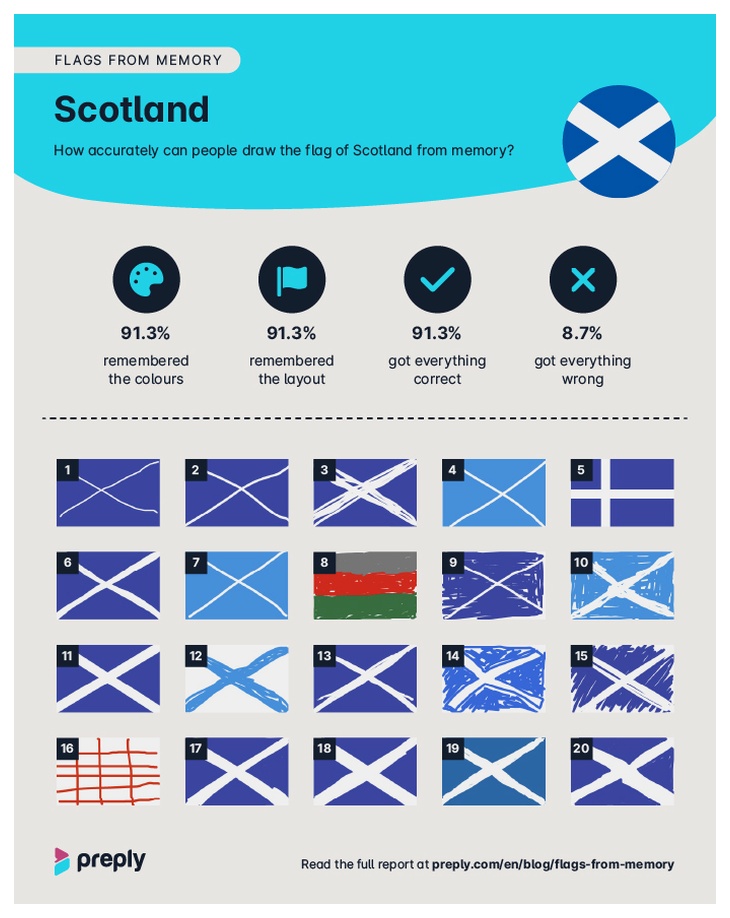
Scotland’s flag stands out as the most recognizable, with an impressive 92% of surveyed individuals correctly identifying its colors and design. Similarly, 92% also recognized the colors of the Irish flag; however, only half of the participants accurately arranged its design.
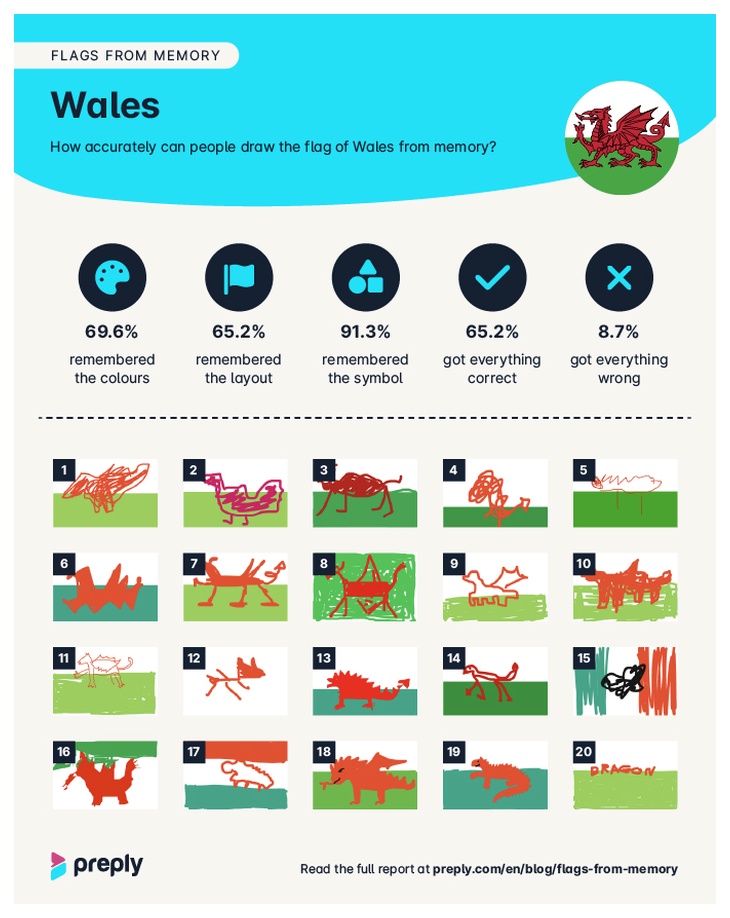
The Welsh flag is often seen as the most challenging to remember among the flags of the UK, with only 65-67% of people able to correctly identify its colors and design. In contrast, the Irish flag is much more recognizable, with an impressive 92% accuracy in recall.
METHODOLOGY
For this exercise, we collected international flag drawings from a group of 23 people.
How have we rated each flag?
For the colours, we have considered it correct, despite the tone as long as the colour is right.
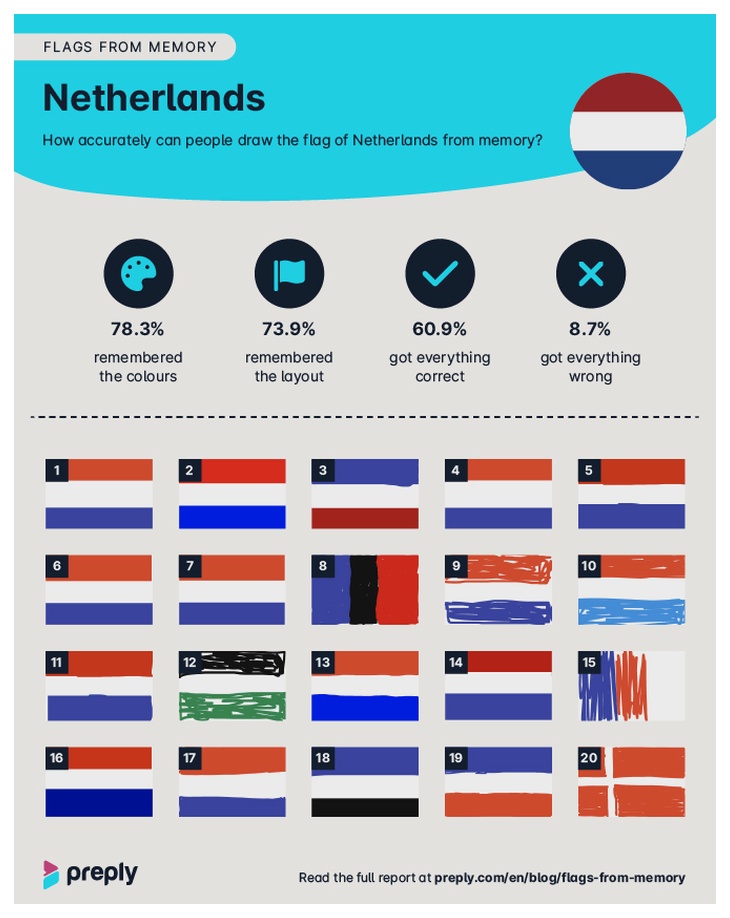
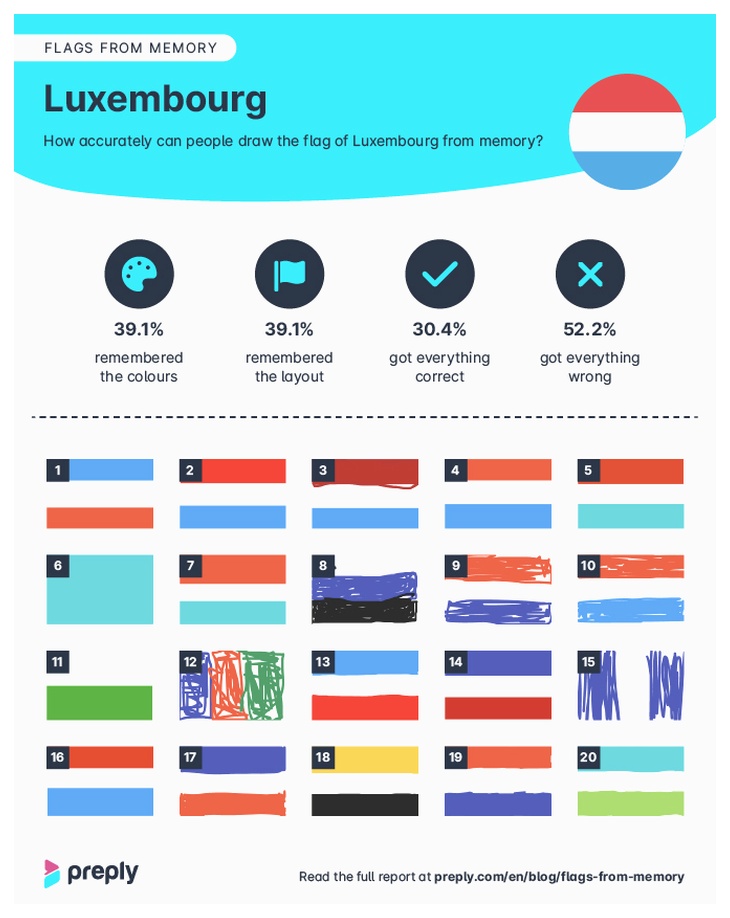
We recognize that some flags, like those of Luxembourg and The Netherlands, stand out due to the varying shades of their stripes. This raises an interesting question: do people actually notice this distinction when they draw these flags, such as using a lighter blue for Luxembourg?
When selecting symbols, our focus wasn’t on finding flawless representations. Instead, we prioritized their overall shape, positioning, and color. For instance, we paid attention to the number of stripes or stars present.
For the line-up/order we considered the placement of the stripes, symbol and the thickness of the bars.
RESULTS
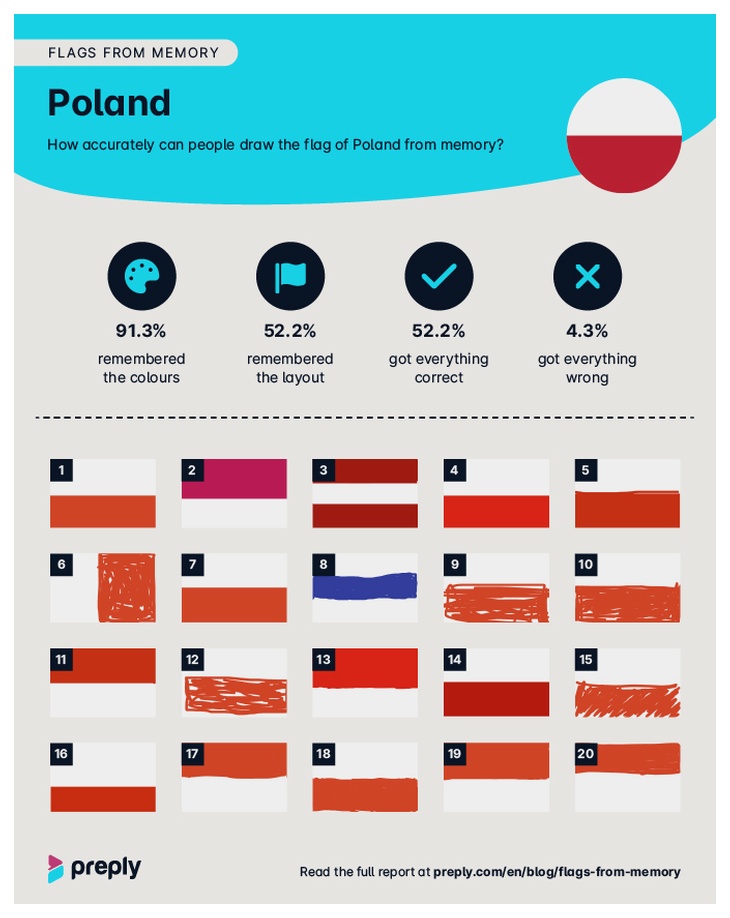
Poland
Out of 23 participants, 21 correctly identified the colors of the flag—white and red. When it came to the arrangement, 12 people accurately guessed the lineup, with white positioned at the top and red at the bottom. Remarkably, another 12 participants nailed both the colors and their order. However, there was one participant who didn’t manage to guess either correctly.
US
Out of 23 participants, an impressive 23 correctly identified the colors of the flag: blue, red, and white. When it came to the flag’s design, 20 participants accurately guessed the arrangement of the blue box alongside the red and white stripes, though we won’t count the exact number of stripes due to their complexity. In terms of symbols, 22 out of 23 recognized the stars, with the number of stars omitted from scoring because of drawing constraints. Overall, 20 participants nailed the flag’s full design, while none of them missed the mark entirely.
France
Out of 23 participants, an impressive 23 correctly identified the colors of the flag. When it comes to the order of the colors, 16 participants nailed it. Additionally, 16 individuals managed to guess both the colors and their correct sequence perfectly. Remarkably, everyone in the group made at least one correct guess!
Germany
Out of 23 participants, an impressive 100% accurately identified the colors of the flag. However, only 11 individuals, about 48%, correctly guessed the order of the colors. Additionally, 11 participants managed to get both the colors and their arrangement right. Remarkably, everyone—none of the participants—failed to make a guess!
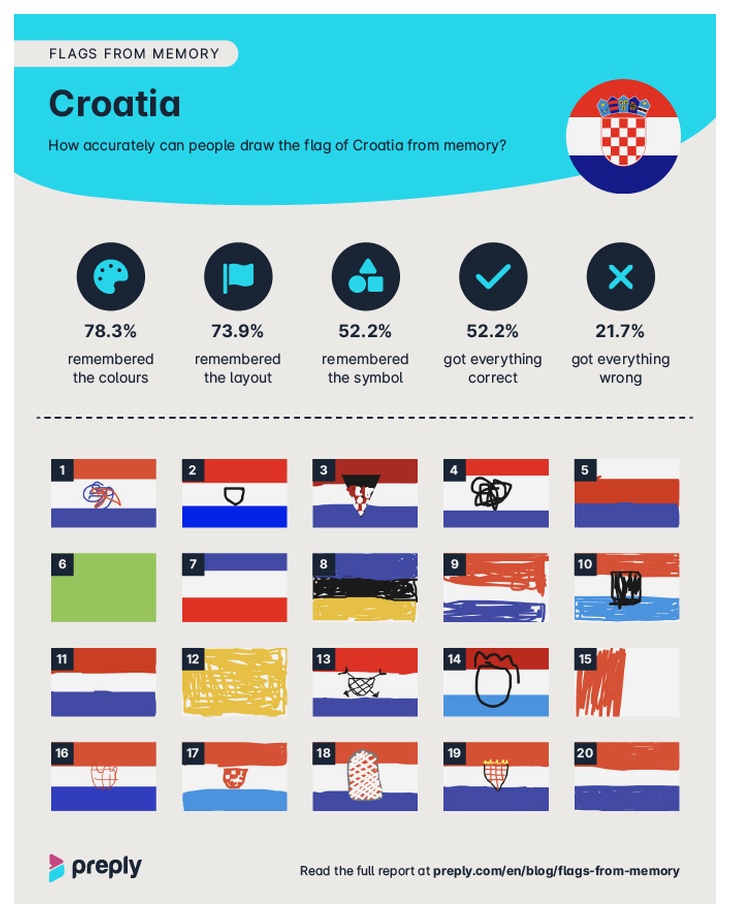
Croatia
When it comes to guessing the flag’s features, here’s how our participants fared: 18 out of 23 correctly identified the colors, while 17 accurately predicted the order of those colors. Only 12 recognized the presence of a symbol in the flag, and the same number achieved a perfect guess overall. Interestingly, 5 participants did not manage to guess any details correctly.
India
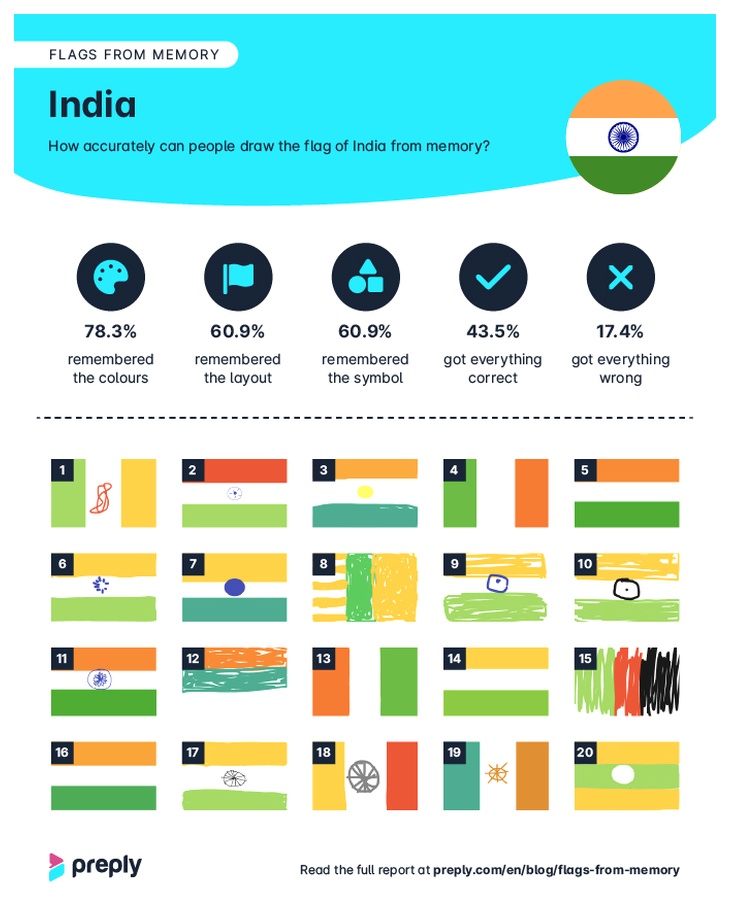
In a recent survey, 18 out of 23 participants accurately identified the colors of the flag. When it came to the order of the colors, 14 participants got it right, and the same number recognized that there is a symbol on the flag. Overall, only 10 out of 23 people managed to guess the flag perfectly, while 4 participants were unable to make any correct guesses.
Spain
Out of 23 participants, 23 correctly identified the colors of the flag. When it came to the order of those colors, 18 people got it right. Only 9 individuals recognized that there was a symbol featured on the flag, while just 7 participants managed to guess all aspects of the flag accurately. Impressively, not a single person failed to make a guess.
Italy
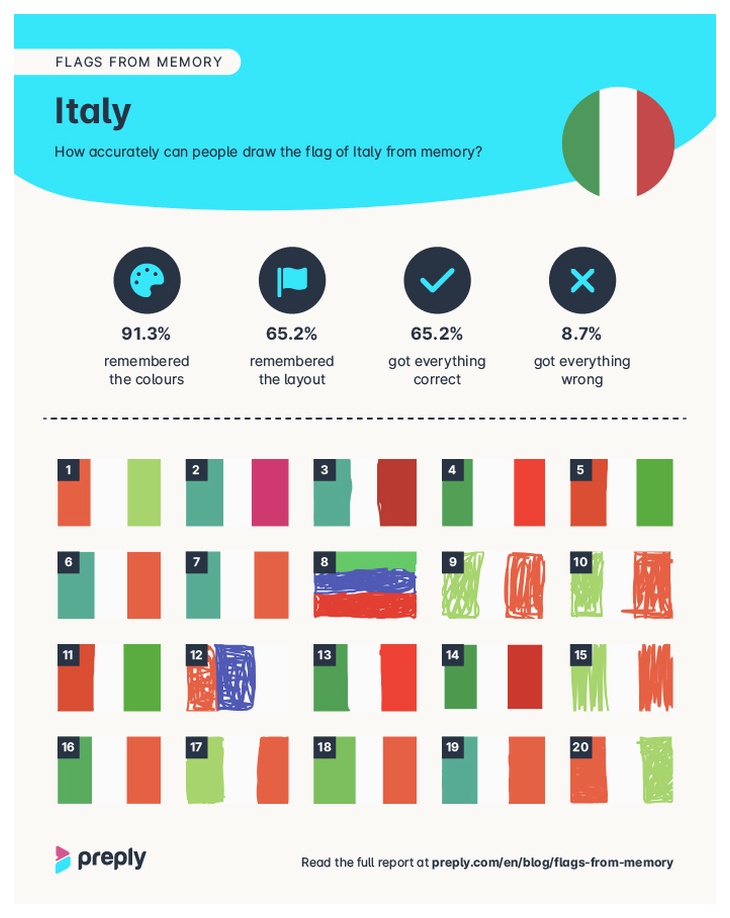
Out of 23 participants, 21 successfully identified the correct colors. When it came to the order of the colors, 15 participants got it right. Overall, 15 individuals perfectly guessed the arrangement of the flag. Notably, 2 participants were unable to guess either the colors or the order.
Brazil
Out of 23 participants, 17 successfully identified the correct colors of the flag, while 16 accurately guessed its order or lineup. Additionally, 14 noticed that there was a symbol present on the flag. In total, 13 participants nailed every aspect of the flag, whereas 5 individuals were unable to make any correct guesses.
Korea
Out of 23 participants, only 11 correctly identified the colors of the flag, while 10 successfully guessed the order of the colors. Additionally, 10 people recognized that there is a symbol featured on the flag. Remarkably, 10 participants managed to guess all aspects of the flag accurately. Conversely, 12 individuals did not make any correct guesses at all.
UK
Out of 23 participants, an impressive 23 correctly identified the colors of the flag. When it came to the arrangement, 21 out of 23 got the order right. Overall, 21 participants nailed the flag’s details perfectly, while everyone managed to make at least one guess—no one left without attempting!
China
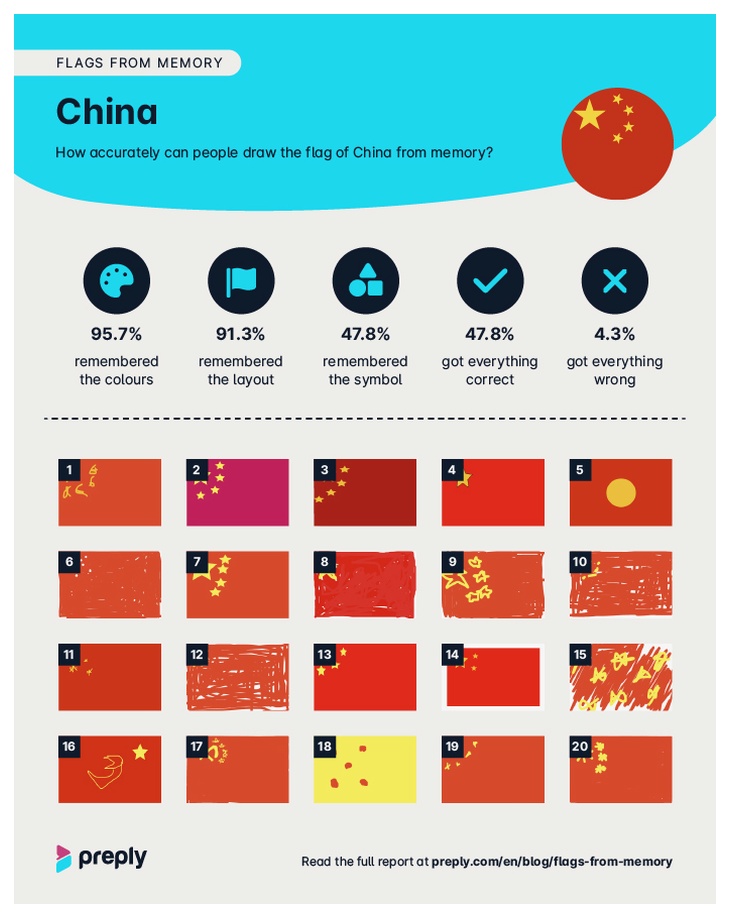
Out of 23 participants, 22 correctly identified the colors of the flag, while 21 accurately guessed its arrangement. Only 11 recognized the presence of a symbol, and the same number perfectly identified every aspect of the flag. Impressively, just one participant was unable to make any correct guesses.
Sweden
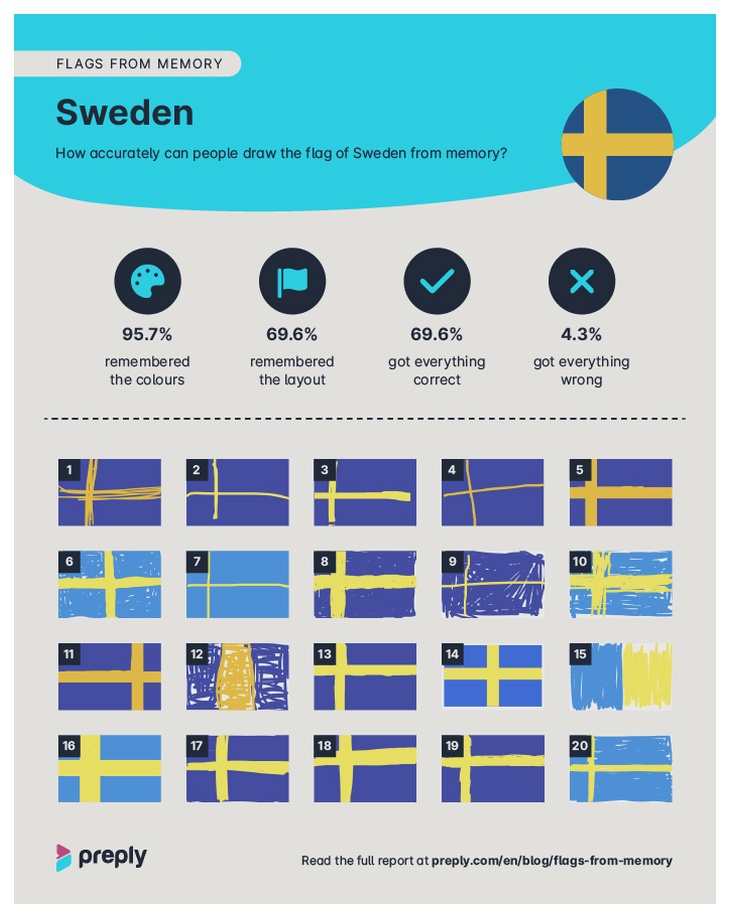
In a recent survey, 22 out of 23 participants correctly identified the colors, while 16 successfully predicted the order of the elements. Impressively, 16 also nailed the flag design. Only one participant missed all three aspects.
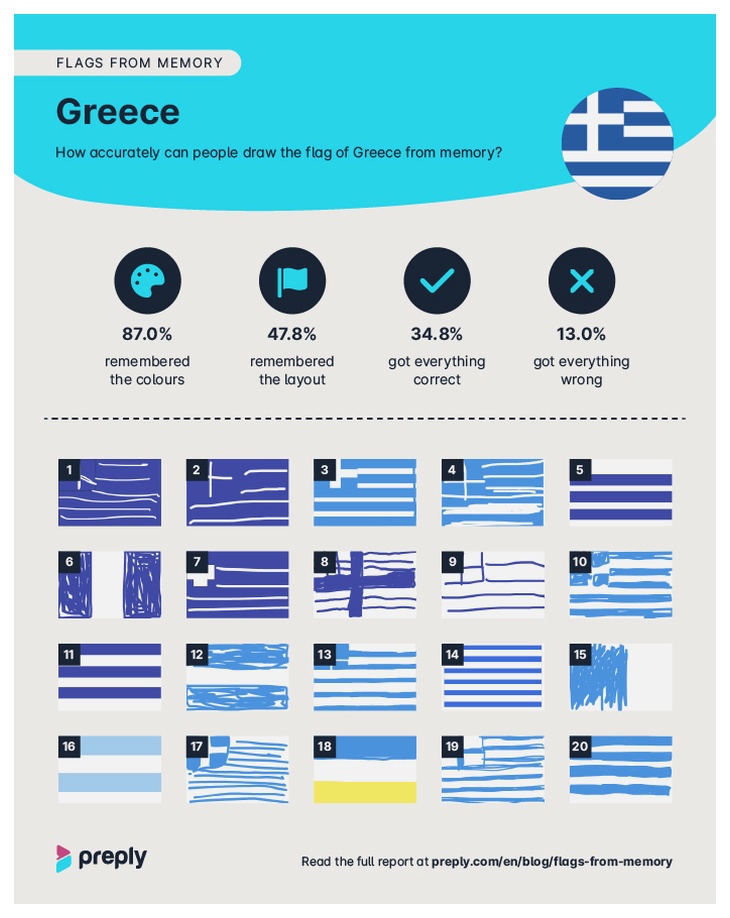
Greece
In a recent guessing game, 20 out of 23 participants accurately identified the colors. When it came to the order or lineup, 11 participants got it right. Only 8 individuals nailed the flag’s details perfectly, while 3 participants missed the mark entirely.
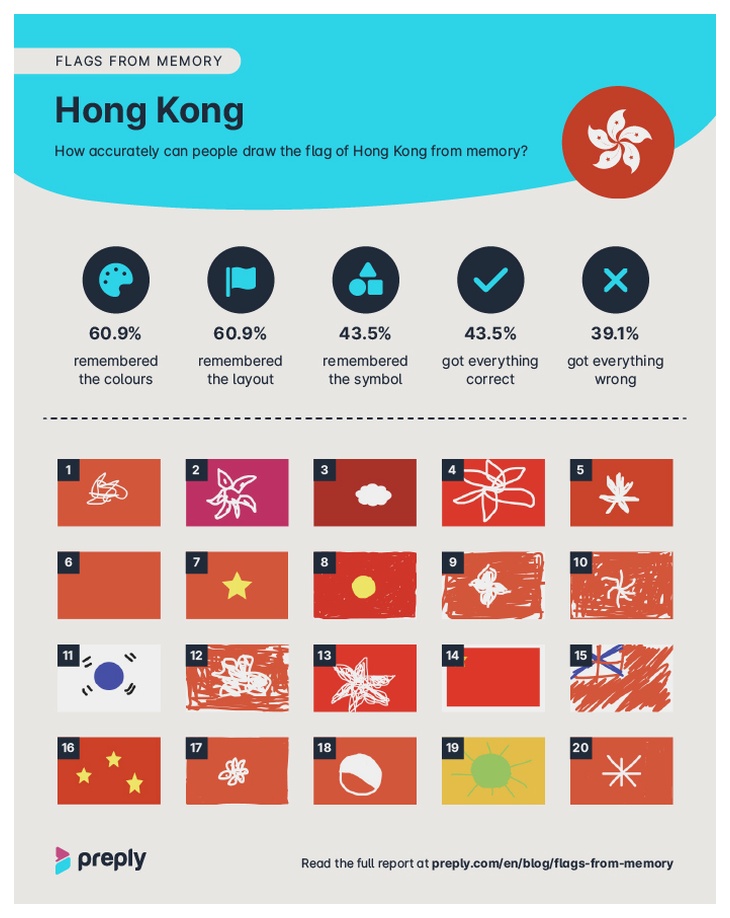
Hong Kong
Out of 23 participants, 14 accurately identified the colors and the order of the lineup. Only 10 guessed the symbol correctly, while the same number managed to perfectly identify the flag. Interestingly, 9 participants were unable to make any correct guesses at all.
Japan
Of the 23 participants, everyone accurately identified the colors, lineup, and flag, resulting in a perfect score across the board. Remarkably, none of the participants missed any guesses!
Sri Lanka
Out of 23 participants, only 5 correctly identified the colors of the flag. Similarly, just 5 people guessed the order or lineup accurately, while 8 managed to identify the symbol. Only 2 participants nailed the flag in its entirety. Unfortunately, a significant 16 out of 23 participants were unable to guess any elements correctly.
Netherlands
Out of 23 participants, 18 successfully identified the correct colors, while 17 accurately guessed the order of the lineup. Only 14 managed to perfectly recognize the flag. Interestingly, 2 individuals were unable to make any correct guesses.
Luxembourg
Out of 23 participants, 9 successfully identified the correct colors, while another 9 guessed the order or lineup accurately. Only 7 participants nailed the flag’s design perfectly. Unfortunately, 12 of the participants were unable to make any correct guesses at all.
Philippines
Results Summary: Out of 23 participants, 9 successfully identified the correct colors, while another 9 accurately guessed the order of the lineup. Only 6 participants got the symbol right, and just 5 achieved a perfect guess of the flag. Notably, 12 participants were unable to guess any elements correctly.
Iceland
Out of 23 participants, 11 successfully identified the correct colors of the flag. When it came to the order or lineup, 14 participants got it right. However, only 9 individuals accurately guessed the flag in its entirety. Interestingly, 7 participants were unable to make any correct guesses at all.
Indonesia
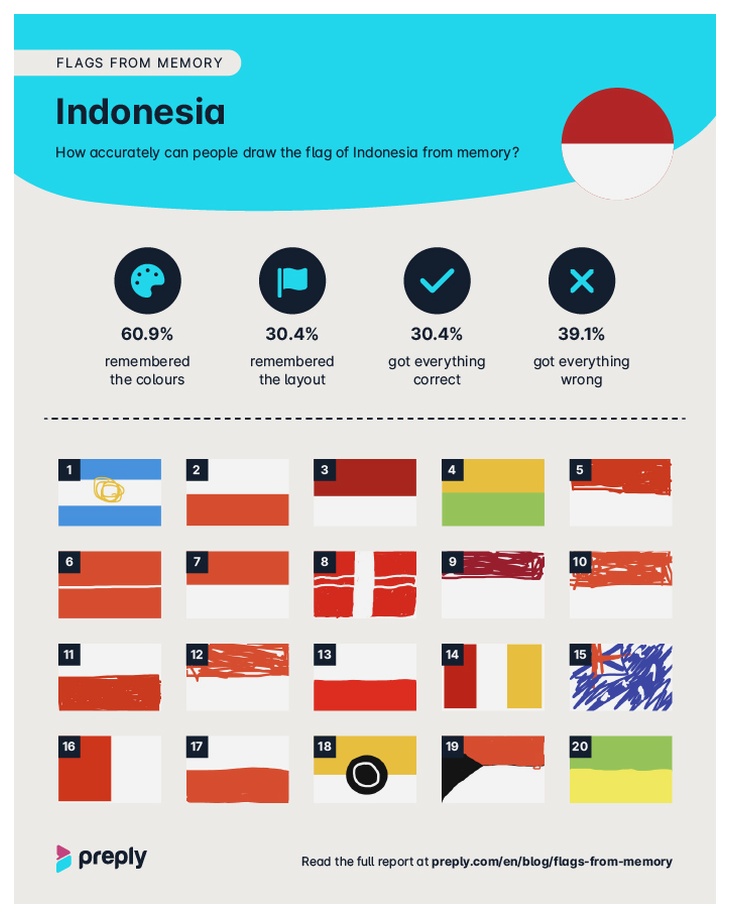
Out of 23 participants, 14 successfully identified the correct colors. When it came to the order or lineup, only 7 got it right. Additionally, 7 individuals managed to perfectly guess the flag. Unfortunately, 9 participants didn’t accurately guess any of the elements.
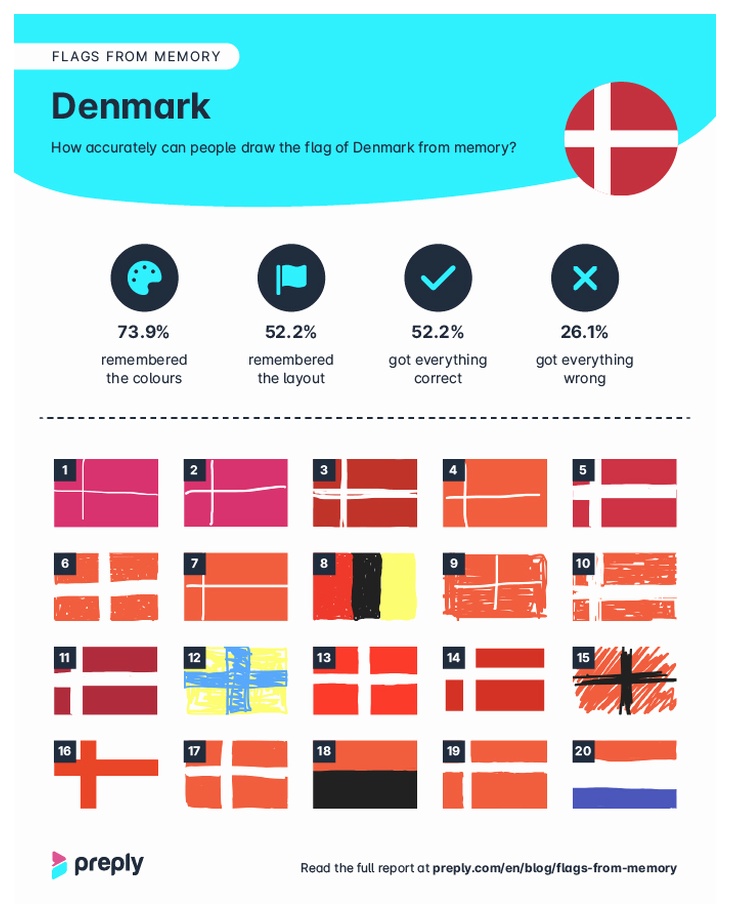
Denmark
Out of 23 participants, 17 correctly identified the colors. When it came to the order or lineup, 12 participants got it right. Additionally, 12 people perfectly guessed the flag. Interestingly, 6 participants failed to guess any of the elements.
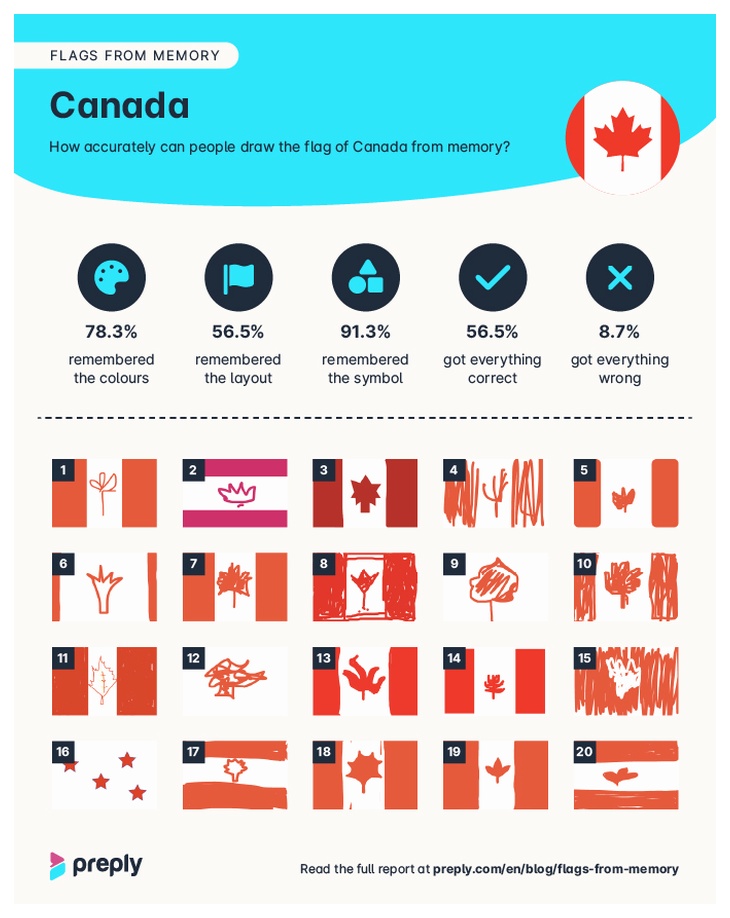
Canada
Out of 23 participants, 18 correctly identified the colors, while 13 successfully guessed the order of the elements. A notable 21 participants accurately recognized the symbol, but only 13 got the flag’s details right. Interestingly, 2 individuals were unable to make any correct guesses at all.
Hungary
Out of 23 participants, 15 correctly identified the colors of the flag, while 10 managed to guess the order of the colors accurately. Only 9 out of 23 got the flag exactly right, and notably, 7 participants were unable to make any correct guesses.
Portugal
Out of 23 participants, 18 successfully identified the colors, while 13 correctly guessed the order or lineup. Additionally, 12 people accurately recognized the symbol, and only 10 participants nailed the flag in its entirety. Interestingly, 5 individuals didn’t make any correct guesses at all.
Wales
Out of 23 participants, 16 accurately identified the colors, while 15 got the order of the lineup correct. An impressive 21 participants correctly guessed the symbol, and 15 nailed the flag design. However, 2 individuals didn’t make any correct guesses at all.
Scotland
Out of the 23 participants, an impressive 21 successfully identified the correct colors and lineup of the flag. All 21 participants accurately guessed the flag’s design, while only 2 individuals missed the mark entirely.
Ireland
Out of 23 participants, 21 successfully identified the correct colors of the flag. When it came to the order or lineup of those colors, 12 participants got it right. Impressively, 12 individuals nailed the flag’s design as a whole. However, there were 2 participants who didn’t make any correct guesses at all.
Frequently Asked Questions
What was the purpose of the flag sketching experiment?
The experiment aimed to gauge national flag knowledge by inviting participants to sketch the flags of 30 different countries purely from memory.
Which flags were the hardest for participants to remember?
Flags with intricate designs and less common colors, such as Sri Lanka’s flag, were the hardest to remember, with only five participants correctly identifying its colors.
What historical significance do flags have?
Flags have a rich history, serving as symbols of identity, unity, and sovereignty for nations, dating back to ancient civilizations.
Which flags were the easiest for participants to remember?
Flags with simple designs and those representing participants’ home countries, such as Germany, the USA, and Japan, were the easiest to remember.
How did the flags of the UK compare in recognizability?
Scotland’s flag was the most recognizable among the UK flags, with 92% of participants correctly identifying its colors and design, while the Welsh flag was the most challenging.