
- Canada’s most diverse cities
- 1. Kitchener, ON
- 2. Winkler, MB
- 3. Guelph, ON
- 4. Squamish, BC
- 5. London, ON
- Canada’s cities with the greatest linguistic diversity
- Which Canadian province is the most diverse?
- Conclusion
- Frequently Asked Questions
- What factors were considered to evaluate the diversity of Canadian cities?
- Which city in Canada ranks as the most diverse?
- How has the immigrant population in Winkler, Manitoba changed recently?
- What is the most multicultural province in Canada?
- How many languages are spoken in Canada according to the article?
We examined data on the cultural and linguistic diversity of cities and provinces throughout Canada to identify those that are reaping the greatest benefits from this rich diversity.
Canada boasts a vibrant tapestry of cultures and languages that shape its unique identity. Over the years, the country has embraced individuals and families from diverse corners of the globe. According to recent Census data, Canada is home to more than 8.6 million immigrants, and that number keeps rising, highlighting the nation’s ongoing commitment to diversity and inclusion.
Since 2016, Canada’s population has surged by over 5%, ushering in a wave of cultural and linguistic diversity. This dynamic mix has transformed the country into a vibrant socio-cultural mosaic, promoting a rich exchange of ideas and experiences that drives innovation and inclusivity.
To uncover the regions in Canada with the richest linguistic and cultural diversity, we examined the most recent Canadian Census data, focusing on five key factors across 110 of the largest cities. Additionally, we explored the diversity found throughout all 13 provinces, providing a comprehensive look at Canada’s multicultural landscape.
We considered five key factors to deduce the most diverse areas of Canada. These were:
- Immigrant residents: The percentage of the population that are, or who have ever been, landed immigrants or permanent residents.
- Immigration Growth Comparison (2011-2015 vs. 2016-2021): Analysis of the immigrant community size change between these two periods.
- **In-Migrant Population:** The percentage of residents who moved to the city or province within five years prior to 2021. In-migrants are individuals who did not reside in the area five years before the reference date but were living there as of 2021.
- Percentage of Population Speaking Non-Official Languages: The proportion of individuals whose first language is a non-official language, excluding French and English.
- Non-official language spoken at home: The percentage of the population who recorded speaking at least one non-official language at home.
We evaluated each city and province based on the number of individuals in five distinct categories, ultimately assigning an overall diversity score to each location. By ranking these scores, we identified the most diverse areas, showcasing the places with the richest variety of people.
Canada’s most diverse cities
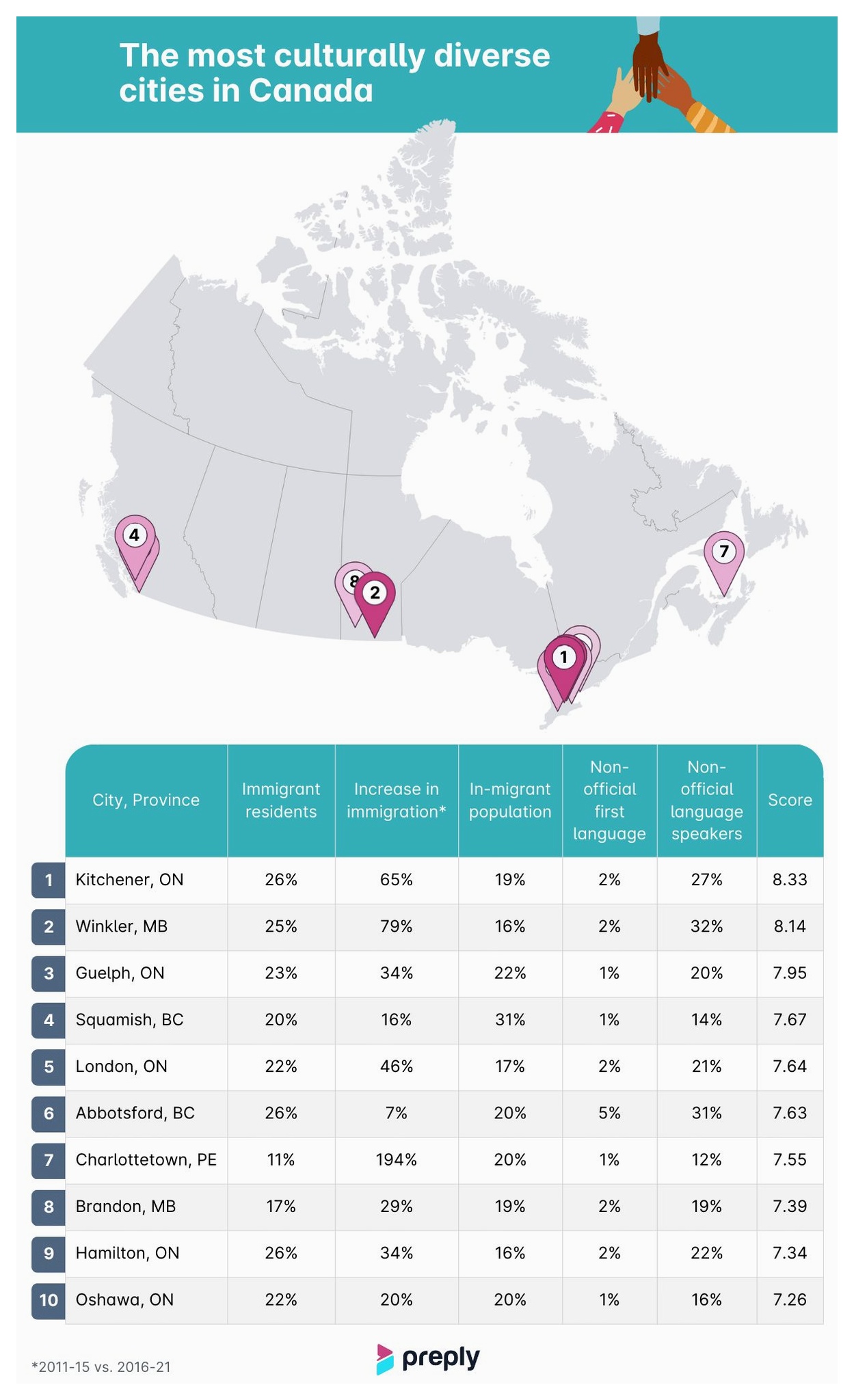
Considering various metrics, we’ve identified the ten most culturally and linguistically diverse cities in Canada. Leading the pack is Kitchener, Ontario, boasting an impressive score of 8.33 out of 10. Trailing closely are Winkler, Manitoba, at 8.14, and Guelph, Ontario, with a score of 7.95.
Surprisingly, just two of Canada’s ten largest cities made it into the top ten for diversity. However, Toronto, the nation’s biggest city, ranks 19th overall and boasts the highest percentage of immigrants and speakers of multiple non-official languages.
More than half of the top-ranking cities are found in Ontario, totaling 11. British Columbia follows with six cities, while Manitoba contributes two, and Prince Edward Island has one.
Québec city only ranked 83rd of the 110 cities analyzed.

Learn a language with personalised 1-on-1 classes with our expert tutors from all over the world
French lessons online
Spanish lessons online
1. Kitchener, ON
Kitchener stands out as the top city for multicultural and linguistic diversity, boasting a rich history of embracing immigrants. In the 20th century, it saw a notable influx of people from German-speaking nations, which has contributed to its vibrant cultural tapestry. Today, Kitchener proudly hosts a wide array of ethnic and cultural communities, making it a dynamic and inclusive place to live.
Kitchener is experiencing a significant wave of immigration, mirroring trends seen across the nation. Between 2011-2015 and 2016-2021, the city welcomed over 10,000 new permanent residents, marking a remarkable 65% increase. In comparison, Canada’s overall immigration rate during the same timeframe was just 18%.
Over a quarter (27%) of the population also noted speaking at least one language other than French or English.
2. Winkler, MB
Winkler, though small in population, has emerged as a vibrant melting pot of cultures and backgrounds. This dynamic city serves as a regional center for commerce, agriculture, and industry, laying a strong foundation for ongoing economic growth and development. Notably, the immigrant population surged by 79% between 2011-2015 and 2016-2021, contributing to a remarkable increase in permanent residents, who now make up 25% of the community.
Winkler is a vibrant hub of linguistic diversity, with nearly one-third of its residents speaking at least one non-official language in their homes. This rich tapestry of languages reflects the community’s multicultural fabric and enhances its unique character.
Learn a language online with our free learning materials.
Learn English online
Learn French online
3. Guelph, ON
Guelph is known for its inclusive and progressive spirit, creating a warm and inviting atmosphere for individuals from all walks of life. Currently, it boasts the 12th largest immigrant population in Canada, with immigrants accounting for 23% of the city’s residents.
The city has implemented a Strategic Plan designed to foster values that promote an inclusive, connected, and thriving community, supported by various organizations dedicated to this mission.
The University of Guelph plays a vital role in enriching the community by attracting students and residents from across Canada and around the globe, fostering a vibrant and diverse environment.
4. Squamish, BC
Squamish has both a fast-growing economy and community. The population increased by 22% between 2016 and 2021.
Squamish ranks as the fourth city in Canada with the highest percentage of newcomers, with nearly one-third (31%) of its residents having moved there within the past five years. Additionally, one in five residents is an immigrant, enriching the community with a vibrant mix of cultures and backgrounds.
Its close location to Vancouver makes it easily accessible for a diverse, multicultural community, making it a favored option for individuals seeking a quieter lifestyle away from the hustle and bustle of the big city.
5. London, ON
London is among Canada’s largest cities, boasting a diverse population that creates a vibrant community rich in various languages, cultures, and ethnicities. This blend of backgrounds enhances the city’s social fabric and fosters a dynamic environment for all its residents.
London hosts Western University, the seventh largest in Canada, which draws a vibrant mix of students and faculty from various backgrounds. Many of these individuals choose to settle in London and its nearby regions, contributing to the city’s dynamic community.
The city boasts a rich tapestry of linguistic diversity, with more than 8,000 residents who grew up speaking a non-official language and over 112,000 individuals who communicate in at least one non-official language. This vibrant mix highlights the cultural mosaic that defines the community.
Canada’s cities with the greatest linguistic diversity
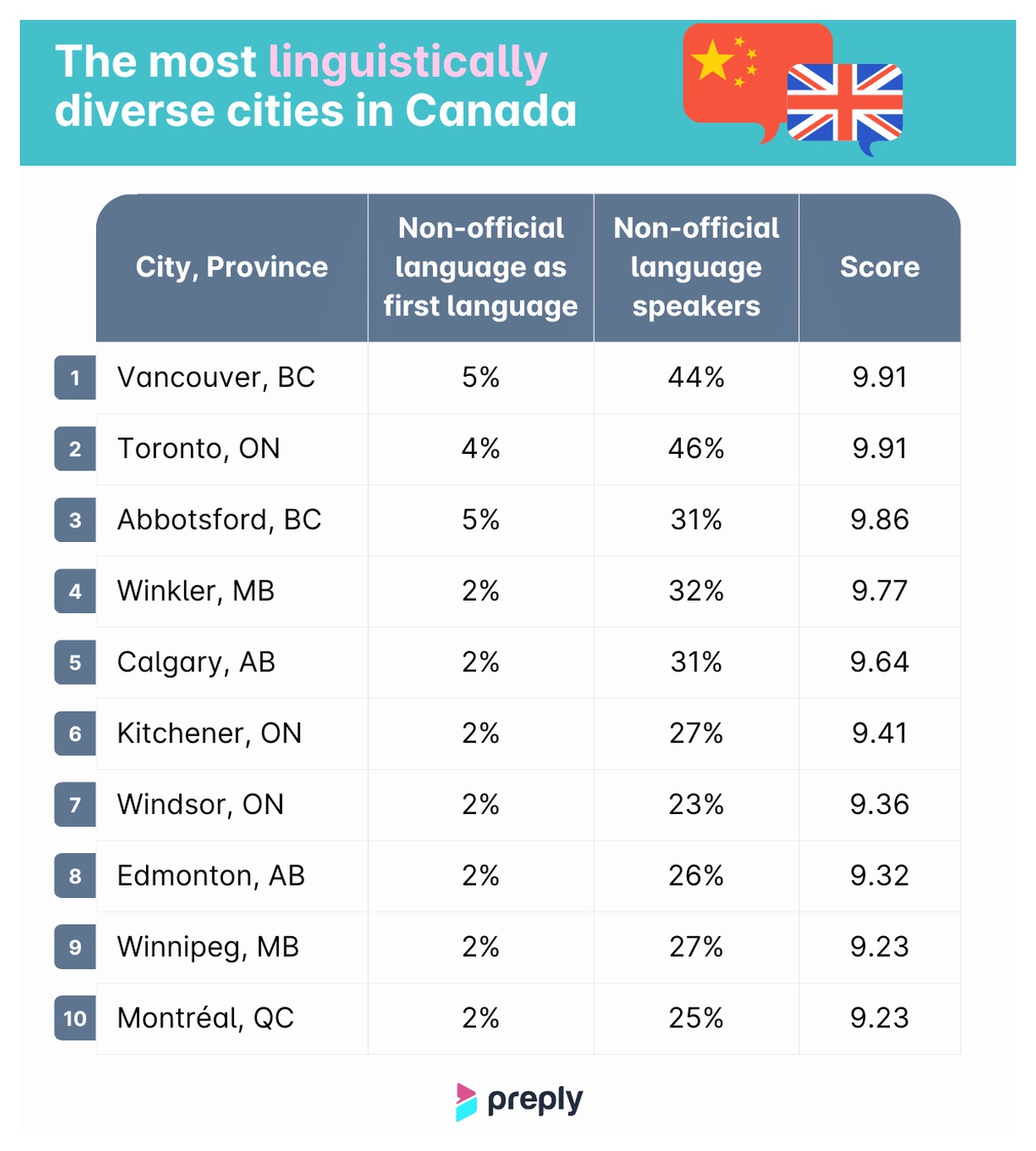
Census data reveals that Canada is a vibrant tapestry of over 200 languages spoken by its residents. While English and French hold the status of official languages, numerous other languages thrive in everyday conversations across the country. Our goal was to delve deeper and uncover which cities boast the richest diversity of these non-official languages.
To uncover this information, we examined the percentage of residents who used a non-official language as their first language, along with those who communicated in at least one non-official language at home.
Vancouver and Toronto emerged as the top contenders, both scoring an impressive 9.91 out of 10, while Abbotsford closely trailed with a score of 9.86.
Which Canadian province is the most diverse?
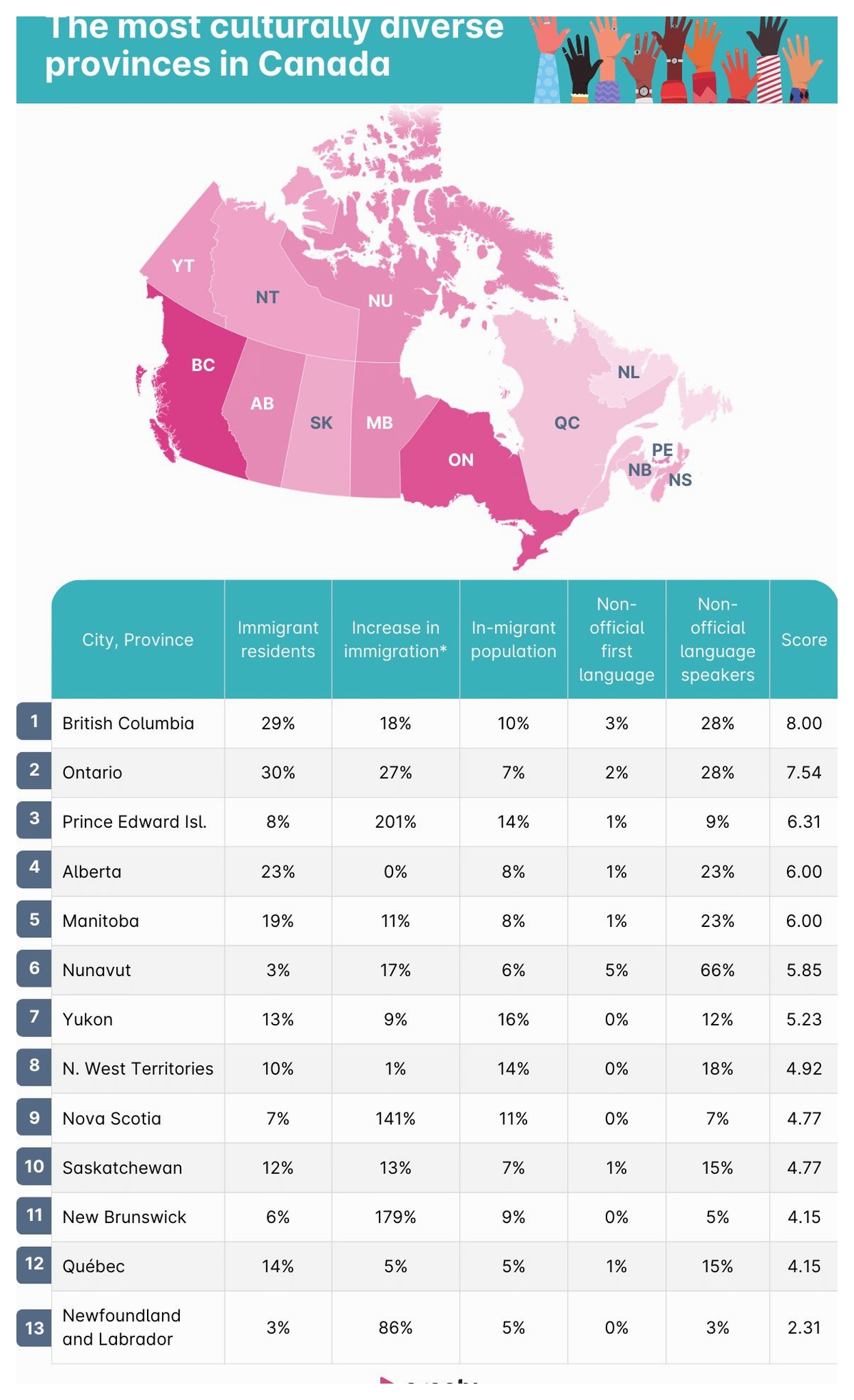
While Ontario boasts many of Canada’s most diverse cities, British Columbia (BC) stands out as the country’s most multicultural province. Nestled on the western edge of Canada, BC is renowned for its stunning landscapes and natural beauty, but it has also emerged as a vibrant cultural and linguistic melting pot, celebrating a rich tapestry of traditions and communities.
In 2021, nearly one in three residents of British Columbia (29%) were immigrants, reflecting an impressive 18% increase in immigration from 2011 to 2021. This rate surpasses the national average for Canada, which stands at 23%. Additionally, cultural diversity is evident in the province, with 28% of the population speaking a language other than French or English at home, and 3% identifying a non-official language as their primary language.
Conclusion
In our ever-evolving global landscape, Canada exemplifies the power of diversity, driven by a steady influx of immigrants. This rich multicultural fabric is particularly evident in cities like Kitchener, Winkler, Guelph, Squamish, and London, which shine as beacons of cultural variety. However, the trend of embracing diversity can be seen throughout cities across the nation, highlighting Canada’s commitment to inclusivity.
At LingualNeeds, we believe that language classes can bridge gaps between residents, fostering deeper understanding on both linguistic and cultural levels. We encourage individuals from diverse backgrounds to delve into various languages, whether they are official or not. For those whose first language isn’t one of Canada’s official languages, taking online English or French lessons can be a valuable step toward connecting more meaningfully with neighbors and fellow Canadians.
Methodology
We examined the 2021 Canadian Census data, released in 2022, to identify the most diverse cities and provinces across Canada.
The data points we incorporated into our index were as follows:
- Immigrants (total from before 2001 to 2021)
- Immigrants (the increase between 2011 to 2015 and 2016 to 2021)
- Total in-migrants (components of migration five years ago)
- First official language spoken for the total population, excluding institutional residents
- All languages spoken at home for the total population, excluding institutional residents
We evaluated each city and province based on five key metrics, assigning scores from one to ten for each data point. By calculating the average score across all metrics, we determined a final score that highlights the most diverse regions.
For our analysis, we focused on data from ‘Census Metropolitan Areas’ (CMAs) which typically align with a primary city. When a CMA encompassed several cities, such as St. Catharines-Niagara, we included only the largest city in our index. In cases where a single city was represented by multiple CMAs, we aggregated the data to reflect the total population. Additionally, we excluded cities with populations under 20,000 to ensure our index captures significant urban centers.
Frequently Asked Questions
What factors were considered to evaluate the diversity of Canadian cities?
Five key factors were considered: the percentage of immigrant residents, immigration growth comparison (2011-2015 vs. 2016-2021), in-migrant population, percentage of the population speaking non-official languages, and non-official languages spoken at home.
Which city in Canada ranks as the most diverse?
Kitchener, Ontario, ranks as the most diverse city in Canada, with a score of 8.33 out of 10.
How has the immigrant population in Winkler, Manitoba changed recently?
Winkler’s immigrant population surged by 79% between 2011-2015 and 2016-2021, contributing to 25% of the community being permanent residents.
What is the most multicultural province in Canada?
British Columbia is recognized as the most multicultural province in Canada, with 29% of its residents being immigrants.
How many languages are spoken in Canada according to the article?
Canada is home to over 200 languages spoken by its residents.