- Key findings
- Americans’ favorite and most used baby talk words
- Baby talk Americans’ love to use with pets and romantic partners
- Baby talk critics
- The baby talk words and characteristics American’s find irksome
- “You’re not a parent, so you wouldn’t understand,” tops list as most irritating parent phrase
- Parental online and conversational habits that can be frustrating
- Building a multilingual family
- Frequently Asked Questions
- What is baby talk and why is it used by parents?
- What are some of the favorite baby talk words among American parents?
- How do non-parents feel about baby talk?
- Is baby talk only used with children?
- What are some common phrases that irritate non-parents during conversations?
Parenthood is an extraordinary adventure brimming with joy, challenges, and invaluable lessons. However, it also comes with its fair share of quirks and unique habits. For non-parents, the world of parenting can appear both intriguing and entertaining, sparking a blend of curiosity and amusement as they observe this captivating journey from afar.
Childhood development is a fascinating journey filled with both joy and complexity. Young children absorb knowledge through observation, play, online learning, and even playful baby talk. In this formative stage, parents emerge as their children’s primary educators, cultivating a special mix of patience, creativity, and nurturing. This educational experience not only shapes the child’s language but also transforms the parents themselves. Intrigued by this dynamic, we explored the distinctive language habits of parents that catch the attention of those without children.
To uncover the perceptions of non-parents regarding typical parenting conversations, we conducted a survey with 997 Americans. Our findings revealed their opinions on everything from beloved baby talk phrases to candid discussions about children’s bodily functions, shedding light on what they truly think about the everyday topics parents often discuss.
Key findings
- “Cuddles,” “dolly,” and “night-night” are America’s favorite baby talk words.
- “Night-night,” “tummy,” and “binky” are the top baby talk words people hear young parents say.
- “Boo boo,” “tummy,” and “wuv” are the top baby talk words people use with a romantic partner.
- Nearly half of pet parents say they use baby talk with their pets.

Learn a language with personalised 1-on-1 classes with our expert tutors from all over the world
French lessons online
Spanish lessons online
Americans’ favorite and most used baby talk words
From the moment a child takes their first breath, parents instinctively seek to bond with them. One of the most powerful tools for this connection is language, encompassing both spoken words and nonverbal cues. Whether it’s a parent’s warm greeting or the baby’s first cries, these early interactions lay the foundation for meaningful communication between them.
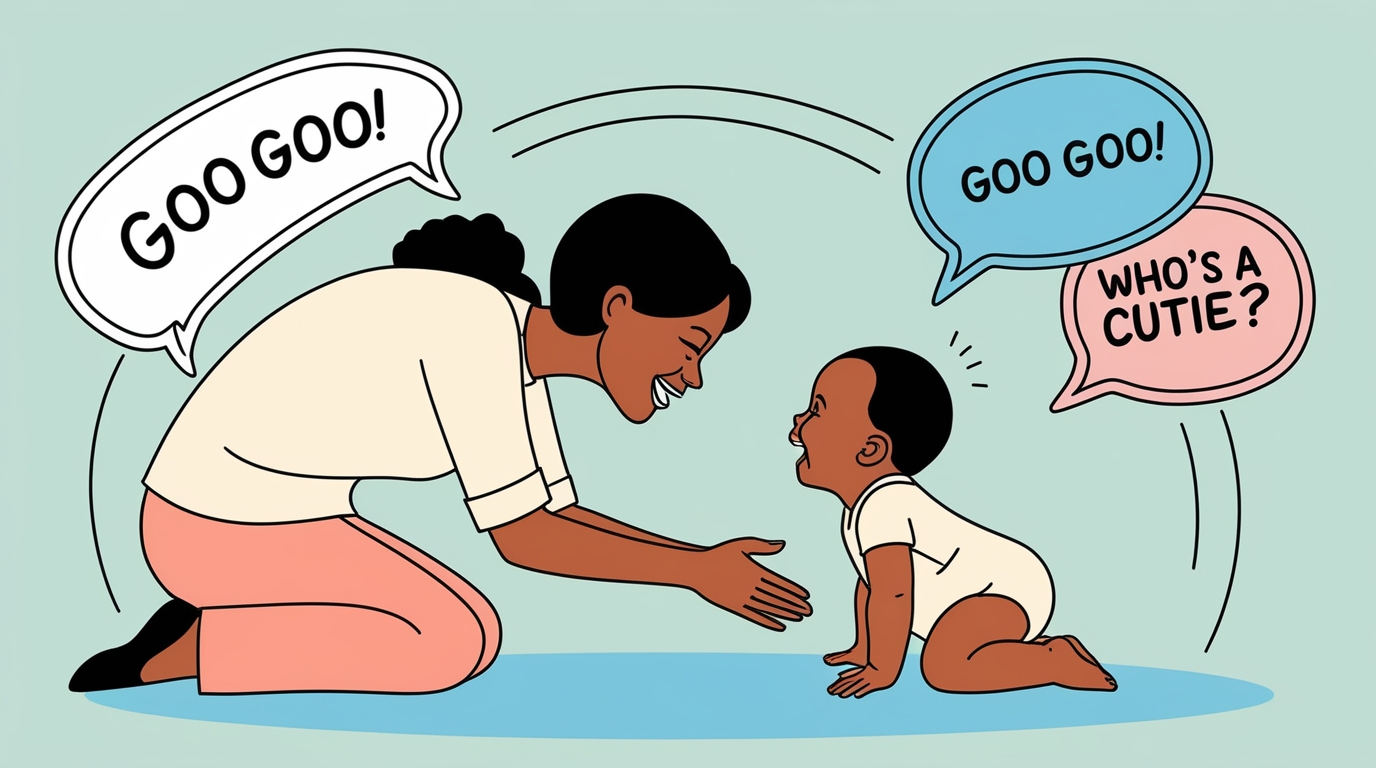
Babies begin their verbal journey with playful, nonsensical sounds that encourage them to explore their voices. In turn, parents engage with their little ones through baby talk, characterized by imaginative words and a lively, high-pitched tone that captures their attention and fosters communication.
While countless baby-talk words and phrases emerge as each child invents their own unique language, certain terms resonate more with American parents. Favorites like “cuddles,” “dolly,” and “night-night” capture the hearts of many, reflecting the sweet and tender moments shared between caregivers and little ones.
Young parents often have a unique vocabulary that reflects their care for their children. Common phrases include “night-night” for bedtime, gently rubbing their child’s “tummy” to soothe them, and offering a “binky” for comfort. These terms frequently make the list of the most commonly used words among parents.

Baby talk Americans’ love to use with pets and romantic partners
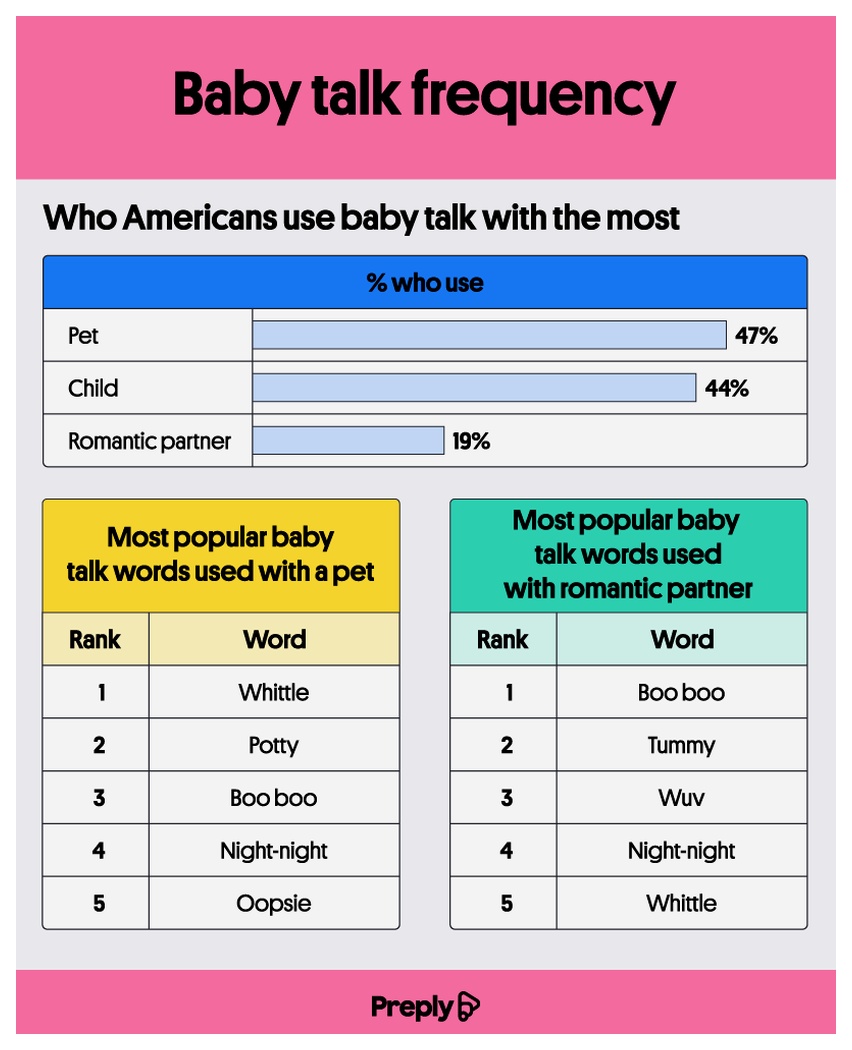
While the term “baby talk” implies it’s primarily for infants, many Americans also employ this playful language with their pets and romantic partners. Interestingly, a survey reveals that 47% of people use baby talk with their pets, surpassing the 44% who reserve it for their children.
Many pet owners view their beloved furry companions as their children, which explains why they often resort to baby talk when interacting with them. Some of the most popular terms used include “whittle,” “potty,” and “boo boo.” This playful language helps strengthen the bond between pets and their owners, adding a touch of warmth to their everyday communication.
Romance often flourishes through playful pet names, shared inside jokes, and unique language habits. Interestingly, 19% of our survey respondents also embrace baby talk as part of their affectionate communication. The most popular terms they use include “boo boo,” “tummy,” and the endearing phrase “I ‘wuv’ you,” highlighting a charming aspect of relationships across America.
Learn a language online with our free learning materials.
Learn English online
Learn French online
Baby talk critics
Many Americans enjoy using baby talk, recognizing its positive impact on child development. However, some people dislike this way of speaking, despite evidence supporting its benefits for young children.
While invented words may not help with language acquisition, “parentese”—characterized by a higher pitch, slower tempo, and exaggerated intonation—has been shown to significantly enhance infant speech development. Research from PNAs reveals that children whose parents engage in this effective form of baby talk tend to speak real words at nearly double the rate of those whose parents do not.
Despite its popularity, most observers find baby talk to be quite bothersome. In fact, a recent survey revealed that 56% of participants feel uneasy when they hear someone using baby talk, and a striking 69% find it irritating when parents communicate with their children in this way.
Many non-parents find baby talk off-putting, with 53% admitting they find it annoying and 56% considering it a turnoff when their partners use this style of communication with kids. Interestingly, this isn’t always a deliberate choice. A significant number of parents struggle to switch between baby talk and their usual speech, leading 72% to report instances where they’ve heard parents talk to adults as if they were children.

Interestingly, pet parents have more leeway. Only 41% find it annoying when people use baby talk with their pets.
The baby talk words and characteristics American’s find irksome
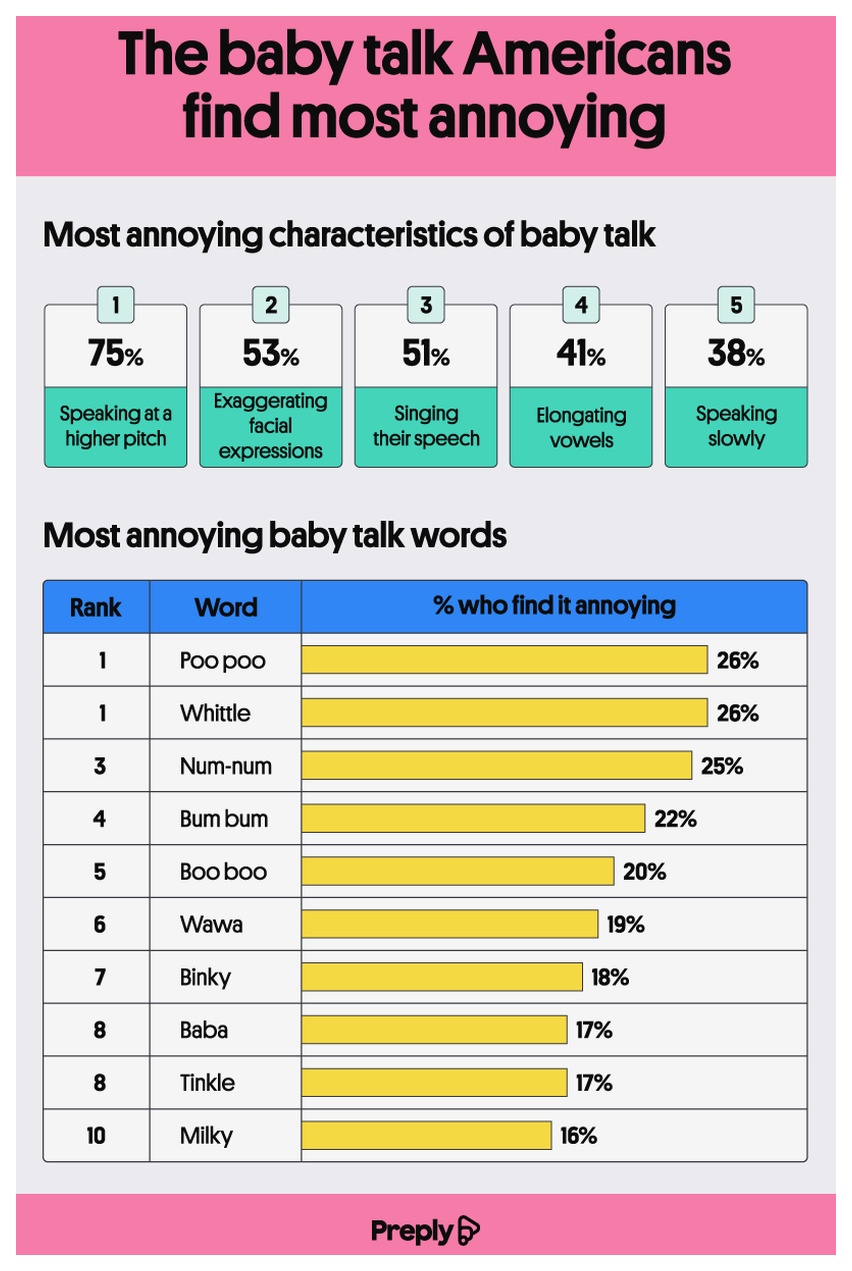
Few things can challenge the patience of non-parents quite like the endless chatter of baby talk. So, the next time you ask an adorable little one if they need to “poo poo” after their “num-nums,” be mindful of your surroundings—especially any non-parents nearby. Those phrases are often at the top of the list for the most grating baby talk expressions!
The days of baby talk might be numbered, as a striking 68% of prospective parents have expressed their intention to avoid it altogether. While many parents cherish the playful nuances of this speech style, outsiders often see it differently. In fact, survey respondents identified some common pet peeves associated with baby talk, including the use of a higher pitch, exaggerated facial expressions, and an inclination to sing their words.
The use of baby talk can spark a range of feelings among both parents and non-parents. However, it’s essential to engage with your child in a way that fosters their language development. Effective communication lays the foundation for strong language skills as they grow.
Language expert Sylvia Johnson from LingualNeeds emphasizes the importance of establishing a solid foundation for language learning. “For parents, laying this groundwork is crucial. Engaging resources like English tutors can significantly enhance a child’s ability to communicate, build friendships, and fully enjoy their experiences,” Johnson explains.
Excessive questioning can impede a child’s growth. Instead of bombarding them with questions, try to foster a dialogue by commenting on their activities. Allow them ample time to think and respond, as children often require a bit longer to process information. Use clear and simple language, echo their words, and build upon their ideas. Gently correct any errors they make, and show your interest by repeating the sounds and words they express. This approach not only supports their speech development but also encourages a more interactive learning experience, according to Johnson.
“You’re not a parent, so you wouldn’t understand,” tops list as most irritating parent phrase
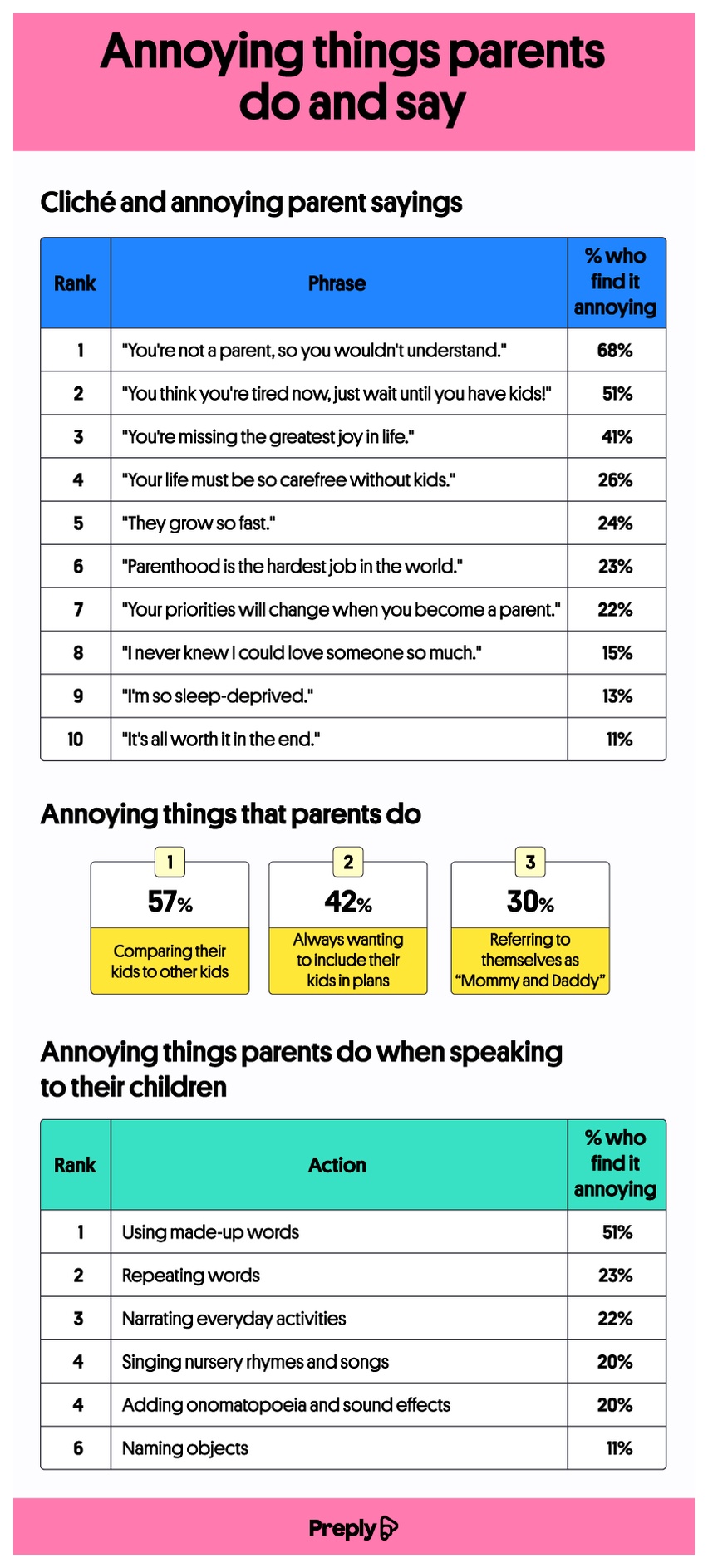
Parenting is a journey filled with countless tales about your little ones. While it’s natural for parents to share stories related to their kids in various discussions, many non-parents advise against it. In fact, a striking 70% of non-parents find it frustrating when conversations consistently shift back to children. Balancing these stories can help keep conversations enjoyable for everyone.
While a flat tire that delays your arrival or your child’s newfound potty training success might seem like interesting topics to discuss, they may not be well-received. In fact, 72% of non-parents find conversations about children’s bodily functions quite bothersome. So, it’s worth considering other topics to engage your audience!
Parents should be mindful of their language, especially when conversing with those without children. Certain phrases can trigger eye rolls and annoyance among non-parents. One of the most overused and grating remarks is, “You’re not a parent, so you wouldn’t understand,” which irritates 68% of non-parents. Being aware of these clichés can help foster more engaging and respectful conversations.
Parental online and conversational habits that can be frustrating
The internet offers an overwhelming wealth of information, but many people find discussions about children’s private lives less appealing. Non-parents often express frustration with parents who overshare personal details, post excessive photos, or boast about their children’s achievements. In fact, 28% of non-parents have taken action—such as unfriending, unfollowing, muting, or blocking someone—due to the constant stream of kid-related posts.
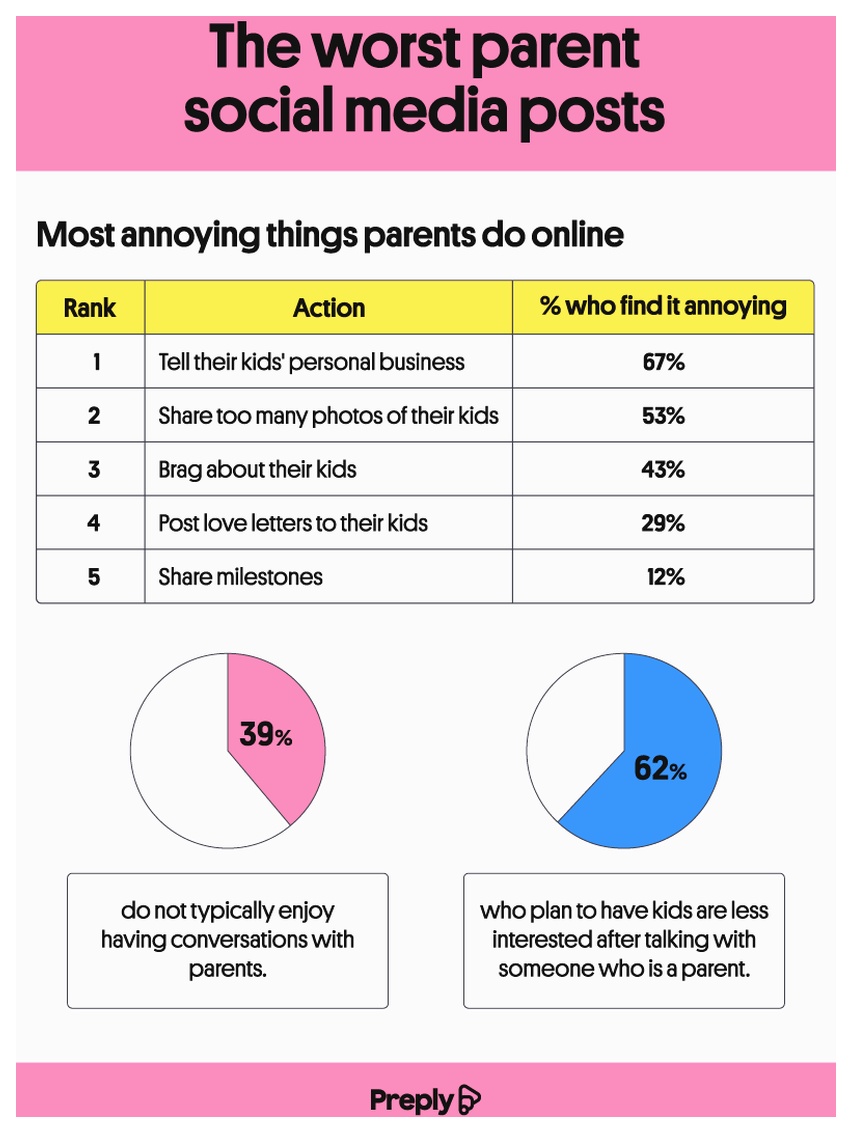
Engaging with parents, whether in person or online, can prompt non-parents to reconsider their own aspirations for parenthood. A recent survey highlighted that 62% of individuals contemplating parenthood felt less enthusiastic after chatting with current parents. Additionally, 39% of respondents confessed they generally find conversations with parents less enjoyable, with 47% finding discussions with parents of infants and toddlers particularly bothersome.
Parenthood may present its challenges and often feels distant to those without children, but it also offers the profound reward of instilling values and skills in the next generation—gifts that children will carry forward throughout their lives.
Building a multilingual family
Baby talk, often seen as both charming and somewhat irritating, plays a significant role in enhancing children’s language development. It’s intriguing to see how parents communicate with their little ones in this unique way, fostering essential skills in a world where effective communication is vital.
Language learning extends far beyond the realm of parenthood; it plays a vital role in our multicultural society, where diverse partnerships are increasingly common. For couples from different backgrounds, cultivating a multilingual family can be greatly enhanced by incorporating playful communication techniques often used in baby talk, along with leveraging resources like online Spanish lessons. Just as parents modify their language to engage with their children, partners can adopt a similar strategy to foster a warm, inclusive, and enriching multilingual atmosphere.
At LingualNeeds, we offer personalized tutoring and flexible language classes tailored to your family’s schedule, making it easier than ever to reach your language goals. By embracing language learning, your family can cultivate a rich tapestry of cultures and traditions that will be cherished by future generations.
Methodology
On September 1, 2023, we conducted a survey with 997 Americans to explore the behaviors and phrases commonly used by parents. Our participants, aged 18 to 76, included 47% female, 50% male, and 3% nonbinary individuals. Following this, on October 12, 2023, we surveyed another group of 997 Americans to gather their opinions on baby talk. This second group had a similar age range and demographic breakdown, with 49% female, 50% male, and 1% nonbinary.
Frequently Asked Questions
What is baby talk and why is it used by parents?
Baby talk is a playful form of communication characterized by a higher pitch, exaggerated intonation, and imaginative words. Parents use it to bond with their children and enhance language development.
What are some of the favorite baby talk words among American parents?
Some favorite baby talk words among American parents include ‘cuddles,’ ‘dolly,’ and ‘night-night’.
How do non-parents feel about baby talk?
Many non-parents find baby talk irritating, with 56% feeling uneasy about it and 69% finding it bothersome when parents use it with children.
Is baby talk only used with children?
No, baby talk is also commonly used by many Americans with their pets and romantic partners, with 47% using it with pets and 19% with partners.
What are some common phrases that irritate non-parents during conversations?
Common phrases that irritate non-parents include ‘You’re not a parent, so you wouldn’t understand,’ which annoys 68% of non-parents.