- The most common British sayings
- Popular British greetings and goodbyes
- British sayings about the weather
- British idioms about food and drink
- British phrases and idioms about animals
- British sayings about everyday activities: Work, play, and beyond
- Regional differences in British sayings
- Welsh sayings
- Scottish sayings
- Northern Irish sayings
- Mastering the delivery of British idioms
- Learn from a local with LingualNeeds
- Frequently Asked Questions
- What does the British greeting ‘Alright?’ mean?
- What does the phrase ‘It’s pouring rain’ describe?
- What does ‘Not my cup of tea’ mean?
- What is the meaning of the phrase ‘Barking up the wrong tree’?
- How can I improve my understanding of British slang?
The English language brims with quirky and perplexing British expressions that can baffle even native speakers. While mastering these phrases can be challenging, we’re here to guide you through them!
This guide delves into British idioms and slang, offering insights into their meanings and the cultural backdrop behind them. By familiarizing yourself with these expressions, you’ll be able to connect with your British friends and converse like a local. So, “grab a cuppa,” and let’s get started!
The most common British sayings
Let’s dive into some popular phrases you’re likely to hear while enjoying a drink at the pub (that’s “bar” for those outside the UK).
Popular British greetings and goodbyes
- “Alright?” – This common British greeting translates to “Are you all right?” or “Are you okay?” It’s used casually, so there’s no need to provide a detailed response about your well-being.
- Time-of-Day Greetings in the UK: Brits often greet others by simply stating “Morning,” “Afternoon,” or “Evening,” omitting “Good.” This shorthand effectively conveys the same sentiment as “Good morning/afternoon/evening.”
- “What’s up?” – In British English, this phrase is a casual way of asking how you are. A typical response is “not bad” or “all right,” which reflects the British tendency to understate their feelings.
- “See ya later” – A casual farewell often used to close a conversation, implying future interaction rather than an immediate meeting.
- Toodles – This might seem like nonsense, but it also means “goodbye.”
In British English, greetings and farewells come in countless forms. Discover a variety of popular ways to say hello and goodbye with LingualNeeds, enhancing your communication skills and cultural understanding!
British sayings about the weather
Exploring British culture reveals a fascinating tendency: many common expressions revolve around the weather. While it may seem like Brits are obsessed with meteorological matters, this fascination stems from the weather’s notorious unpredictability.
Check out these amusing English sayings and phrases that often pop up in weather conversations or feature weather-related terms!
- **It’s Pouring Rain** – This phrase describes heavy rain. “Pouring” suggests an intense downpour, while “pissing” is informal and slightly crude, best reserved for friends.
- “Save it for a rainy day” refers to setting aside resources for future needs or emergencies. For example, “My grandmother gave me some money, but I’ll save it for a rainy day.”
- Rain on someone’s parade – To ruin someone’s plans, akin to how rain can lead to the cancellation of a parade.
- Storm in a teacup – This phrase refers to a small uproar over a trivial issue.
- Snowed under – Brits often use this saying when overwhelmed with too much work.
British idioms about food and drink
Many British expressions incorporate vocabulary related to food and drink. While you may recognize these words from your English classes, you might be surprised by how they come together in these phrases!
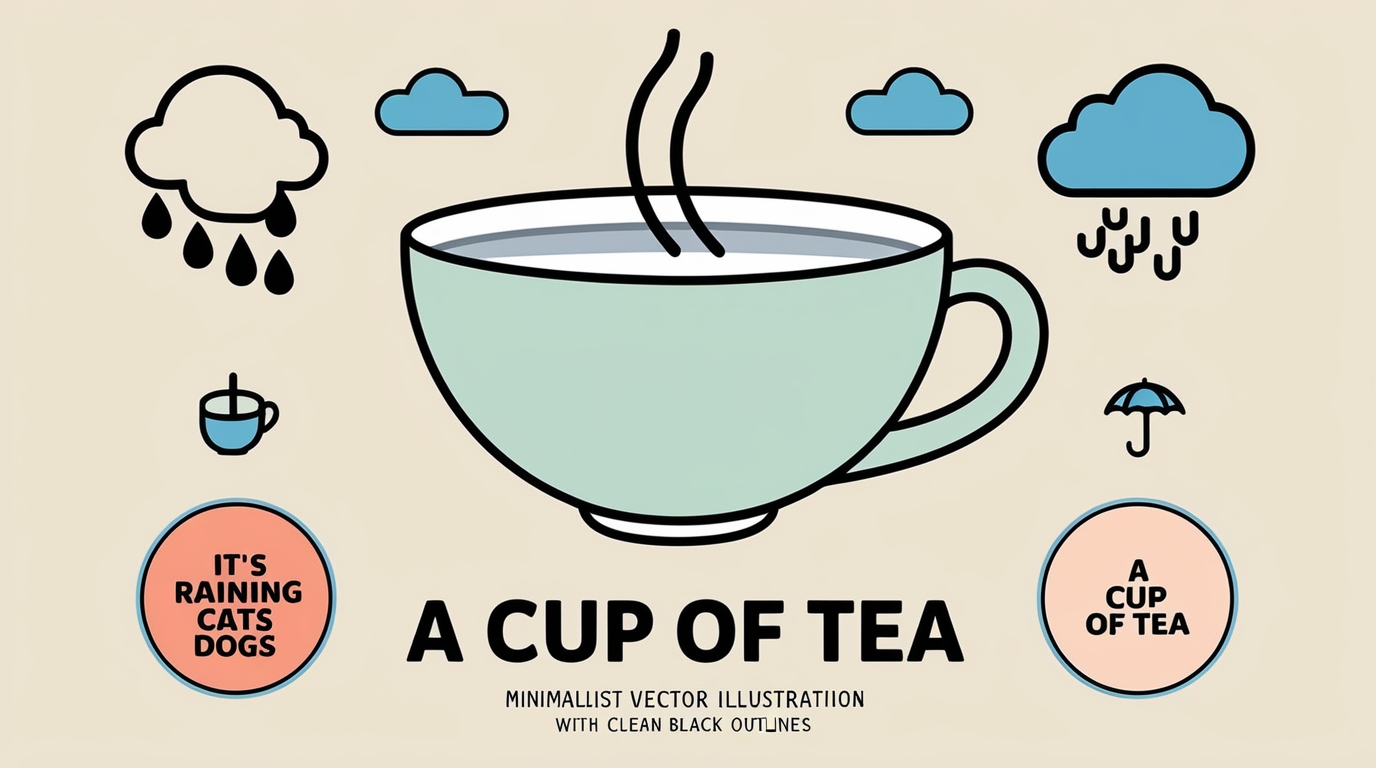
- Not my cup of tea – This phrase indicates a lack of interest or preference for something, rooted in British tea culture.
- **Takes the Biscuit** – Use this phrase to express frustration with someone’s annoying or rude behavior. For example, “She’s asked you to do that too? That really takes the biscuit.”
- The phrase “the proof’s in the pudding” emphasizes that the true value of something is determined by personal experience or its results. Originating from the longer expression “the proof of the pudding is in the eating,” it highlights the importance of testing something to evaluate its quality, much like tasting a baked pudding to judge its flavor.
- “Gone pear-shaped” refers to a plan or task that has gone awry or failed.
- Cool as a cucumber – This phrase describes someone who remains calm and composed in stressful situations. The comparison to cucumbers highlights their refreshing nature.
Brits are known for their colorful slang, especially when it comes to food and drink. Check out some of our top picks below!
- Brew – Hot drink, such as tea or coffee. “Fancy a brew?”
- Biscuit – Cookie. “I’ll put the kettle on and get some biscuits.”
- Brekkie – Breakfast. “Let’s go out for a fry-up brekkie.”
- Chippy – Fish and chip shop. “On Fridays, we get takeaway from the chippy.”
- Crisps – Potato chips. “I’m feeling peckish. Anyone fancy some crisps?”
- Nosh – Food, meal. “This pub has great nosh.”
- Tea – Not just the drink but also dinner or supper. “I’ll put the tea on at 6.”
British phrases and idioms about animals
In Britain, pets hold a special place in people’s hearts, reflecting a deep-rooted passion for animals that also extends to hunting and racing traditions. As a result, animal-related phrases are commonly woven into everyday language. Let’s explore some of these expressions.
- Barking up the wrong tree – This phrase refers to pursuing a misguided course of action while attempting to solve a problem. Originating from hunting, it describes dogs barking at the wrong tree after losing track of their prey.
- One-horse race: A term used to describe a competition with a clear and inevitable winner, originating from horse racing contexts.
- The bee’s knees – A phrase indicating something is excellent, whether it refers to a person, object, or activity.
- Raining cats and dogs – This British idiom describes extremely heavy rainfall, reflecting the nation’s fondness for discussing both weather and pets.
British sayings about everyday activities: Work, play, and beyond
Here are some other popular British sayings about everyday activities:
- Burning the midnight oil – This phrase means to work or study late into the night, originating from the historical practice of using oil lamps and candles for light. It describes the dedication of individuals who sacrifice sleep to complete tasks.
- **The Ball’s in Your Court**: This phrase indicates that it’s your turn to take action or make a decision. Originating from tennis, it refers to the player who must respond to a serve by returning the ball to the opponent’s side.
- **Playing Second Fiddle**: This phrase refers to being in a subordinate or supporting role, much like a second violinist who assists the first violinist in an orchestra.
- **Third Wheel**: This term describes someone who feels like an unnecessary presence in a social situation, typically when two individuals are in a romantic relationship. The act of being in this position is often referred to as “third-wheeling.”
Regional differences in British sayings
Britain consists of four distinct countries: England, Wales, Scotland, and Northern Ireland. Each of these regions boasts its own unique idioms and slang, reflecting their rich cultural diversity. Here are a few examples to explore:
Welsh sayings
- What’s occurrin’? – Commonly used in Wales as a casual greeting similar to “What’s up?”, this phrase gained popularity through the BBC sitcom Gavin and Stacey.
- Cwtch (pronounced “cutch”) refers to a warm cuddle or hug, often used affectionately among family and friends.
Scottish sayings
- **The noo** – This Scottish phrase translates to “right away” or “the now.” While you might encounter the expression “och aye the noo,” it’s best to avoid using it with Scots, as “och aye” and “the noo” are typically not used together. This combination, meant to convey “oh yes, right now,” is a fabrication of English or American television writers.
- **Boak**: The term “boak” refers to a feeling of nausea or disgust. If something or someone is “giving you the boak,” it indicates that they are repulsive or off-putting. This expression is informal and best reserved for use among friends.
Northern Irish sayings
- **Yer Man**: This versatile phrase refers to any person, regardless of gender, and can be used in various contexts. For example, “Yer man over there” typically denotes a man nearby, though “over there” can refer to a location as close as the room corner or as far as another country. While it may seem perplexing at first, you’ll quickly become familiar with its common usage.
- **Dead On**: A straightforward affirmation indicating that something is correct or satisfactory. For instance, you might respond to a request with “dead on,” or refer to someone as “dead on” to compliment their character.
Mastering the delivery of British idioms
You might be feeling a bit “in a muddle” or even “in over your head” with all these quirky British expressions, and that’s completely understandable! With thousands of amusing sayings to choose from, it can be tricky to know when and how to use them effectively.
However, if you’re feeling brave and want to put your newfound slang into practice, consider the following tips:
- Watch British TV shows and films to improve your language skills by hearing phrases in context. British media showcases diverse regional accents and dialects. For example, Netflix’s “Top Boy” offers modern slang influenced by Jamaican Patois, such as “wagwan,” while “Made in Chelsea” features more affluent accents.
- Stay updated with British slang on social media. With the rise of Brits on TikTok, Twitter, and Instagram, you can easily learn the latest local lingo and stay current with evolving slang.
- Engage in authentic conversations with native speakers to effectively learn British sayings in context. Interact with friends, language partners, or tutors to absorb their speaking style, intonation, and pronunciation.

Learn from a local with LingualNeeds
Understanding British sayings and slang offers a fascinating glimpse into the local culture and enhances your conversational skills. While it might seem puzzling at first, your attempts to grasp their distinctive expressions will surely earn you the admiration of the British people.
Looking to boost your language skills? Consider booking a lesson with a native speaker! At LingualNeeds, you’ll find thousands of affordable English tutors from across the UK. They can help you go beyond just memorizing vocabulary— you’ll dive into authentic cultural insights and refine your pronunciation quickly and effectively.
Have a “chinwag” (a chat) with a LingualNeeds English tutor today and book your free trial.
Frequently Asked Questions
What does the British greeting ‘Alright?’ mean?
‘Alright?’ translates to ‘Are you all right?’ or ‘Are you okay?’.
What does the phrase ‘It’s pouring rain’ describe?
It describes heavy rain, with ‘pouring’ suggesting an intense downpour.
What does ‘Not my cup of tea’ mean?
It indicates a lack of interest or preference for something.
What is the meaning of the phrase ‘Barking up the wrong tree’?
It refers to pursuing a misguided course of action.
How can I improve my understanding of British slang?
Watch British TV shows and films, stay updated on social media, and engage in conversations with native speakers.