
- What are possessive adjectives in Spanish?
- Spanish possessive adjectives chart
- How to choose the right possessive adjective
- Possessive adjectives vs. possessive pronouns
- Short-form Spanish possessive adjectives (unstressed)
- Long-form Spanish possessive adjectives (stressed)
- 4 tips for using Spanish possessive adjectives
- Know when to omit a possessive adjective
- Don’t use possessive adjectives when describing feelings
- Avoid confusion when using su and sus
- Don’t confuse tu with tú
- Practice exercise and worksheet
- Improve your Spanish grammar with a LingualNeeds tutor
- Frequently Asked Questions
- What are possessive adjectives in Spanish?
- How do you choose the right possessive adjective in Spanish?
- What is the difference between possessive adjectives and possessive pronouns?
- What are the two forms of possessive adjectives in Spanish?
- When should you omit a possessive adjective in Spanish?
An adjective adds detail to a noun, but a possessive adjective takes it a step further by indicating ownership. For instance, in the sentence “Her dog is very friendly,” the word “her” functions as the possessive adjective, showing that the dog belongs to her.
Possessive adjectives help you to use pronouns to show ownership or possession without sounding repetitive.
This post provides a comprehensive guide to mastering possessive adjectives in Spanish. With clear examples and practical exercises, you’ll gain the essential skills needed to use this grammatical element accurately, helping you on your journey to fluency.
What are possessive adjectives in Spanish?
Possessive adjectives indicate ownership by linking a noun to its owner, making them essential in both writing and speech. By using these adjectives, you can efficiently convey possession without the need to repeatedly mention the same person or object.
There are two types of possessive adjectives, and they both have different uses.
- Short-form adjectives are always placed before the noun and are meant for clarification, not to add emphasis.
- Long-form adjectives follow the noun and are used to differentiate between possessors, emphasizing the true owner of the noun.
To choose the right possessive adjective, it’s essential to consider the noun it modifies. In Spanish, every noun has a specific gender (masculine or feminine) and number (singular or plural). Therefore, possessive adjectives must match the gender and number of the noun they’re describing. Understanding this agreement is key to mastering Spanish grammar!
For example:
- Number: mi carro (my car, singular); mis carros (my cars, plural)
- Gender: nuestro carro (our car, masculine), nuestra maleta (our suitcase, feminine)
Spanish possessive adjectives chart
In Spanish, possessive adjectives, like all adjectives, must agree with the noun in both gender and number. This means you need to determine if the noun is masculine or feminine, as well as whether it is singular or plural.
Remember that possessive adjectives describe the person or thing being possessed or owned, not the owner.

How to choose the right possessive adjective
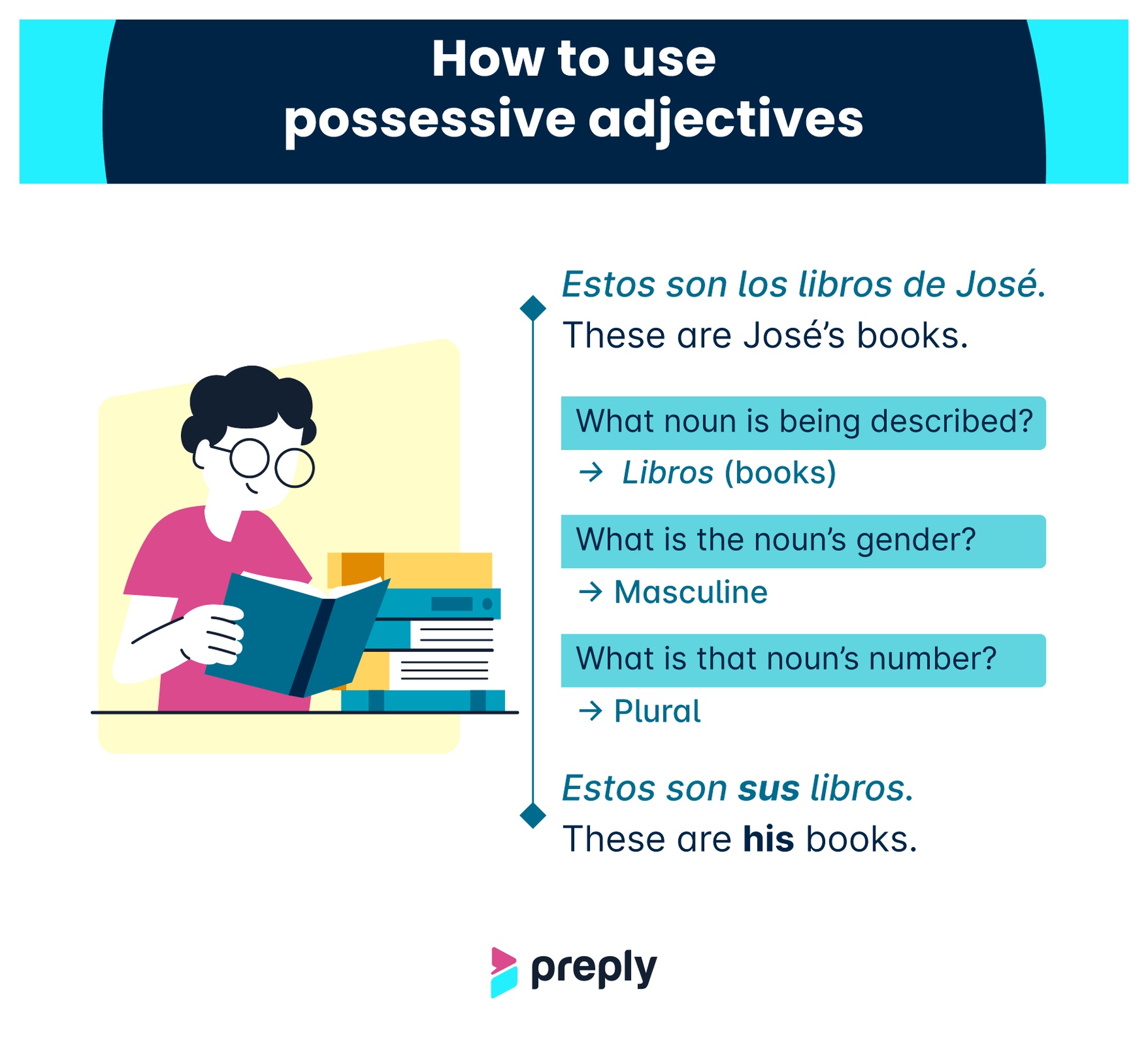
When learning Spanish, choosing the right possessive adjective hinges on three crucial factors: the noun you’re describing, its gender (masculine or feminine), and whether it’s singular or plural. Keeping these elements in mind will help you use possessive adjectives accurately in your sentences.
For example: las llaves de Samuel (Sam’s keys/the keys of Sam)
To choose the right possessive adjective instead of repeating, Samuel, while you’re talking, consider these factors:
- Noun described: The noun is llaves.
- Gender: The word llaves is feminine.
- Number: In this sentence, llaves is used in its plural form.
This indicates that the appropriate possessive adjective is “sus.” You can use it in a sentence like this: “Esas son sus llaves.” (Those are his keys.)
Possessive adjectives vs. possessive pronouns
Possessive adjectives and possessive pronouns both express ownership, which can confuse learners at any level. The key distinction is that possessive adjectives must always be paired with a noun, while possessive pronouns replace the noun entirely. Additionally, possessive pronouns are frequently used alongside definite articles like “el,” “la,” “los,” and “las.” Understanding this difference is essential for mastering possession in language!
For example:
- Possessive adjective: mis estudiantes (my students)
- Possessive pronoun: Los estudiantes son míos. (The students are mine.)
Short-form Spanish possessive adjectives (unstressed)
In Spanish, possessive adjectives come in two forms: short and long. The short-form possessive adjectives, which are unstressed, are used without added emphasis and are always positioned before the noun they modify.
|
Short-form possessive adjectives |
||
|
English |
Spanish singular (masculine/feminine) |
Spanish plural (masculine/feminine) |
|
my |
mi |
mis |
|
your (singular, informal/for someone you address as tú) |
tu |
tus |
|
his/hers/its your (singular, formal/for someone you address as usted) |
su |
sus |
|
our |
nuestro/nuestra |
nuestros/nuestras |
|
your (plural, for people you address as vosotros/vosotras) |
vuestro/vuestra |
vuestros/vuestras |
|
their your (plural, formal/for people you address as ustedes) |
su |
sus |
For example:
- ¿Has visto mi bolsa? (Have you seen my bag?)
- Me gusta tu mochila. (I like your backpack. )
- ¿Tiene su equipaje de mano? (Does he have his carry-on luggage?)
- ¿Vienes a nuestra casa? (Are you coming to our house?)
- Vamos a vuestro restaurante. (Let’s go to your restaurant.)
- ¿Has comprado sus marcadores? (Have you bought their markers?)
- ¿Dónde están sus apuntes de historia? (Where are your [formal] history notes?)
Long-form Spanish possessive adjectives (stressed)
In Spanish, there are specific long-form (stressed) adjectives that add emphasis and allow for clear contrast between different possessors. Notably, these adjectives always come after the nouns they modify, enhancing their descriptive power.
For example:
- Short-form: Esa es mi revista. That is my magazine.
- Long-form: La revista es mía. The magazine is mine.
Short-form possessive adjectives help clarify who owns specific items, often serving as quick responses to questions about ownership. In contrast, long-form possessive adjectives are used to resolve misunderstandings regarding ownership, providing clear emphasis on the rightful owner of an item.
Just like short-form possessive adjectives, long-form possessive adjectives must match the noun they describe in both gender and number. The key difference is that long-form adjectives are placed after the noun.
he noun in gender and number. However, these will be placed after the noun.
|
Long-form possessive adjectives |
||
|
English |
Spanish singular (masculine/feminine) |
Spanish plural (masculine/feminine) |
|
(of) mine |
mío/mía |
míos/mías |
|
(of) yours (singular, informal, for someone you address as tú) |
tuyo/tuya |
tuyos/tuyas |
|
(of) his/hers/its (of) yours (singular, formal/for someone you address as usted) |
suyo/suya |
suyos/suyas |
|
(of) ours |
nuestro/nuestra |
nuestros/nuestras |
|
(of) yours (plural, for people you address as vosotros/vosotras) |
vuestro/vuestra |
vuestros/vuestras |
|
(of) theirs (of) yours (plural, formal/for people you address as ustedes) |
suyo/suya |
suyos/suyas |
For example:
- Un perro mío. A dog of mine, one of my dogs
- Una pulsera tuya. A bracelet of yours, one of your bracelets
- Una bicicleta suya. A bicycle of his/hers/theirs/your, one of his/her/their/your bicycles
- Un gato nuestro. A cat of ours, one of our cats
- Un amigo vuestro. A friend of yours, one of your friends
- Un pastel suyo. A cake of theirs (formal), one of their (formal) cakes
4 tips for using Spanish possessive adjectives
Having a solid understanding of possessive adjectives in both forms is a great start! Now, let’s explore four essential tips for effectively using Spanish possessive adjectives in your conversations.
Know when to omit a possessive adjective
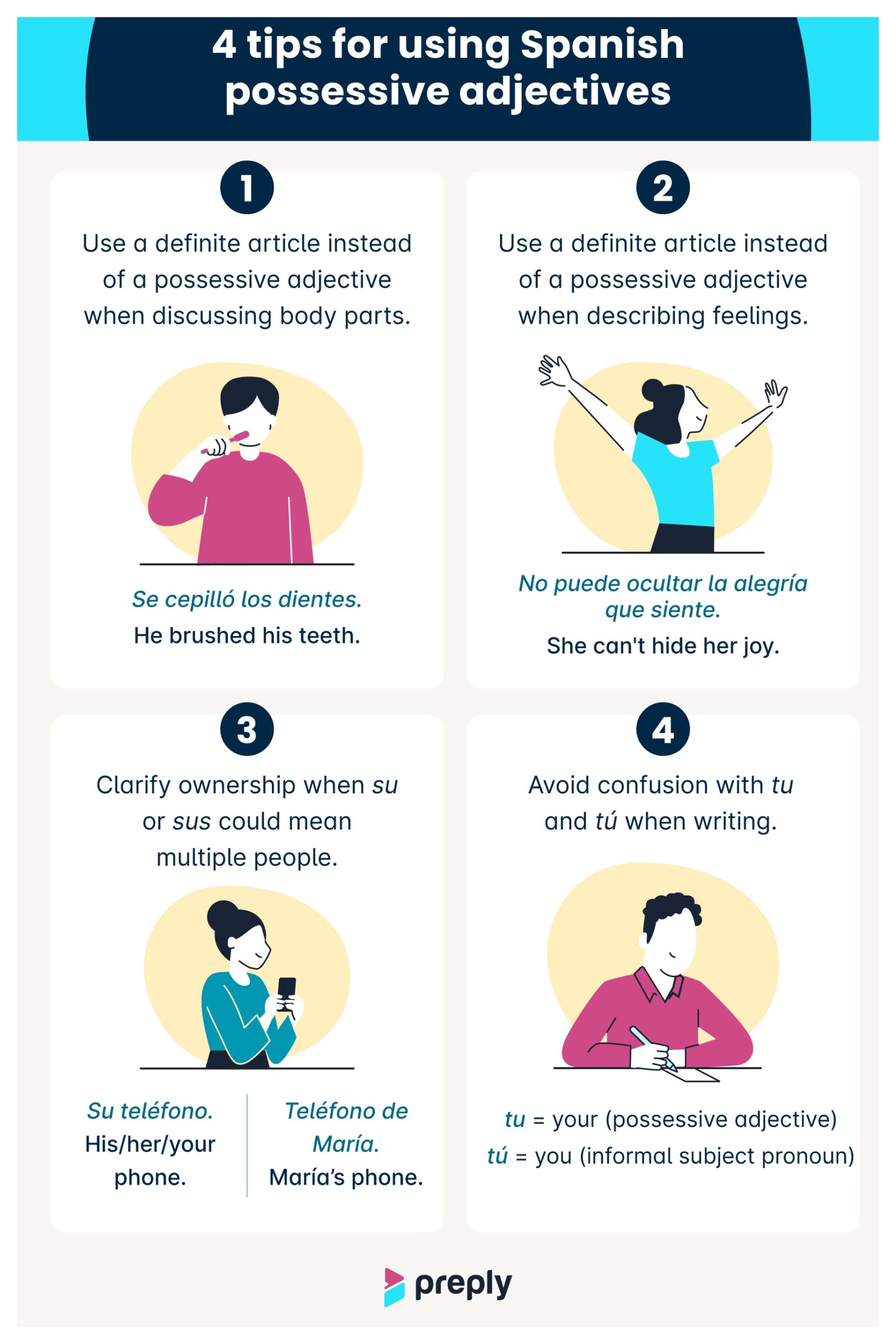
When discussing body parts in Spanish, it’s important to avoid using possessive adjectives to indicate ownership. Instead, pair definite articles (el, la, los, las) with reflexive pronouns to express that a body part belongs to someone. This approach is essential for proper grammar and clear communication.
- For example: Me lavo el cabello. (I wash my hair.)
When a sentence includes several nouns that share the same owner, or when the owner is clearly identified, you can skip using a possessive adjective.
Don’t use possessive adjectives when describing feelings
When discussing someone’s feelings and emotions, opt for definite articles instead of possessive adjectives. This approach is particularly effective for intangible concepts—those that cannot be physically grasped.
- For example: “Te envío esta carta con todo mi amor.” (I send you this letter with all my love.)
Avoid confusion when using su and sus
Possessive adjectives like “su” and “sus” can represent “his,” “her,” “its,” “your,” or “their,” which often leads to confusion about ownership. To make it clearer who is being referred to, replace “su/sus” with a phrase that combines “de” with the appropriate pronoun or person’s name.
For example:
- Sus libros could be referring to his/her/its/their books.
- This can be clarified by saying los libros de los alumnos.
In Spanish, possession is expressed using “de,” much like saying “the books of the students” in English. This approach eliminates the need for apostrophes, which are not used in the Spanish language.
Don’t confuse tu with tú
At first glance, “tu” and “tú” may appear similar in both appearance and pronunciation, but they serve distinct purposes in the language. To speak more like a native, it’s essential to grasp these differences:
- The pronoun “tú” with an acute accent is the informal Spanish subject pronoun for “you.” It is essential to include the accent, as “tu” without it means “your.” “Tú” is solely used to replace the subject in a sentence.
- The pronoun “tu” (without an accent) is the informal possessive adjective for “your,” used to indicate possession when addressing someone as “tú.”
Practice exercise and worksheet
It’s time to apply what you’ve learned! Review the sentences below and fill in the blanks with the appropriate possessive adjectives that correspond to the given pronouns.
It’s important to note that possessive adjectives must match the gender and number of the noun they modify, which refers to the item being possessed rather than the owner. You can find the answers provided beneath each sentence for your reference.

1. (yo) Este es ________ libro.
Este es mi libro. (This is my book.)
2. (tú) ¿Dónde está _______ chamarra?
¿Donde está tu chamarra? (Where is your coat?)
3. (Samuel) No tiene ________ pasaporte.
Samuel no tiene su pasaporte. (Samuel doesn’t have his passport.)
4. (Margarita) Margarita perdió____ perro.
Margarita perdió su perro. (Margarita lost her dog.)
5. (usted) ¿Es _____ carro?
¿Es su carro? (Is it your car?)
6. (nosotros) _____ comida es deliciosa.
Nuestra comida es deliciosa. (Our food is delicious.)
7. (vosotros) Quiero apoyar _____ causa.
Quiero apoyar vuestra causa. (I want to support your cause.)
8. (ellos) Fuimos a _____ eventos.
Fuimos a sus eventos. (We went to their events.)
9. (ustedes) Trajeron _____computadoras.
Trajeron sus computadoras. (You all brought your computers.)
10. (Sr. Martinez) El Sr. Martinez busca ____ salon de clase.
El Sr. Martinez busca su salon de clase. (Mr. Martinez looks for his classroom.)
Improve your Spanish grammar with a LingualNeeds tutor
The choice of possessive adjective can dramatically alter the meaning of a sentence, making correct usage essential for clear communication. Additionally, understanding when to omit a possessive adjective is crucial for advancing your Spanish skills and achieving fluency.
While self-studying Spanish grammar is a great way to enhance your understanding, gaining confidence in speaking the language requires consistent practice, especially with native speakers. An effective way to achieve this is by working with a tutor.
With a LingualNeeds tutor, you can refine your understanding of Spanish possessive adjectives while receiving immediate, personalized feedback. They will craft tailored lesson plans that cater specifically to your learning style, help you navigate cultural nuances, and collaborate with you to achieve your fluency objectives.
Start your journey to Spanish fluency by enrolling in online classes with a tutor today. Gain the skills you need to communicate confidently in everyday situations and make significant progress toward mastering the language.
Frequently Asked Questions
What are possessive adjectives in Spanish?
Possessive adjectives indicate ownership by linking a noun to its owner, making them essential in both writing and speech.
How do you choose the right possessive adjective in Spanish?
Choosing the right possessive adjective depends on the noun you’re describing, its gender (masculine or feminine), and whether it’s singular or plural.
What is the difference between possessive adjectives and possessive pronouns?
Possessive adjectives must always be paired with a noun, while possessive pronouns replace the noun entirely.
What are the two forms of possessive adjectives in Spanish?
The two forms are short-form (unstressed) adjectives, which are placed before the noun, and long-form (stressed) adjectives, which follow the noun.
When should you omit a possessive adjective in Spanish?
You should omit a possessive adjective when discussing body parts or when the owner is clearly identified in the sentence.


