

- Quick overview: stem changing verbs in Spanish
- What are Spanish stem-changing verbs (and how do you form them)?
- Examples of regular, non-stem changing verbs.
- Type 1: e > ie stem changing verbs
- Type 2: o > ue changes
- Type 3: e > i changes
- (Less Common) Type 4: i > ie changes
- (Less Common) Type 5: u > ue changes
- Let’s practice
- Never hesitate over stem-changing verbs again
- Frequently Asked Questions
- What are stem-changing verbs in Spanish?
- How do you form the stem of a verb?
- How many main groups of stem-changing verbs are there?
- Do stem changes occur in all tenses?
- How can I improve my understanding of stem-changing verbs?
We understand your frustration—after dedicating so much time to mastering regular verb conjugation, the introduction of a whole category of irregular verbs can feel overwhelming!
Don’t panic.
If you have a grasp of Spanish conjugations, you’ll find stem-changing verbs quite manageable. Many of these verbs are frequently used in everyday conversation, making them even more relevant to your learning. By immersing yourself in Spanish through listening and engaging in conversations with your tutor or language exchange partners, you’ll pick them up in no time!
That being said, it’s essential to understand what stem-changing verbs are, how to conjugate them correctly, and when to leave the stem unchanged. This knowledge will enhance your grasp of the language and improve your communication skills.
Quick overview: stem changing verbs in Spanish
Only got five minutes? Here’s the gist:
- Not all irregular verbs are stem-changing. For instance, “ser” is an irregular verb that follows different rules than stem-changing verbs.
- To get the stem of the verb, simply chop off the final two letters.
- There are 5 main groups of stem-changing verbs.
- The stem changes only happen in the present tense.
What are Spanish stem-changing verbs (and how do you form them)?
In Spanish, verbs are categorized into three groups based on the last two letters of their infinitive form.
- – ar verbs
Examples: luchar (fight), andar (walk), mirar (look)
- – ir verbs
Examples: vivir (live), partir (leave), subir (to go up/raise)
- – er verbs
Examples: beber (drink), poner (put), hacer (do/make)
The “stem” of a verb is created by removing the last two letters from the infinitive form. Once you have the stem, you can add the appropriate verb ending to conjugate it correctly.
Examples of regular, non-stem changing verbs.
|
Verb |
Stem |
First person singular, present tense example |
|
Beber (drink) |
beb- |
Yo bebo (I drink) |
|
Luchar (fight) |
luch- |
Ella lucha (she fights) |
|
Partir (leave) |
part- |
Tu partes (you leave) |
A stem-changing verb is a unique category of irregular verbs in Spanish. Unlike regular verbs, where you simply add the appropriate ending to the stem for conjugation, stem-changing verbs alter the stem itself during this process.
Look at the examples below to see how these verbs change their stem when conjugated in the present simple.
|
Verb |
Stem |
Conjugation Example (Present Simple) |
|
Pensar (think) |
Pens- |
Yo pienso (I think) |
|
Querer (want) |
Quer- |
Ella quiere (she wants) |
|
Poder (can/be able to) |
Pod- |
Ellos/Ustedes pueden (they can) |
However, the stem doesn’t change in first and second person plural form (“nosotros” and “vosotros” respectively).
Here’s an example:
|
Verb |
Stem |
Conjugation Example (Present Simple) |
|
Pensar (think) |
Pens- |
Nosotros pensamos (I think) |
|
Querer (want) |
Quer- |
Vosotros queréis (you want) |
|
Poder (can/be able to) |
Pod- |
Nosotros podemos (we can) |
Quick tip: The term “vosotros” is the informal plural form of ‘you’ used to address a group in Spain. However, in Latin America, you’ll encounter “ustedes” as the standard plural form. While “ustedes” is also present in Spain, it’s reserved for formal contexts and is less frequently used.
There are five categories of stem-changing verbs, but there’s no need to worry about memorizing them all at once. The key verbs in these categories are frequently used in everyday conversation, so regular practice and exposure will naturally help you remember them over time.
With that in mind, it’s helpful to familiarize yourself with the key stem changes you may encounter. We’ve compiled some examples for your reference below.
Type 1: e > ie stem changing verbs
In this group, the e in the stem will change to ie when conjugated.
|
Subject |
Verb: Pensar (think) |
|
Yo (I) |
Pienso |
|
Tu (informal you) |
Piensas |
|
Él, Ella (he, she) |
Piensa |
|
Nosotros (we) |
Pensamos |
|
Ellos/Ellas/Ustedes (they, you all) |
Piensan |
|
Vosotros (Spain) (you all) |
Pensáis |
Type 2: o > ue changes
In this group, the o in the stem will change to ue when conjugated.
|
Subject |
Verb: Poder (to be able to/can) |
|
Yo (I) |
Puedo |
|
Tu (informal you) |
Puedes |
|
Él, Ella (he, she) |
Puede |
|
Nosotros (we) |
Podemos |
|
Ellos/Ellas/Ustedes (they, you all) |
Pueden |
|
Vosotros (Spain) (you all) |
Podéis |
Type 3: e > i changes
In this group, the e in the stem will change to i when conjugated.
|
Subject |
Verb: Pedir (ask/order) |
|
Yo (I) |
Pido |
|
Tu (tu) |
Pides |
|
Él, Ella (he, she) |
Pide |
|
Nosotros (we) |
Pedimos |
|
Ellos/Ellas/Ustedes (they, you all) |
Piden |
|
Vosotros (Spain) (you all) |
Pedís |
(Less Common) Type 4: i > ie changes
In this group of verbs, the letter “i” in the stem transforms into “ie” during conjugation. While this type of stem change is relatively rare, here’s an illustrative example to clarify its usage.
|
Subject |
Verb: Inquirir (Inquire) |
|
Yo (I) |
inquiero |
|
Tu (you) |
inquieres |
|
Él, Ella (he, she) |
inquiere |
|
Nosotros (we) |
inquirimos |
|
Ellos/Ellas/Ustedes (they, you all) |
inquieren |
|
Vosotros (Spain) (you all) |
inquirís |
(Less Common) Type 5: u > ue changes
Another intriguing category of stem-changing verbs involves those that transform the vowel “u” into “ue” during conjugation. A prime example of this is the frequently used verb “jugar,” which means “to play.”
|
Subject |
Verb: Jugar (to play) |
|
Yo (I) |
juego |
|
Tu (you) |
juegas |
|
Él, Ella (he, she) |
juega |
|
Nosotros (we) |
jugamos |
|
Ellos/Ellas/Ustedes (they, you all) |
juegan |
|
Vosotros (Spain) (you all) |
jugáis |
Let’s practice
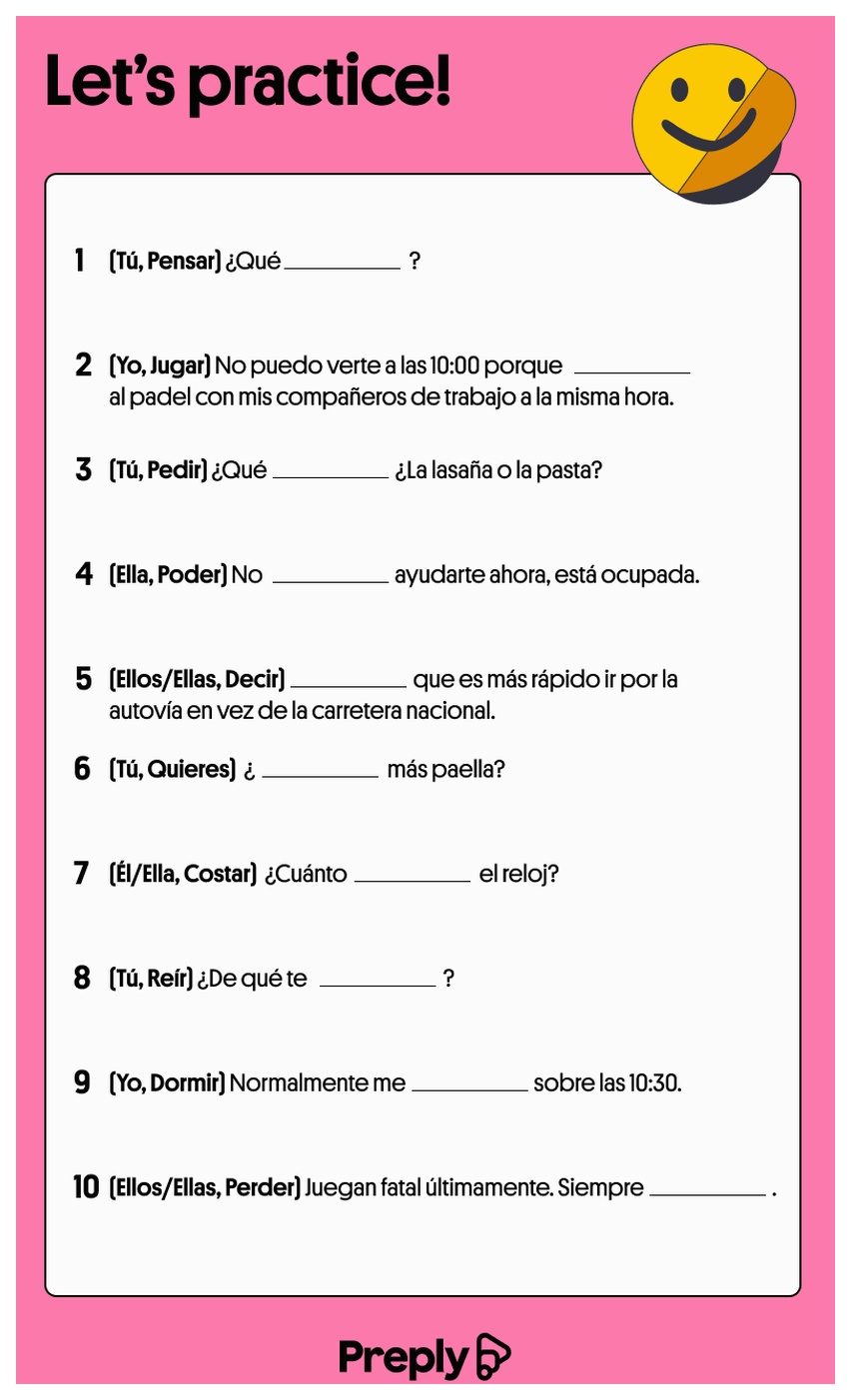
Download or print your worksheet including answers here.
Never hesitate over stem-changing verbs again
Engaging in exercises like the one mentioned above is a great way to get to know stem-changing verbs better. However, remember that this is just the beginning of your learning journey.
You’re eager to speak Spanish, but to truly master the language, you need to actively practice using verbs in conversation. Until you do, they will remain stuck in your passive memory. We understand that beginning to speak a new language can be daunting, which is why we suggest partnering with a skilled language tutor who can help you feel comfortable and confident as you learn.
Are you worried about mixing up stem-changing verbs occasionally? It’s completely normal! However, you’ll feel much more at ease making mistakes when you’re collaborating with a professional in a supportive, judgment-free environment where you can practice freely.
Tu puedes con esto 💪.
Browse our Spanish tutors and specific classes tailored to your language learning goals!
“I recently began my Spanish learning journey with Daniel, and it’s been an incredible experience! I struggled to stay motivated with apps and websites, but now I eagerly anticipate our engaging conversations. I’m confident that my Spanish skills will improve much faster with his guidance. Thank you, Daniel!” – Rowan, Spanish learner
Frequently Asked Questions
What are stem-changing verbs in Spanish?
Stem-changing verbs are a unique category of irregular verbs that alter the stem during conjugation, unlike regular verbs.
How do you form the stem of a verb?
To form the stem of a verb, you chop off the last two letters of the infinitive form.
How many main groups of stem-changing verbs are there?
There are five main groups of stem-changing verbs in Spanish.
Do stem changes occur in all tenses?
No, stem changes only happen in the present tense.
How can I improve my understanding of stem-changing verbs?
Regular practice, exposure through conversation, and working with a language tutor can significantly enhance your grasp of stem-changing verbs.


