
- Why tones are crucial in Mandarin Chinese
- Understanding Mandarin tones
- Syllables with one vowel letter
- Syllables with two or three vowel letters
- Solutions for common challenges
- How can you tell the differences between tones?
- How to practice different tones
- Tone sandhi
- 6 ways to practice Mandarin tones
- 1. Tone drills
- 2. Word associations
- 3. Simple tongue twisters
- 4. Recording and playback
- 5. Listening and mimicking
- 6. Conversation practice
- Frequently Asked Questions
- Why are tones important in Mandarin Chinese?
- How many tones are there in Mandarin Chinese?
- What is tone sandhi in Mandarin?
- What are some effective ways to practice Mandarin tones?
- Can you provide an example of how a tone change alters meaning in Mandarin?
In Western languages such as English, pitch is often used to express emotions or emphasize certain points without changing a word’s meaning. In contrast, Mandarin Chinese is a tonal language, where the pitch or tone of a syllable can completely alter its meaning. This unique feature sets Mandarin apart from many Western languages, highlighting the importance of tone in effective communication.
In this article, you’ll discover the fascinating world of Mandarin tones and learn how many there are in this vibrant language. We’ll provide clear examples and valuable tips to make mastering Mandarin tones easier and more enjoyable.
Why tones are crucial in Mandarin Chinese
Tones play a vital role in Mandarin, as they can completely alter the meaning of words. A simple mispronunciation of a tone can result in confusion or even create unintended humor. Understanding and mastering these tones is essential for effective communication in the language.
Consider the simple word “thanks.” In Mandarin Chinese, “thanks” is expressed as 谢谢, pronounced (xiè xiè). The accents above the characters denote a swift, emphatic downward tone. However, if the tones shift to (xiē xiē), it translates to “have a rest,” while (xiě xiě) means “to write something down.” This illustrates how a slight change in pronunciation can alter your message entirely, highlighting the importance of tone in effective communication.
Understanding Mandarin tones
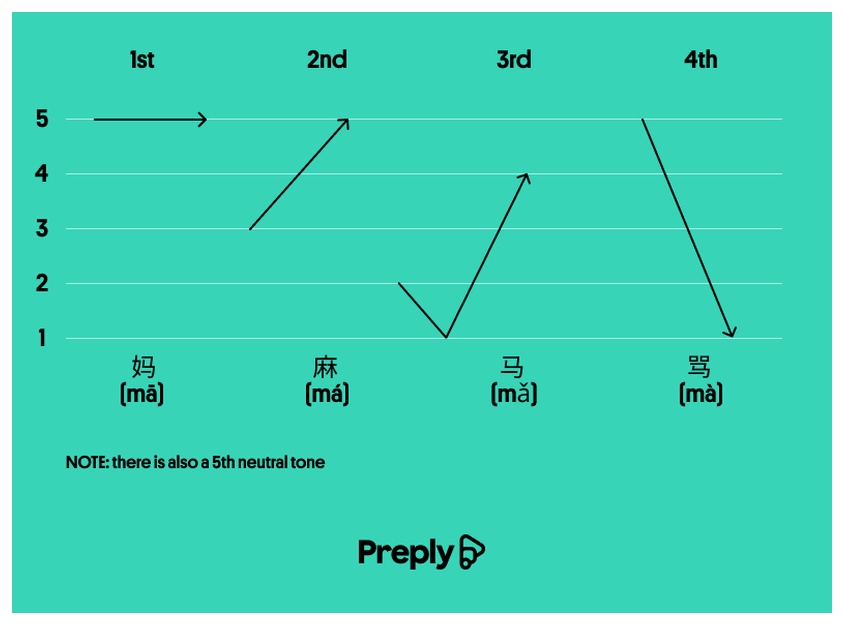
Have you ever wondered how many tones exist in Mandarin Chinese? While it’s commonly stated that there are four tones, the reality is a bit more nuanced. In addition to those four distinct tones, there is also a neutral tone, often referred to as a silent tone. This subtlety adds depth to the language and is essential for proper pronunciation and meaning.
Let’s explore each tone individually. To clearly illustrate the differences, we’ll keep the consonant and vowel the same. The only variable will be the tone itself.
First tone (high and even): This tone is characterized by a steady, elevated pitch. A well-known example is 妈 (mā), which typically translates to “mother” in Chinese.
Second tone (rising): In this tone, the pitch begins low and then ascends. A great example is the word 麻 (má), which translates to the sensation of numbness.
The third tone, characterized by a pitch that first drops and then rises, can pose a challenge for learners. A great example of this tone is the word 马 (Mǎ), which means “horse.” Understanding this tonal shift is essential for mastering pronunciation in Mandarin.
The fourth tone, characterized by a sharp drop in pitch, begins at a high level and swiftly descends. A prime example of this tone is the word 骂 (mà), which translates to “to scold.”
Engaging tone: The neutral tone is brief and subtle, typically occurring in unstressed syllables and commonly appearing at the end of phrases. For example, in the word 妈妈 (māma), meaning “mother,” the second syllable is pronounced in a neutral tone, adding a soft touch to the word.
A prevalent example of a silent tone in Mandarin is the character 了 (le). Often used as a sentence-ending particle, it typically signifies a change of state or the completion of an action, particularly in the past tense. For instance, in the phrase 走了 (zǒu le), which translates to “someone left,” the 了 (le) is pronounced silently.
It’s important to remember that tone marks are always applied to vowels. When a word contains multiple vowels, the tone mark is positioned over the last vowel. This rule applies to both single and compound vowels. Let’s explore some examples to better understand where to place these tone marks.
Syllables with one vowel letter
The tone mark is placed directly on the vowel letter.
Examples:
- mā (妈, mom)
- kē (科, subject)
- dāo (刀, knife)
- lù (路, road)
Syllables with two or three vowel letters
When the initial vowel letter is a medial sound, like “i,” “u,” or “ü,” the tone mark is placed on the vowel that follows it. Medials, also known as middle sounds, refer to the sounds located in the center of a word.

Examples:
- miào (妙, great)
- huì (会, can/meeting)
- qiāo (敲, knock)
- jué (觉, feel)
When the initial vowel isn’t a medial vowel, the tone mark is consistently positioned on that first vowel.
Examples:
- liǎn (脸, face)
- fèi (费, fee)
- hóu (猴, monkey)
- shēn (深, deep)
If the tone mark is on “i,” the dot on the “i” is removed.
Examples:
- nǐ (你, you)
- mǐ (米, rice)
- jǐ (几, several)
- xī (西, west)
Solutions for common challenges
Mastering the tones of Mandarin can be a daunting task for English speakers and those unfamiliar with tonal languages like Chinese. To make the learning process easier, here are three useful tips to enhance your tonal skills.
How can you tell the differences between tones?
The distinctions between tones can often be subtle, particularly when comparing the second and third tones. A helpful way to differentiate them is by noting that the third tone is typically pronounced with a longer, more drawn-out sound. In contrast, the second tone is shorter and resembles the intonation used when asking questions in English, like “Right?” or “No?”
How to practice different tones
A great way to improve your speaking skills is to read aloud at a slow pace. Speaking out loud not only reinforces your brain’s memory of tone but also develops muscle memory in your mouth, making your speech more fluid and confident.
Begin your language journey with brief texts that incorporate tones alongside Chinese characters. This approach will help you effortlessly connect the pronunciation to the words, making it easier to adapt as contexts shift.
Tone sandhi
Tone sandhi is an intriguing linguistic phenomenon where the pronunciation of tones alters depending on their context. A common example occurs when two third tones are adjacent; in this case, the first third tone shifts to a second tone. This adjustment helps ensure a more fluid and harmonious speech pattern.
A great example of tone sandhi in Mandarin is the greeting 你好 (nǐ hǎo). When you break it down, each character is pronounced with the third tone. However, when spoken together, it transforms into “ní hǎo.” This illustrates how tone sandhi alters pronunciation in connected speech.
While the rule may seem complex at first glance, the solution is quite straightforward. Simply shorten the pronunciation of the first character. Remember, as we discussed earlier, the second tone is briefer than the third tone.
6 ways to practice Mandarin tones
1. Tone drills
Tone drills are essential for mastering individual tones and their combinations in Chinese. A practical approach is to create a Chinese tone chart. For instance, practicing the syllable “ma” with various tones—“mā,” “má,” “mǎ,” and “mà”—will help you grasp the nuances of each tone. Check out the video below for inspiration on crafting your tone chart. Additionally, using flashcards with tone markings can be an effective way to quiz yourself and reinforce your learning.

2. Word associations
To enhance your memory of tones, consider linking them to physical movements or visual signals. For instance, you could use specific hand gestures to symbolize the pitch of each tone. This technique not only makes learning more interactive but also strengthens your understanding of tonal patterns.
3. Simple tongue twisters
Tongue twisters are a fantastic tool for mastering Chinese tones while adding a playful twist to your learning experience. They transform the sometimes tedious process into an enjoyable challenge. For instance:
妈(mā) 妈(ma) 放(fàng) 花(huā) 马(mǎ) translates to, “Mom is walking a colorful horse, and that colorful horse is munching on fried twisted dough.” It’s a playful sentence that showcases the beauty of the Chinese language through its rhythm and imagery.
Check out these Chinese tongue twisters for more practice.
4. Recording and playback
Capture your voice by recording yourself speaking, then listen to the playback to assess your tone. This practice not only allows you to identify and correct mistakes but also lets you monitor your improvement as you continue to develop your skills.
5. Listening and mimicking
Engaging with native speakers is a powerful way to enhance your language skills. You can immerse yourself by tuning into Chinese podcasts, joining online Mandarin lessons, or practicing with a partner through language apps. Additionally, online Chinese classes provide valuable opportunities to hear the nuances of tone in real-life contexts. Challenge yourself to mimic their pronunciation and intonation for effective practice.
6. Conversation practice
Eager to enhance your language skills? Dive into these helpful tips from LingualNeeds for selecting the perfect tutor. Additionally, think about connecting with a language exchange partner or joining a Mandarin-speaking group to immerse yourself in the language.
In summary, mastering tones is essential for learning Mandarin Chinese, as they play a vital role in effective communication. Mandarin features four distinct tones, along with a neutral tone. To enhance your understanding, practice these tones in different combinations with consonants and vowels. This approach will not only strengthen your tonal recognition but also expand your vocabulary. Best of luck on your language journey!
Frequently Asked Questions
Why are tones important in Mandarin Chinese?
Tones are crucial in Mandarin as they can completely alter the meaning of words, making understanding and mastering them essential for effective communication.
How many tones are there in Mandarin Chinese?
Mandarin Chinese has four distinct tones, plus a neutral tone, which adds depth to the language.
What is tone sandhi in Mandarin?
Tone sandhi is a phenomenon where the pronunciation of tones changes depending on their context, such as when two third tones are adjacent, causing the first to shift to a second tone.
What are some effective ways to practice Mandarin tones?
Some effective ways to practice include tone drills, word associations, simple tongue twisters, recording and playback, listening and mimicking, and conversation practice.
Can you provide an example of how a tone change alters meaning in Mandarin?
For example, the word ‘thanks’ is pronounced as (xiè xiè) with a downward tone, but if the tones shift to (xiē xiē), it means ‘have a rest’, illustrating how tone changes meaning.