- Key findings
- How many Australians regularly use subtitles
- Which platforms are Australians using subtitles for the most?
- The hardest-to-understand TV shows, celebrities and accents
- Conclusion
- Methodology
- Frequently Asked Questions
- What percentage of Australians regularly use subtitles while watching content?
- Which generation is most likely to use subtitles?
- What are the main reasons Australians use subtitles?
- Which platforms do Australians prefer for using subtitles?
- How do subtitles assist language learners?
Subtitles were previously primarily seen as a tool for accessibility, transcribing and translating dialogue and sounds.
In today’s increasingly digital landscape, where audiences engage with content across various platforms—from television and streaming services to social media—subtitles have surged into the spotlight. They now play a crucial role in how many viewers experience and enjoy their favorite shows and movies.
At LingualNeeds, our passion for language learning and cultural exploration drives us to investigate the evolving content consumption habits of Australians, especially concerning subtitles. To gain insights into this trend, we surveyed 1,508 Australians to understand their views on subtitles and what this means for language learners and cultural enthusiasts.
Key findings
- 27% of Australians occasionally watch content with subtitles
- 63% use subtitles for streaming service platforms than regular TV
- 47% use subtitles when an accent is hard to understand
- 49% said their subtitle usage has become more frequent than it used to be
- 47% of respondents find dialogue harder to understand than before, leading to increased use of subtitles.
- 63% of Gen Z prefer to view online videos with subtitles

Learn a language with personalised 1-on-1 classes with our expert tutors from all over the world
French lessons online
Spanish lessons online
How many Australians regularly use subtitles
Many Australians depend on subtitles to enrich their media experience, but how frequently do they actually navigate to the settings to activate them?
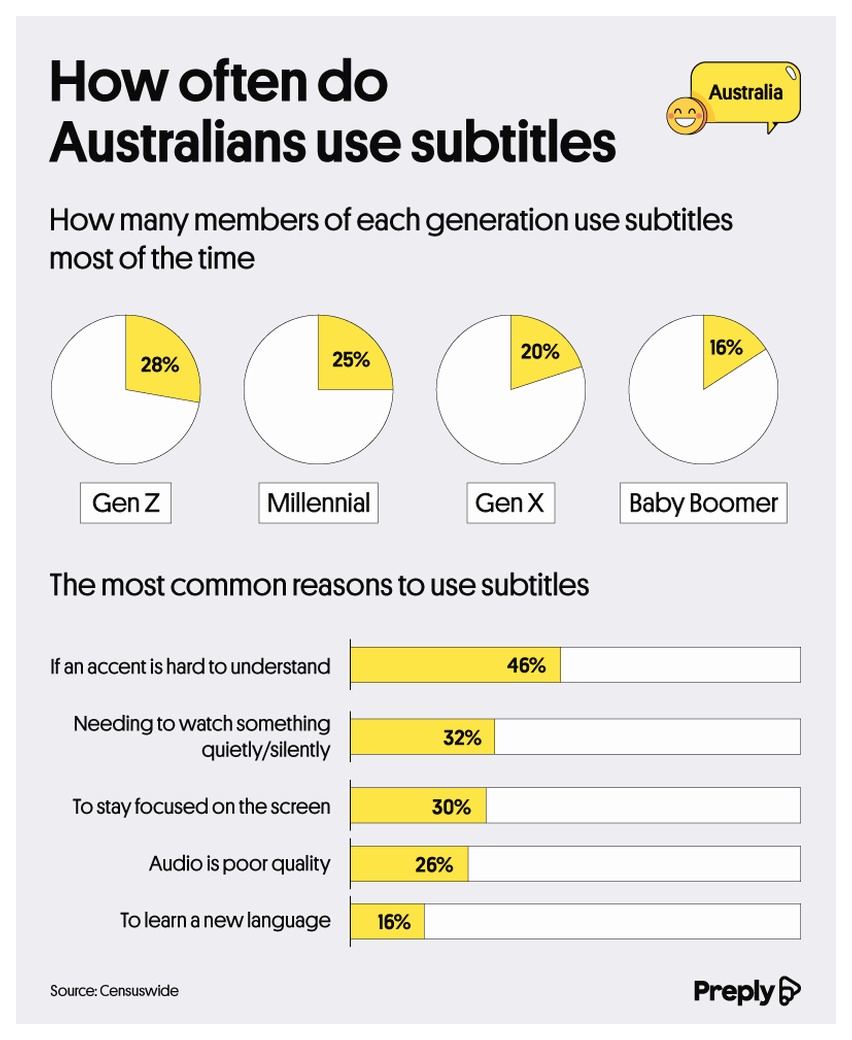
The survey revealed that 15% of Australians consistently use subtitles while watching content. Notably, Generation Z leads the pack, with 28% of respondents always opting for subtitles, followed closely by Millennials at 19%.
A recent survey revealed that over 24% of Australians regularly rely on subtitles while watching content. Notably, this trend is most prominent among Gen Z and Millennials, with 33% of these younger viewers opting for subtitles. In contrast, only 15% of Baby Boomers share this habit.
A recent survey revealed that 26% of Australians occasionally use subtitles while watching TV shows, films, or social media content. Among the generations, Gen X leads with 31% using subtitles occasionally, closely followed by Boomers at 29%.
20% of participants stated that they only ever used subtitles rarely, with 31% of those being Boomers, and 27% of them Gen X.
Only 12% of viewers reported that they never use subtitles while consuming media. This trend varies across generations: 19% of Baby Boomers, 12% of Generation X, 10% of Millennials, and just 4% of Generation Z prefer to watch without subtitles.
After exploring the frequency with which Australians use subtitles while enjoying content, we aimed to uncover the various reasons behind this trend.
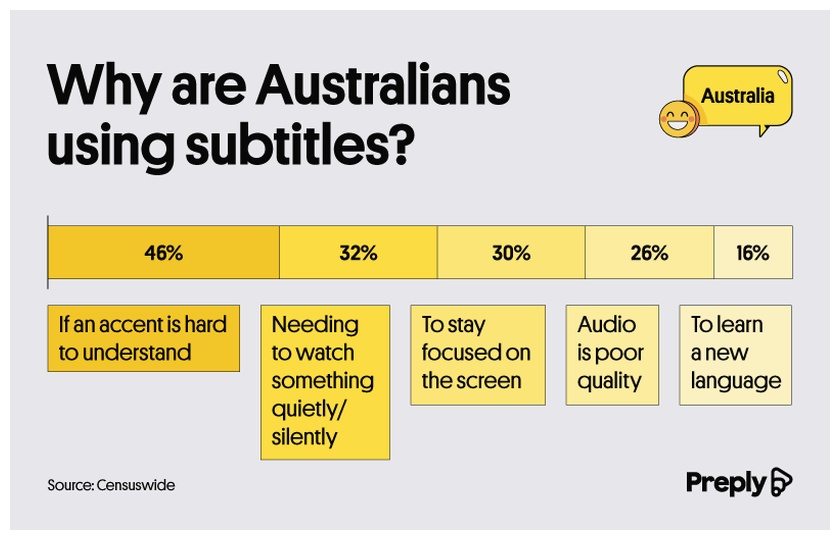
In Australia, nearly half of the population (46%) turns to subtitles when an accent proves challenging to understand. Notably, Generation X leads the pack, with 52% opting for subtitles, closely followed by Baby Boomers at 51%.
Did you know that 32% of Australians turn to subtitles when they want to watch something quietly, whether it’s late at night or early in the morning? Among these viewers, millennials stand out as the most considerate, with a notable 39% opting for subtitles to ensure a more peaceful viewing experience.
A significant 30% of respondents reported using subtitles to help them stay focused while watching. Among these, Gen Z leads the pack, with 45% relying on subtitles to maintain their interest, closely followed by Millennials at 32%.
A recent study reveals that 26% of Australians rely on subtitles while watching TV or movies, primarily due to poor audio quality. Notably, Gen Z faces the most challenges with sound, often struggling to hear dialogue over loud sound effects. As a result, 30% of Gen Z viewers are choosing to use subtitles to enhance their viewing experience.
A noteworthy 16% of individuals utilize subtitles in films and TV shows as a tool for learning a new language. Notably, Generation Z, having grown up in a tech-savvy environment, leads the way with 20% using subtitles to enhance their language skills.
Which platforms are Australians using subtitles for the most?
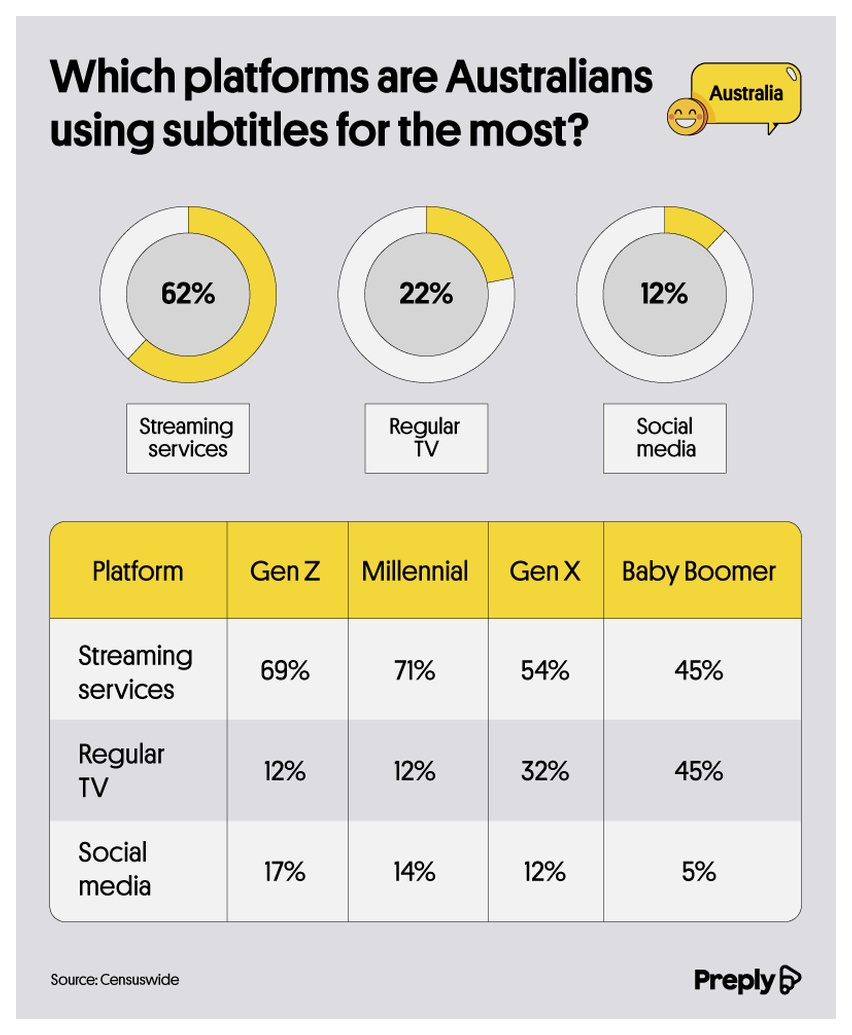
As screens become an ever-present part of our lives, the use of subtitles has expanded significantly, enhancing accessibility across various media platforms, including television, streaming services, and social media. With subtitles more accessible than ever, which platforms are Australians turning to most for this feature?
Streaming services have become the go-to choice for Australians, with a remarkable 62% opting to turn on subtitles. This trend is particularly significant among younger viewers, as 71% of Millennials and 69% of Gen Z find subtitles essential for their streaming experience.
Nearly half of respondents, 49%, believe that Netflix stands out with the best subtitle options, while only 5% favor Disney+, and a mere 4% support both YouTube and Amazon Prime. Interestingly, 17% of people think that none of these streaming platforms excel in subtitle features.
A recent survey revealed that 22% of respondents regularly rely on subtitles while watching television, with Baby Boomers leading the pack—45% of them use subtitles. According to Ofcom, Baby Boomers are also the most avid TV viewers, with 59% of those aged 55-64 and a remarkable 76% of individuals aged 65 and older tuning in. Given their strong TV-watching habits, it’s no wonder that Boomers are the most frequent users of subtitles.
Subtitles aren’t limited to just movies and TV shows; they’re also gaining traction on social media platforms. In fact, 12% of users incorporate subtitles in their social media content. Among different generations, 17% of Gen Z, 14% of Millennials, and 12% of Gen X utilize subtitles in videos on platforms like TikTok, Instagram Reels, and Facebook.
Learn a language online with our free learning materials.
Learn English online
Learn French online
The hardest-to-understand TV shows, celebrities and accents
For many Australians, the diverse range of accents featured in TV shows can pose a challenge, even with a common language like English. In the following section, we highlight the shows that often leave viewers reaching for the subtitles to keep up with the dialogue.
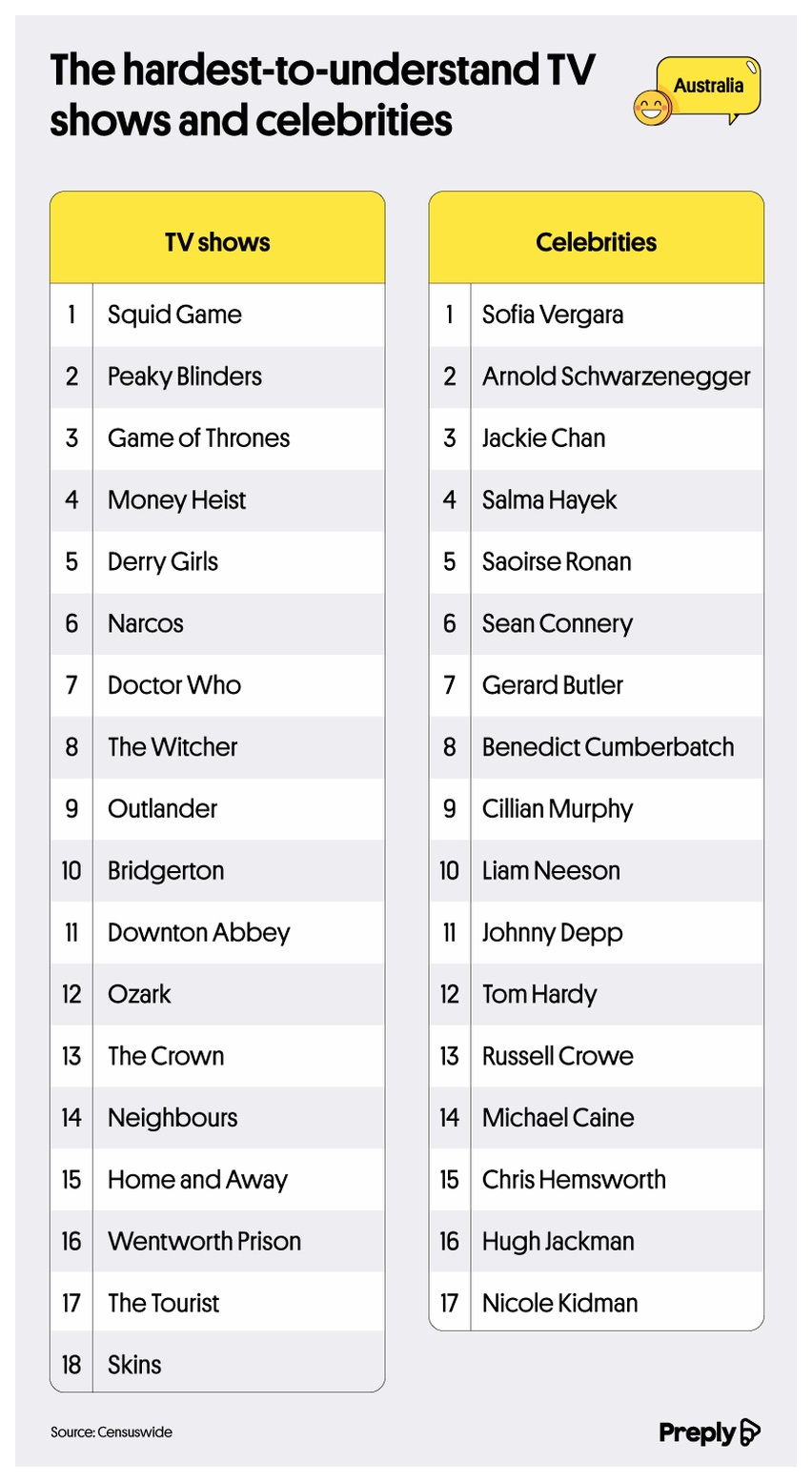
Nearly half of the survey participants report no difficulty in understanding various accents. In fact, 44% of them stated they have not faced any challenges comprehending the TV shows mentioned.
Interestingly, 19% of Australians found it challenging to grasp the popular South Korean series, *Squid Game*. The hit Netflix show was either dubbed by various actors for English audiences or required viewers to watch it in its original Korean with subtitles. If you’re interested in learning Korean, LingualNeeds provides online classes with a selection of approximately 764 private teachers to choose from.
The British crime drama *Peaky Blinders* has proven challenging for 11% of viewers in Australia. The show’s characters speak with thick Brummie (Birmingham) accents and use a unique dialect, which can be tough for those unfamiliar with the local lingo to fully grasp.
If you’re eager to enhance your conversational English skills, look no further than LingualNeeds! We provide a diverse selection of experienced tutors ready to guide you through engaging lessons. Enjoy the convenience of learning from home without straining your budget, and unlock your potential in English communication today!
Approximately 10% of viewers found the fantasy drama Game of Thrones challenging to follow due to its diverse accents. Set in a richly imagined world, the series features a wide array of actors utilizing various British accents, including Geordie, Yorkshire, and London, along with accents from countries like the United States, Germany, and the Netherlands.
Many Australians find it challenging to follow certain TV shows, and they also have trouble understanding the accents of specific actors. Some celebrities are particularly noted for their difficult-to-decipher speech, making it even more challenging for viewers.
Colombian actress Sofia Vergara topped the list of celebrities that viewers found most difficult to understand, with 19% of respondents expressing this sentiment. Notably, Spanish emerged as the accent that required subtitles for the highest percentage of viewers, at 26%. This trend sheds light on the challenges many face in understanding the “Modern Family” star, renowned for her distinctive Spanish accent.
Seventeen percent of people consider Austrian actor Arnold Schwarzenegger the hardest actor to understand. This can be attributed to his distinctive accent, which combines elements of Austrian and American English, along with his unique pronunciation style.
Jackie Chan, the iconic star from Hong Kong, was reported to be difficult to understand by 15% of Australians. This challenge may stem from his strong Cantonese accent and fast-paced speech, which can make it hard for some viewers to keep up with his dialogue.
Mexican actress Salma Hayek has gained recognition not only for her talent but also for her fast-paced speech, which can be challenging for some audiences. In fact, her quick delivery may pose comprehension issues for about 8% of Australians.

Interestingly, nearly half of Australians (46%) rely on subtitles to grasp the dialogue of actors with accents. The accents that Australians find most challenging to understand include:
Spanish ranks as the most challenging accent for listeners, with 26% requiring subtitles to fully grasp it. If you’re eager to enhance your Spanish skills, LingualNeeds connects you with experienced tutors who provide private lessons at budget-friendly rates. Plus, you can explore Latin American Spanish through specialized online instructors.
Scottish was the second hardest to follow according to 23% of participants, followed by Italian (21%) and Irish (19%).
Alternatively, 23% of people felt that they didn’t need any subtitles to understand accents on their different forms of media.
Conclusion
Our survey results reveal that Australians enthusiastically support the use of subtitles for various compelling reasons. Subtitles not only enhance focus but also improve comprehension in challenging audio situations and facilitate communication across different languages.
Subtitles may have their drawbacks, such as occasional inaccuracies, potential distractions, and a reliance on text, but their benefits are undeniable. They play a crucial role in supporting the hearing impaired and assisting those who find it challenging to follow dialogue.
Methodology
Censuswide conducted a national online survey involving 1,508 Australians aged 16 to over 55 on behalf of LingualNeeds. The aim was to explore the motivations and usage patterns of subtitles among these diverse age groups.
Frequently Asked Questions
What percentage of Australians regularly use subtitles while watching content?
15% of Australians consistently use subtitles while watching content.
Which generation is most likely to use subtitles?
Generation Z leads the pack, with 28% of respondents always opting for subtitles.
What are the main reasons Australians use subtitles?
Australians use subtitles primarily for understanding difficult accents, watching quietly, and staying focused.
Which platforms do Australians prefer for using subtitles?
Streaming services are the preferred choice, with 62% of Australians opting for subtitles on these platforms.
How do subtitles assist language learners?
16% of individuals utilize subtitles as a tool for learning a new language, with Generation Z leading the way.