

- A simple formula for using gustar
- How conjugating gustar is different than other verbs
- How to conjugate gustar
- 1. Make sure the verb form agrees with the subject and tense
- 2. Choose the correct indirect object pronoun
- 3. Add an optional prepositional phrase
- Other ways to use gustar
- With infinitives
- In negative sentences
- In questions
- Conjugating gustar in the indicative mood
- Present
- Imperfect
- Preterite
- Progressive
- Future
- Conditional
- Present perfect
- Pluperfect
- Future perfect
- Preterite perfect
- Conditional perfect
- Conjugating gustar in the subjunctive mood
- Present
- Imperfect 1
- Imperfect 2
- Future
- Present perfect
- Pluperfect
- Conjugating gustar in the imperative mood
- Gustar practice exercise
- Master Spanish grammar with LingualNeeds
- Frequently Asked Questions
- What is the verb ‘gustar’ used for in Spanish?
- How does the conjugation of ‘gustar’ differ from regular Spanish verbs?
- What are the forms of ‘gustar’ used for singular and plural subjects?
- How do you express dislike using ‘gustar’?
- What steps should you follow to correctly conjugate ‘gustar’?
If you want to express your preferences in Spanish, you’ll need to use the verb “gustar.” However, if you feel a bit puzzled about how to use it correctly, you’re in good company! Many Spanish learners find this verb’s conjugation tricky due to a few key reasons:
- The term “gustar” literally translates to “_______ pleases me,” which can be challenging for learners since English typically uses “I like _______.” In Spanish, the subject being liked precedes the verb, shifting the focus of the sentence.
- Unlike most Spanish verbs, the verb “gustar” changes form based on whether one or multiple items are liked. As a result, each tense will use both singular and plural forms.
Whether you’re starting your journey with Spanish or looking to refine your skills, this guide will equip you with everything you need to master the verb “gustar.” You’ll learn how to conjugate it correctly, explore its forms across various tenses, and engage in practice exercises to reinforce your understanding. Get ready to enhance your Spanish grammar with confidence!
If you’re already acquainted with the verb “gustar” and just need a quick refresher on its conjugations across different tenses, click here for a helpful reference guide.
A simple formula for using gustar
At first, the verb “gustar” may appear daunting due to its unconventional conjugation. However, understanding that it is conjugated according to the subject—the thing that is liked—can simplify the process. Once you grasp this concept, using “gustar” becomes much more manageable!
Here’s an easy-to-follow guide for using “gustar” that illustrates the proper word order. The example sentences below showcase this with two forms of the verb in the present tense.
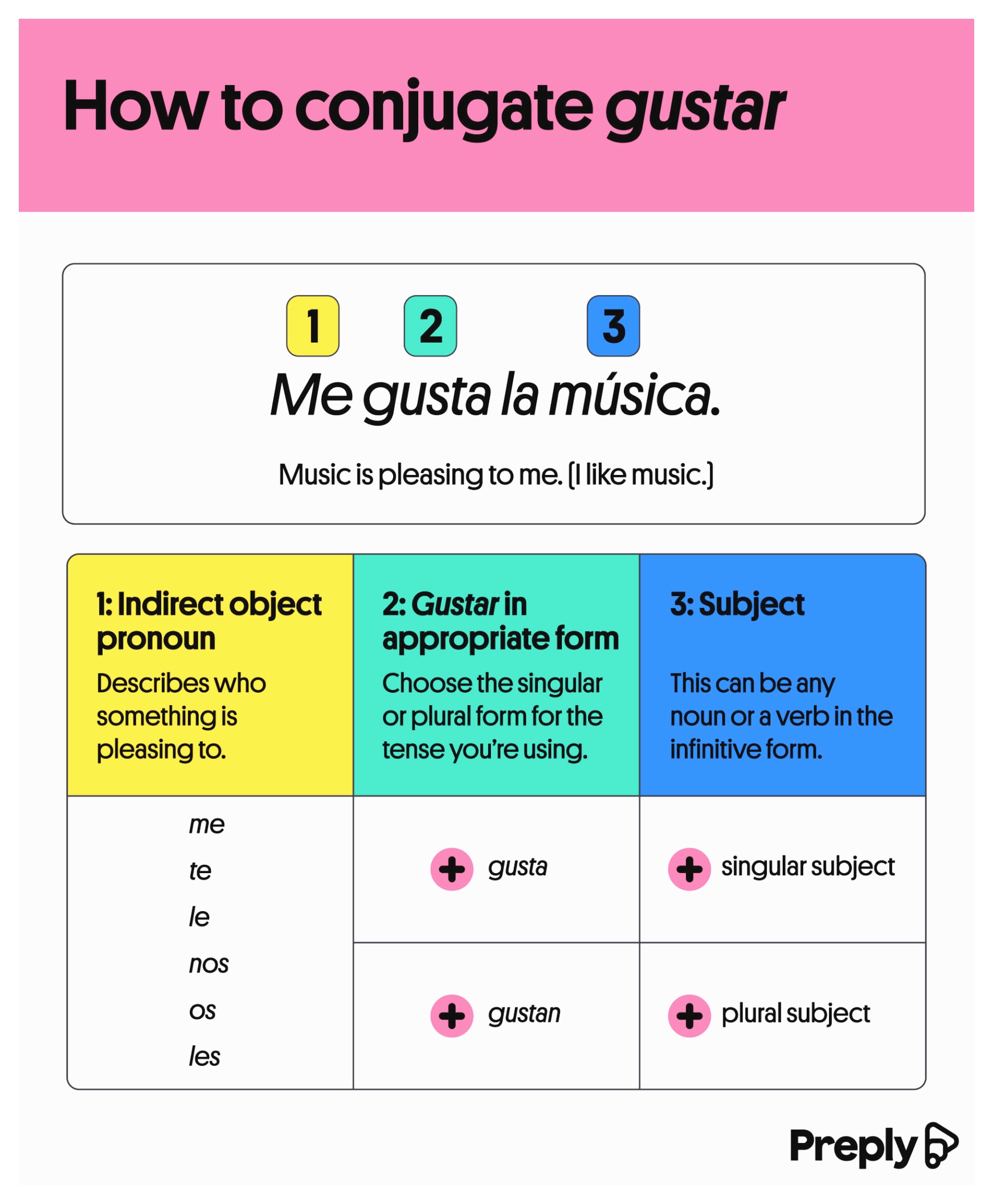
[Indirect object pronoun] + [gustar in appropriate form] + [subject/thing being liked]
- Me gusta mi trabajo. = My work is pleasing to me. (I like my work.)
- Me gustan los perros. = Dogs are pleasing to me. (I like dogs.)
When using “gustar,” it’s crucial to understand the role of the indirect object pronoun, as it indicates who finds something pleasing. For instance, it tells us who enjoys the experience. Remember to select the appropriate pronoun based on the subject’s perspective!
- me = to me
- te = to you
- le = to him, her, it, you (formal)
- nos = to us
- os = to you (plural)
- les = to them, you (plural, formal)
When determining which form of gustar to use, you must determine whether one or multiple things are being liked.
In the present tense use the following rule:
- Gusta is used when the thing being liked is singular or an infinitive verb.
- Gustan is used when the things being liked are plural.
For example:
- I enjoy eating bread daily. The verb “comer” is an infinitive, which is why “gusta” is used.
- Nos gusta la fruta. Fruit is pleasing to us (We like fruit). “La fruta” is singular, so gusta must be used.
- Te gustan las clases de Español. Spanish classes are pleasing to you (you like Spanish classes). “Las clases” are plural, therefore gustan is used.
It’s important to remember that in gustar phrases, any noun or verb in its infinitive form can serve as the subject—the element that is being liked.
How conjugating gustar is different than other verbs
You might have realized that “gustar” differs significantly from typical Spanish -ar verbs. Unlike regular verbs, you don’t have to memorize various forms for each subject pronoun, such as “yo” for “I” or “tú” for “you.” This unique aspect simplifies the learning process!
When conjugating gustar, the only two things to consider are the number of subjects (things being liked) and the verb tense.
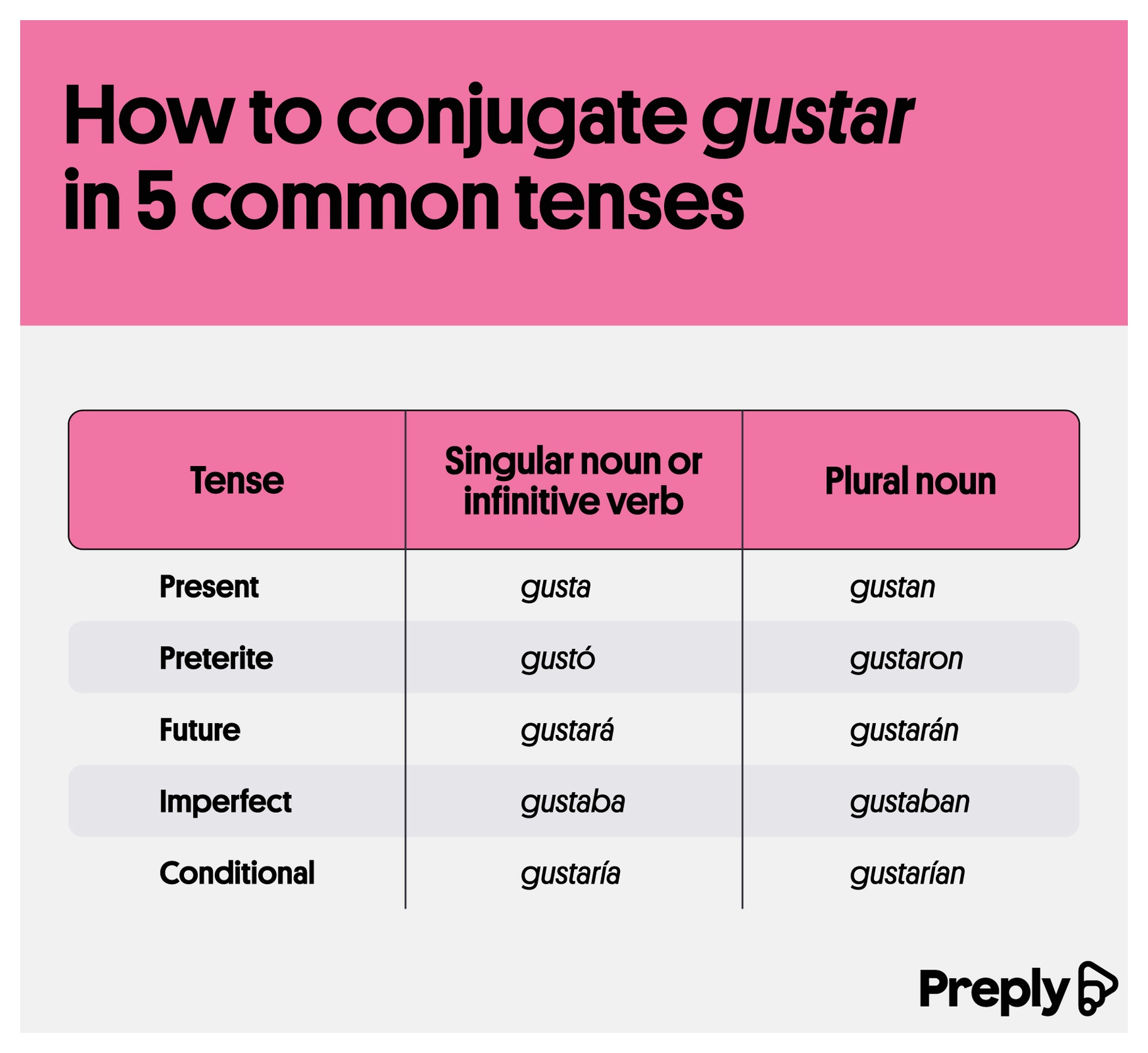
In Spanish, verbs change form based on whether the subject is singular or plural. For instance, in the present indicative tense, you would say “me gusta” for singular subjects and “me gustan” for plural ones. Similarly, in the past preterite tense, you would use “me gustó” for a singular subject and “me gustaron” for a plural subject. Understanding these distinctions is key to mastering Spanish verb conjugation!
Once you master these two forms across all tenses, expressing your likes and dislikes with “gustar” in any situation will become a breeze.
Use this chart as a quick reference to the most common conjugations of gustar:
How to conjugate gustar
To help you correctly conjugate gustar in any situation, follow the following steps.
1. Make sure the verb form agrees with the subject and tense
In Spanish, the verb “gustar” changes according to the subject (the item or items that are liked) and the tense (when they are being liked). It’s important to note that the structure follows “_____ is pleasing to me,” rather than the English phrasing “I like ____.” This means that the focus of the sentence is on the thing that brings pleasure, not on the person who enjoys it.
When referring to a single subject that you enjoy, use the singular form of the verb (for instance, “gusta” in the present tense). Conversely, when discussing multiple subjects that you like, switch to the plural form (for example, “gustan” in the present tense). This distinction helps convey your message clearly and accurately.
For example, to express the equivalent of saying “I like your flower.” or “I like your flowers”.
- Me gusta tu flor. Your flower is pleasing to me.
- Me gustan tus flores. Your flowers are pleasing to me.
Not only does the form of gustar change with the subject, it also changes based on the tense being used.
In the past (preterite) tense the following two forms are used:
- ¿Te gustó el libro? Was the book pleasing to you?
- ¿Te gustaron los libros? Were the books pleasing to you?
It’s essential to understand that there are only two forms of “gustar,” but they vary based on the tense used.
2. Choose the correct indirect object pronoun
The term “gustar” literally translates to “to be pleasing to” someone or something. Therefore, it’s essential to clarify who or what finds it pleasing.
To do this, you must use Spanish indirect object pronouns:
- me = to me
- te = to you
- le = to him, her, it, you (formal)
- nos = to us
- os = to you (plural)
- les = to them, you (plural, formal)
For instance, if you want to express that “your house is pleasing to me” in Spanish, you would use the indirect object pronoun “me” and say, “Me gusta tu casa.” Using the subject pronoun “yo” in “Yo gusta tu casa” would incorrectly imply that “I am pleasing to your house.”
3. Add an optional prepositional phrase
Many times a prepositional phrase or a name is added to clarify the person or thing doing the liking.
The prepositional phrases are:
- a mí = to me
- a ti = to you
- a él, a ella, a usted = to him, her, it, you (formal)
- a nosotros, a nosotras = to us
- a vosotros, a vosotras = to you (plural)
- a ellos, a ellas, a ustedes = to them, you (plural, formal)
There are a few situations in which this is used:
- **Emphasis in Spanish: “A mí me gustó el concierto” vs. “Me gustó el concierto”**
While both phrases mean “I liked the concert,” the inclusion of “a mí” emphasizes that the speaker personally enjoyed it.
- Clarification: “A mis hermanos les gustó el concierto” translates to “The concert pleased my brothers.” While “les gustó” is grammatically correct, it may create ambiguity about who enjoyed the concert. Including “a mis hermanos” eliminates any uncertainty.
Other ways to use gustar
The verb “gustar” is incredibly versatile! It allows you to express not just your favorite things, but also the activities you enjoy. When used in a negative form, you can easily convey what you don’t like, making it a great tool for sharing your preferences. Plus, you can ask others about their likes, opening up conversations about interests and hobbies.
With infinitives
In order to express activities and things you like to do, you can use the singular form of gustar (gusta).
For example:
- Nos gusta jugar al baloncesto. To play basketball is pleasing to us. (We like playing basketball.)
- He enjoys walking in the park.
In negative sentences
To use gustar as a negative, simply add no in front of the indirect object pronoun.
Here is a simple formula to help:
[no] + [Indirect object pronoun] + [gustar in appropriate form] + [subject/thing being liked]
For example:
- No le gusta cantar en publico. To sing in public is displeasing to him. (He doesn’t like singing in public.)
- No nos gustaron las películas. The movies were displeasing to us. (We did not like the movies.)
In questions
To discover what others enjoy or to grasp their preferences, you can utilize gustatory questions. Simply apply the same formula, ensuring to use question mark punctuation in writing and an inquisitive tone when speaking.
¿[Indirect object pronoun] + [gustar in appropriate form] + [subject/thing being liked]?
For example:
- ¿Le gusta tomar café? Is drinking coffee pleasing to him?
- ¿Le gustó el evento? Was the event pleasing to her?
For emphasis or clarification, you can also use the name of the person being referred to.
For example:
- ¿A Eduardo le gustan los frijoles? Are beans pleasing to Eduardo? (Does Eduardo like beans?)
Conjugating gustar in the indicative mood
The indicative mood is used to discuss actions, events, and states that are considered objective and factual.
Click the links below to jump to each tense:
| Present | Imperfect | Preterite |
| Progressive | Future | Conditional |
| Present perfect | Pluperfect | Future perfect |
| Preterite perfect | Conditional perfect |
Present
The present tense indicates when an action is happening right now. For example, in the sentence “Lacy trabaja en la escuela,” it shows that Lacy is currently working at the school.
This construction is employed to describe actions or events happening now or expected to occur soon. For example: “Prometo que voy a limpiar mi dormitorio cuando termino de comer,” which translates to “I promise I will clean my room when I finish eating.”
The present tense serves to convey absolute statements or universal truths. For instance, “La Ciudad de México está construida encima de las ruinas de Tenochtitlan” translates to “Mexico City is built on the ruins of Tenochtitlan,” highlighting a lasting historical fact.
|
Indirect object pronouns |
Gustar form |
Example |
|
me te le nos os les |
gusta |
Me gusta correr. Running is pleasing to me (I like to run). |
|
gustan |
Nos gustan los restaurantes argentinos. Argentinian restaurants are pleasing to us. (We like Argentinian restaurants) |
Imperfect
The imperfect tense is used to describe actions that were habitual, ongoing, or repeated in the past. For example, “Iba a la tienda todos los sábados cuando vivía en Barcelona” translates to “I went to the store every Saturday when I lived in Barcelona.” This tense helps convey a sense of routine and continuity in past experiences.
|
Indirect object pronouns |
Gustar form |
Example |
|
me te le nos os les |
gustaba |
A mi amiga le gustaba ir a los conciertos. Going to concerts was pleasing to my friend. (My friend liked going to concerts.) |
|
gustaban |
Nos gustaban los bailes folclóricos de México. The folkloric dances of Mexico were pleasing to us. (We liked the folkloric dances of Mexico.) |
Preterite
The preterite tense is essential for discussing actions that have been completed in the past. It highlights events that occurred at a definite time, allowing for clear storytelling. For instance, the phrase “Fui a la tienda ayer” translates to “I went to the store yesterday,” illustrating a specific action that took place.
|
Indirect object pronouns |
Gustar form |
Example |
|
me te le nos os les |
gustó |
No les gustó la comida de la cafetería. The food from the cafeteria was not pleasing to them. (They did not like the food from the cafeteria.) |
|
gustaron |
¿Te gustaron las canciones de la orquesta? Were the orchestra’s songs pleasing to you? (DId you like the orchestra’s songs? |
Progressive
The present continuous tense in Spanish corresponds to the English “-ing” form and is used to indicate actions happening right now. This tense is created by combining a form of “estar” (to be) with the present participle of the main verb. For example, to express “I am eating,” you would say “Estoy comiendo.”
|
Indirect object pronouns |
Gustar form |
Example |
|
me te le nos os les |
está gustando |
No me está gustando tu actitud. Your attitude is not pleasing to me. (I am not liking your attitude.) |
|
están gustando |
Nos están gustando los eventos del retiro. The events of this retreat are pleasing to us. (We are liking the retreat events.) |
Future
The future tense allows us to discuss events that are set to occur. It’s essential for expressing upcoming plans or appointments. For instance, you might say, “Iré a la casa de mi amiga mañana,” which translates to “I will go to my friend’s house tomorrow.”
|
Indirect object pronouns |
Gustar form |
Example |
|
me te le nos os les |
gustará |
¿Le gustará venir a mi fiesta el viernes? How would you feel about joining me for my party this Friday? I’d love to have you there! |
|
gustarán |
Te gustarán los libros. The books will be pleasing to you. (You will like the books. ) |
Conditional
The conditional tense allows us to express possibilities, desires, and hypothetical situations. It’s perfect for discussing what could happen in the future or reflecting on events that might have occurred in the past.
|
Indirect object pronouns |
Gustar form |
Example |
|
me te le nos os les |
gustaría |
Me gustaría ordenar un aperitivo. It would be pleasing to me to order an appetizer. (I would like to order an appetizer.) |
|
gustarían |
Nos gustarían los asientos de enfrente. The front seats would be pleasing to us. (We would like the front seats.) |
Present perfect
The present perfect tense, found in both English and Spanish, is a unique compound tense that combines two verbs: the auxiliary verb “haber” (meaning “to have”) and the past participle. This structure is essential for expressing actions that began in the past and still have relevance or continue into the present.
|
Indirect object pronouns |
Gustar form |
Example |
|
me te le nos os les |
ha gustado |
Me ha gustado la película hasta ahora. The movie has been pleasing to me until now. (I have liked the movie so far.) |
|
han gustado |
Les han gustado los trabajos que he hecho. The work I have done has been pleasing to them. (They have liked the work I have done so far.) |
Pluperfect
The pluperfect tense is a fascinating way to discuss past events in relation to one another. It consists of two key components: the auxiliary verb “haber” (to have) and the past participle. This tense specifically highlights actions that occurred before another event in the past, providing a clearer timeline of events.
|
Indirect object pronouns |
Gustar form |
Example |
|
me te le nos os les |
había gustado |
Me había gustado la fiesta hasta que llegó mi exnovio. The party was pleasing to me until my ex-boyfriend arrived. (I liked the party until my ex-boyfriend arrived.) |
|
habían gustado |
Os habían gustado las pizzas hasta que encontraron un insecto. The pizzas had been pleasing to ya’ll until you found an insect. (Y’all liked the pizzas until you found an insect.) |
Future perfect
The future perfect tense is employed to indicate an action that will be completed before a specific moment in the future. It relies on assumptions about what will occur and is formed using the auxiliary verb “haber” (to have) along with a past participle. This structure helps us convey future events with clarity and precision.
|
Indirect object pronouns |
Gustar form |
Example |
|
me te le nos os les |
habrá gustado |
¿Cree que a los clientes les habrá gustado la presentación? Would the presentation be pleasing to the clients? (Do you think the clients will have liked the presentation?) |
|
habrán gustado |
¿Le habrán gustado los tenis? Would the tennis shoes have been pleasing to her? (Would she have liked the tennis shoes?) |
Preterite perfect
The preterite perfect tense is seldom used in everyday Spanish conversation; instead, it primarily appears in literary works. This tense typically follows conjunctions like “aunque” (even though) or “apenas” (just) and serves to highlight actions that took place right before another past event.
|
Indirect object pronouns |
Gustar form |
Example |
|
me te le nos os les |
hubo gustado |
Aunque me hubo gustado el restaurante, tuve que salir temprano. Even though I would have found the restaurant pleasing, I had to leave early. (Even though I would have liked the restaurant, I had to leave early.) |
|
hubieron gustado |
Apenas les hubieron gustado los helados cuando empezó a llover en el parque. The ice cream would have been pleasing to them just when it began to rain at the park. (Just when they would have liked the ice cream, it began to rain at the park.) |
Conditional perfect
Let’s delve into the conditional perfect tense, a fascinating aspect of compound tenses. This tense is used to express events that would have occurred if specific conditions had been fulfilled. To construct the conditional perfect tense, you will need the auxiliary verb “haber” (to have) combined with the appropriate form of the verb “gustar.” This structure allows you to convey hypothetical scenarios effectively.
|
Indirect object pronouns |
Gustar form |
Example |
|
me te le nos os les |
habría gustado |
Si no hubiese estado tan frío, nos hubiera gustado el partido de fútbol. If it hadn’t been so cold, the soccer game would have been pleasing to us. (If it hadn’t been so cold, we would have liked the soccer game.) |
|
habrían gustado |
Si no hubiesen sido tan violentos, me habrían gustado los videojuegos. If they hadn’t been so violent, the video games would have been pleasing to me. (If they wouldn’t have been so violent, I would have liked the video games.) |
Conjugating gustar in the subjunctive mood
In Spanish, the subjunctive mood is used to discuss hypothetical facts, uncertainties, wishes, and desires.
Click the links below to jump to each tense:
| Present | Imperfect 1 | Imperfect 2 |
| Future | Present perfect | Pluperfect |
Present
The present subjunctive mood is used most when speaking about a thought, belief, or assumption.
|
Indirect object pronouns |
Gustar form |
Example |
|
me te le nos os les |
guste |
Espero que te guste mi canción. I hope that my song is pleasing to you. (I hope you like my song.) |
|
gusten |
Creo que les gusten los días de poco trabajo. I believe that days with little work are pleasing to you (plural). (I believe that you like days with little work.) |
Imperfect 1
The imperfect subjunctive mood can be utilized in two primary ways, with the first and most common form ending in “-ara.” Both variations are employed to express uncertainty or improbable events in the past. Additionally, this mood allows you to share your perspective on past occurrences.
|
Indirect object pronouns |
Gustar form |
Example |
|
me te le nos os les |
gustara |
Me costó mucho encontrar un trabajo que me gustara. It took me a lot to find a job that was pleasing to me. (It took me a lot to find a job I liked.) |
|
gustaran |
Es como si no te gustaran los regalos que te regalé. It’s like the gifts I gave you aren’t pleasing to you. (It’s like you don’t like the gifts I gave you.) |
Imperfect 2
The second imperfect subjunctive mood serves a similar purpose as the first, though it is considered more traditional and is less frequently used. Like its counterpart, it conveys uncertainty or unlikely events from the past. Additionally, this form can express personal opinions about past occurrences.
|
Indirect object pronouns |
Gustar form |
Example |
|
me te le nos os les |
gustase |
Tal vez antes no les gustase la escuela, pero ahora si. Maybe school wasn’t pleasing to you (plural) before, but now it is. (Maybe you (plural) didn’t like school before, but now you do. |
| gustasen |
No creo que me gustasen las películas de horror. I don’t think that horror movies would be pleasing to me. (I don’t think that I’d like horror movies.) |
Future
To discuss hypothetical scenarios or potential future events, we employ the future subjunctive mood. This grammatical structure helps us express uncertainty and possibilities that lie ahead.
|
Indirect object pronouns |
Gustar form |
Example |
|
me te le nos os les |
gustare |
Les gustare que preparemos merienda ahora. If we prepare an evening snack now it will be pleasing to you. (You will like it if we prepare an evening snack for you now.) |
|
gustaren |
Me gustaren las clases de guitarra si no tardaran tanto. The guitar classes would be pleasing to me if they did not last so long. (I would like the guitar lessons if they did not last so long.) |
Present perfect
The present perfect subjunctive is a compound verb that combines the present subjunctive form of “haber” (to have) with the past participle of “gustar.” This mood is particularly useful for conveying doubt, belief, or desire, making it an essential part of expressing nuanced emotions in Spanish.
|
Indirect object pronouns |
Gustar form |
Example |
|
me te le nos os les |
haya gustado |
Espero que les haya gustado pasar tiempo aquí con nosotros. I hope that spending time here with us has been pleasing to you. (I hope that you have liked spending time here with us.) |
|
hayan gustado |
Dudo que les hayan gustado los videos de orientación en el trabajo. I doubt that the orientation videos at work were pleasing to them. ( I doubt they liked the orientation videos at work.) |
Pluperfect
The pluperfect subjunctive serves to convey doubt or uncertainty regarding events that occurred prior to another past event. To form this mood, you’ll need to use a conjugated form of the verb “haber” (to have) along with the past participle of “gustar.”
|
Indirect object pronouns |
Gustar form |
Example |
|
me te le nos os les |
hubiera gustado |
Te hubiera gustado ver a los niños en su partido de béisbol. Seeing the boys at their baseball game would have been pleasing to you. (You would have liked watching the boys at their baseball game.) |
|
hubieran gustado |
Me hubieran gustado los vestidos si fueron de color mas vibrantes. The dresses would have been pleasing to me if they had more vibrant colors. (I would have liked the dresses if they were more vibrant colors.) |
Conjugating gustar in the imperative mood
The imperative mood is a powerful tool in language, allowing us to issue orders and commands. It serves to instruct someone to take action (affirmative) or to advise against it (negative). To create a negative command, simply place the word “no” before the indirect object pronoun. This structure keeps communication clear and direct.
|
Indirect object pronouns |
Gustar form |
Example |
|
me te le nos os les |
¡Que guste! |
¡Que no te guste mentir! Don’t let lying be pleasing to you! (Don’t like to lie!) |
|
¡Que gusten! |
¡Que les gusten los cohetes! That the fireworks are pleasing to you! (That you like the fireworks!) |
Gustar practice exercise
Eager to test your knowledge? Dive into these questions to gauge your understanding of the verb “gustar.” If you hit a snag, don’t hesitate to revisit your notes for guidance and clarification. Happy practicing!
- We like dark chocolate. ______ gusta el chocolate oscuro. (nos)
- Martha likes looking at the stars. A Marta _____ gusta mirar las estrellas. (le)
- Do you like to sing? ¿Te _______ cantar? (gusta)
- He likes the books we are reading. A él le _______ los libros que estamos leyendo. (gustan)
- I think you would like our school. Creo que les _________ nuestra escuela. (gustará)
- He would like to order the fish. A él le _______ ordenar el pescado. (gustaría)
- My brother is really liking university. A mi hermano le _____ gustando mucho la universidad. (está)
- They liked the concert. Les _________ el concierto. (gustaron)
- Have you liked the trip so far? ¿Te ______ gustado el viaje hasta entonces? (ha)
- I would have enjoyed the new show, but the actor’s performance was lacking. Me hubiera gustado la nueva telenovela, pero la actuación del actor no fue buena.

Master Spanish grammar with LingualNeeds
Struggling to grasp the nuances of the verb “gustar”? One-on-one online Spanish lessons could be the solution you need! At LingualNeeds, our experienced tutors specialize in simplifying challenging concepts like “gustar,” tailoring each session to your unique needs and level of understanding. If you’re eager to elevate your Spanish skills, let LingualNeeds match you with a tutor who can guide your progress effectively.
Finding the perfect tutor to match your needs and schedule is simple! Start by answering a few quick questions about your goals, skill level, and availability. Our smart algorithm will then suggest tutors tailored to you. Take the time to review their profiles, focusing on pricing, availability, and location to refine your choices. Plus, you can schedule a trial lesson—choose between 25 or 50 minutes—to see if it’s the right fit. After the trial, you can either continue with that tutor or explore other options that may suit you better.
After discovering your ideal tutor, consider subscribing to a lesson plan that fits your needs. This commitment will help you maintain consistent practice and make significant progress in your Spanish language journey.
Frequently Asked Questions
What is the verb ‘gustar’ used for in Spanish?
The verb ‘gustar’ is used to express preferences or likes in Spanish, translating literally to ‘to be pleasing to’ someone.
How does the conjugation of ‘gustar’ differ from regular Spanish verbs?
‘Gustar’ is conjugated based on the subject being liked rather than the person liking it, which differs from the typical conjugation patterns of regular Spanish verbs.
What are the forms of ‘gustar’ used for singular and plural subjects?
‘Gusta’ is used when the subject is singular or an infinitive verb, while ‘gustan’ is used for plural subjects.
How do you express dislike using ‘gustar’?
To express dislike, simply add ‘no’ in front of the indirect object pronoun, such as ‘No me gusta’ for ‘I don’t like’.
What steps should you follow to correctly conjugate ‘gustar’?
To conjugate ‘gustar’ correctly, ensure the verb agrees with the subject in number and tense, choose the appropriate indirect object pronoun, and optionally add a prepositional phrase for clarity.


