
- How many letters are in the French alphabet?
- French alphabet pronunciation
- The French to English alphabet with sounds
- ▶
- How do you pronounce accents in French?
- Silent letters
- French vowels
- Oral vowels
- Nasal vowels
- Semi-vowels
- French consonants
- Master French alphabet pronunciation and beyond with LingualNeeds
- Final thoughts
- Frequently Asked Questions
- How many letters are there in the French alphabet?
- What is the significance of mastering pronunciation in French?
- What are the different types of accents used in French?
- What are some common silent letters in French?
- How can I improve my French pronunciation?
Mastering the pronunciation of letters in a new language is crucial. It serves as the foundation for accurately pronouncing entire words and helps you grasp various accents, enhancing your overall communication skills.
In this article, we explore the intricacies of the French alphabet and its pronunciation. Join us as we guide you through each letter, helping you master their correct pronunciation and understand how they differ from their English counterparts. Read on to enhance your knowledge of the French language!
How many letters are in the French alphabet?
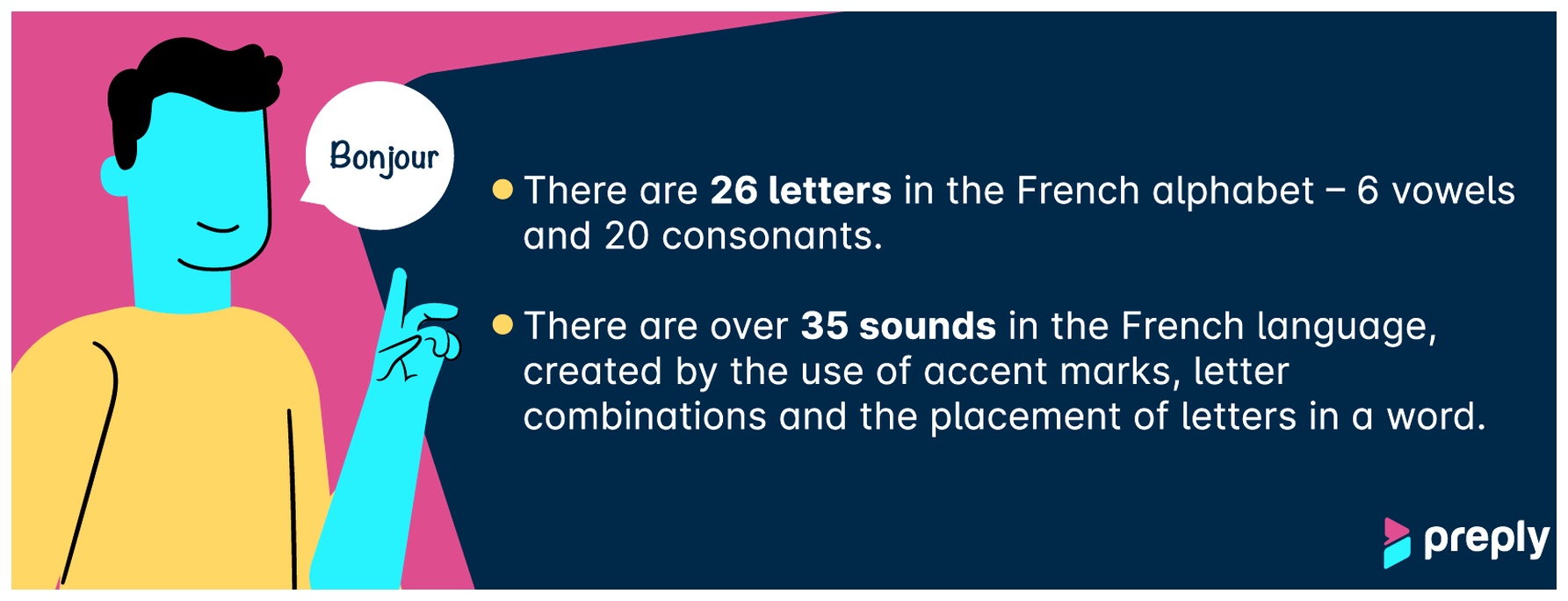
The French alphabet consists of 26 letters, including 20 consonants and 6 vowels. Although French shares the same Latin alphabet as English, the pronunciation of the letters varies significantly between the two languages.
The French alphabet consists of just twenty-six letters, yet it boasts more than 35 distinct sounds, known as phonemes. These sounds arise from various combinations of letters, their arrangements, and the use of accent marks.
French alphabet pronunciation
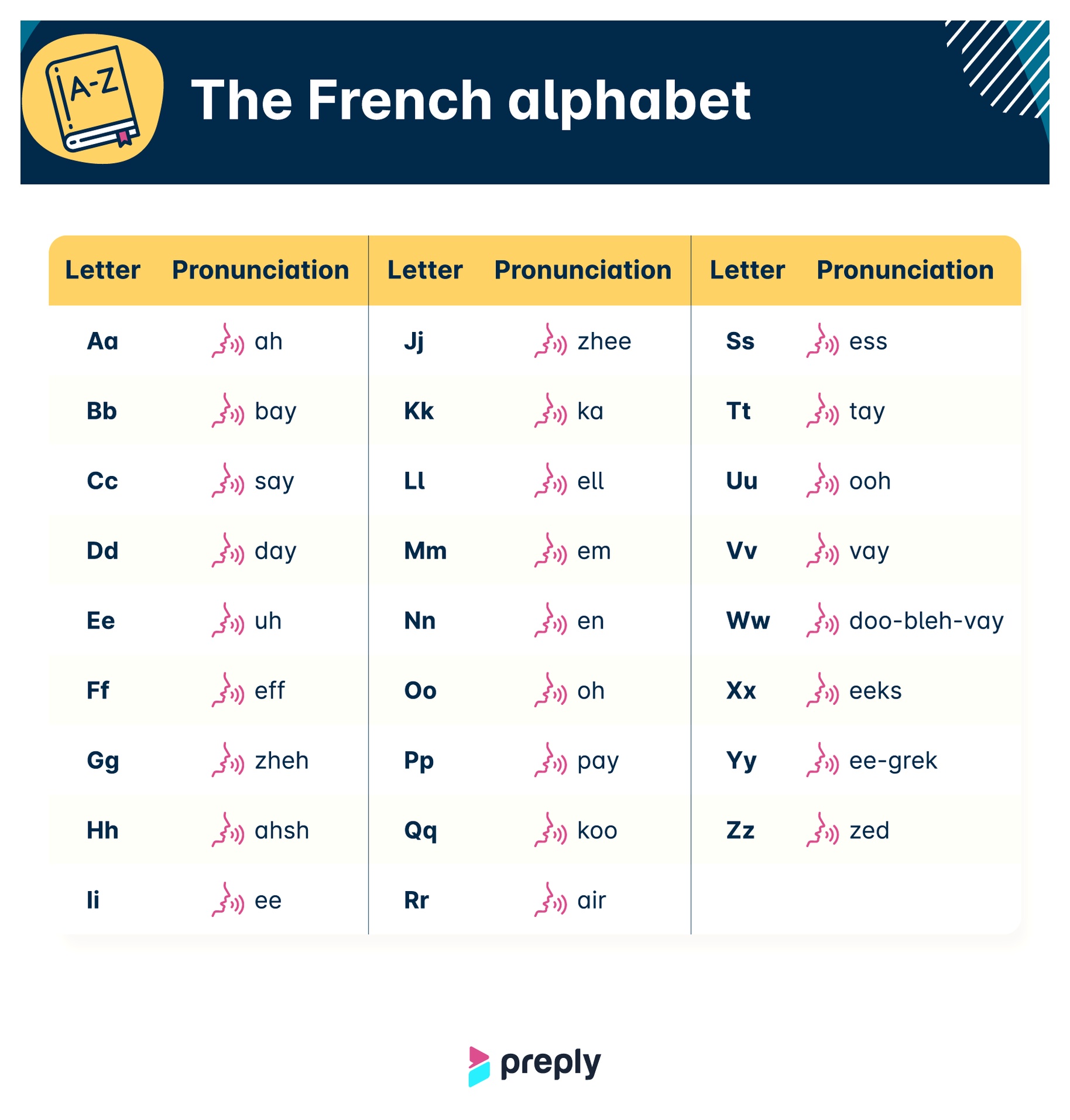
The chart below serves as a helpful pronunciation guide for each letter of the French alphabet. If you’re an English native speaker singing or reciting the French alphabet song, this chart will show you how to pronounce each letter. Keep in mind that letters can sound different when they appear within words; for instance, the letter ‘h’ is usually silent in French, except when it follows the letter ‘c.’
French is considered a non-phonetic language, which means that each letter can represent multiple sounds. As a result, mastering French involves more than just memorizing the alphabet; you also need to familiarize yourself with its unique pronunciation rules.
The French to English alphabet with sounds
In the table below, we explore the French alphabet, providing insights into the pronunciation of each letter. This guide will help you master the sounds and improve your spoken French.
| Letter | Pronunciation |
| a | ah |
| b | bay |
| c | say |
| d | day |
| e | uh |
| f | eff |
| g | zheh |
| h | ahsh |
| i | ee |
| j | zhee |
| k | ka |
| l | ell |
| m | em |
| n | en |
| o | oh |
| p | pay |
| q | koo |
| r | air |
| s | ess |
| t | tay |
| u | ooh |
| v | vay |
| w | doo-bleh-vay |
| x | eeks |
| y | ee-grek |
| z | zed |
How do you pronounce accents in French?
In French, five diacritical marks are used on the vowels a, e, i, o, u, and the consonant c. These accents not only influence pronunciation but can also alter the meaning of words entirely. Understanding these marks is essential for mastering the nuances of the language!
Here’s what each French accent mark is, including which letters it applies to and how it affects each letter:
- Acute accent (é): The acute accent can be placed on an e at the beginning or end of the word.
- Grave accent (à, è, ù): The grave accent can change the pronunciation of the e and change the meaning of words.
- **Circumflex Accent (â, ê, î, ô, û)**: The circumflex accent alters the pronunciation of vowels a, e, and o, distinguishes between homographs, and indicates Latin origins of certain words.
- Cedilla accent (ç): This gives the c a [s] sound.
- Diaeresis mark (ë, ï, ü): This is placed above two consecutive vowels to indicate that they should be pronounced separately.
Silent letters
In the French language, certain letters remain silent, creating intriguing nuances in pronunciation. The specific letters that go unpronounced can vary based on their position within a word, adding an extra layer of complexity to mastering French phonetics.
Here are some general rules for silent letters in French:
- The letter h isn’t usually pronounced in French words unless it’s associated with a c, making the [ch] sound.
- The letter u isn’t pronounced if it appears after a g or q, but it changes the pronunciation of the g.
- The letter n is silent when associated with another letter that creates a nasal sound, like [en] or [an].
- The letter i isn’t pronounced if it comes after an o because oi in French is meant to sound like [wa].
- The e at the end of a word is typically silent unless the e has an acute accent symbol (é).
- The letters s, x, t, d, g, and p are usually silent if they appear at the ends of words.
French vowels
The French alphabet features six vowels: a, e, i, o, u, and y. However, the richness of the language comes from its 19 distinct vowel sounds. These include 12 oral vowel sounds, four nasal ones, and three semi-vowel sounds created when two vowels are pronounced together.
The distinctions among these vowel types lie primarily in their pronunciation. Oral vowels are articulated mainly through the mouth, while nasal vowels involve airflow passing through both the nose and mouth. Semi-vowels, often referred to as “glides,” require a smooth transition between two vowel sounds within a syllable.
The International Phonetic Alphabet (IPA) is an invaluable resource for grasping pronunciation variations across languages. Created by linguists, this universal alphabet captures the diverse sounds that constitute human speech. These distinct sounds, known as phones or phonemes, are what differentiate words within a language, making the IPA essential for language learners and linguists alike.
In English, words such as “sat,” “bat,” and “cat” are easily differentiated by the unique sounds of their initial syllables.
Below, we’ll employ the International Phonetic Alphabet (IPA) to illustrate the distinct sounds of various French vowels. We’ll also include English words that match these sounds for better understanding.
Oral vowels
Oral vowels are represented by a variety of sounds in the International Phonetic Alphabet (IPA), including: [a], [ɑ], [e], [ǝ], [Ɛ], [i], [o], [ø], [ↄ], [œ], [u], and [y].
Here are a few examples of oral vowels, categorized by their IPA sound:
- The [a] sound uses the letter a, as in Paris. The English equivalent is apple.
- The [e] sound uses e-acute (é) and the letter combinations er, et, ai and ez. Examples in French include été (summer) and nez (nose). The English equivalent is okay.
- The [Ɛ] sound uses e-circumflex (ê), e and the letter combinations ai and ei. Examples in French include laine (wool) and lettre (letter). The English equivalent is felt.
- The [i] sound uses i, y and i-circumflex (î). Examples in French include livre (book) and île (island). The English equivalent is see.
- The [o] sound uses o, o-circumflex (ô), and letter combinations au and eau. Examples in French include eau (water) and mot (word). The English equivalent is float.
Exploring the pronunciation of letters across different languages—and even within the same language—reveals that a single letter can generate various sounds based on its context. This fascinating variability highlights the complexity of language and the importance of context in understanding pronunciation.
Nasal vowels
Nasal vowels correspond to these IPA sounds: [ã], [ɛ̃], [œ̃], [ɔ̃].
There aren’t direct English equivalents to the French nasal vowels, so we provided similar sounds.
Here are a few examples of nasal vowels, categorized by their IPA sound:
- The [ã] sound features letter combinations such as an, am, aon, en, and em. In French, examples include “vent” (wind) and “sans” (without), with the English equivalent being “man.”
- The [ɛ̃] sound features letter combinations such as in, im, ain, aim, un, ym, en, ein, and ain. In French, examples include “vin” (wine) and “chien” (dog), while the English equivalent is “pin.”
- The [ɔ̃] sound uses letter combinations on and om. Examples in French include front (forehead) and compagnon (companion). The English equivalent is long.
- The [œ̃] sound uses letter combinations un and um. Examples in French include brun (brown) and parfum (perfume). The English equivalent is bunk.
Semi-vowels
French semi-vowels correspond to these IPA sounds: [j], [w], [ɥ].
Here are a few examples of semi-vowels, categorized by their IPA sound:
- The [j] sound uses the letters i, ll, il and y, as in payer (to pay) and travail (work). The English equivalent is yam.
- The [w] uses the letters ou and o, as in moyen (way) and oui (yes). The English equivalent is water.
- The [ɥ] uses the letter u, as in huit (eight). The English equivalent is suite.
French consonants
French features 20 consonants and 19 distinct consonant sounds. This discrepancy arises because certain consonants produce identical International Phonetic Alphabet (IPA) sounds. For instance, both the letters ‘k’ and ‘c’ can represent the IPA sound [k].
Here are a few examples of consonants, categorized by their IPA sound:
- The [b] sound uses the letters b and bb, as in beau (beautiful). The English equivalent is barbell.
- The [k] sound uses the letters c, k and que. Examples in French include cassé (broken) and kayak (kayak). The English equivalent is cake.
- The [s] sound uses the letters s, ss, c, ç and t. Examples in French include scie (saw) and garçon (boy). The English equivalent is center.
Master French alphabet pronunciation and beyond with LingualNeeds
While learning about French pronunciation is valuable, nothing compares to the experience of practicing with a live tutor. At LingualNeeds, our French tutors provide personalized guidance, ensuring you hear and articulate each letter correctly. They offer a wealth of helpful techniques to help you conquer challenging sounds like the French “r,” “u,” and nasal vowels.
Collaborating with a native French speaker at the start of your language learning journey offers significant advantages, such as establishing solid habits and boosting your confidence. The key to mastering any language lies in your ability to communicate effectively and comprehend others. Enrolling in French classes with a tutor from the very beginning is an excellent way to achieve this goal.
Final thoughts
At first, the sounds of the French alphabet might seem challenging, but with some practice, they will begin to feel more familiar and natural. Keep at it, and you’ll notice significant improvement!
Begin your journey into the French language by exploring the pronunciation chart above to familiarize yourself with the unique sounds. Once you feel confident with the basics, take the next step by booking a lesson with a LingualNeeds French tutor. This hands-on practice will help you refine your pronunciation and enhance your conversational skills!
Frequently Asked Questions
How many letters are there in the French alphabet?
The French alphabet consists of 26 letters, including 20 consonants and 6 vowels.
What is the significance of mastering pronunciation in French?
Mastering pronunciation is crucial as it serves as the foundation for accurately pronouncing entire words and helps grasp various accents.
What are the different types of accents used in French?
French uses five diacritical marks on vowels and the consonant ‘c’, including acute, grave, circumflex, cedilla, and diaeresis.
What are some common silent letters in French?
Common silent letters include ‘h’, ‘u’ after ‘g’ or ‘q’, ‘n’ in nasal sounds, and ‘e’ at the end of words.
How can I improve my French pronunciation?
Improving French pronunciation can be achieved through practice with a live tutor, who can provide personalized guidance and techniques.


