

- Key findings
- How often are people communicating when working remotely?
- How has remote work impacted people’s communication skills?
- What effect does remote work have on people’s social skills?
- How has communication shifted since the dawn of remote work and online learning?
- The communication challenges with remote work
- What are companies doing about it?
- About LingualNeeds
- Methodology
- Frequently Asked Questions
- How has remote work affected Canadians’ communication skills?
- What percentage of Canadians feel confident communicating through digital platforms?
- How often do remote workers communicate with their teams?
- What challenges do employees face when returning to the office?
- What role does LingualNeeds play in enhancing communication skills?
Over four years have passed since Canada, like many other nations, entered lockdown, fundamentally reshaping how we work. This sudden shift to a virtual environment impacted countless individuals, with 78% of Canadians reporting that they have worked or studied remotely at some time. Now, as we look to the future, a shift is occurring, with businesses beginning to invite employees back to the office.
While hybrid work models offer flexibility, they also come with challenges. Return-to-office policies are introducing new pressures on employees’ work habits. After years of adjusting to remote or flexible arrangements, many are now facing a significant change in their working and communication styles.
With the recent return to office life, the team at LingualNeeds is eager to dive into the realm of language learning and effective communication, particularly through our English conversation tutoring sessions. We’re curious about how the rise of virtual work and education has influenced our communication abilities. Has the shift to online platforms made face-to-face interactions more challenging? Let’s explore this intriguing question together.
To better understand communication in the hybrid work environment, LingualNeeds conducted a survey of more than 1,500 Canadian residents. This research aimed to uncover employees’ experiences, perceptions, and needs regarding effective communication in this evolving workplace landscape.
Key findings
- 4 in 10 Canadians believe that their social skills have declined due to limited in-person interactions during remote work
- Over half (57%) of people do not feel very confident communicating through digital platforms
- On average, employees communicate with people in their teams just 4 times a week

Learn a language with personalised 1-on-1 classes with our expert tutors from all over the world
French lessons online
Spanish lessons online
How often are people communicating when working remotely?
At LingualNeeds, we were curious about how often individuals connect with others while working or studying remotely and the impact of this communication. Our findings revealed that, on average, remote workers and learners engage in conversations just 4.2 times a week—equating to less than once a day. This highlights a significant gap in social interaction during remote activities.
One-third of respondents reported daily conversations with colleagues, while an additional 11% engage in communication at least four times a week. Conversely, 6% connect with others just once a week, and some employees interact with their team members only every few months. This infrequent communication may hinder the development of their verbal and written skills.
How has remote work impacted people’s communication skills?
The transition to remote learning and working has significantly transformed how we communicate and collaborate. But what implications arise from these new communication methods and the reduced frequency of face-to-face interactions?
Approximately 70% of individuals experienced noticeable changes in their verbal or written communication skills, significantly affecting their return to the office environment.
Many Canadians have experienced notable enhancements in their writing skills, including grammar, punctuation, and tone. In fact, 42% of respondents reported that their written communication improved as a result of remote work or online studies, with 21% indicating a significant boost. Interestingly, only 8% felt their writing skills declined during this time. This trend may be attributed to the increased focus on digital messaging over traditional face-to-face interactions.
Verbal skills, including clear communication, public speaking, and active listening, faced significant challenges in virtual environments. The absence of face-to-face interactions hindered the growth of these abilities, resulting in a reported 12% decrease in verbal proficiency among respondents. However, it’s worth noting that not everyone experienced a decline; approximately one-third of individuals actually reported an improvement in their oral communication skills during this time.
Among respondents under 25, who faced considerable challenges with virtual learning during lockdowns, 14% reported a decline in their written communication skills. Additionally, 26% observed a drop in their verbal communication abilities, with 9% indicating a significant deterioration. Notably, these figures are the highest among all age groups surveyed.
Learn a language online with our free learning materials.
Learn English online
Learn French online
What effect does remote work have on people’s social skills?
Remote work provides an incredible level of flexibility and freedom, yet it can also lead to feelings of isolation and disconnection from traditional workplace dynamics. The absence of spontaneous conversations and casual coffee breaks, coupled with extended periods of solitude, can make it challenging for individuals to maintain their social skills.
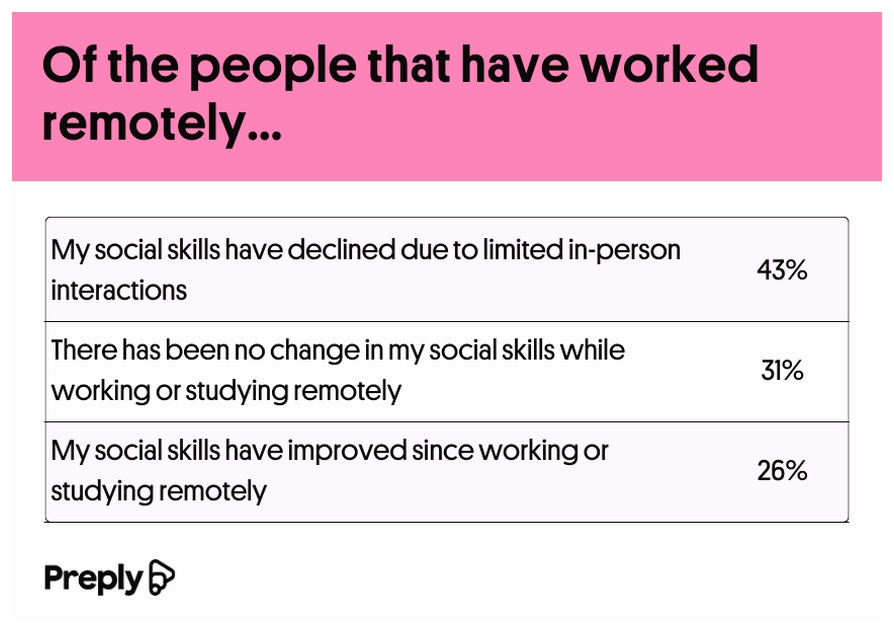
Among those who have experienced remote work, over two-thirds reported a shift in their social skills. Specifically, 43% felt that their abilities were hindered due to the reduced face-to-face interactions associated with this work style, while 26% experienced an enhancement in their social capabilities. It’s particularly noteworthy that younger employees, especially those aged 16 to 24, were the most impacted, with 52% acknowledging a decline in their social skills.
The study revealed a noticeable gender gap among remote workers and students. Among those who have engaged in remote activities, 46% of women reported a decline in their social skills, whereas only 37% of men felt the same. Conversely, 30% of men experienced an improvement in their social abilities, compared to just 24% of women.
How has communication shifted since the dawn of remote work and online learning?
Remote work can pose unique challenges for employee communication, making it less frequent and more complex than in a traditional office environment. The shift from in-person interactions to virtual exchanges has transformed how we connect. Instead of simply turning to a colleague for a quick question, we now rely on clear, concise instant messages. Interestingly, 14% of employees reported that they’ve had to adapt their communication style for digital platforms, while 6% admit they find it difficult to communicate clearly in a remote setting.
Not all changes have been negative; many individuals have actually seen an improvement in their digital communication skills. In fact, 22% of participants reported becoming more efficient in their tech-based interactions as a result of the shift to remote work. Additionally, 16% noted a heightened awareness of the digital etiquette essential for effective virtual communication.

The communication challenges with remote work
In a recent survey about digital communication platforms, many participants showcased a strong confidence in their navigational skills. Yet, only 43% reported feeling very comfortable and confident using these tools, while one in six admitted to feeling uneasy. Additionally, a significant 86% of Canadians encountered challenges when collaborating with team members during remote work or study sessions.
The primary challenge highlighted by participants was the technical difficulties faced when using virtual communication tools and platforms, a concern affecting 17% of users. This issue transcends generational boundaries, impacting everyone, including the tech-savvy Gen Z.
Remote work often presents challenges related to connection and communication. According to our survey, 17% of participants reported feelings of disconnection or isolation from their colleagues, while 16% missed the casual, spontaneous interactions that naturally occur in a traditional office setting.

Working in international teams or with global clients can present unique challenges, particularly when it comes to managing different time zones. In fact, 12% of Canadians reported difficulties in real-time communication due to these time differences.
What are companies doing about it?
Nearly 10% of individuals struggle with effective communication due to insufficient training or unfamiliarity with virtual communication tools. As remote and hybrid work models become more prevalent, it’s crucial for organizations to provide appropriate training and establish a solid framework to support seamless communication.
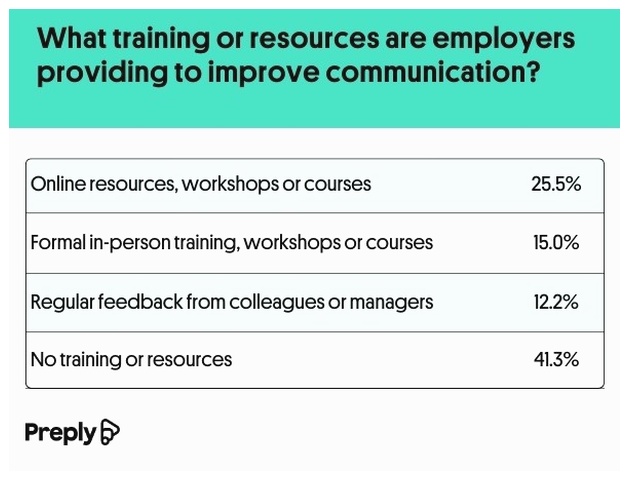
Effective communication stands out as a crucial workplace skill, enhancing collaboration, understanding, morale, and productivity. With the transition to online work, the landscape of communication has evolved significantly; however, many employers have not prioritized supporting this vital skill in a hybrid environment. Consequently, a communication skills gap has emerged. Alarmingly, more than 40% of Canadians report receiving no training or resources from their employers to bolster their communication abilities while working remotely.
As employees transition back to the office, a new challenge may emerge. Those who have grown accustomed to isolated work and limited communication may find it difficult to re-adjust to the demands of frequent in-person interactions.
As workplaces consider a return to the office, it’s crucial for employers to provide support for the soft skills that are likely to be impacted during this transition.
Sylvia Johnson, Head of Methodology at LingualNeeds, says:
The COVID-19 pandemic has transformed the way we work, leading to a dramatic decrease in face-to-face social interactions. As employees adapt to remote work, their communication has shifted to more structured and deliberate exchanges on digital platforms. While convenient, this shift can stifle the spontaneity and depth of social cues that naturally arise in in-person conversations. As a result, many individuals may feel that their social skills have diminished due to the lack of direct interactions.
In contrast, forming virtual teams enhances the exchange of knowledge and ideas among employees, resulting in quicker and more effective solutions. Additionally, this approach helps streamline communication, significantly reducing the need for excessive meetings and fostering a more organized work environment.
About LingualNeeds
LingualNeeds is a dynamic online language learning platform that bridges the gap between thousands of teachers and learners across the globe. Utilizing a sophisticated machine-learning algorithm, it pairs students with the perfect tutors, who then craft personalized lesson plans tailored to each learner’s budget, schedule, and proficiency level.
As you prepare to re-enter the workforce or enhance your language skills, LingualNeeds offers a comprehensive range of lessons, from English to French. If you’re looking to improve your conversational abilities for in-person interactions, consider partnering with a French conversation tutor who can guide you through practical practice. No matter your objectives, our dedicated community of tutors is here to support you at every stage of your learning journey.
Methodology
Between January 30 and February 2, 2024, we conducted a survey with 1,518 Canadian residents to gather insights on their perspectives regarding communication skills. This survey, carried out by Censuswide, required participants to have been residents of Canada for a minimum of 12 months.
Frequently Asked Questions
How has remote work affected Canadians’ communication skills?
Approximately 70% of individuals experienced noticeable changes in their verbal or written communication skills due to remote work, with many reporting enhancements in writing but challenges in verbal skills.
What percentage of Canadians feel confident communicating through digital platforms?
Over half (57%) of Canadians do not feel very confident communicating through digital platforms.
How often do remote workers communicate with their teams?
On average, remote workers communicate with their teams just 4 times a week, equating to less than once a day.
What challenges do employees face when returning to the office?
Employees who have become accustomed to limited communication during remote work may struggle with the demands of frequent in-person interactions.
What role does LingualNeeds play in enhancing communication skills?
LingualNeeds offers personalized language learning and English conversation tutoring sessions to help individuals improve their communication abilities for in-person interactions.


