

- Key findings
- The most common misspellings on LinkedIn
- Have you ever made these grammar mistakes?
- Spelling mistakes across industries
- Make no mistake …
- Frequently Asked Questions
- What are the most commonly misspelled words on LinkedIn?
- Why is accurate spelling important on LinkedIn?
- What is the most frequent misspelling of ‘entrepreneur’?
- How can individuals improve their spelling and grammar skills?
- What common grammar mistake do people make with the word ‘bachelor’s’?
In today’s competitive landscape, first impressions are crucial, and spelling errors on your resume or professional profiles can significantly harm your reputation. LinkedIn, in particular, is a key platform where these mistakes can have a lasting impact.
Your LinkedIn profile is more than just an online resume; it’s a dynamic showcase of your skills, achievements, and professional persona. However, even small typos can significantly affect how potential employers perceive you among countless candidates.
We delved into LinkedIn profiles to uncover the most frequent spelling and grammar mistakes. By examining data from thousands of profiles, we’re ready to reveal the common linguistic blunders that many users make. Read on to discover the top offenders—and be sure to check your own LinkedIn profile to ensure you’re not making these errors!
Key findings
- The 3 most misspelled words on LinkedIn are management, programming and I’m.
- Commonly misspelled as “entreprenuer” and “enterpreneur,” entrepreneur is the most misspelled word across the 25 specific industries we analyzed.
- Bachelor’s is commonly missing an apostrophe before the ‘s,’ making “Bachelors” the top grammar mistake on LinkedIn.
- Accountant, commonly misspelled as “accountnat,” is one of the accounting industry’s top misspelled words.

Learn a language with personalised 1-on-1 classes with our expert tutors from all over the world
French lessons online
Spanish lessons online
The most common misspellings on LinkedIn
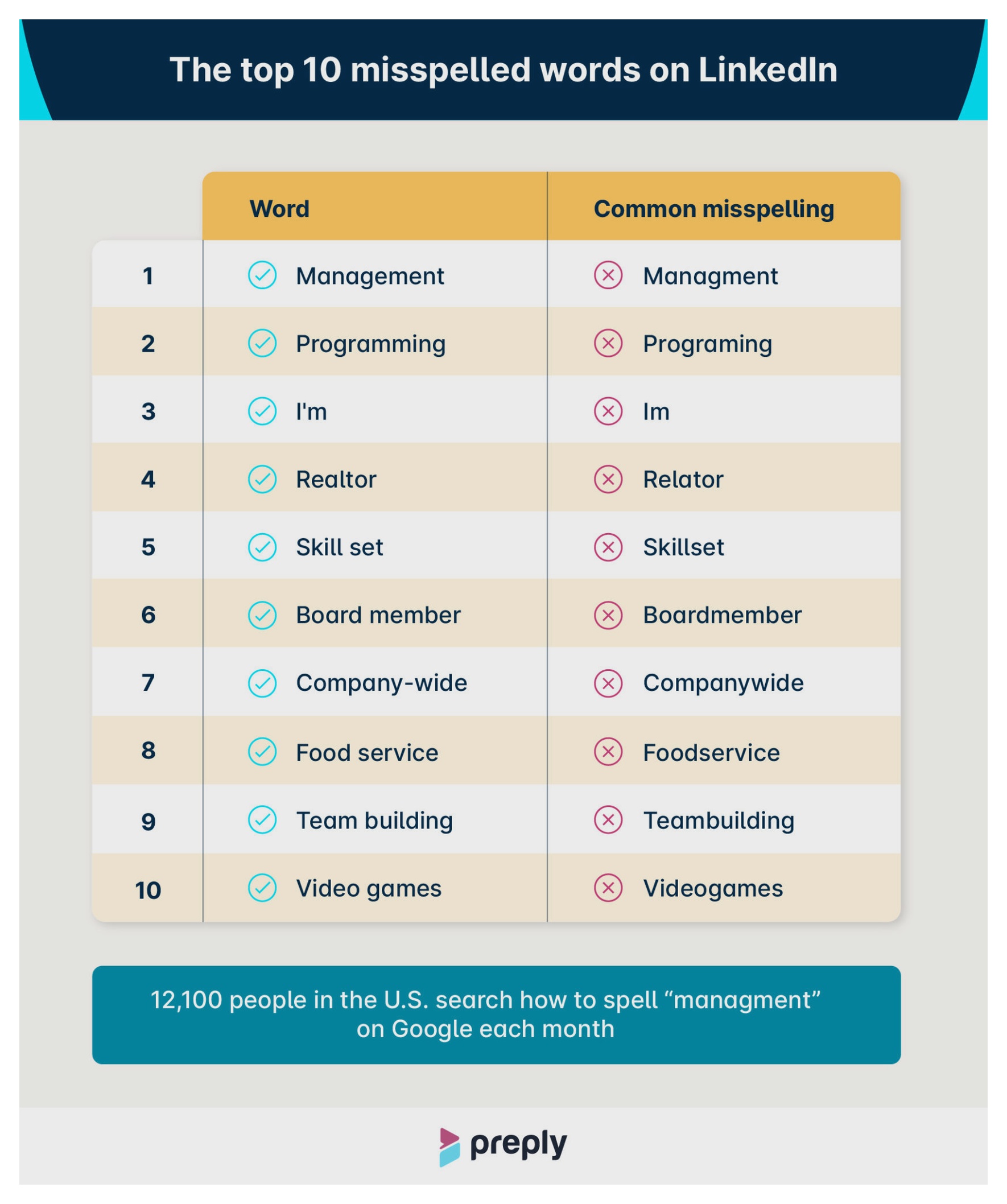
Each month, around 121,000 individuals in the U.S. mistakenly search Google to confirm the spelling of “managment,” a common misspelling of the word “management.” This error is especially prevalent in LinkedIn profiles, highlighting the importance of accurate spelling in professional settings.
Every month, around 1,900 people search for the spelling debate between “programing” and “programming.” While “programing” isn’t technically wrong, “programming” is the favored spelling in everyday English. As a result, “programing” is often seen as a misspelling.
The term “Im” is a frequent misspelling on LinkedIn, intended as a shorthand for “I’m,” which stands for “I am.” This incorrect contraction often appears in casual, hurried typing but misses the crucial apostrophe that helps distinguish “I’m” from other words or acronyms.
To uncover the reasons behind these commonly misspelled words, we consulted language expert Sylvia Johnson from LingualNeeds. She explains that these frequent errors arise not from specific language rules, but from a mix of factors including unfamiliarity with spelling patterns, simple typos, and occasional lapses in attention to detail.
Individuals often place a higher value on quick communication and concise messages rather than on accuracy. Native speakers typically acquire grammar instinctively, which means they might not fully grasp the underlying rules. This lack of awareness can sometimes result in errors in their language use.
English spelling can be notoriously tricky, with its many rules often seeming complex and inconsistent. Johnson highlights that misspellings often stem from various factors, including personal errors, gaps in teaching methods, and the natural intricacies of English spelling conventions.
Have you ever made these grammar mistakes?
Effective communication hinges on a shared language, whether you’re conversing in English, exploring online French courses, or collaborating with international colleagues. Many misunderstandings stem from misconceptions or lapses in fundamental grammar rules, like differentiating between nouns and verbs. Recognizing these basics is essential for clearer interactions.
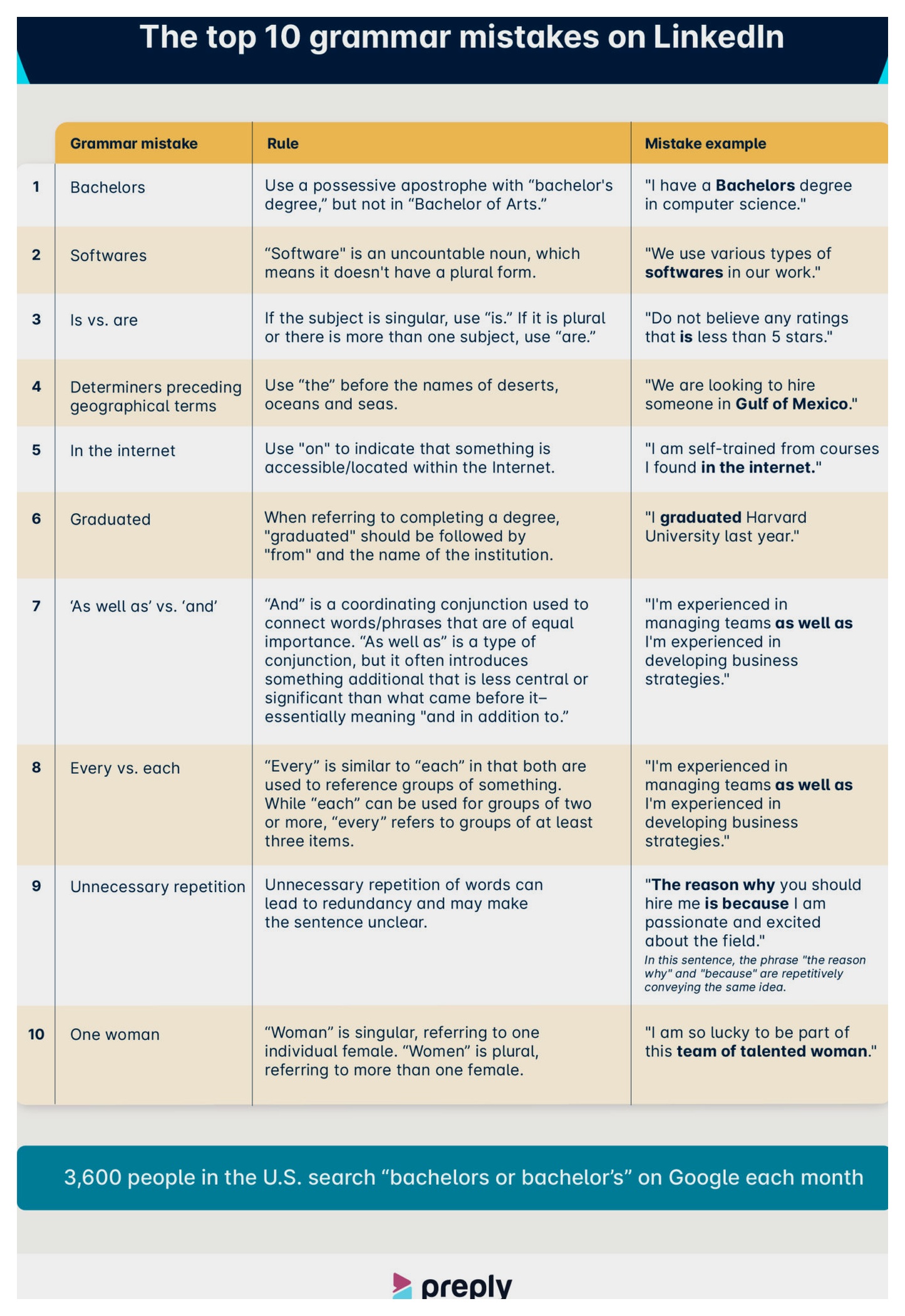
Consider the common uncertainty about how to correctly write “bachelor’s” when discussing an academic degree. Surprisingly, around 3,600 individuals in the U.S. turn to Google each month to figure out whether an apostrophe is necessary.
The term “bachelor’s,” with an apostrophe, signifies possession and is typically used before the word “degree.” However, things get a bit trickier when referring to multiple individuals; in that case, simply “bachelors” is used without an apostrophe.
In the world of technology, the term “softwares” is often misused, even though “software” serves as both singular and plural. This misunderstanding likely arises from the instinct to add an ‘s’ to create a plural form.
Many individuals struggle with when to use “is” versus “are.” While the rule seems straightforward—use “is” for singular subjects and “are” for plural ones—confusion arises when the subject isn’t clear. Understanding the subject of your sentence is key to making the right choice!
Given the multitude of grammar and spelling rules to keep in mind, we wondered if there are effective exercises or strategies to assist learners. Language tutor Martin S. from LingualNeeds recalls a personal experience: “I once misspelled ‘stationery’ as ‘stationary’ while developing a teacher’s resource at a language school. I embraced the mistake with humor, suggesting that the error shouldn’t go ‘anywhere’!”
When students express concerns about making mistakes, I emphasize that conveying meaning takes precedence over perfect grammar. I encourage them to maintain a notebook or use a notes app to jot down any errors they notice while speaking. Reviewing these notes later allows them to reflect on their mistakes and work towards improving their accuracy.
I encourage students to concentrate on mastering one specific grammar structure at a time before moving on to another. This approach not only enhances their spoken and written accuracy in the language but also strengthens their memory retention skills.
Learn a language online with our free learning materials.
Learn English online
Learn French online
Spelling mistakes across industries
As business English tutors, we delve into the LinkedIn profiles of users from 25 distinct industries, uncovering prevalent misspellings unique to each sector.
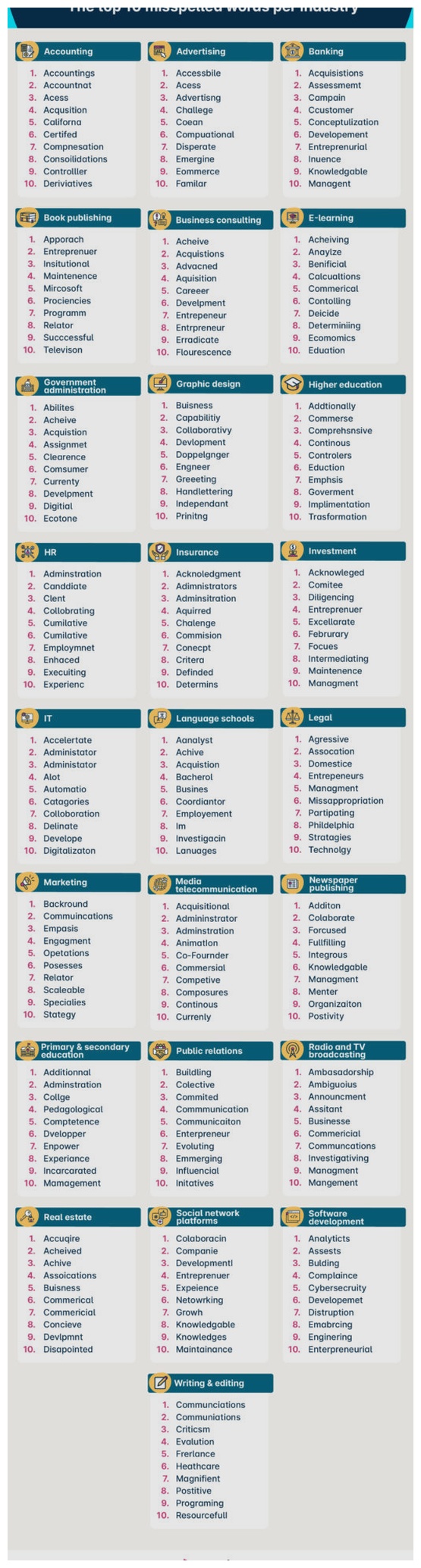
The words “entrepreneur,” “management,” and “realtor” often top the list of commonly misspelled terms. In fact, Google search data reveals that around 1,600 Americans search for the correct spelling of “entrepreneur” each month, highlighting just how often this challenging word trips people up.
In the world of accounting, a frequent misspelling is “accountnat,” while the advertising industry often struggles with “advertisng.” Similarly, in business consulting, the term “entrepreneur” is commonly misspelled as “entrepeneur.” These errors highlight the challenges professionals face in maintaining accuracy in their fields.
The graphic design industry frequently stumbles over the misspelling “prinitng” instead of the correct term, “printing.” Similarly, higher education professionals sometimes mistakenly write “eduction” when they mean “education,” and language schools occasionally get it wrong with “lanuages” instead of “languages.” These common errors highlight the importance of attention to detail in communication.
Similarly, pedagogical is seen misspelled in primary and secondary education as “pedagological,” and “commersial” surfaces in the media telecommunications sector.
In the real estate sector, you might often see “devlpmnt” used in place of “development.” Similarly, in the writing and editing industry—where accuracy is crucial—typos like “communciations” can sometimes replace the correct spelling of “communications.” These common errors highlight the importance of attention to detail in professional fields.
Make no mistake …
The prevalence of misspelled words on LinkedIn highlights a crucial aspect of professional life: effective communication is essential. Clear and accurate language not only reflects attention to detail but also fosters credibility and professionalism in your career.
Effective communication begins with a shared language, whether you’re conversing in English, exploring online French courses, or collaborating with colleagues from around the globe. Establishing this common ground is essential for meaningful exchanges and understanding.
LingualNeeds is here to offer essential support tailored for businesses seeking to boost their employees’ communication skills. With its corporate language training, LingualNeeds delivers a well-organized learning experience designed to help your team thrive. Whether it’s easing the transition for relocating staff or enhancing interactions with international clients, our language tutoring equips your workforce for success.
Online one-on-one English lessons enhance pronunciation, introduce essential business terminology, and elevate overall professional communication skills. This empowers employees to express themselves with confidence and clarity in their work environments.
Methodology
To uncover the most commonly misspelled words on LinkedIn, we analyzed data from the platform’s interface. We filtered out acronyms, personal and business names (like Xceleration), industry jargon (such as empowerED), references from pop culture (like BookTok), and terms in other languages. This careful curation allowed us to compile the insightful lists featured in this post.
We began our research by examining 25 key industries known for their prevalent use of LinkedIn profiles. To ensure clarity and consistency, we adhered to spelling and grammar standards set by respected sources such as the Merriam-Webster Dictionary, Dictionary.com, and Grammarly’s English Grammar Guide.
We conducted an analysis of monthly Google Search volumes to uncover the most common misspellings and grammar errors that people in the U.S. seek help with.
The data was collected in May 2023.
Frequently Asked Questions
What are the most commonly misspelled words on LinkedIn?
The most commonly misspelled words on LinkedIn include ‘management,’ ‘programming,’ and ‘I’m.’
Why is accurate spelling important on LinkedIn?
Accurate spelling on LinkedIn is crucial because it affects how potential employers perceive you and your professionalism.
What is the most frequent misspelling of ‘entrepreneur’?
‘Entrepreneur’ is most commonly misspelled as ‘entreprenuer’ or ‘enterpreneur’.
How can individuals improve their spelling and grammar skills?
Individuals can improve their spelling and grammar skills by maintaining a notebook of errors, reviewing them, and concentrating on mastering one grammar structure at a time.
What common grammar mistake do people make with the word ‘bachelor’s’?
A common mistake is omitting the apostrophe, leading to the misspelling ‘Bachelors’ instead of the correct ‘bachelor’s’.


