- Do people who speak more than one language earn more money?
- Do the richest people on the planet speak more than one language?
- 32% of the world’s richest people speak a second language
- Does the way you speak about the future influence how rich and happy you are?
- Does speaking a second language earn you more money in the UK?
- Conclusion
- Frequently Asked Questions
- Do multilingual individuals tend to earn more money?
- What percentage of billionaires speak a second language?
- Which languages are most commonly spoken by billionaires?
- What role does language play in job opportunities in the UK?
- Does the way people talk about the future affect their wealth and happiness?
Do people who speak more than one language earn more money?
The release of Forbes’ 2022 World Billionaire List revealed an intriguing trend: a significant number of billionaires are multilingual. Remarkably, 32% of the world’s wealthiest individuals can communicate in at least one additional language, highlighting the potential advantages of language skills in achieving success.
To uncover the secrets behind billionaire success, we examined the languages they speak, revealing intriguing patterns in popularity. But what drives this trend? Are certain languages more advantageous for financial success? Additionally, do bilingual job roles generally offer higher pay compared to those that don’t require a second language? Let’s explore these compelling questions.
To address these intriguing questions, we examined the relationship between the languages spoken by the world’s wealthiest individuals and their fortunes. Additionally, we used data from Numbeo and The World Happiness Index to explore whether affluent, “happier” countries tend to favor languages that are advantageous in the job market.
Next, we analyzed high-paying job listings on LinkedIn and Glassdoor to identify which languages are sought after for specific roles and if they correlate with higher salaries. This thorough investigation allowed us to uncover the true financial benefits of being bilingual.
Do the richest people on the planet speak more than one language?
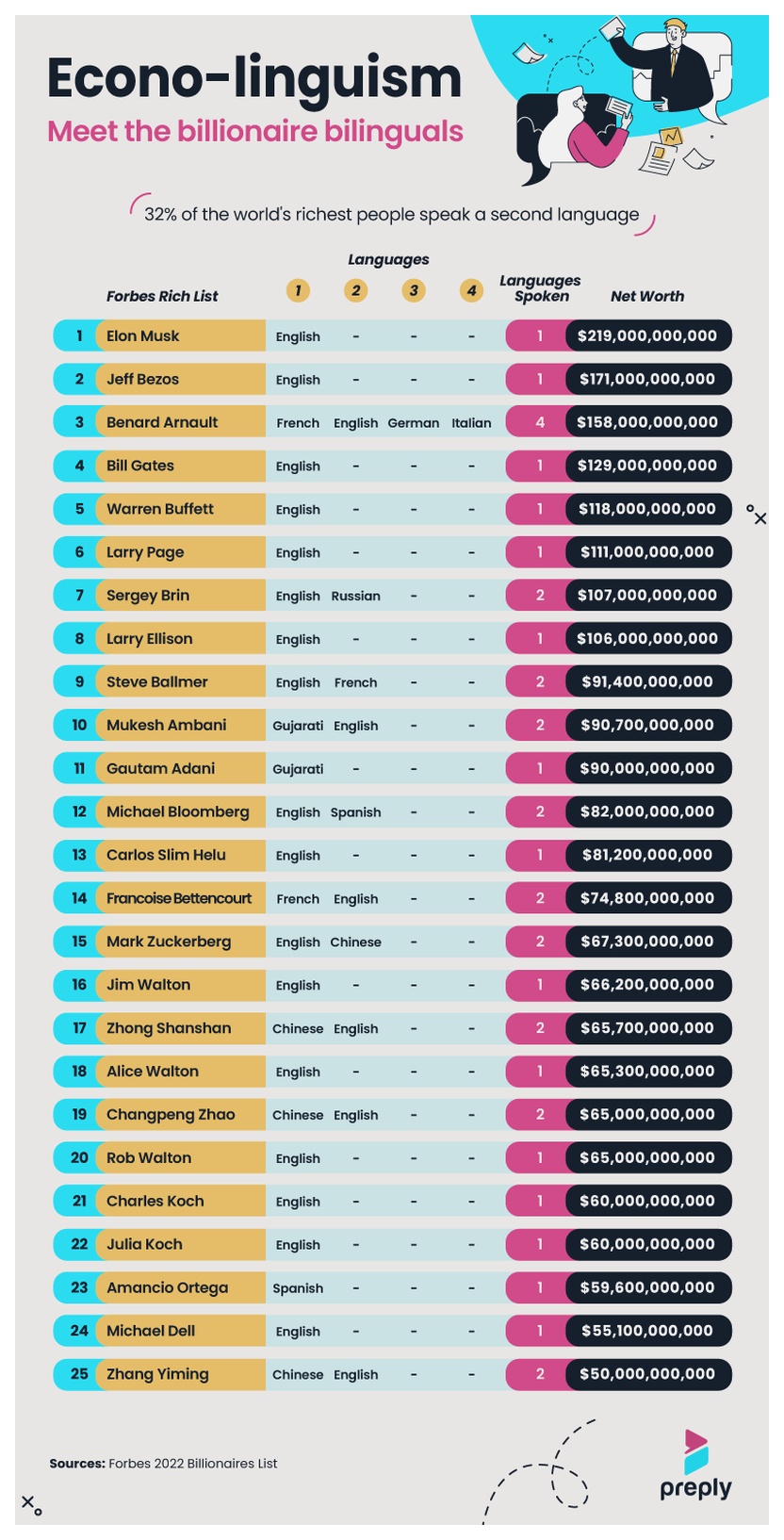
At the forefront of the wealth rankings is none other than Tesla’s visionary, Elon Musk, boasting an astonishing net worth of $219 billion (£181 billion). Despite his frequent status as the world’s richest individual, Musk surprisingly does not speak a second language. Close behind him is Bernard Arnault, the CEO of LVMH Moët Hennessy – Louis Vuitton SE, with a remarkable net worth of $158 billion (£130 billion).
His primary language is French, but he is also fluent in English, German, and Italian. Given that Germany ranks as the third richest country and the UK as fifth, it’s no wonder the billionaire chose to master these languages. Additionally, with Italy celebrated for its rich culture, art, and history, learning Italian further enhances his investment and art collection pursuits.
Ranking third on the list of the world’s wealthiest individuals is Sergey Brin, the co-founder of Google, boasting an impressive net worth of $107 billion (£88 billion). While English is his primary language, Brin is also fluent in Russian. Meanwhile, Steve Ballmer, who holds the tenth spot with a net worth of $91.4 billion (£75 billion), speaks both English and French. A recent article highlighted a remarkable moment when Ballmer delivered a speech entirely in French, which left Finance Minister Christine Lagarde thoroughly impressed, ultimately earning him permanent legal residency in France.
32% of the world’s richest people speak a second language
Mukesh Ambani, the director of Reliance Industries Ltd, boasts a staggering net worth of $90.7 billion (£75.2 billion), placing him 11th on the global wealth list. Hailing from Gujarat, his first language is spoken by over 46 million people across India, the United States, and the UK. In addition to Gujarati, Ambani is also fluent in English, showcasing his ability to connect with a diverse audience.
Michael Bloomberg ranks 13th on the billionaire list, boasting a staggering net worth of $82 billion (£68 billion). He is fluent in English as his primary language and Spanish as his secondary. Our research highlights that the most common languages spoken by billionaires include Chinese, French, and Spanish—reflecting the global influence of these regions, particularly China, which is the third-largest country in the world. Notably, Mark Zuckerberg, the co-founder of Facebook, holds a net worth of $67.3 billion (£55.8 billion) and also speaks Chinese as his second language. With the vast financial opportunities present in China, it’s clear why billionaires are keen to communicate effectively for deal-making in this lucrative market.

Learn a language with personalised 1-on-1 classes with our expert tutors from all over the world
French lessons online
Spanish lessons online
Does the way you speak about the future influence how rich and happy you are?
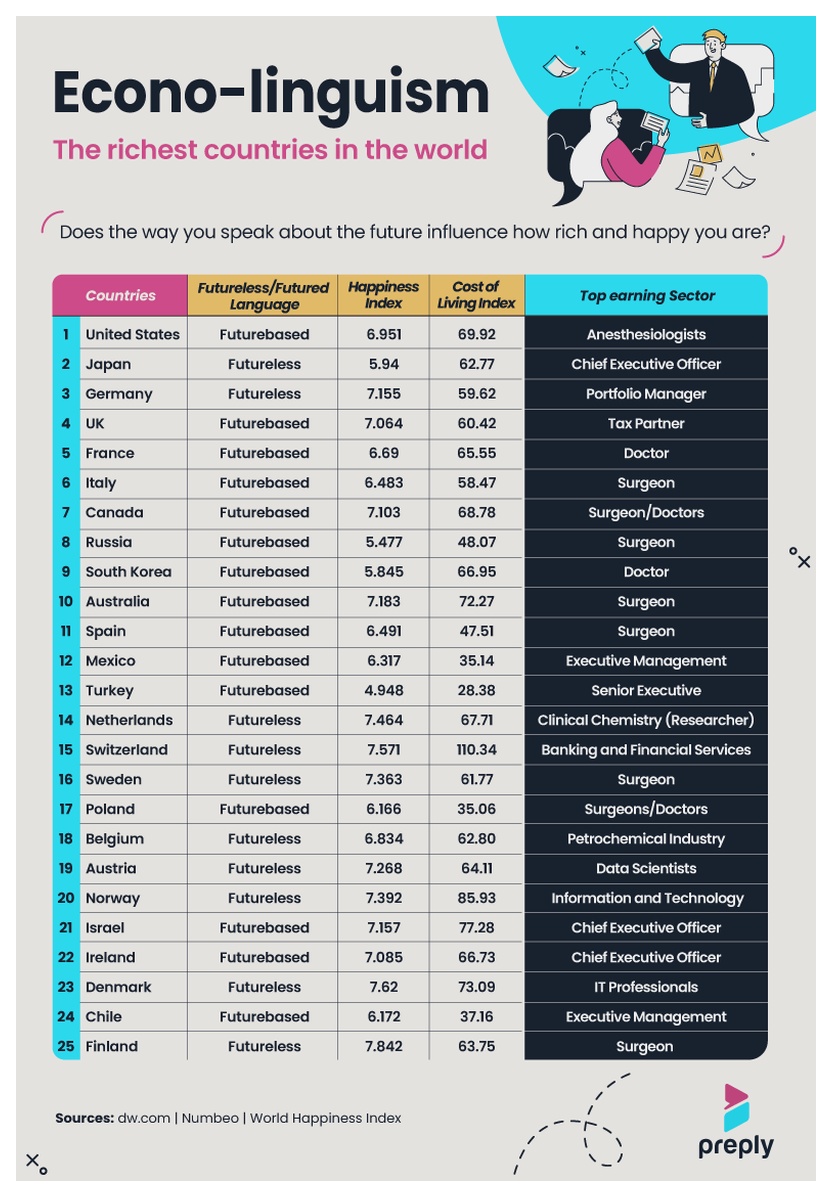
A 2015 article highlighted a fascinating connection between a country’s discourse on the future and its overall wealth. This raised questions about the validity of this relationship. To explore this further, we analyzed data from The World Happiness Index and Numbeo. Our goal was to see if a focus on future-oriented language—what we call “future speaking”—influences both the happiness and wealth of a nation’s population.
Japan secured the second spot on our list of the happiest countries, boasting a substantial population of 126,476,461 and an overall happiness score of 5.94. Interestingly, the culture tends to embrace a “futureless” approach, focusing on addressing issues in the present rather than deferring decisions for the future.
With a staggering wealth of $4.87 trillion (£4tn), it’s clear that waiting to “save money for the future” may not be the best strategy—acting now is more effective. In related findings, Germany ranked fourth in overall happiness, achieving a score of 7.155.
With a population of 83,783,942, Germany boasts an impressive happiness score alongside a substantial wealth of $3.69 trillion (£3 trillion). Notably, the country communicates in a future-oriented manner, which may indicate a link between such proactive communication and overall happiness. This suggests that nations embracing a forward-thinking approach might be more likely to foster a sense of well-being among their citizens.
The Business Insider article we mentioned earlier argues that a forward-looking mindset can significantly impact a country’s wealth and success. This is particularly evident in the United Kingdom, where the soaring cost of living has raised concerns about economic stability and prosperity.
The UK ranked fifth globally, boasting a net worth of $2.64 trillion (£2 trillion) and a population of approximately 67.9 million. Despite its wealth, the country’s happiness score stood at just 7.064, indicating room for improvement. This lower score might be attributed to the UK’s unique future-oriented communication style and a high cost of living, which is rated at 60.42.
Switzerland, renowned as one of the happiest nations globally, boasts an impressive happiness rating of 7.571. Interestingly, the country communicates in a futureless manner, suggesting a fascinating connection between this unique linguistic style and the overall sense of contentment among its people.
Remarkably, their cost of living stands at a steep 110.34. This figure indicates that although adopting a forward-thinking financial approach may yield benefits over time, other aspects, like overall well-being, play a more crucial role in quality of life.
Our research highlighted the highest-paying job sectors worldwide and identified which professions offer the best financial rewards in different countries. Notably, the medical and business fields emerged as the most lucrative, with anesthesiologists leading the pack as the highest earners in the United States, the wealthiest country globally.
In Japan, which ranked second on the list, chief executive officers command the highest salaries. Following closely, Germany takes the third spot with portfolio managers earning the most. In the UK, tax partners top the earnings chart, while in France, doctors lead the way in compensation. Meanwhile, Italy’s highest earners are surgeons.
Does speaking a second language earn you more money in the UK?
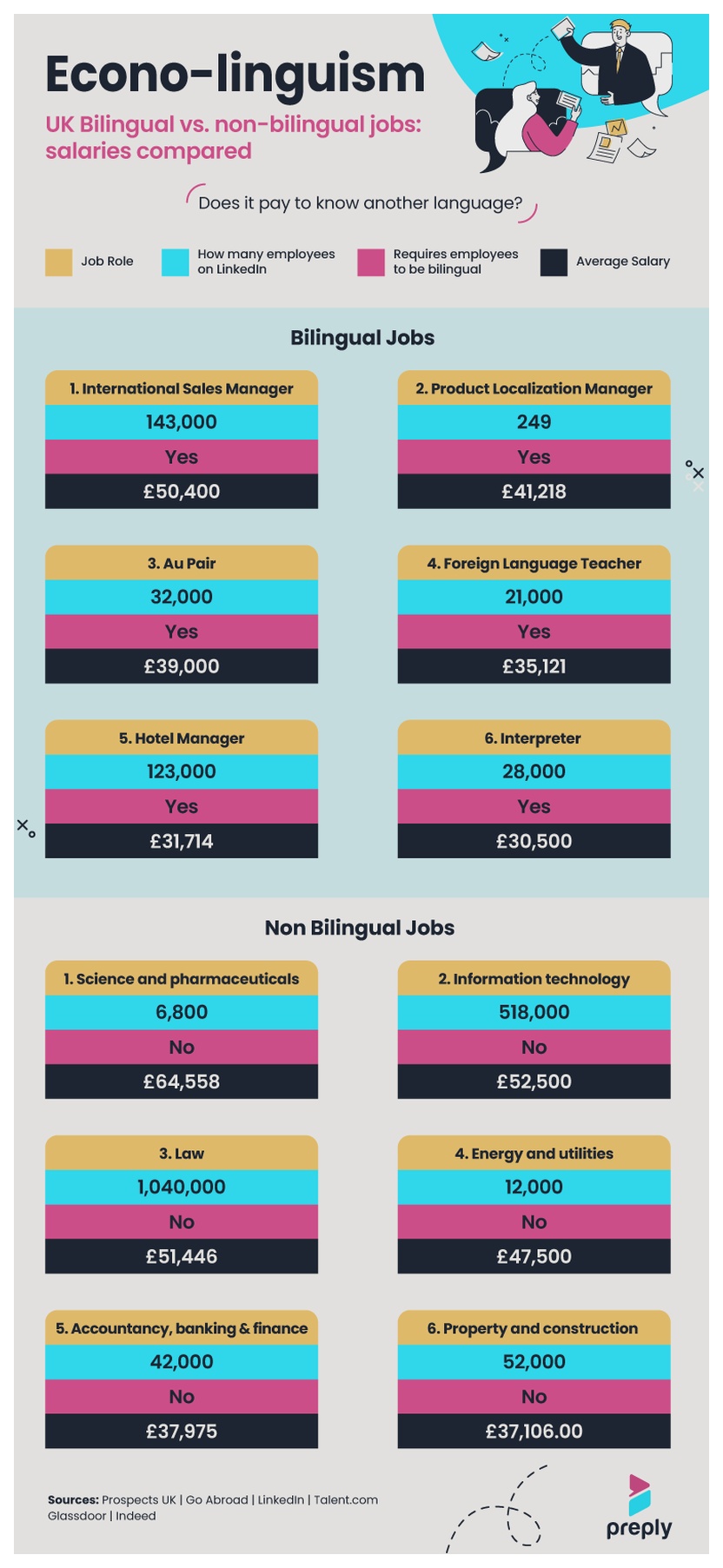
In our quest to uncover the truth behind the pay gap for bilingual versus English-only positions, we turned to the internet for answers. Utilizing platforms like LinkedIn and Glassdoor, we meticulously compared salaries to create a comprehensive ranking of bilingual and non-bilingual jobs. This research aimed to reveal any significant differences in compensation based on language skills.
The top-earning bilingual position highlighted is that of an international sales manager, boasting an average salary of £50,400 in the UK. Interestingly, LinkedIn reveals a substantial pool of 143,000 professionals in this role, significantly outnumbering the highest-paying job in science and pharmaceuticals, which has just 6,800 workers.
It’s fascinating to discover that international sales managers in the UK earn salaries nearly on par with lawyers, with legal professionals averaging £51,446. This high earning potential may be attributed to the sales manager position often requiring proficiency in a second language. Additionally, au pairs in the UK earn an average of £39,000, and there are about 32,000 of them listed on LinkedIn.
Becoming an au pair is an exciting opportunity that often requires proficiency in a second language, as the host family may not speak English. In fact, au pairs can earn surprisingly high salaries, often surpassing those in fields like accounting and banking, where the average salary is £37,975, and engineering, which averages at £35,644—both of which typically do not require a second language. This makes the au pair role not only culturally enriching but also financially rewarding.
Neither the finance nor engineering sectors explicitly require proficiency in a second language, highlighting a stark difference when compared to the advantages of being bilingual. Mastering another language can significantly enhance career prospects and open doors to greater wealth and success in the workplace.
Learn a language online with our free learning materials.
Learn English online
Learn French online
Conclusion
In summary, this research highlights the fascinating connection between language, wealth, and success. A significant number of the world’s richest individuals are bilingual, indicating that language skills can play a crucial role in financial success. Additionally, the manner in which people use language to talk about the future correlates with levels of happiness and economic prosperity. This suggests that the impact of language goes far beyond mere communication, influencing broader aspects of life and achievement.
Exploring different job sectors uncovers fascinating insights, particularly regarding bilingualism, which is frequently linked to greater earning potential. This trend highlights the tangible advantages of mastering multiple languages in diverse professional environments. As our world becomes more interconnected, language skills emerge as a crucial asset for both personal development and career growth.
If you’re eager to seize new opportunities, platforms like LingualNeeds provide a convenient way to boost your language skills. They offer a range of options, including online English lessons, Spanish classes, and specialized business English training. These resources can open doors to enhanced career prospects and wider horizons. In our ever-changing world, embracing language diversity is essential for a more enriching and successful journey.
Methodology
- We discovered a link between language and global wealth distribution by analyzing three factors: the languages spoken by the world’s wealthiest individuals, countries’ future-oriented language, and the wage gap between bilingual and non-bilingual jobs.
- In the billionaire languages section, we analyzed the Forbes 2022 Billionaire List to determine the percentage of the world’s wealthiest individuals who are bilingual.
- In our analysis of how countries discuss the future, we examined the impact of future-oriented versus futureless language on GDP, cost of living, and overall happiness, utilizing data from Numbeo and The World Happiness Index. For the top-earning jobs section, we sourced information from reputable international databases to determine each country’s highest-paying profession.
- We analyzed and ranked salaries for bilingual and non-bilingual jobs in the UK work sector using data from LinkedIn and Glassdoor.
Frequently Asked Questions
Do multilingual individuals tend to earn more money?
Yes, research indicates that a significant number of billionaires are multilingual and that bilingual job roles often offer higher pay.
What percentage of billionaires speak a second language?
32% of the world’s richest individuals can communicate in at least one additional language.
Which languages are most commonly spoken by billionaires?
The most common languages spoken by billionaires include Chinese, French, and Spanish.
What role does language play in job opportunities in the UK?
Being bilingual can significantly enhance career prospects, with international sales managers earning competitive salaries compared to non-bilingual roles.
Does the way people talk about the future affect their wealth and happiness?
Yes, there is a connection between future-oriented language and higher levels of happiness and economic prosperity.