- Key findings
- Where do we learn slang?
- The most popular slang in America right now
- Slang that originated from COVID-19
- The most annoying slang in America
- Who uses the most slang?
- What types of people are using slang?
- When is it OK and not OK to use slang?
- Frequently Asked Questions
- What percentage of Americans use slang in every conversation?
- Where do most people learn new slang terms?
- Which slang term is currently the most recognized in America?
- Is slang considered acceptable in professional environments?
- What are some of the most disliked slang terms in America?
Every day, a fresh word or phrase emerges, often leaving us puzzled about its origins and meaning. It’s a fascinating reminder of how language constantly evolves and adapts.
Language used to develop slowly, with new words taking decades to become widely accepted. However, our increasing connectivity and rapid communication have accelerated this process, allowing new terms to quickly integrate into our everyday vocabulary, regardless of our location. For instance, in the spring of 2021, over 300 new words, updates, and definitions were added to the dictionary, featuring terms like “5G,” “snack,” and “yeet.”
Slang plays a significant role in shaping modern language, often influenced by social media and celebrities. For example, the phrase “throw shade” gained popularity from the show RuPaul’s Drag Race, while gamers introduced the term “pwned.” Additionally, the trend “Throwback Thursday” started in 2006 when a sneaker collector shared a nostalgic photo of his favorite shoes.
We wanted to see how Americans feel about this corner of language, so we surveyed nearly 2,000 English speakers.
Key findings
- 20% of Americans admit to using slang in every conversation.
- 50% of Americans use slang terms without knowing what they mean.
- The most well-known slang words and phrases in America are “ghosted,” “salty,” and “on point.”
- 58% of Americans don’t know what the ‘Rona’ means.
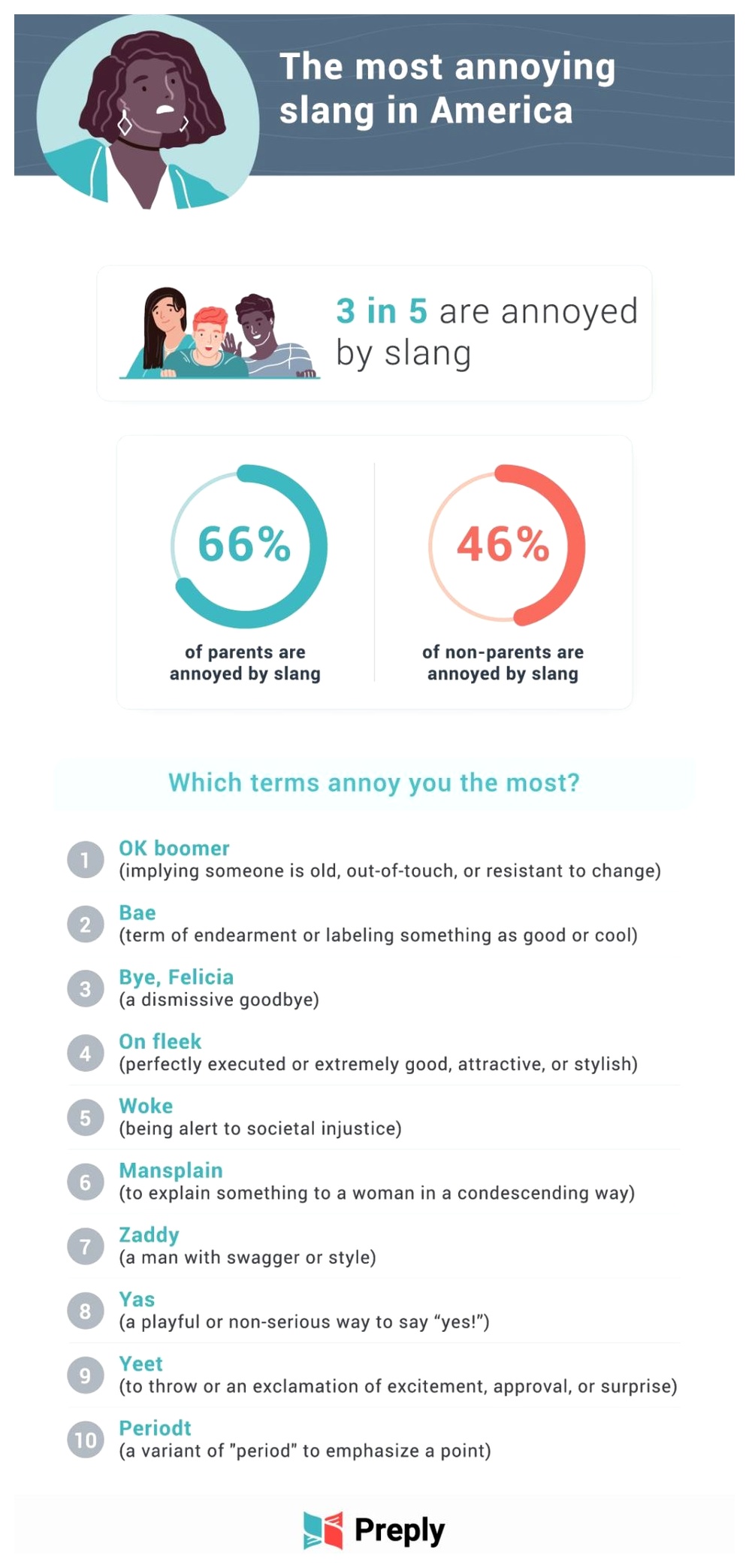
- 66% of parents are annoyed by slang, compared to 46% of people without children.
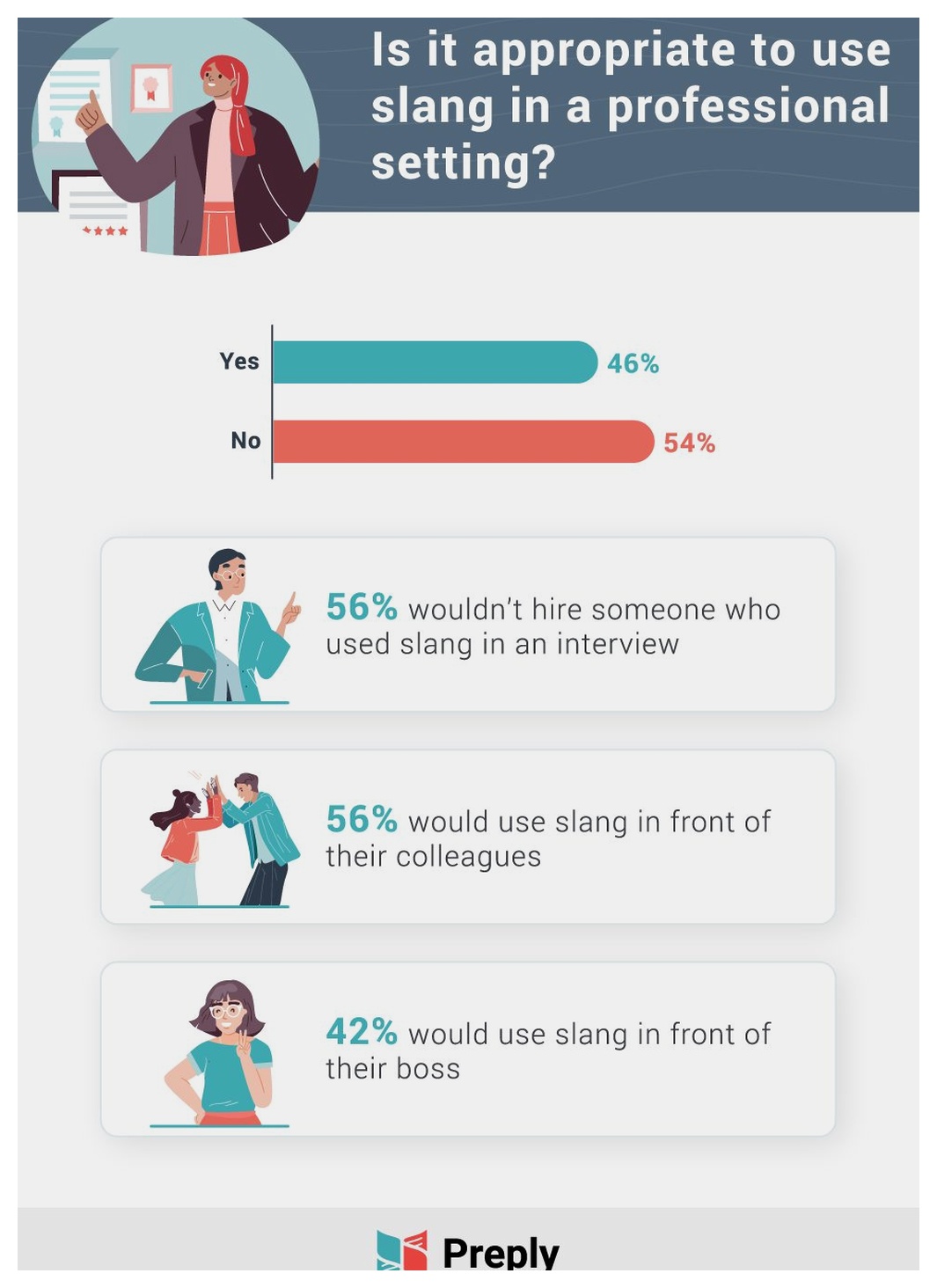
- 46% of Americans believe using slang is acceptable in professional environments, with 42% willing to use it in the presence of their boss.
Where do we learn slang?
Whether we love or hate it, we have to learn this sort of language somewhere — but where?
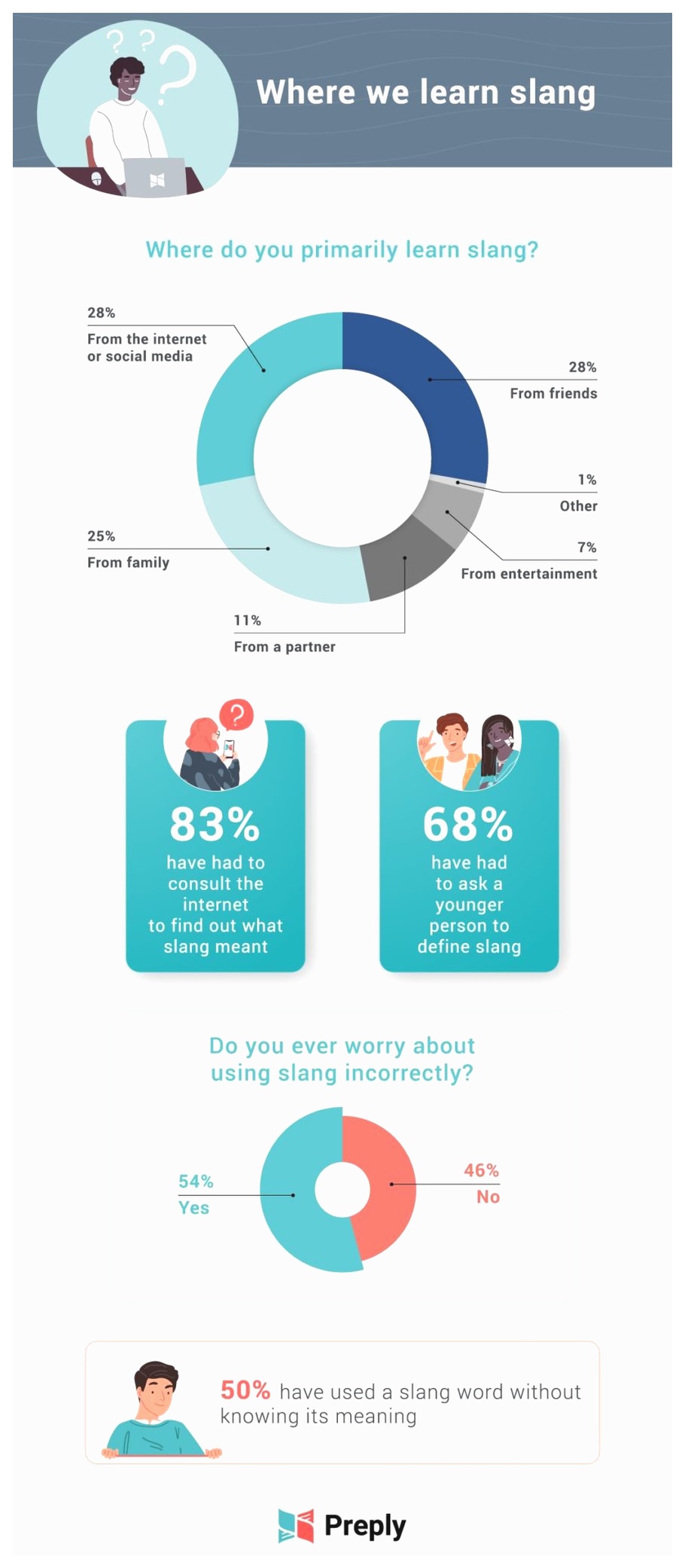
For over half of us (56%), the internet and social media are the primary sources for picking up new slang. Additionally, many people learn these trendy terms from their peers or fellow students.
- “From my children: they keep me ‘cool’ and up to date on the ‘cool’ words used these days.”
- “Prior to COVID, in my workplace. We had a lot of late teens to thirtysomething [people] working with us.”
Most respondents don’t stress about using slang accurately—46% admit they aren’t worried about getting it wrong, and half have used slang terms without fully understanding their meanings.
The most popular slang in America right now
While many people may find slang irritating, its prevalence is undeniable. Remarkably, about 80% of Americans acknowledge incorporating slang into their speech, with 20% using it in every single conversation.
To explore popular slang, we surveyed Americans on terms they frequently use in conversation. Interestingly, half of the respondents recognized the term “ghosted,” while nearly as many—48%—were familiar with “salty” and “on point.”
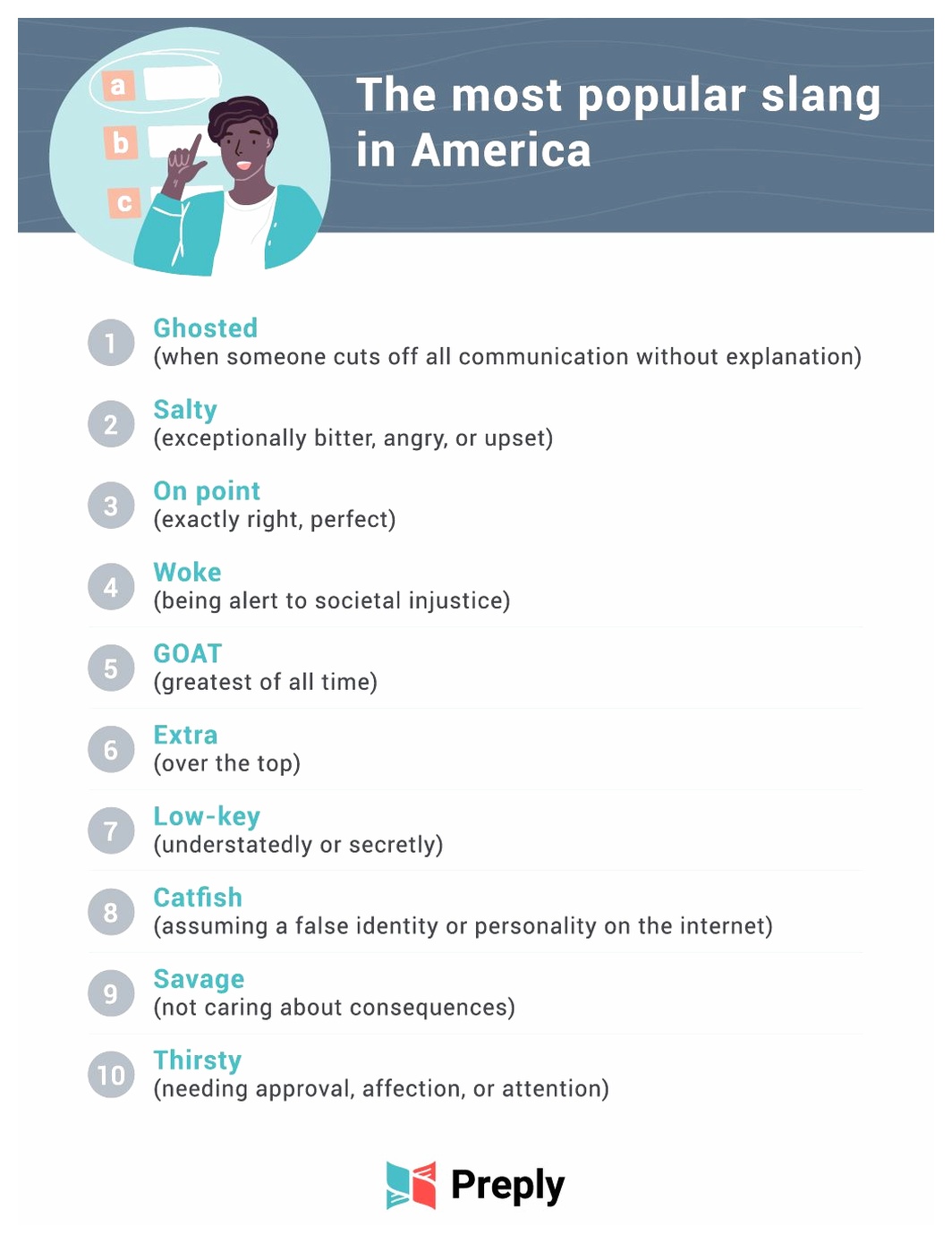
On the flip side, the most unpopular slang terms included “vom,” referring to vomit, “lewk,” which describes an individual’s distinctive style, and “JOMO,” an acronym introduced in 2012 that stands for “the joy of missing out.”
Slang that originated from COVID-19
Crises often give rise to new vocabulary that reflects the challenges of the times. For instance, wartime introduced terms like “ammo,” “AWOL,” “FUBAR,” and “civvies.” Similarly, the COVID-19 pandemic has spawned a fresh lexicon, prompting the Oxford English Dictionary to update its entries to capture the pandemic’s influence on the English language.
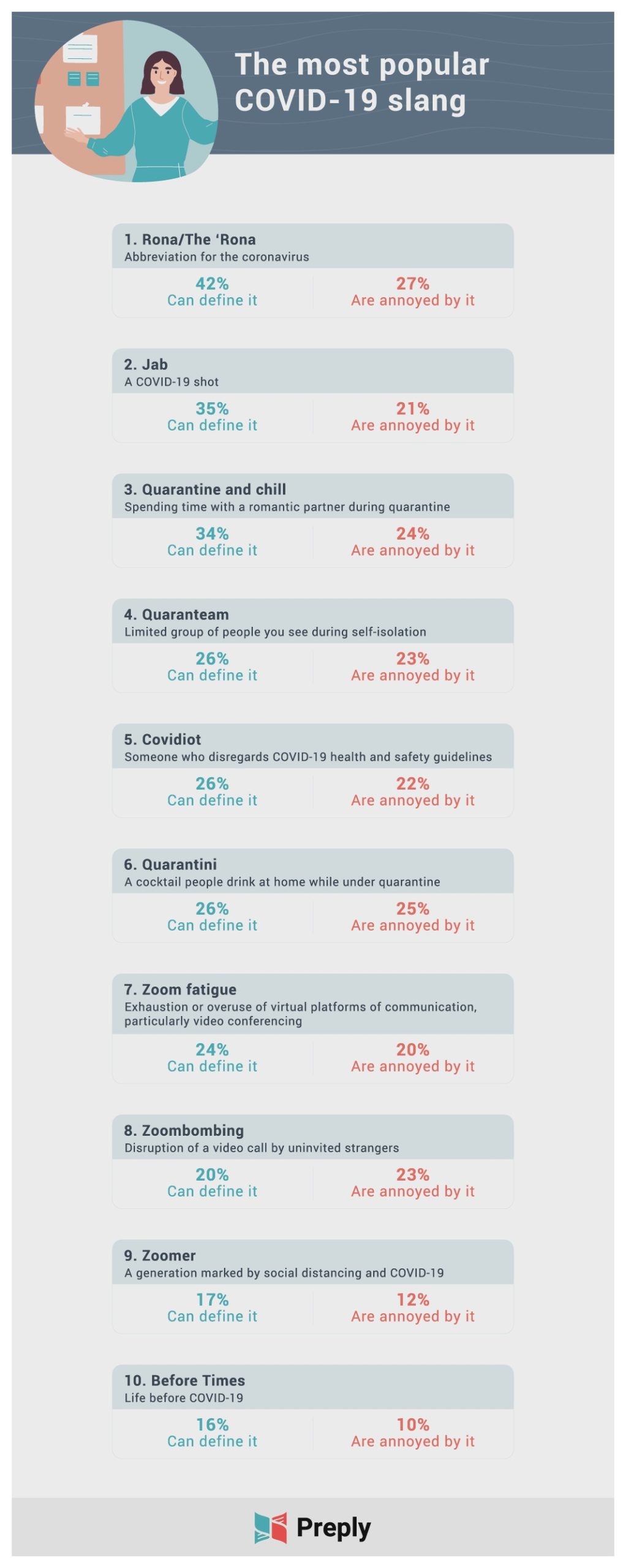
The latest updates feature formal terms such as “COVID-19” and “frontliner,” alongside more casual entries like “maskne” and “quarantini,” which have made their way onto the OED’s watchlist. But which of these terms resonate most with Americans?
The term that topped the list was “Rona,” a colloquial abbreviation for “coronavirus,” which was used by 42% of people. It was closely followed by “jab,” referring to a vaccine shot at 35%, and the catchy phrase “quarantine and chill” at 34%. Additionally, Americans have become familiar with terms like “maskne” (acne caused by masks), “long-hauler” (individuals facing prolonged effects of COVID-19), and “ghost kitchen” (kitchens dedicated solely to delivery meals).
The most annoying slang in America
Every slang term has its fans and detractors, but some catch more flak than others. Leading the pack of most-disliked slang is the phrase “OK boomer,” which many baby boomers found particularly offensive. It shares the top position with “bae,” a contemporary term for a significant other, with both terms receiving 29% disapproval.
Trailing closely at 28% is the iconic phrase “Bye, Felicia,” first popularized by Ice Cube’s character in the 1995 comedy classic *Friday*. While it may irritate many, this dismissive line has remarkably persisted in popular culture for over 25 years.
Who uses the most slang?
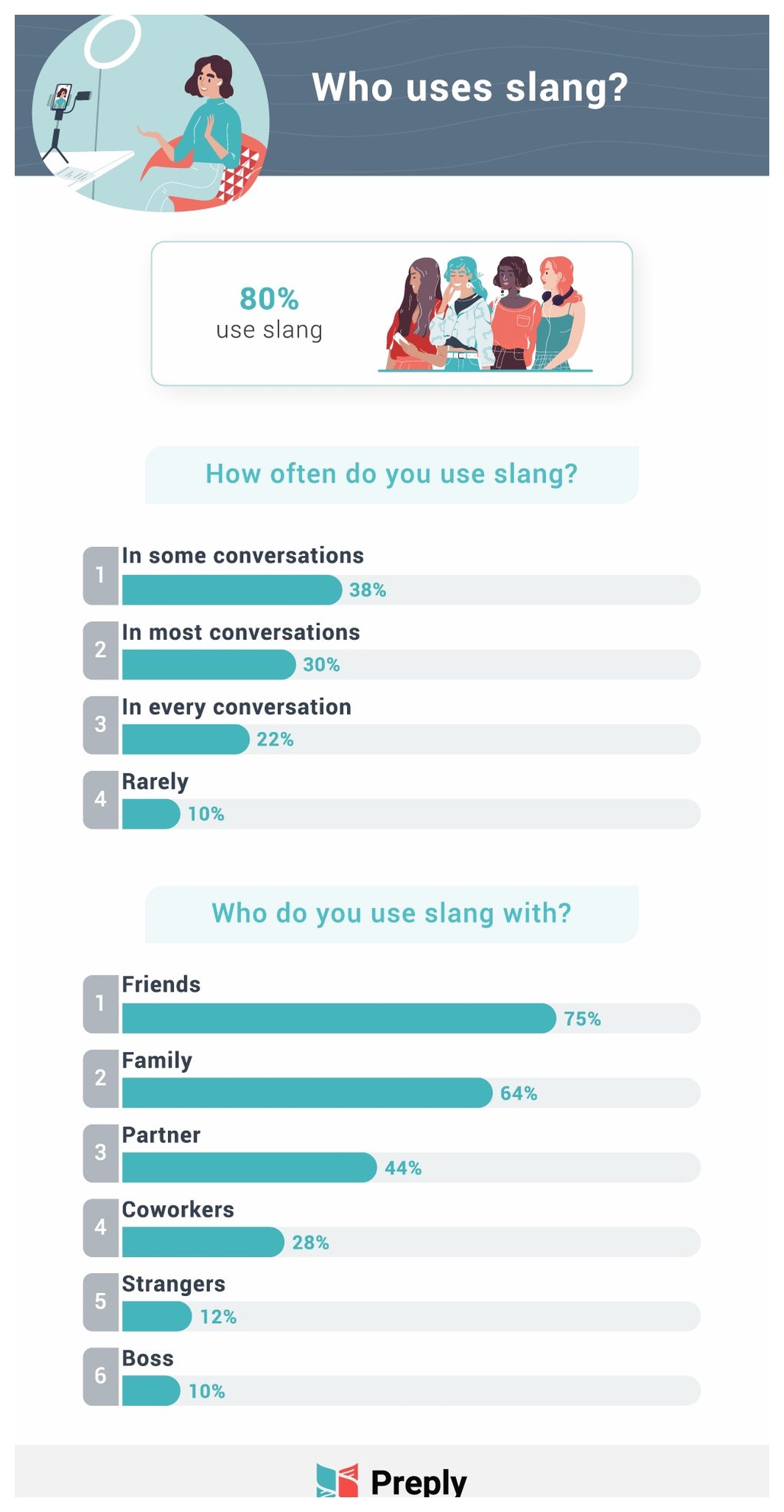
An impressive 80% of respondents report using slang, with over half (52%) incorporating it into nearly every conversation. This highlights the crucial role slang plays in our everyday communication.
People tend to use slang more frequently in casual situations, particularly with friends (75%) and family (64%), where they feel comfortable expressing themselves informally. However, the use of slang drops significantly in more formal or unfamiliar contexts. Our survey revealed that only 12% of respondents used slang when interacting with strangers and a mere 10% used it with their boss.
What types of people are using slang?
Interestingly, a significant 81% of introverts frequently incorporate slang into their speech, with more than half (54%) using it in nearly every conversation they engage in.
Parents tend to embrace slang more than those without children, which makes sense considering that 70% of respondents pick up new slang from younger generations. In fact, 60% of individuals incorporate slang into most, if not all, of their conversations.
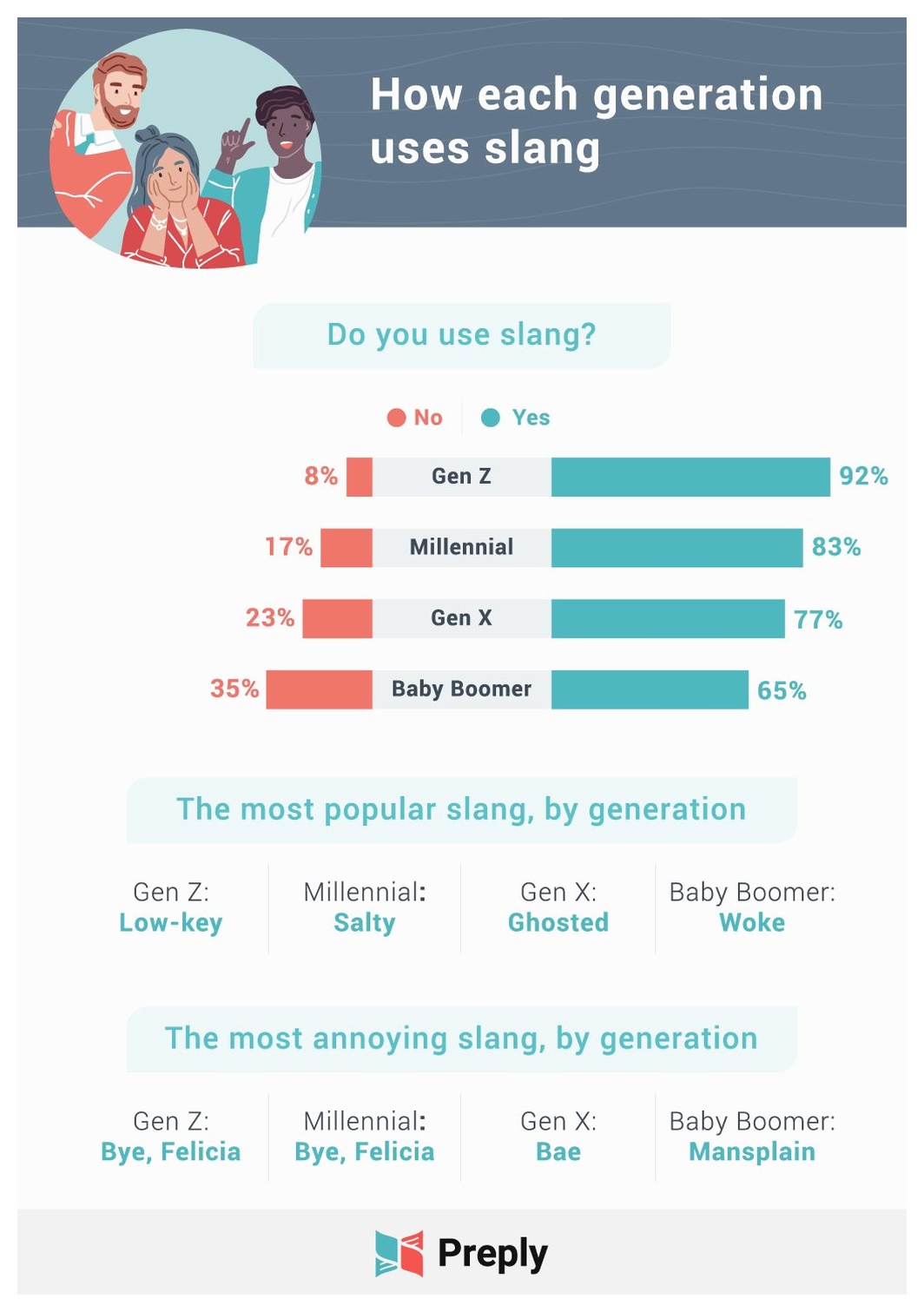
Slang is primarily a creation of younger generations, and its appeal grows stronger with each age group. Research shows that the use of slang rises dramatically from one generation to the next: 65% of baby boomers use it, compared to 77% of Gen X, 83% of millennials, and a striking 92% of Gen Z. This trend highlights how language evolves and adapts among younger demographics.
Slang terms like “awesome,” “cool,” and “nice” have maintained their popularity across generations, from baby boomers to millennials. However, each generation introduces its own twists, especially regarding the most frequently used and, with one notable exception, the most irritating slang expressions.
Slang varies across generations, with boomers frequently using “woke,” Gen X adopting “ghosted,” millennials saying “salty,” and Gen Z favoring “low-key.” When it comes to the most irritating terms, boomers can’t stand “mansplain,” while Gen X is annoyed by “bae.” Interestingly, both millennials and Gen Z share a mutual dislike for the phrase “Bye, Felicia.”
When is it OK and not OK to use slang?
In general, people are generally comfortable with using slang in different social contexts, though the acceptance levels fluctuate based on the specific situation.
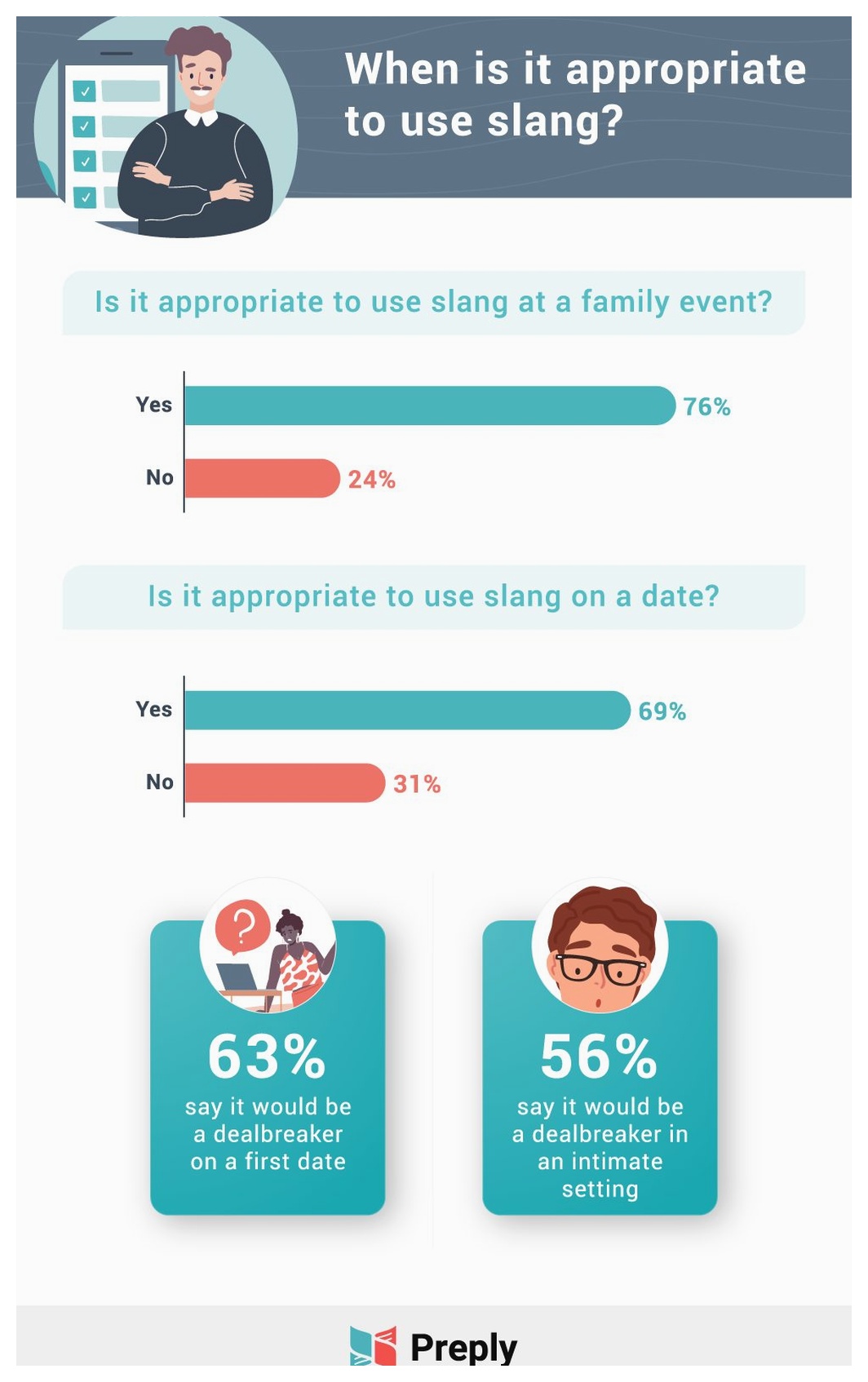
For instance, slang often finds its way into family gatherings, with 75% of survey respondents believing it’s suitable to use at such events. However, comfort levels with slang vary significantly across different generations.
The survey revealed that a significant 83% of respondents felt comfortable using slang when talking to their siblings. However, this familiarity decreased to 69% when communicating with their parents and further declined to 59% with their grandparents, highlighting how generational gaps influence language use.
A significant 69% of survey respondents believe that using slang is acceptable during romantic encounters, like dates. However, context matters: 63% indicated that frequent slang use in a first date conversation could be a dealbreaker, and over half felt the same way about its use in intimate settings. This highlights the delicate balance between casual language and meaningful connection in romance.
In an apparent contradiction, however, 64% said it was appropriate to use slang even in an intimate dating situation.
On first dates, men are a bit more receptive to using slang compared to women, with 71% of men considering it acceptable, versus 66% of women. Interestingly, the term “mansplain” tends to annoy men the most, while women find the phrase “OK, boomer” particularly grating.
Survey respondents overwhelmingly believe that slang thrives in casual, social situations. However, the workplace tells a different tale. A significant 54% of participants deemed slang inappropriate in professional settings, particularly when interacting with supervisors. While 44% would avoid slang around their coworkers, an even greater 58% would refrain from using it in the presence of their boss.
There’s a clear rationale behind this hesitation, as many business leaders prefer a more formal communication style. In fact, a significant 56% of respondents indicated that they would be unlikely to hire a candidate who used slang during the interview process.
Slang plays a significant role in our language and culture, with its acceptance varying across different settings and evolving with each generation. Embracing slang is essential not only for mastering a language but also for keeping pace with contemporary speech trends and cultural shifts.
In summary, grasping the meaning of slang can be beneficial, even if we personally choose not to use it due to its annoyance, often wishing to bid it farewell with a “Bye, Felicia.” Understanding slang helps us connect with others and navigate conversations more effectively.
Frequently Asked Questions
What percentage of Americans use slang in every conversation?
20% of Americans admit to using slang in every conversation.
Where do most people learn new slang terms?
56% of respondents learn new slang primarily from the internet and social media.
Which slang term is currently the most recognized in America?
The most well-known slang terms in America include ‘ghosted,’ ‘salty,’ and ‘on point.’
Is slang considered acceptable in professional environments?
46% of Americans believe using slang is acceptable in professional environments, with 42% willing to use it in the presence of their boss.
What are some of the most disliked slang terms in America?
The most disliked slang terms include ‘OK boomer’ and ‘bae,’ both receiving 29% disapproval.