- Key findings
- How many Ireland residents regularly use subtitles
- The regions and cities using subtitles the most
- What is the reason(s) people in Ireland use subtitles?
- Which platforms are Ireland using subtitles for the most?
- Subtitle Smackdown: Unveiling the Ultimate Streaming Platform for Enhanced Viewing Experience
- The hardest-to-understand accents, TV shows and celebrities
- Conclusion
- Methodology
- Frequently Asked Questions
- What percentage of Irish residents regularly use subtitles?
- Why do people in Ireland prefer using subtitles?
- Which streaming platforms in Ireland are most commonly used with subtitles?
- What is the most challenging TV show for viewers to understand according to the survey?
- What generational differences exist in subtitle usage in Ireland?
Subtitles have evolved from being merely an accessibility tool for transcribing or translating dialogue and sounds to a cultural staple in today’s viewing experience. In fact, a 2023 Netflix survey revealed that 40% of viewers find it challenging to enjoy TV shows without subtitles, highlighting their growing importance in modern entertainment.
As streaming platforms continue to rise and screens become a staple in every home, LingualNeeds is eager to leverage our language learning expertise and passion for cultures. We’re diving into the changing landscape of content consumption in Ireland, with a particular focus on the growing popularity of subtitles.
To gain insights into the perspectives of Irish residents on subtitles, we conducted a survey involving 1,504 participants. Our goal was to explore how these views might impact language learners and cultural enthusiasts.
Key findings
- 30% of Irish residents watch content with subtitles most of the time
- 50% use subtitles for streaming service platforms than regular TV
- 40% use subtitles when an accent is hard to understand
- 50% said their subtitle usage has become more frequent than it used to be
- 36% of respondents find background music hinders dialogue comprehension, leading to increased subtitle usage.
- 57% of Gen Z prefer to view online videos with subtitles

Learn a language with personalised 1-on-1 classes with our expert tutors from all over the world
French lessons online
Spanish lessons online
How many Ireland residents regularly use subtitles
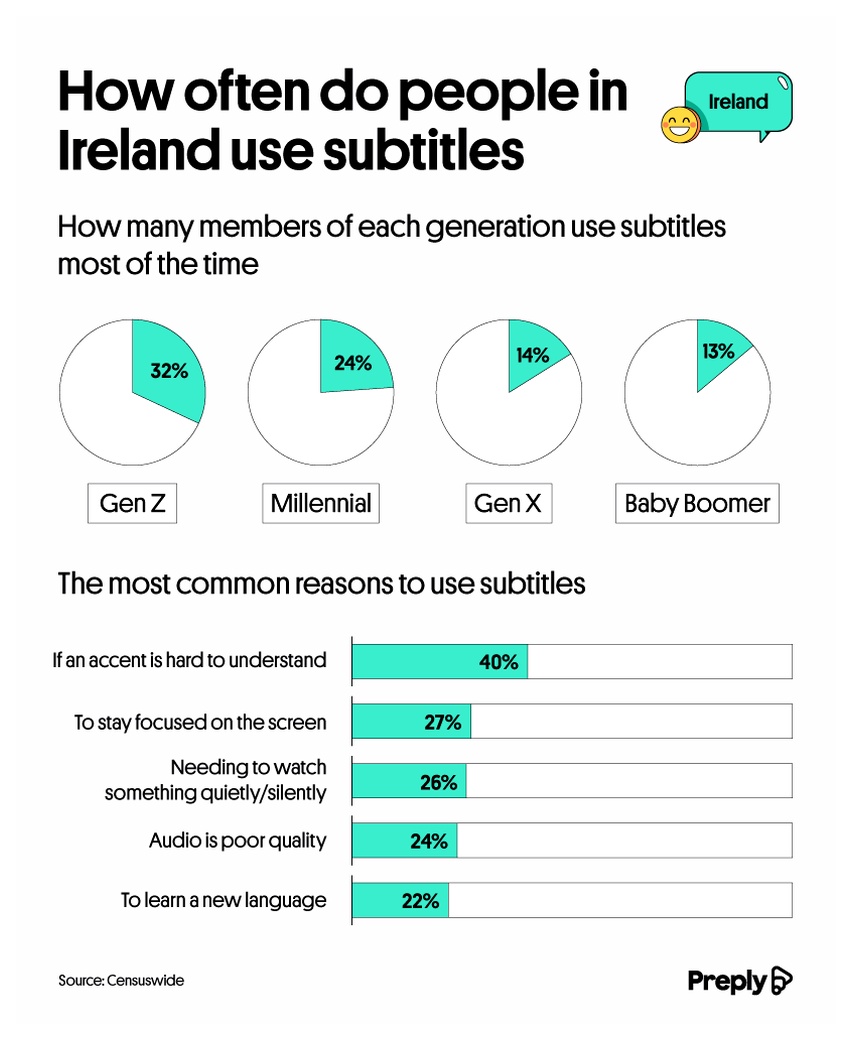
Our research found that 30% of Irish residents often prefer to use subtitles, while a significant 16% rely on them all the time. Delving into the preferences across various age groups revealed even more intriguing insights about attitudes towards subtitles.
For Generation Z, a cohort immersed in technology from a young age, subtitles are deemed essential by 32% of respondents. In stark contrast, only a mere 7% of 16 to 24-year-olds reported rarely using subtitles, highlighting a clear preference for accessible viewing experiences.
A notable 24% of Millennials embrace the idea of using subtitles, but this trend is even more pronounced among 25-34-year-olds, where 40% say they rely on subtitles most of the time. In contrast, only 14% of Gen X-ers share this enthusiasm, and a significant 57% of individuals aged 45-54 report that they rarely use subtitles.
Baby Boomers are the least inclined to use subtitles, with only 13% opting for this feature while watching TV. A deeper dive into the viewing habits of those aged 55 and older shows that just 4% consistently have subtitles activated on their screens, highlighting a significant generational gap in subtitle usage.
The regions and cities using subtitles the most
Attitudes toward subtitles vary not only by age but also across different regions in Ireland. Notably, Munster stands out as the region least inclined to use this TV feature, with a striking 44% of residents reporting that they never use subtitles.
In contrast, Leinster stood out with 31% of its residents admitting they frequently rely on subtitles while watching television. Not far behind, Ulster followed closely with 30% of its population also opting for subtitles most of the time.
Among various cities, Dublin stands out as the most enthusiastic about subtitles, with a remarkable 31% of its residents frequently using them. Following closely are Limerick and Waterford, where 30% of the population also reports using subtitles most of the time.
Despite this, 20% of residents in Waterford admitted they never use subtitles, revealing a noticeable divide in the city’s viewing habits.
Interestingly, despite Dublin ranking high in various aspects, 40% of its residents reported that they rarely use subtitles. This trend may be linked to the city’s average age of approximately 38 years, as highlighted by the 2022 Census, along with a significant portion of the population being aged 65 and older.
Learn a language online with our free learning materials.
Learn English online
Learn French online
What is the reason(s) people in Ireland use subtitles?

People opt for subtitles for various reasons, whether it’s to learn a new language or to compensate for unclear audio. Interestingly, a significant 40% of those surveyed indicated that subtitles help them better understand diverse accents, with 43% of Baby Boomers specifically sharing this sentiment.
A significant 27% of individuals reported using subtitles to stay focused while watching content, with this trend being particularly pronounced among Gen Z respondents, 39% of whom favored subtitles. Growing up in a digital age brimming with endless media options, it’s no surprise that maintaining concentration on a single task has become increasingly challenging for this generation.
In addition, 26% of viewers reported using subtitles when watching content at a low volume, a practice that resonates with 28% of Millennials. Notably, 26% of Gen Z also acknowledged using subtitles for the same reason, indicating that this trend is especially prevalent among those under 40.
In our survey, we found that 23% of respondents consider subtitles a fallback option when the audio quality on TV is poor, a sentiment particularly echoed by 28% of Baby Boomers. Additionally, 21% of participants reported using subtitles as a tool for learning a new language, with Millennials leading the charge—23% of them found this method especially beneficial.
Which platforms are Ireland using subtitles for the most?
In today’s digital age, where our screens serve as windows to everything from electoral debates and breaking news to binge-worthy shows recommended by friends, it’s no surprise that we encounter a diverse array of media. But among all these options, which form of media did the people of Ireland rely on subtitles for the most?
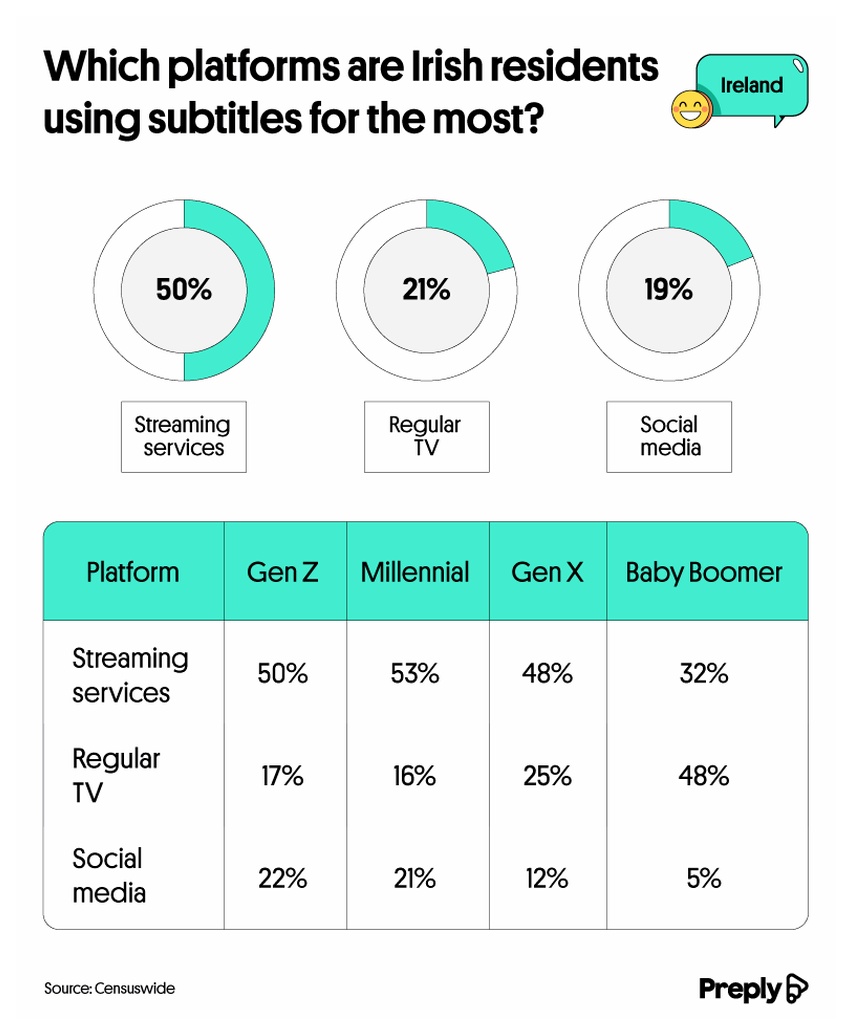
A recent survey found that half of all respondents use subtitles while streaming content on platforms like Netflix and Disney+, with 53% of Millennials and 50% of Gen Z agreeing. In contrast, only 21% of the overall population said they rely on subtitles when watching traditional television. Notably, this trend is particularly strong among Baby Boomers, with 48% indicating they prefer subtitles in that context.
As video-sharing platforms like TikTok continue to captivate audiences globally, the integration of subtitles has become essential. In fact, a recent survey revealed that 19% of respondents believe subtitles enhance their viewing experience on these social media sites.
The primary users of subtitles on social media are Gen Z, with 22% opting for this feature while consuming content. Millennials are not far behind, as 21% of them also prefer to watch videos with subtitles.
Subtitle Smackdown: Unveiling the Ultimate Streaming Platform for Enhanced Viewing Experience

Streaming services vary widely in their subtitle offerings, influencing their popularity among viewers. While some platforms provide a rich selection of films and TV shows with subtitle options, others fall short, leaving those who rely on subtitles for accessibility at a disadvantage. This inconsistency can significantly impact the overall viewing experience.
Many services provide a narrow selection of languages, leading to feelings of exclusion and a lack of representation. Given this context, which service did the people of Ireland believe offered the best subtitle options?
Netflix topped the rankings, with an impressive 71% of users praising its subtitle options as the best in the industry. Offering subtitles in 30 different languages, it’s no wonder that Netflix received such high marks for accessibility and user satisfaction.
Disney+ secured the second spot in our survey, garnering 27% of the votes. While it offers 16 subtitle languages, it trails significantly behind Netflix in this area. Nevertheless, the platform still manages to keep a majority of its audience pleased.
Amazon Prime Video secured third place with 20% of the votes for the best subtitle service. The platform boasts an impressive selection of 28 languages for subtitles. However, due to its diverse and sometimes niche catalog of TV shows and movies, not all titles are equipped with subtitle options.
Hulucame ranked last in our survey, garnering just 3% of the votes. This disappointing score may stem from several factors, including inaccurate subtitles, the absence of subtitle options for certain shows and movies, and subtitles that are out of sync.
The hardest-to-understand accents, TV shows and celebrities

The world is brimming with fascinating accents, but some can be more challenging to grasp than others, often influenced by your upbringing. For instance, someone accustomed to American accents might struggle to comprehend a strong Northern Irish accent, and the reverse can also be true. This highlights how our familiarity shapes our understanding of speech.
Many TV shows feature a diverse cast of actors from around the world, giving viewers the chance to hear a variety of native dialects. Considering this, which TV show did our survey participants identify as the most challenging to comprehend?
At the forefront of global entertainment in 2021 was the sensational hit *Squid Game*, featuring talented actors from South Korea. Although Netflix provides the convenience of English dubbing for many shows, viewers largely chose to experience *Squid Game* in its original Korean language, seeking a deeper sense of authenticity and immersion in the gripping storyline.
Nevertheless, it soon became apparent that several translations were inaccurate, altering the meaning of various quotes and scenes. This likely played a significant role in viewers struggling to grasp the show’s content.
Taking second place is *Derry Girls* (2018), a Channel 4 series that vividly captures the essence of the Troubles in Northern Ireland during the 1990s. The show features a talented cast, all sporting authentic Northern Irish accents, which might pose a challenge for viewers from other regions trying to catch every word.
Next up is *Narcos* (2015), a gripping series that delves into the tumultuous life of infamous drug lord Pablo Escobar. It explores how he constructed his vast empire while evading law enforcement for years. Although Escobar hailed from Colombia, he was brought to life on screen by the talented Brazilian actor Wagner Moura, whose distinctive accent adds a unique flavor to the character.
Following the show’s debut, many Colombian fans found the accents difficult to grasp, raising concerns for native English speakers. Fortunately, much of the series is filmed in Spanish, allowing viewers who aren’t fluent to enjoy it with subtitles.
While it’s clear that some TV shows are leaving our surveyed audience puzzled, let’s delve deeper into the individual actors. How do they contribute to this confusion?
In a recent survey conducted in Ireland, we discovered that 20% of respondents find the legendary Hong Kong actor Jackie Chan occasionally hard to understand. His distinct Cantonese accent, combined with his rapid-fire delivery—often during intense hand-to-hand combat scenes—contributes to this perception.
In a recent survey, 19% of respondents noted that the iconic action star Arnold Schwarzenegger has a distinctly unique accent that can be challenging to understand. This complexity likely arises from his distinctive blend of Austrian and American English. Additionally, Schwarzenegger’s fast-paced line delivery may further complicate matters for listeners, particularly in Ireland.

Sofia Vergara, the talented Colombian comedy actress known for her distinctive Spanish accent, was noted by 18% of respondents as having one of the more challenging accents to understand. This aligns with another finding, where 30% of surveyed individuals admitted they often rely on subtitles when watching performers with Spanish accents. If you’re eager to enhance your Spanish language skills, consider signing up for affordable online lessons with private tutors through LingualNeeds.
In a fascinating moment from the 2024 episode of The Graham Norton Show, Sofia Vergara shared her early struggle to minimize her distinctive accent in hopes of landing more English-speaking roles. Fortunately, her efforts were in vain, as her unique voice ultimately became a hallmark of her charm and success.
Renowned Scottish actor Gerard Butler garnered 6% of the votes for having one of the most distinctive accents among actors. While he has skillfully adopted various accents for his film roles, his Paisley heritage remains unmistakably evident in his performances.
Additionally, a survey found that 27% of respondents often need subtitles when listening to individuals with Scottish accents. This insight sheds light on why the star’s name appears on this list.
Conclusion
Our survey findings clearly highlight a range of reasons why many people in Ireland are choosing to use subtitles. In today’s fast-paced, technology-driven environment, distractions are omnipresent, making subtitles a valuable tool for enhancing focus and understanding.
Subtitles not only boost our focus while watching but also make us more mindful viewers, especially during late-night sessions. They enable us to appreciate shows in multiple languages, expanding our viewing experience. This versatility underscores the significance of subtitles in modern entertainment.
Despite the progress made, there’s still significant room for improvement in translation accuracy and the timing of subtitles in TV shows and movies. Nevertheless, for individuals who are hard of hearing or struggle with dialogue comprehension, subtitles continue to be an essential resource.
If you’re eager to enhance your conversational English skills, look no further than LingualNeeds! They provide a diverse selection of experienced English teachers, allowing you to learn from the comfort of your home. Enjoy affordable language-learning sessions tailored to your needs, making it easier than ever to achieve fluency.
Methodology
Censuswide conducted a comprehensive online survey involving 1,504 Irish residents aged 16 to over 55 for LingualNeeds. This nationally representative study aimed to explore the motivations and patterns behind the use of subtitles among participants.
Frequently Asked Questions
What percentage of Irish residents regularly use subtitles?
30% of Irish residents often prefer to use subtitles, while 16% rely on them all the time.
Why do people in Ireland prefer using subtitles?
People use subtitles to better understand accents, stay focused, watch at low volume, and as a fallback for poor audio quality.
Which streaming platforms in Ireland are most commonly used with subtitles?
Half of all respondents use subtitles while streaming content on platforms like Netflix and Disney+, with 21% relying on subtitles on traditional television.
What is the most challenging TV show for viewers to understand according to the survey?
The most challenging TV show identified in the survey is *Squid Game*, primarily due to its original Korean language and inaccurate translations.
What generational differences exist in subtitle usage in Ireland?
32% of Generation Z consider subtitles essential, while only 7% of 16 to 24-year-olds report rarely using them, indicating a significant preference among younger viewers.