
- Key takeaways
- Brands that provoke emotional language
- Ranking well-known brands by emotional language
- Industries that elicit emotional language
- Keyword analysis of reviews with emotional language
- Brands that provoke the least emotional language
- Language learning for business
- Frequently Asked Questions
- What brands provoke the strongest emotional responses according to the article?
- Which industries are noted for eliciting emotional language in reviews?
- What are some common emotional words used in reviews?
- How does the emotional language of brands relate to customer service?
- What brands are cited as provoking the least emotional language?
In today’s digital age, consumers frequently express their opinions about brands through online reviews. The words they choose can significantly shape how others perceive a brand, swaying opinions in both positive and negative directions.
As passionate supporters of language learning, we recognize the immense power of words. This inspired us to delve into the rich vocabulary that individuals employ when discussing brands, seeking to uncover the nuances of their expressions.
To uncover the most emotionally engaging brands, we examined all companies on Trustpilot with ratings of 4.5 or lower that had garnered at least 500 reviews in the past year. Trustpilot is a popular online platform where customers share their experiences and feedback about different brands. By leveraging the Emotion dataset from Hugging Face, we analyzed the sentiment expressed in these reviews, allowing us to determine which brands inspire the strongest emotional responses from their customers.
Key takeaways
- Cash App, Instacart, and Yelp are the top three brands that elicit emotional language.
- Travel and vacation, electronics and technology, and money and insurance are the top industries that elicit emotional language.
- “Fees,” “beware,” and “lied” are the most frequent emotional language used in reviews.
- “Scam,” “fraud,” and “joke” are the predominant adversarial descriptors used in reviews.

Learn a language with personalised 1-on-1 classes with our expert tutors from all over the world
French lessons online
Spanish lessons online
Brands that provoke emotional language
Through a detailed analysis of the language people use to express their opinions and experiences, we uncovered valuable insights into the dynamics between consumers and the brands they interact with. The choice of words reveals the emotions customers link to a brand and their overall experiences, providing a deeper understanding of brand perception.
To uncover how brands impact consumer emotions, we conducted a detailed language analysis of TrustPilot reviews. By utilizing the Emotion dataset, we categorized each review and brand based on six key emotions: sadness, joy, love, anger, fear, and surprise, and assigned a corresponding score. This approach enabled us to compile a list of companies that evoke the strongest emotional responses from their customers.
In our research, we examined the anger quotient associated with various brands to identify the top 100 brands that provoke the strongest emotional reactions.
After analyzing thousands of brands, we found that Cash App, Instacart, and Yelp stand out as the top brands that inspire strong emotional responses.
Ranking well-known brands by emotional language
Trustpilot features reviews for a wide range of brands, from major players to smaller businesses. To dive deeper into this, our team focused on analyzing 100 well-known brands that inspire strong emotional responses in their reviews. We carefully ranked these brands based on the emotional intensity of their customer feedback, providing insights into how consumers express their feelings about these familiar names.
As in previous rankings, Cash App, Instacart, and Yelp continue to dominate the top spots. This time, the top 10 also welcomes fresh faces such as Capital One, eBay, Avis, and Spectrum, adding exciting variety to the lineup.
Learn a language online with our free learning materials.
Learn English online
Learn French online
Industries that elicit emotional language
Consumers often have emotional connections with brands for various reasons, yet certain patterns emerge, particularly related to the industry in which a brand operates. Some sectors are known for evoking strong feelings in their customers. To explore this further, we set aside industry reputations and focused on our analysis of data to identify which industries actually prompted the most emotional language among consumers.
Analyzing a list of 100 brands known for their emotional resonance allowed us to identify which industries generate the strongest emotional language. This insight highlights the sectors that most effectively connect with consumers on an emotional level.
The travel and vacation industry tops the list when it comes to sparking emotional responses from reviewers, often due to issues like lost luggage or canceled flights. Following closely behind are electronics and technology, along with money and insurance, which round out the top three categories known for eliciting strong feelings.
In our review, we found that certain industries, including animals and pets, construction and manufacturing, sports, and hobbies and crafts, lacked brands that resonated emotionally enough to secure a spot in the top 100. As a result, they did not make it onto our list.
Keyword analysis of reviews with emotional language
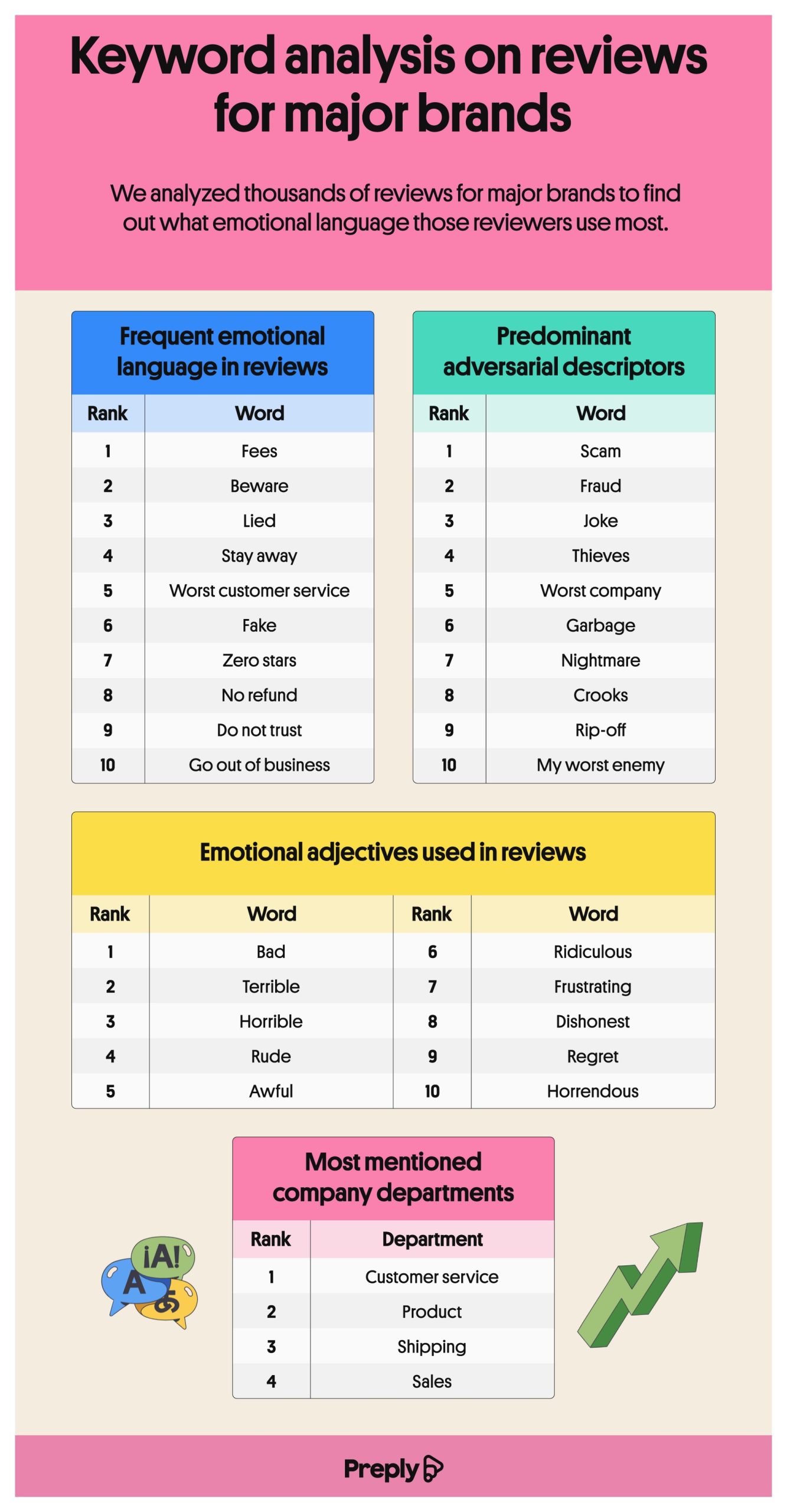
Analyzing the language used in customer reviews reveals the key factors behind both positive and negative sentiments, helping us understand what resonates most with consumers. To delve deeper into this emotional landscape, we identified the most frequently used emotional keywords in reviews for the top 100 well-known brands, focusing exclusively on feedback collected over the past year.
In our analysis, we identified the most commonly used emotional words in reviewers' feedback. Terms like "fees," "beware," and "lied" emerged as the top choices, revealing key triggers behind their emotional responses to the brand. This insight helps us understand the factors that led to their strong feelings.
We also examined adversarial descriptors, which reveal how reviewers express their negative emotions towards brands. Terms like "scam," "fraud," and "joke" frequently appear in these reviews, highlighting a strong sense of discontent. Additionally, we explored the use of adjectives, where "bad," "terrible," and "horrible" emerged as the most common negative descriptors. This analysis helps us understand the language consumers use to convey their dissatisfaction.
Many reviewers frequently highlight specific departments in their emotional feedback. To uncover which areas are most associated with these feelings, we examined the frequency of departmental mentions. Our analysis revealed that customer service emerged as the most commonly referenced department in emotional reviews, followed by product and shipping.
Brands that provoke the least emotional language
Among the brands we examined, those with the lowest anger quotient distinctly emerged as companies that inspire the least amount of emotional language from their customers.
Brands that excel in product quality, customer service responsiveness, and a keen understanding of their customers' needs often inspire positive reviews. As a result, their customers tend to express their feedback using much less confrontational language.
The top three brands overall that elicit the least emotional language from their customers are Ticketsales.com, TEMU, and Indeed.
Among the prominent brands, EF Educational Tours, Cupshe, and TaskRabbit generate the least emotional responses from their customers. While they do receive negative feedback, the intensity of anger expressed in their reviews is over four times lower compared to brands that provoke stronger emotional reactions.
Language learning for business
Our analysis of the emotional language in customer reviews reveals a treasure trove of insights into how customers feel and perceive brands. These insights are invaluable for companies, enabling them to deepen their understanding of their audience and foster stronger, more meaningful connections.
Language learning can significantly enhance your professional life in numerous ways. It allows you to gain deeper insights into customer feedback, facilitates effective communication with international clients, and fosters better collaboration with colleagues who speak different languages. Embracing new languages opens up a world of opportunities in the workplace.
Are you interested in harnessing language insights to elevate your customer relations? Look no further than LingualNeeds! Our tailored online language classes empower professionals to sharpen their communication skills. Just as businesses analyze language to better connect with their customers, you can deepen your language proficiency with our engaging Spanish lessons or by collaborating with one of our skilled French instructors. Transform your professional interactions and unlock new opportunities with us!
Effective communication is not only essential for businesses; it also serves as a bridge to the global community. With LingualNeeds by your side, you can expertly navigate this journey and enhance your connections worldwide.
Methodology
We examined brands on Trustpilot that hold a rating of 4.5 or lower, with a minimum of 500 reviews in the past year. Our focus was on the top 10 most recognized brands that exhibited the highest levels of customer anger. For this analysis, we exclusively considered reviews from the last 12 months. To assess the emotional tone of these reviews, we utilized the Emotion dataset from Hugging Face.
Frequently Asked Questions
What brands provoke the strongest emotional responses according to the article?
Cash App, Instacart, and Yelp are identified as the top three brands that elicit emotional language.
Which industries are noted for eliciting emotional language in reviews?
The travel and vacation, electronics and technology, and money and insurance industries are highlighted as the top sectors that evoke emotional language.
What are some common emotional words used in reviews?
Frequent emotional words include 'fees,' 'beware,' and 'lied', while negative descriptors like 'scam,' 'fraud,' and 'joke' are also prevalent.
How does the emotional language of brands relate to customer service?
Customer service is the most commonly referenced department in emotional reviews, indicating its significant impact on customer feelings.
What brands are cited as provoking the least emotional language?
Ticketsales.com, TEMU, and Indeed are mentioned as the brands that elicit the least emotional language from their customers.


