
- Key findings:
- Canada’s favorite love language to express
- Canada’s favorite love language to receive
- Love languages preferred by different genders
- Women’s favorite love languages to receive:
- Men’s favorite love languages to receive:
- Love languages preferred by different ages
- Love languages across different cities
- Toronto
- Montreal
- Calgary
- Conclusion
- Methodology:
- Frequently Asked Questions
- What are the five love languages identified by Dr. Gary Chapman?
- Which love language is the most popular among Canadians?
- What percentage of Canadians struggle with expressing words of affirmation?
- How do men and women differ in their preferred love languages in Canada?
- What challenges do residents of Montreal face regarding love languages?
Love transcends borders, yet the way we express and experience it is uniquely individual. Enter the concept of “love languages,” a compelling framework that helps us understand our personal preferences in giving and receiving affection.
Developed by Dr. Gary Chapman, the concept of love languages identifies five distinct ways people express and receive love: words of affirmation, quality time, physical touch, acts of service, and gifts. Understanding these love languages can enhance relationships by fostering better communication and connection.
At LingualNeeds, we understand that language plays a vital role in expressing love. With the season of romance approaching, we set out to explore the preferred love languages of Canadians across various regions, generations, and genders. To uncover these insights, we surveyed over 1,000 Canadians about their love language choices.
Key findings:
- Quality time is Canada’s favorite love language; both to give and receive.
- Words of affirmation is the most challenging love language to express, as reported by most Canadians, ranking highest in all major cities.
- A quarter of Canadians have split with a partner due to major differences in preferred love languages.

Learn a language with personalised 1-on-1 classes with our expert tutors from all over the world
French lessons online
Spanish lessons online
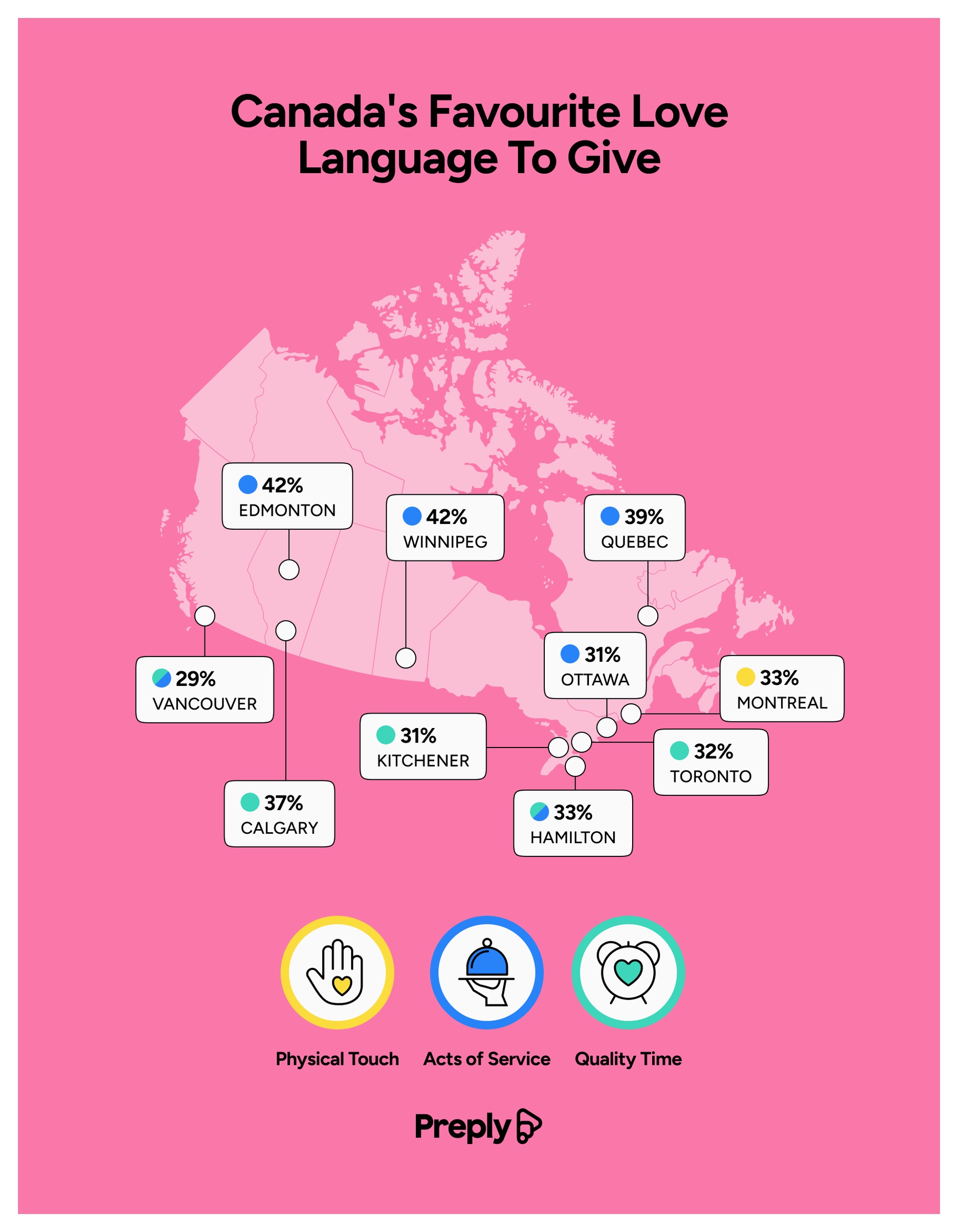
Canada’s favorite love language to express
Canadians have a distinct preference when it comes to expressing their love. According to our findings, the top love language they share is quality time, with 30% of respondents choosing it as their favorite. Close behind are acts of service at 29% and physical touch at 23%.
While many Canadians express affection effortlessly, words of affirmation pose a significant challenge for some. In fact, a surprising 40% of Canadians struggle to find the right words to reassure their partners, highlighting the complexities of verbal affection in relationships.
Canada’s favorite love language to receive
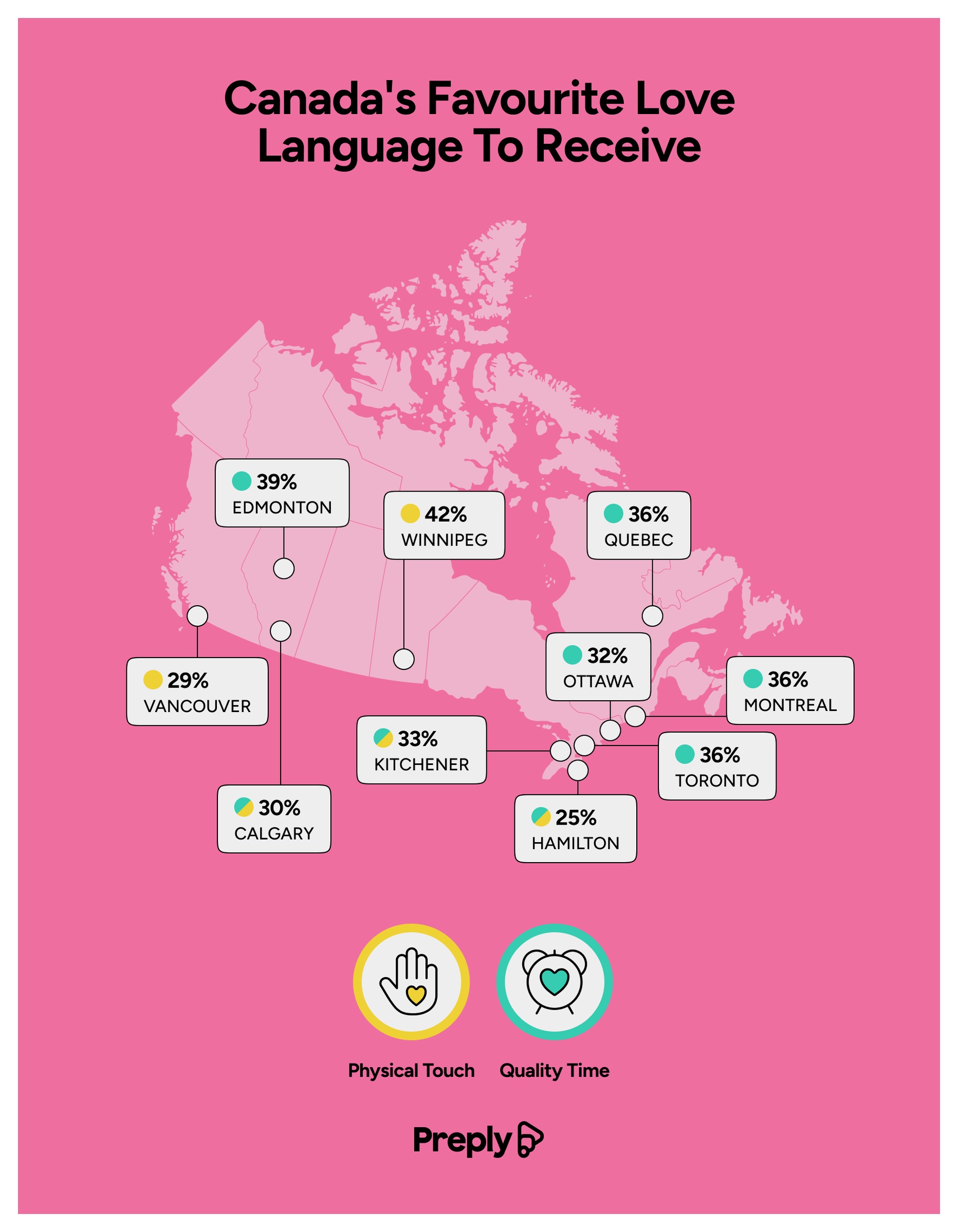
We explored the touching ways Canadians express and prefer to receive love, revealing that many cherish heartfelt connections. Remarkably, one in three Canadians favors quality time with their partner as their top love language. Following closely, 28% of respondents value physical touch, while 19% appreciate acts of service. These insights highlight the diverse yet meaningful ways affection is shared across the country.
Before you splurge on extravagant gifts for your partner this Valentine’s Day, take note! Gift-giving ranked as the least favored love language, with only 5% of survey participants expressing a preference for it. According to experts, mastering a new love language can be as challenging as learning an entirely new language. So, consider exploring other ways to express your affection!
Learn a language online with our free learning materials.
Learn English online
Learn French online
Love languages preferred by different genders
Do Canadian men and women show and experience love in distinct ways? Evidence suggests they do. Our survey found that one-third of Canadian women favor expressing love through acts of service, while 32% of men lean towards spending quality time together.
Here’s a breakdown of how different genders prioritize the five love languages they appreciate most. Interestingly, women and men have distinct top choices, with women favoring one love language and men another. However, both groups agree that gift-giving comes in last on their preference lists.
Women’s favorite love languages to receive:
- Quality time (33%)
- Acts of service (26%)
- Physical touch (18%)
- Words of affirmation (16%)
- Gift giving (7%)
Men’s favorite love languages to receive:
- Physical touch (39%)
- Quality time (34%)
- Words of affirmation (12%)
- Acts of service (11%)
- Gift giving (3%)
Love languages preferred by different ages
Love is a dynamic force, and so are the ways we express it. Among Gen-X and Millennials, acts of service rank as the top love language, chosen by 34% and 32% respectively. However, the younger generation is shifting the focus—29% of Gen-Zers prefer spending quality time with their partners. This evolution in love languages reflects changing values in relationships.
Young lovers and seasoned romantics alike have differing preferences when it comes to affection. One-third of Baby Boomers and Gen Xers indicate that physical touch is their preferred love language. In contrast, 35% of Millennials and Gen Z choose quality time as their favorite way to receive love.
In the analysis of four generational cohorts, a clear consensus emerged: words of affirmation ranked as the most challenging love language to convey. Among these groups, Baby Boomers stood out, with 46% identifying it as their toughest form of expressing love, surpassing all other love languages.

Love languages across different cities
Embark on a romantic adventure through three iconic Canadian cities! Experience the enchanting atmosphere of Old Montreal, the vibrant energy of Toronto, and the delightful character of Calgary. Each city speaks its own unique love language, inviting you to explore the diverse expressions of affection they offer.
Toronto
In the vibrant city of Toronto, residents proudly embrace the art of love, with quality time reigning supreme as their favorite love language—32% enjoy giving it, while 36% cherish receiving it. Interestingly, 40% of Torontonians find words of affirmation to be the most challenging love language to convey to their partners.
Montreal
Montreal, often hailed as the city of romance, embraces love through meaningful gestures. Remarkably, one-third of its residents consider physical touch the ultimate expression of affection, making it the only city in the study to elevate this love language above all others.
A recent study reveals that residents of Montreal face more significant challenges in their relationships due to differing love languages compared to other Canadian cities. Notably, 35% of Montrealers have experienced problems in at least one previous relationship stemming from these differences, and 29% have seen a relationship completely fall apart because of love language misunderstandings.
Calgary
Calgarians embrace a rich tapestry of love languages, with 37% citing quality time as their top choice for making their partner feel cherished. However, there’s an intriguing twist: Calgary residents struggle with expressing words of affirmation, scoring 47% in difficulty in this area. This insight highlights the unique ways in which locals connect with their loved ones.

Conclusion
Understanding someone else’s love language can significantly strengthen both personal and professional relationships. In the same way, learning spoken languages like French or English can break down communication barriers and enhance interactions. While LingualNeeds doesn’t specialize in deciphering love languages, we excel at connecting you with skilled language tutors to help you master a new language.
Discover our engaging French lessons or connect with our dedicated English tutors online, designed specifically for Canadian learners. Enhance your language skills conveniently and effectively!
Methodology:
In January 2024, we conducted a survey of 1,002 Canadians to explore their preferred love languages for both giving and receiving affection. Our diverse respondents, born between 1901 and 2005, included 48% females, 49% males, and 2% nonbinary individuals, ensuring a wide range of perspectives on this topic.
Frequently Asked Questions
What are the five love languages identified by Dr. Gary Chapman?
The five love languages are words of affirmation, quality time, physical touch, acts of service, and gifts.
Which love language is the most popular among Canadians?
Quality time is Canada’s favorite love language, both to give and receive.
What percentage of Canadians struggle with expressing words of affirmation?
40% of Canadians report struggling to express words of affirmation.
How do men and women differ in their preferred love languages in Canada?
One-third of Canadian women prefer acts of service, while 32% of men prefer quality time.
What challenges do residents of Montreal face regarding love languages?
35% of Montrealers have experienced problems in relationships due to differing love languages.