- Korean basic vowels
- Korean double vowels
- How to pronounce Korean vowels
- Pronunciation of “ㅗ” (o) and “ㅜ” (u) in combination with a single vowel
- Sound difference between “ㅔ” (e), “ㅐ” (ae), “ㅒ” (yae), and “ㅖ” (ye)
- Sound difference between “ㅗ” (o), “ㅓ” (eo), “ㅛ” (yo), and “ㅕ” (yeo)
- Similar sound between “ㅙ” (wae), “ㅚ” (oe), and “ㅞ” (we)
- Different pronunciations of “ㅢ” (eui)
- Complex sounds “ㅡ” (eu) and “ㅢ” (eui)
- How to form syllables with Korean vowels
- Korean vowels: Next steps
- Frequently Asked Questions
- What is Hangul?
- How many basic vowels are there in Korean?
- What are double vowels in Korean?
- How do you pronounce Korean vowels?
- What are some tips for mastering Korean vowels?
If you’ve started exploring online Korean lessons, you might have encountered the Korean alphabet, known as Hangul. This unique writing system is an essential part of learning the language and opens the door to understanding Korean culture.
Hangul is made up of consonants and vowels. In the realm of vowels, known as “모음” (moeum), there are both basic and compound varieties. The exciting part is that by simply memorizing the basic vowels, you’ll be well-equipped to grasp and create the compound ones!
In this article, you’ll explore the essentials of Korean vowels, from their accurate pronunciation to their proper placement within syllables. Get ready to enhance your understanding of this fundamental aspect of the Korean language!
Korean basic vowels
Korean boasts 10 fundamental vowels that play a crucial role in its phonetic structure. Unlike the consonants, which each have distinct names in the alphabet, these vowels are referred to by the sounds they create, much like in English.
Check out this helpful table that showcases the basic Korean vowels, along with their romanization (spelling in the Latin alphabet) and an English equivalent sound. This guide will assist you in mastering their pronunciation!
|
Korean vowel |
Romanization |
English pronunciation |
|
ㅏ |
a |
apple |
|
ㅑ |
ya |
yarn |
|
ㅓ |
eo |
hug |
|
ㅕ |
yeo |
yummy |
|
ㅣ |
i |
free |
|
ㅗ |
o |
home |
|
ㅛ |
yo |
yoga |
|
ㅜ |
u |
moon |
|
ㅠ |
yu |
universal |
|
ㅡ |
eu |
No exact equivalent |
Korean double vowels
Double vowels, known as Korean complex vowels, are formed by merging two basic vowels into a single unit. These combinations usually feature one of the basic vowels paired with “ㅣ” (i), “ㅗ” (o), “ㅜ” (u), or “ㅡ” (eu), enriching the sound and expression of the language.
Let’s take a look at the following table of Korean double vowels with their pronunciation in English:
|
Korean vowel |
Romanization |
English pronunciation |
|
ㅐ |
ae |
bet |
|
ㅔ |
e |
bed |
|
ㅒ |
yae |
yeah |
|
ㅖ |
ye |
yesterday |
|
ㅘ |
wa |
waffle |
|
ㅙ |
wae |
wet |
|
ㅚ |
oe |
wet |
|
ㅝ |
wo |
work |
|
ㅞ |
we |
wet |
|
ㅟ |
wi |
win |
|
ㅢ |
eui |
No exact equivalent, but similar to cuisine |
The Korean language features 11 distinct double vowels, each producing its own unique sound. Interestingly, the vowels “ㅙ” (wae), “ㅚ” (oe), and “ㅞ” (we) are spelled differently, yet they are pronounced similarly by native speakers. As illustrated in the table, all three vowels share the same sound as in the English word “wet.”
Also, remember that these double vowels should always be written together without any space between them:
- The Korean vowels “ㅐ” (ae), “ㅒ” (yae), “ㅔ” (e), and “ㅖ” (ye) are formed by combining the simple vowel “ㅣ” (i) with “ㅏ” (a), “ㅑ” (ya), “ㅓ” (eo), and “여” (yeo).
- “ㅘ” (wa), “ㅙ” (wae), and “ㅚ” (oe) come from adding “ㅗ” (o) to “ㅏ” (a), “ㅐ” (ae), and “ㅣ” (i)
- “ㅝ” (wo), “ㅞ” (we), and “ㅟ” (wi) are created by combining “ㅜ” (u) with “ㅓ” (eo), “ㅔ” (e), and “ㅣ” (i)
- “ㅢ” (eui) are the basic vowels “ㅡ” (eu) and “ㅣ” (i) together
How to pronounce Korean vowels
Korean vowels are typically straightforward to pronounce, as they maintain a consistent sound regardless of the word they appear in. Unlike English, where a single letter like “a” can have different pronunciations in “arm” and “April,” Korean vowels provide a more uniform experience for learners.
This approach not only makes it easier to remember pronunciations but also enhances your learning experience. However, it’s important to focus on the double vowels in Korean, as they can present a bit more of a challenge.
You can check out the correct Korean vowel pronunciation for each letter in this video:

Having explored the fundamentals, it’s time to dive into some intriguing examples of Korean compound vowels that may still be puzzling. We’ll examine each case carefully, breaking it down step by step for clarity.
Pronunciation of “ㅗ” (o) and “ㅜ” (u) in combination with a single vowel
When the vowels “ㅗ” (o) and “ㅜ” (u) are paired with another basic vowel, they transform their sound to “w.” This alteration makes the pronunciation of words smoother and more natural.
Sound difference between “ㅔ” (e), “ㅐ” (ae), “ㅒ” (yae), and “ㅖ” (ye)
Although the letters “ㅔ” (e) and “ㅐ” (ae) are romanized differently, they are pronounced the same way in modern Standard Korean. In fact, even native speakers often struggle to distinguish between the two sounds.
The same applies to the letters “ㅒ” (yae) and “ㅖ” (ye). While these two characters represent distinct sounds, their pronunciation remains consistent in spoken Korean.
Sound difference between “ㅗ” (o), “ㅓ” (eo), “ㅛ” (yo), and “ㅕ” (yeo)
At first glance, these four letters may appear puzzling due to their similar pronunciations. But with a bit of listening practice, you’ll start to pick up on the subtle distinctions between them.
When pronouncing “ㅗ” (o) and “ㅛ” (yo), keep your mouth relatively closed. In contrast, for “ㅓ” (eo) and “ㅕ” (yeo), your mouth should be more open. Imagine preparing to say “a” but instead, you produce the sound of the letter “o.” This subtle difference in mouth position is key to mastering these Korean vowels!
Similar sound between “ㅙ” (wae), “ㅚ” (oe), and “ㅞ” (we)
Korean learners often find it challenging to distinguish between the vowels “ㅙ” (wae), “ㅚ” (oe), and “ㅞ” (we).
Even native Korean speakers often struggle to distinguish between these sounds, frequently pronouncing them identically. Essentially, all of these vowels sound like “we” as in the word “well.”
Different pronunciations of “ㅢ” (eui)
The double vowel “ㅢ” (eui) is generally pronounced as “eui” or “ui.” However, its pronunciation can vary depending on the context within a word, sometimes sounding like “의” (eui), “에” (e), or “이” (i).
For instance, the vowel in the word “강의” (kangi) sounds like “ㅣ” (i), whereas in “너의” (neo-e), it is pronounced as “에” (e).
Complex sounds “ㅡ” (eu) and “ㅢ” (eui)
Mastering the pronunciation of “ㅡ” (eu) and “ㅢ” (eui) can be challenging since these vowel sounds are not found in English. To become familiar with their distinct sounds, immerse yourself in listening to native speakers, and enhance your skills by practicing repetition after them.
How to form syllables with Korean vowels
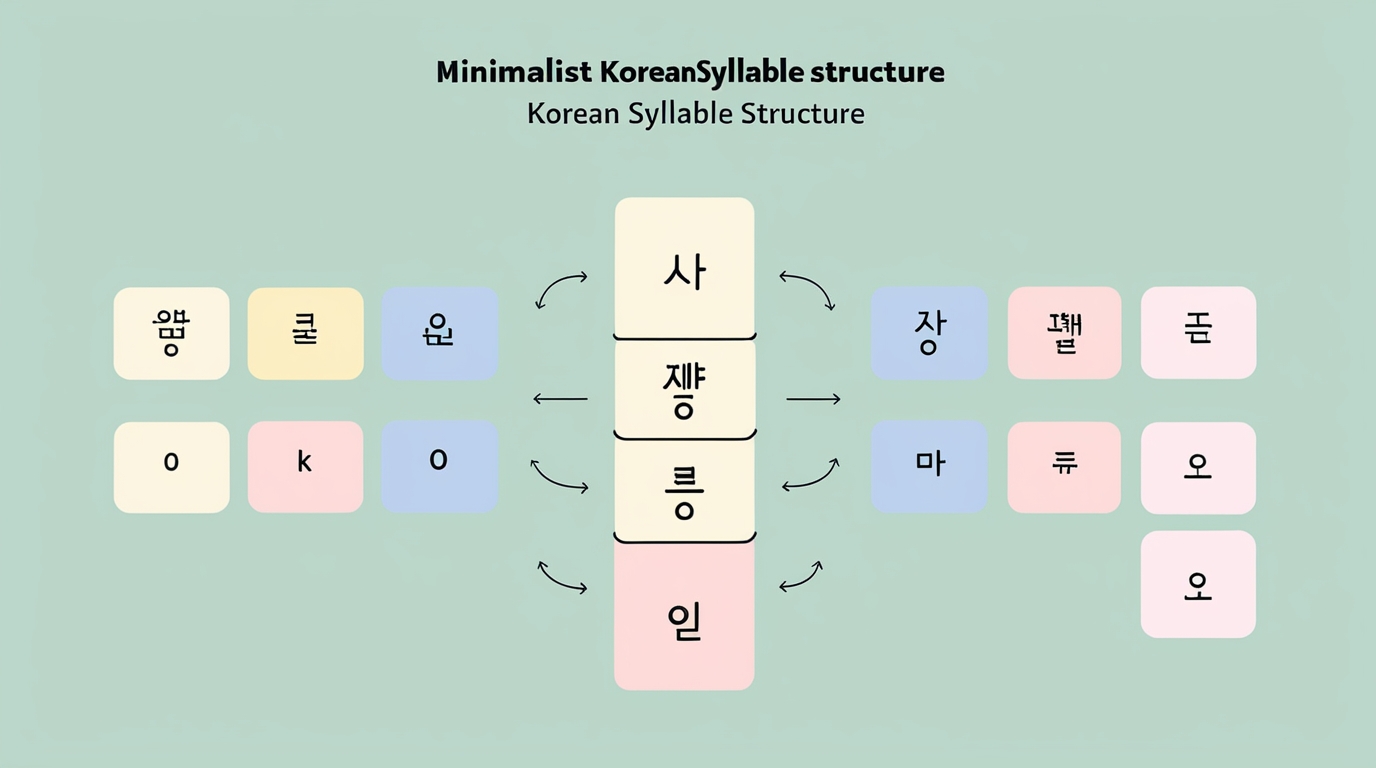
Korean words are formed by syllable blocks that combine consonants and vowels.
In Korean, every syllable contains at least one consonant and one vowel. Even syllables that appear to consist solely of a vowel always begin with the consonant “ㅇ,” since it’s not possible to write a vowel on its own in the Korean language.
Vowels play a crucial role in shaping the structure of Korean syllables. For instance, vertical vowels such as “ㅏ” (a), “ㅣ” (i), and “ㅐ” (ae) are placed to the right of the consonant. In contrast, horizontal vowels like “ㅗ” (o), “ㅠ” (yu), and “ㅡ” (eu) are positioned below the consonant. This arrangement is essential for correctly forming and reading Korean syllables.
This rule extends to complex vowels as well. The manner in which vowels are combined determines their placement in relation to the consonant, whether to the right, below, or in both positions.
For example:
- 매 (mae): Here, “ㅐ” (ae) is a vertical vowel, so it is positioned to the right of the consonant
- 뉴 (nyu): “ㅠ” (yu) is a horizontal vowel and is placed beneath the consonant “ㄴ” (n)
- 왜 (wae): This syllable features a combination of vertical and horizontal vowels, positioned at the bottom right of the silent consonant “ㅇ.”
Korean vowels: Next steps
Now that you’re familiar with Korean vowels, it’s time to learn the rest of the Korean alphabet: the consonants.
As you master each letter of the alphabet, you’ll discover how to blend them into syllables. And once you can form syllables, you’ll be ready to construct complete Korean words!
Here are our recommendations to continue practicing Korean vowels:
- Enroll in online Korean classes with a certified tutor for structured guidance and personalized feedback.
- Enhance your listening skills and vowel pronunciation by subscribing to Korean podcasts or watching Korean shows.
- Discover additional resources: Numerous websites and apps for learning Korean provide valuable tools to enhance your vocabulary.
- Engage in conversations with native Korean friends: Practicing your language skills through casual chats with Korean friends is both enjoyable and effective for improving fluency.
Keep these tips in mind, and you’ll be on your way to mastering the Korean language!
Frequently Asked Questions
What is Hangul?
Hangul is the Korean alphabet and is essential for learning the Korean language.
How many basic vowels are there in Korean?
Korean has 10 fundamental vowels that are crucial for its phonetic structure.
What are double vowels in Korean?
Double vowels, or complex vowels, are formed by merging two basic vowels into a single unit.
How do you pronounce Korean vowels?
Korean vowels are typically straightforward to pronounce, maintaining a consistent sound regardless of the word.
What are some tips for mastering Korean vowels?
Enroll in online classes, listen to podcasts, and engage in conversations with native speakers.