- Consonants in Hangul
- Vowels in Hangul
- Korean syllable blocks
- Basic rules of forming Korean syllables
- Consonant + vowel (vertical)
- Consonant + vowel (horizontal)
- Consonant + double vowel
- Consonant + vowel (vertical) + final consonant
- Consonant + vowel (horizontal) + final consonant
- Consonant + double vowel + final consonant
- Consonant + vowel (vertical) + double consonant
- Consonant + vowel (horizontal) + double consonant
- Consonant + double vowel + double consonant
- Master Korean with LingualNeeds
- Frequently Asked Questions
- What is the Korean alphabet known as?
- How many consonants are there in the Hangul alphabet?
- What are the basic rules for forming Korean syllables?
- What are aspirated consonants in Korean?
- How are double vowels formed in Hangul?
When embarking on your journey to learn Korean, grasping the structure of Korean syllables is essential. Unlike many Western languages, Korean syllables are uniquely composed and can consist of anywhere from two to five characters from the alphabet. Understanding this foundational element will enhance your language skills and comprehension.
In this article, you’ll explore nine different methods for constructing Korean syllables, along with essential rules to guide you. By the end, you’ll be equipped to effortlessly write any Korean word. Let’s jump right in!
Consonants in Hangul
The Korean alphabet consists of 24 letters, with 14 of them being consonants, known as “자음” (jaeum):
- ㄱ (g/k)
- ㄴ (n)
- ㄷ (d/t)
- ㄹ (r/l)
- ㅁ (m)
- ㅂ (b/p)
- ㅅ (s/t)
- ㅇ (ng/ø)
- ㅈ (j)
- ㅊ (ch)
- ㅋ (k)
- ㅌ (t)
- ㅍ (p)
- ㅎ (h)
The final five consonants in the Korean alphabet—ㅊ, ㅋ, ㅌ, ㅍ, and ㅎ—are referred to as aspirated consonants. This means that pronouncing them involves a noticeable burst of air. You can even test this yourself: place your hand in front of your mouth while saying these sounds, and you’ll feel the airflow!
In Korean, certain consonants can produce two distinct sounds. Take the letter “ㄷ,” for instance, which can be pronounced as either “d” or “t.” The pronunciation of some consonants changes based on their placement within the Hangul syllable blocks. For example:
In the word “둘” (meaning “two”), the letter “ㄷ” takes on the sound of “d” when it appears at the beginning of a syllable, either on top or to the left. Therefore, you should pronounce it as “dul.”
In the Korean word “믿다” (to believe), the consonant “ㄷ” appears at the end of the syllable. When consonants are found in this position, they often undergo a sound change to enhance pronunciation. Here, the “ㄷ” transforms into a “t” sound, resulting in the pronunciation “mitta.”
In addition to the basic consonants, Hangul features double consonants. These consonants have a more pronounced sound than their single counterparts, yet they are less forceful than the aspirated consonants.
- ㄲ (kk)
- ㄸ (tt)
- ㅉ (jj)
- ㅃ (pp)
- ㅆ (ss)
Finally, we often encounter pairs of consonants at the end of syllables, referred to as final consonants or “받침” (batchim). In these instances, one of the consonants may become silent, losing its sound. This phenomenon occurs in several specific cases:
- ㄳ, as in 몫 (mok)
- ㄵ, as in 앉다 (antta)
- ㄶ, as in 많다 (mantta)
- ㄺ, as in 닭 (dak)
- ㄻ, as in 닮다 (dartta)
- ㄼ, as in 밟다 (babta)
- ㄽ, as in 곬 (gol)
- ㄾ, as in 핥다 (hatta)
- ㄿ, as in 읊다 (eulta)
- ㅀ, as in 잃다 (ilta)
- ㅄ, as in 값지다 (gabjida)
Vowels in Hangul
The remaining letters in the alphabet are the vowels, known as “모음” (moeum):
- ㅏ (a)
- ㅑ (ya)
- ㅓ (eo)
- ㅕ (yeo)
- ㅣ (i)
- ㅗ (o)
- ㅛ (yo)
- ㅜ (u)
- ㅠ (yu)
- ㅡ (eu)
Take a look at the arrangement of the vowels: the first five are displayed vertically, while the other five stretch out horizontally. Generally, vertical vowels sit to the right of the consonant, whereas horizontal vowels are positioned directly below it.
Additionally, there are 11 double vowels, which are formed by combining the basic vowels.
- ㅐ(ae)
- ㅔ(e)
- ㅒ(yae)
- ㅖ(ye)
- ㅘ (wa)
- ㅙ (wae)
- ㅚ (oe)
- ㅝ (wo)
- ㅞ (we)
- ㅟ (wi)
- ㅢ (eui)
These additional vowels add extra sounds to the Korean alphabet.
Korean syllable blocks
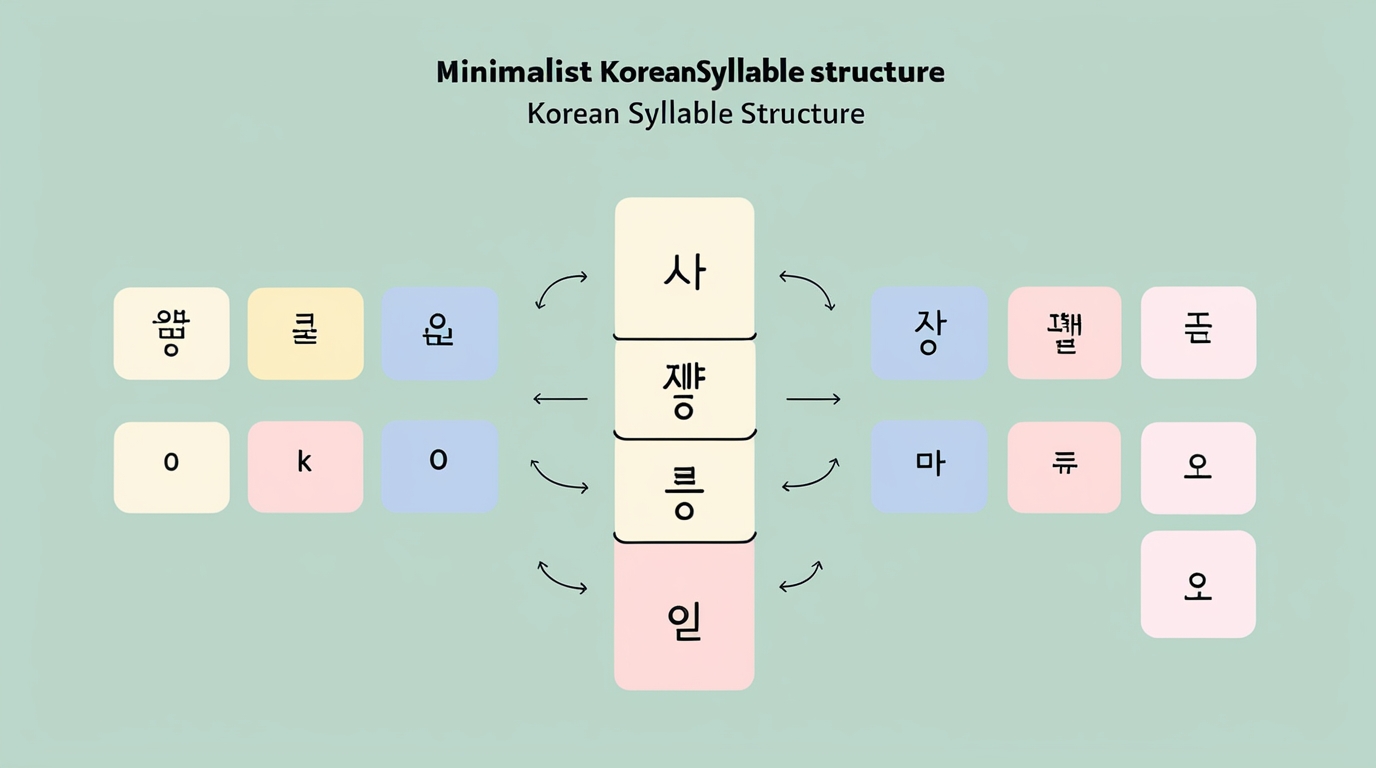
Korean writing utilizes a unique structure where words are created from syllable blocks. Each letter in the Hangul alphabet corresponds to a distinct sound, but they cannot function independently. Instead, these letters are grouped together to form a single block, and a Korean word can be made up of one or multiple syllable blocks.
Basic rules of forming Korean syllables
Understanding the basic rules of forming Korean syllables is crucial for writing in Hangul. Here are the key points:
- Syllables always start with a consonant: Each syllable block begins with a consonant. When a syllable starts with a vowel, it requires the letter “ㅇ” to adhere to this rule. The letter “ㅇ” can represent the “ng” sound or serve as a silent placeholder when forming a syllable with a vowel. For instance, to express the vowel “a,” it is written as “아” instead of “ㅏ.”
- Korean writing is syllabic: Unlike Latin scripts that feature individual letters (e.g., “hello” as h + e + l + l + o), Korean characters are always grouped into syllables. For example, “안녕” (hello) cannot be written as separate letters like “ㅇㅏㄴㄴㅕㅇ.”
- Syllables in a word must stay intact: Unlike spaces that separate words in a sentence, syllables within a word should not be split. For instance, the Korean word for “sky” is written as “하늘” (haneul), not “하 늘” (ha-neul).
- **Vowel Placement Importance:** The arrangement of syllables relies on vowel type. For vertical vowels, position the initial consonant to the left, whereas for horizontal vowels, place it above the vowel.
Now that we know these fundamental rules, let’s explore the nine possible Hangul syllabic block layouts.
Consonant + vowel (vertical)
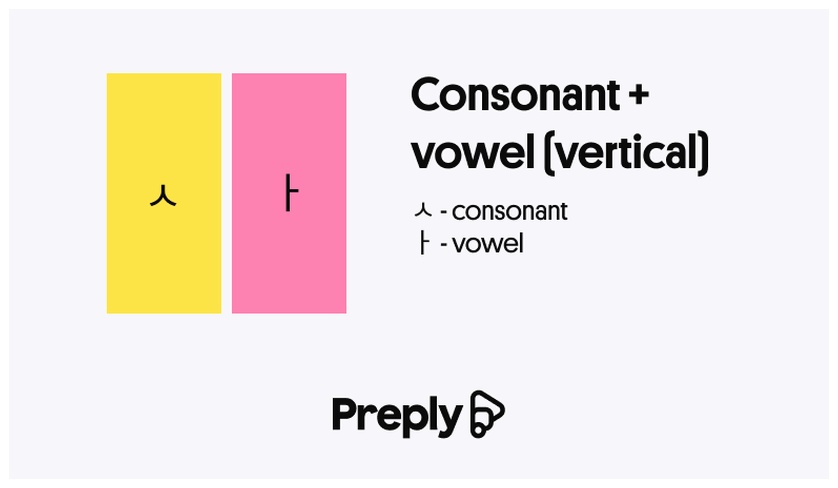
This pattern features a consonant paired with a vertical vowel, including characters like ㅏ, ㅑ, ㅓ, ㅕ, ㅣ, ㅐ, ㅔ, ㅒ, and ㅖ. The text is read from left to right. For example, in the image above, the consonant “ㅅ” combines with the vowel “ㅏ” to form the syllable “사” (sa).
For example:
- 가 (ga)
- 사 (sa)
- 미 (mi)
Consonant + vowel (horizontal)
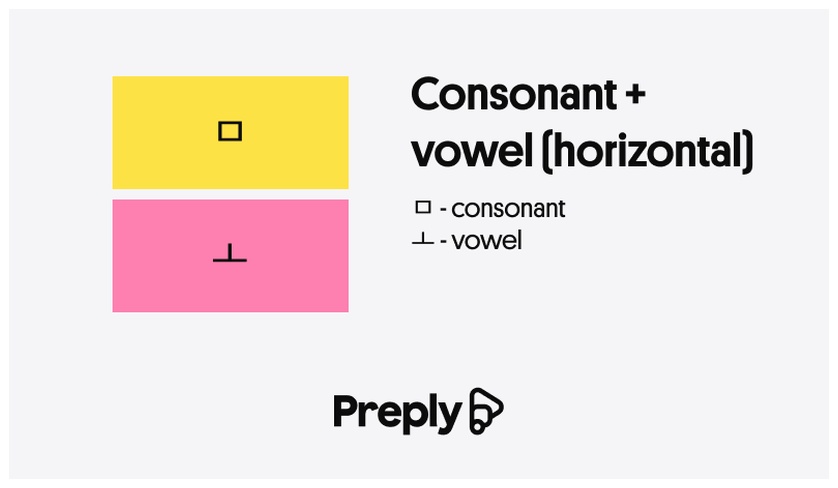
We’ve just explored the creation of the syllable “모” (mo), which blends the consonant “ㅁ” with the vowel “ㅗ.” This structure features a consonant followed by a horizontal vowel, including characters like ㅗ, ㅛ, ㅜ, ㅠ, and ㅡ. Remember, these syllables are read from top to bottom!
Examples include:
- 뉴 (nyu)
- 고 (go)
- 드 (deu)
Consonant + double vowel
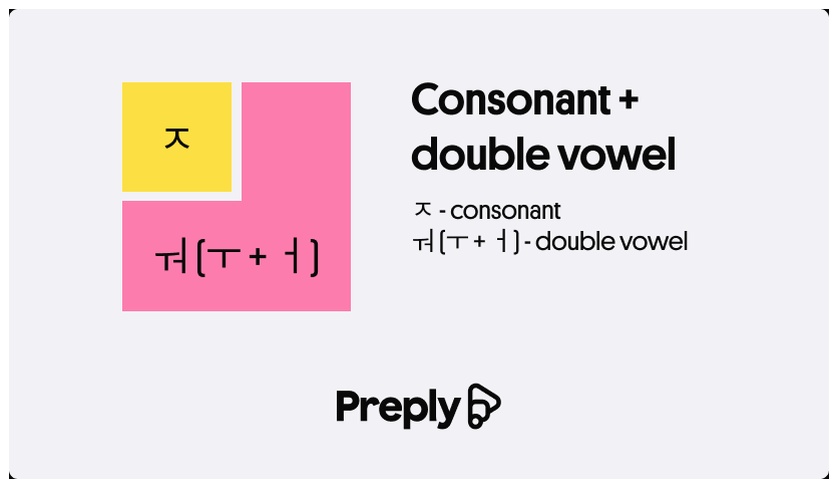
This pattern features a consonant paired with a double vowel, including combinations like ㅘ, ㅙ, ㅚ, ㅝ, ㅞ, ㅟ, and ㅢ. The characters are arranged to be read from left to right and top to bottom. For example, in the image, the consonant “ㅈ” sits at the top left of the syllable, while the double vowel “ㅝ” is positioned at the bottom right, creating the sound “줘” (jwo).
For instance:
- 왜 (wae)
- 뇌 (noe)
- 줘 (jwo)
Consonant + vowel (vertical) + final consonant
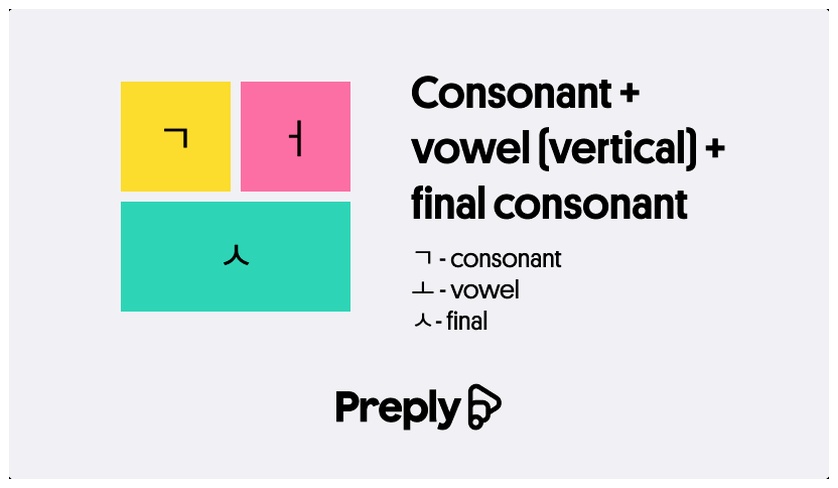
In this example, we explore the syllable “것” (geot), which is composed of the initial consonant “ㄱ,” followed by the vowel “ㅓ,” and concludes with the final consonant “ㅅ.” This structure features a consonant, a vertical vowel, and a closing consonant, and is read from left to right and top to bottom.
For example:
- 날 (nal)
- 덜 (deol)
- 맛 (mat)
Consonant + vowel (horizontal) + final consonant
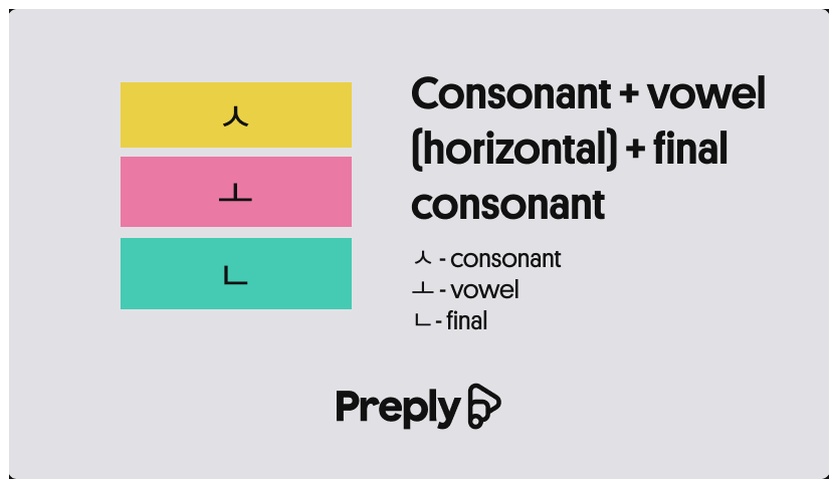
This syllable structure features a consonant, a horizontal vowel (ㅗ, ㅛ, ㅜ, ㅠ, or ㅡ), and a final consonant, arranged vertically. For instance, in the syllable “손” (son), we see the consonant “ㅅ,” followed by the horizontal vowel “ㅗ,” and ending with the final consonant “ㄴ.”
For example:
- 꿈 (kkum)
- 순 (sun)
- 물 (mul)
Consonant + double vowel + final consonant
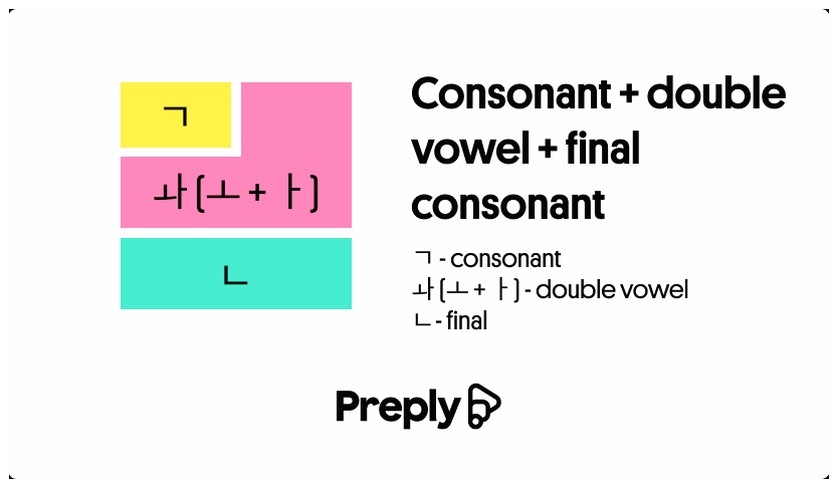
This example illustrates how to create the syllable “관” (kwan) using the characters “ㄱ,” “ㅘ,” and “ㄴ.” The structure consists of a consonant, a combined vowel, and a final consonant. When reading it, start from the top and move left to right.
Examples include:
- 관 (kwan)
- 확 (hwak)
- 윗 (wit)
Consonant + vowel (vertical) + double consonant
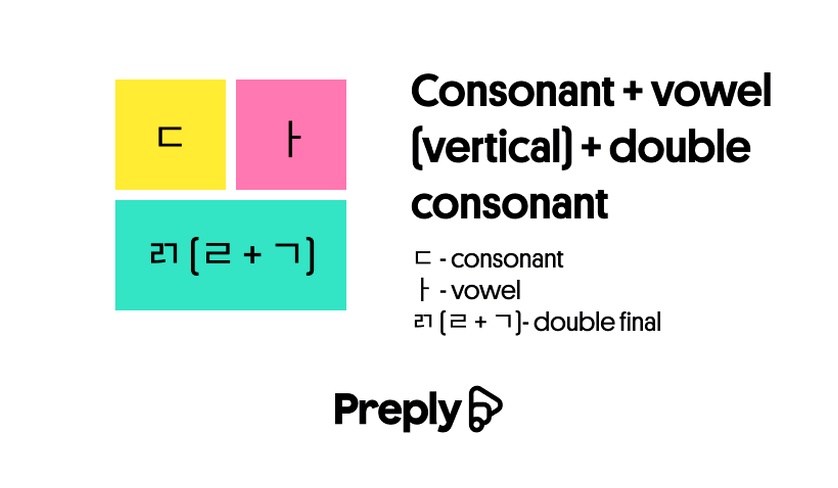
This pattern features a consonant followed by a vertical vowel and concludes with a double consonant at the bottom. It is read from left to right and from top to bottom. For example, in the image, the syllable “닭” (dak) illustrates this structure, with the two lower consonants appearing smaller to fit neatly within the syllable block.
More examples include:
- 맑 (mal)
- 밟 (bab)
- 않 (an)
Consonant + vowel (horizontal) + double consonant
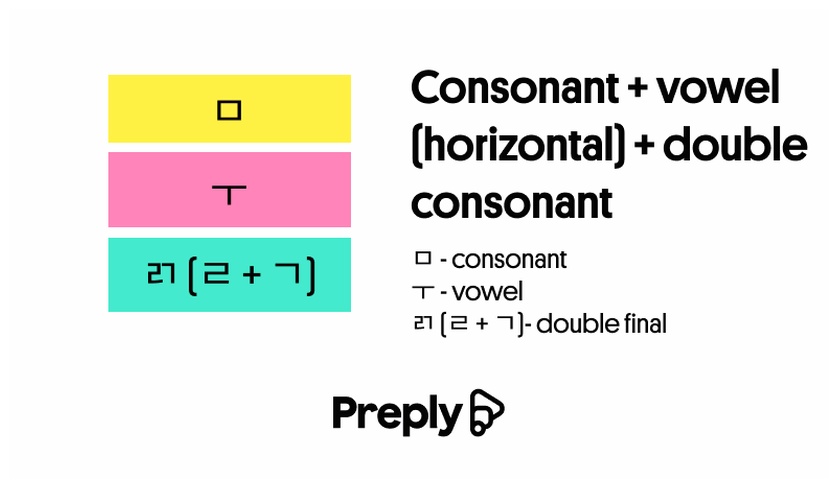
The example above illustrates the syllable “묽” (muk), which is composed of a consonant, a horizontal vowel, and a double consonant. Notably, this syllable is read exclusively from top to bottom.
For example:
- 흙 (heuk)
- 곬 (gol)
- 곦 (gon)
Consonant + double vowel + double consonant
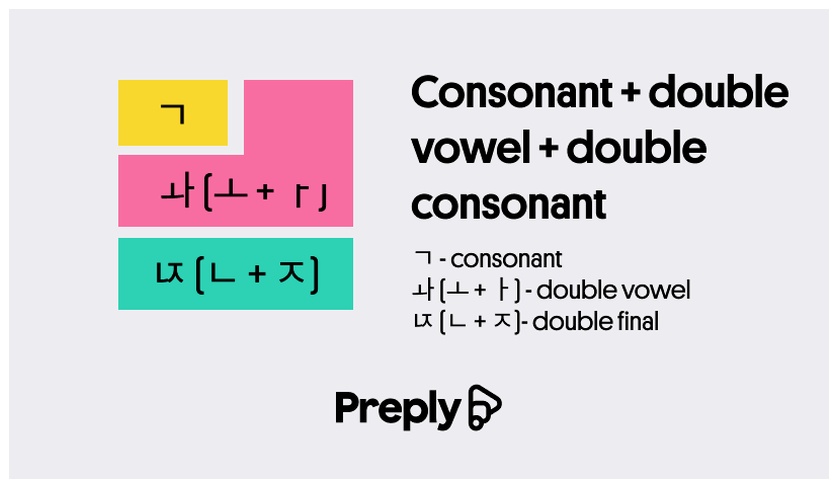
In this pattern, you’ll find a consonant followed by a double vowel and a double consonant, arranged from left to right and top to bottom. For example, the syllable “괁” (kwan) features the consonant “ㄱ,” the double vowel “ㅘ,” and the double consonant “ㄵ.” It’s interesting to note that syllables with this five-letter structure are quite uncommon!
For example:
- 괞 (gwaen)
- 됢 (doel)
- 뷁 (bwek)
Master Korean with LingualNeeds
You’ve discovered nine simple methods for creating syllables in Korean! Just remember the four key rules we’ve outlined, and you’ll quickly grasp how syllable blocks function. Happy learning!
To enhance your understanding of today’s lesson, we encourage you to sign up for online Korean classes or explore websites in Korean. Both options provide excellent opportunities for practice and immersion!
At LingualNeeds, we recognize the significance of selecting the right tutor to customize your online Korean lessons. Mastering the fundamentals will empower you to read Korean text with ease, enhancing both your language proficiency and cultural insights.
Frequently Asked Questions
What is the Korean alphabet known as?
The Korean alphabet is known as Hangul.
How many consonants are there in the Hangul alphabet?
There are 14 consonants in the Hangul alphabet.
What are the basic rules for forming Korean syllables?
Syllables always start with a consonant, Korean writing is syllabic, syllables in a word must stay intact, and the arrangement of syllables relies on vowel type.
What are aspirated consonants in Korean?
Aspirated consonants in Korean are the final five consonants: ㅊ, ㅋ, ㅌ, ㅍ, and ㅎ, which are pronounced with a noticeable burst of air.
How are double vowels formed in Hangul?
Double vowels are formed by combining the basic vowels, creating additional sounds in the Korean alphabet.