- What does Korean writing look like?
- Hangul compared to other alphabets
- Is Korean read left to right?
- How to write Hangul: Korean stroke order
- Understanding Korean syllable structure
- Korean cursive: Does it exist?
- Hangul stroke order: Next steps
- Frequently Asked Questions
- What is the Korean writing system called?
- How many letters are in the Korean alphabet?
- What is Korean stroke order?
- Are Korean words read left to right?
- Is there a form of cursive writing in Korean?
If you’ve begun your journey with online Korean classes and are familiarizing yourself with its unique writing system, you may be curious about how to properly write the Korean alphabet and whether there’s a specific order for the letters. The good news is that there is indeed a designated writing order!
In Korean writing, just like in many other scripts, there’s a specific sequence for forming the various components of each letter or character. This systematic approach is known as Korean stroke order, and it plays a crucial role in writing legibly and efficiently.
In this article, we’ll guide you through the essentials of Korean writing and stroke order, equipping you with the knowledge to masterfully draw each character with ease and efficiency!
What does Korean writing look like?
Hangul, the writing system for the Korean language, is a fascinating and accessible script made up of just 24 letters—14 consonants and 10 vowels. This simplicity makes it easier for learners to master, highlighting the beauty and efficiency of Korean communication.
A standout characteristic of the Korean alphabet, known as Hangul, is its phonetic structure. Each symbol corresponds to a unique sound, which simplifies the learning process. Additionally, Hangul’s characters are crafted with straightforward strokes and circles, making them not only memorable but also easy to write.
Take, for instance, the character “ㅇ,” which is shaped like a simple circle. In the same vein, “ㅁ” takes on the form of a square, and “ㅣ” is depicted as a straight vertical line. These shapes illustrate how characters can be visually distinct yet simple in design.
Hangul uniquely incorporates spaces between words, making it easier for learners to identify where one word ends and another begins. This feature significantly enhances sentence comprehension. In contrast, many other Asian languages, like Japanese, often write words together, which can complicate understanding for new learners.
Hangul compared to other alphabets
When we compare Hangul to other writing systems, such as Japanese, Chinese, or Thai, the distinctions become apparent:
- Japanese’s Hiragana utilizes curvy strokes, as seen in “ひらがな”
- Chinese characters or Hanzi are known for their complexity, with numerous strokes forming each symbol, as in “汉语”
- Thai script features a round and flowing alphabet, as in “ภาษาไทย”
In contrast, the Korean alphabet is characterized by its distinct combination of strokes and circles, as seen in the word “한국어.” This unique design not only simplifies the learning process but also allows learners to memorize the entire alphabet in just one day.
Is Korean read left to right?
In the Korean language, words are constructed using syllable blocks that are arranged from left to right. Each block is composed of individual letters, which are read in a left-to-right and top-to-bottom sequence, similar to the overall layout of the writing.
For example, the characters “한” (han), “국” (guk), and “어” (eo) are three-syllable blocks that form the word “한국어” (hangugeo).
In South Korea, you might notice Korean words displayed vertically, often for visual appeal. This unique style frequently appears on restaurant menus and advertising banners, adding a distinctive flair to the overall design.
How to write Hangul: Korean stroke order
Korean stroke order is the precise sequence used to draw the lines and curves when writing each character in the Korean alphabet. This method applies not only to the individual letters that combine to create a syllable but also to each letter’s unique writing style. Understanding the correct stroke order is essential for proper handwriting and character formation in Korean.
These rules come from Chinese calligraphy and are particularly handy for writing in Korean.
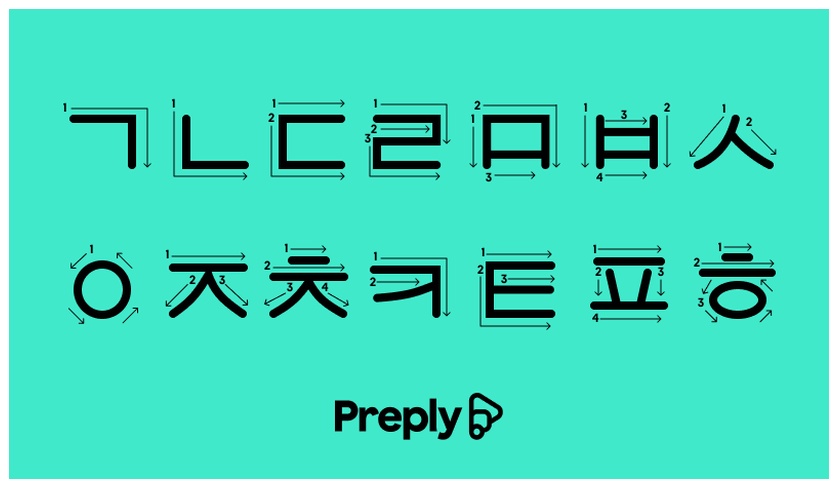
Check out the image below to see the stroke order for all Korean consonant letters:
- ㄱ = k/g
- ㄴ = n
- ㄷ = d/t
- ㄹ = r/l
- ㅁ = m
- ㅂ = b/p
- ㅅ = s/t
- ㅇ = silent letter when written with a vowel/ng
- ㅈ = j
- ㅊ = ch
- ㅋ = k
- ㅌ = t
- ㅍ = p
- ㅎ = h]
And here’s the stroke order for Korean vowels:
- ㅏ = a
- ㅑ = ya
- ㅓ = eo
- ㅕ = yeo
- ㅗ = o
- ㅛ = yo
- ㅜ = u
- ㅠ = yu
- ㅐ= ae
- ㅒ = yae
- ㅖ = ye
- ㅔ = e
- ㅡ = eu
- ㅣ= i ]
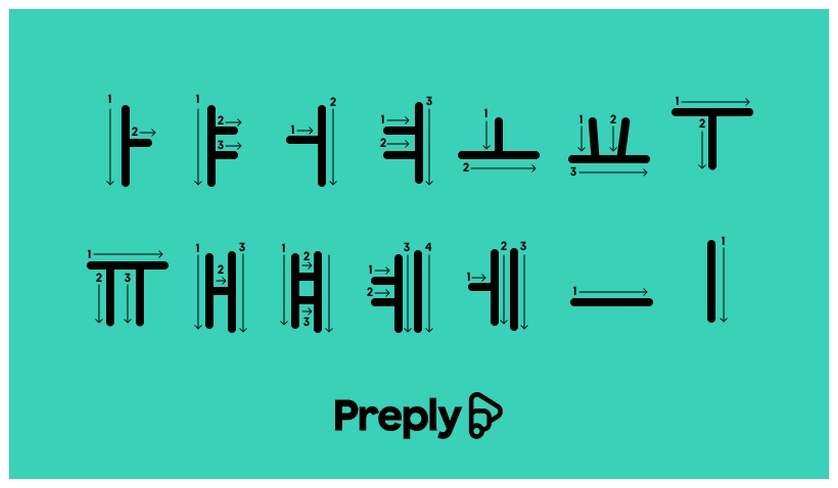
To master the correct order of Hangul letters, the most effective approach is to practice writing each one several times on paper until it becomes second nature. Many websites dedicated to learning Korean provide helpful Hangul guides that illustrate the proper stroke order, making your practice even more effective.
It’s interesting to observe that certain letters adapt their shapes when paired with specific vowels. For example, the letter “ㄱ” (k/g) alters the direction of its final stroke based on the vowel it accompanies.
- When combined with a right-side vowel, the last stroke of “ㄱ” curves left, as seen in “가” (ga).
- But when combined with a vowel situated below the consonant, it maintains a straight stroke, as in “고” (go)
While these changes may seem minor, it’s helpful to be aware of them.
Understanding Korean syllable structure
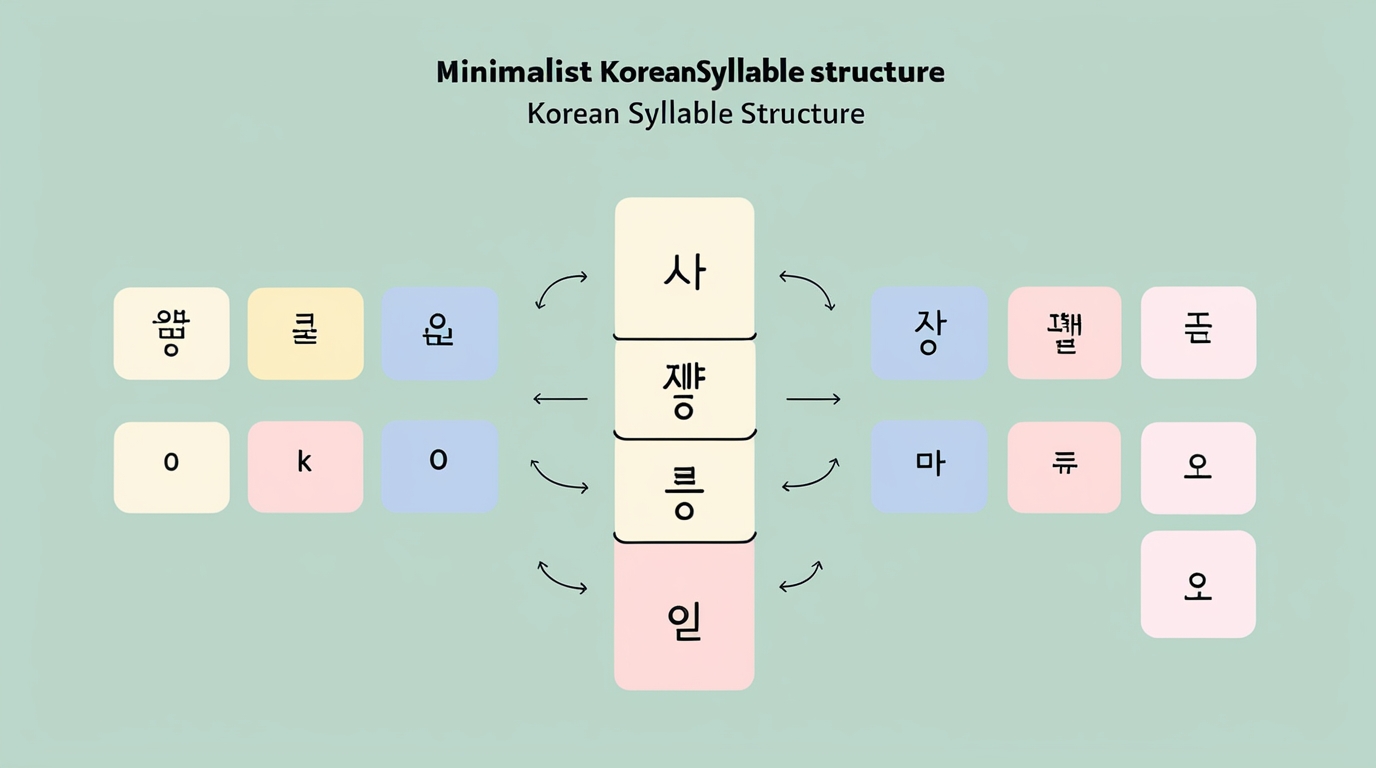
Let’s explore the structure of syllables in Korean! As previously noted, Korean syllables, often referred to as syllable blocks, consist of two to five letters arranged in a unique order.
Take the Korean word for “to speak,” which is “말하다” (malhada). This fascinating term is made up of three syllable blocks, each varying in length: the first block has three letters, while the next two consist of two letters each.
- 말 (mal) formed by letters “ㅁ” (m), “ㅏ” (a), and “ㄹ” (r/l)
- 하 (ha) formed by letters “ㅎ” (h), and “ㅏ” (a)
- 다 (da) formed by letters “ㄷ” (d) and “ㅏ” (a)
The way a syllable is read depends on its letter count and the type of vowel it contains. Syllables with vertical vowels (like ㅏ(a), ㅓ(eo), and ㅣ(i)) are read from left to right, as seen in “가.” Syllables featuring horizontal vowels (such as ㅗ(o), ㅜ(u), and ㅡ(eu)) are read from top to bottom, like “구.” When a syllable combines both vowel types, as in “과,” it incorporates elements of both reading directions.
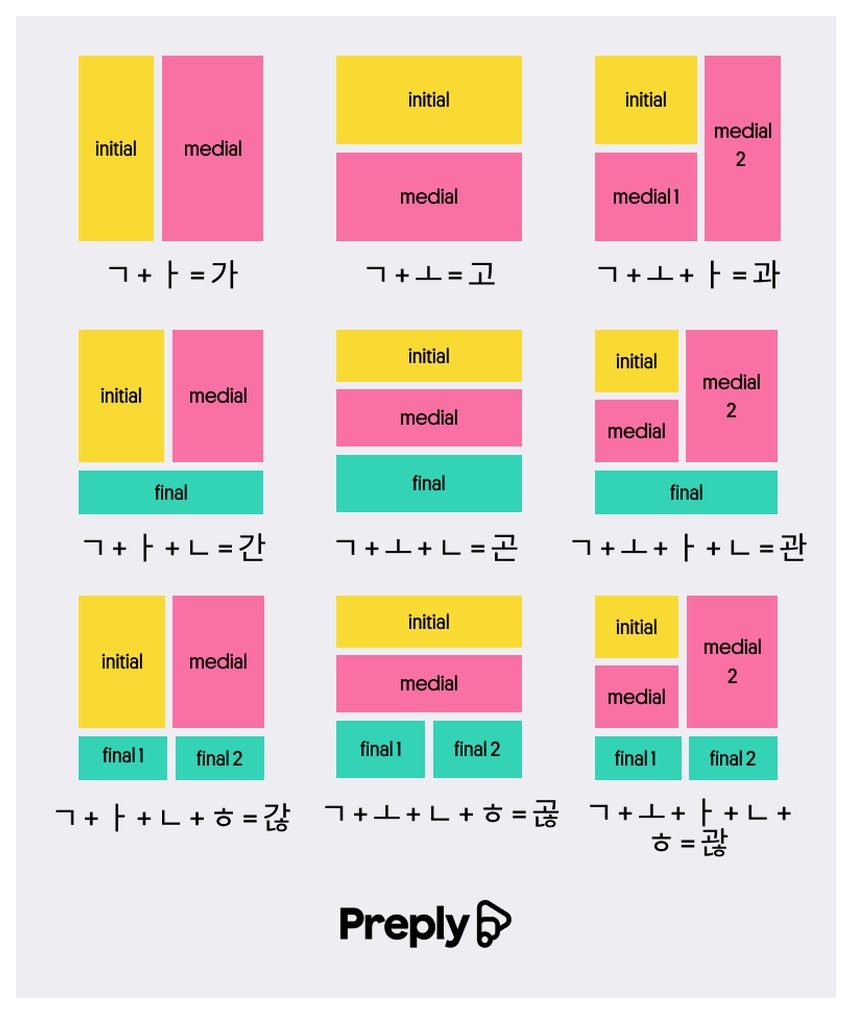
A syllable block must include at least one consonant and one vowel, though it can feature multiple consonants or double vowels. When forming a syllable with just a single vowel, we use the consonant “ㅇ” before the vowel. For instance, to write the vowel “ㅓ” (eo), we write it as “어.” In this case, the “ㅇ” is silent and does not sound like “ng.”
In a syllable block, the vowel can be positioned to the right of the initial consonant, below it, or in both locations simultaneously, depending on the specific vowel used.
In the Korean writing system, vowels like ㅏ (a), ㅐ (ae), ㅑ (ya), ㅒ (yae), ㅓ (eo), ㅔ (e), ㅕ (yeo), ㅖ (ye), and ㅣ (i) are positioned to the right of the initial consonant. This arrangement helps create syllables that are both visually appealing and easy to read.
For example, in the syllable “나” (na), the vowel “ㅏ” (a) is positioned to the right of the consonant “ㄴ” (n).
Vowels like ㅗ (o), ㅜ (u), ㅛ (yo), ㅠ (yu), and ㅡ (eu) are written under the initial consonant.
For instance, in the syllable “두” (du), the vowel “ㅜ” (u) is positioned under the consonant “ㄷ” (d).
Finally, certain vowel combinations in the Korean language, including ㅘ (wa), ㅙ (wae), ㅚ (oe), ㅝ (wo), ㅞ (we), ㅟ (wi), and ㅢ (eui), are uniquely represented by being placed both to the right and below the initial consonant.
For instance, in the syllable “궈” (kwo), the vowel combination “ㅝ” (wo) is placed both to the right and below the consonant “ㄱ” (k/g).
Korean cursive: Does it exist?
Is there a form of cursive in the Korean language? Absolutely! However, it lacks the formal classification that cursive Latin letters have. While Western cursive is often viewed as elegant or sophisticated, Korean cursive is primarily a matter of individual style and personal expression.
In Korean, cursive is referred to as “필기체” (pilgiche), which translates to “note text” or “흘림체” (heullimche), which means “spilling/flowing text.”
While some individuals enjoy the fluidity of cursive writing, Korean is typically valued for its clarity and legibility. A well-written piece in Korean is one that is easily readable and conveys its message effectively.
Cursive writing is less common in Korean compared to the Latin alphabet primarily because Hangul letters are inherently grouped into syllables. If cursive versions of these letters were also clustered, it could hinder readability, making the text harder to understand.
Hangul stroke order: Next steps
By now, you should feel confident in your ability to write the Korean alphabet with the correct stroke order.
Don’t fret if you encounter difficulties with certain letters! You can tackle these challenges in your online Korean lessons, where a committed tutor will offer you tailored guidance and support to help you succeed.
To effectively familiarize yourself with the Korean alphabet, dedicate just a few minutes each day to practice. Consistent effort, coupled with expert guidance, will help you swiftly grasp the nuances of Korean writing. Before you know it, you’ll master this new script!
Frequently Asked Questions
What is the Korean writing system called?
The Korean writing system is called Hangul.
How many letters are in the Korean alphabet?
The Korean alphabet consists of 24 letters: 14 consonants and 10 vowels.
What is Korean stroke order?
Korean stroke order is the specific sequence used to draw the lines and curves when writing each character in the Korean alphabet.
Are Korean words read left to right?
Yes, Korean words are constructed using syllable blocks that are arranged from left to right.
Is there a form of cursive writing in Korean?
Yes, there is a form of cursive in Korean, referred to as ‘필기체’ (pilgiche) or ‘흘림체’ (heullimche), but it is less common compared to cursive Latin letters.