- How do Australians really feel about the use of slang in everyday life?
- Key findings
- Where do we learn slang?
- The most popular slang in Australia right now
- The most annoying slang in Australia
- Who uses the most slang?
- What types of people are using slang?
- When is it OK and not OK to use slang?
- Conclusion
- Frequently Asked Questions
- What percentage of Australians use slang in most conversations?
- Which slang term is considered the most annoying in Australia?
- How do Australians typically learn new slang terms?
- What are some of the most popular slang terms in Australia?
- Is it acceptable to use slang in professional settings?
How do Australians really feel about the use of slang in everyday life?
Every day, new slang words and phrases enter our vocabulary through our conversations, the books we read, the shows we watch, and our activity on social media. While some embrace slang, others may shy away from it, but one thing is clear: it is becoming an integral part of language across diverse countries, cultures, genders, and age groups.
How do Australians truly view the integration of slang into their daily conversations? To find out, LingualNeeds conducted a survey with 1,500 Australians aged 16 to 55, exploring their attitudes towards slang terms ranging from “arvo” to “sheila.”
Key findings
- Over 30% of Australians admit to using slang in most conversations.
- The most well-known slang words in Australia are ‘mate’, ‘thongs’ and ‘sunnies’.
- The most annoying slang words in Australia are ‘sheila’, ‘crikey’ and ‘cake hole’.
- 64% of Australians pick up slang terms from their friends, and 82% tend to use slang terms in conversations with friends.
- Nearly 40% of Australians with children get annoyed when they hear slang in conversation.

Learn a language with personalised 1-on-1 classes with our expert tutors from all over the world
French lessons online
Spanish lessons online
Where do we learn slang?

Slang often seems like a completely different language, and most of us pick it up in two main ways: from our friends and family or through the vast world of the internet and social media.
Most people pick up slang from their friends, accounting for 64.29% of usage. Additionally, more than half (52.56%) discover new slang through the internet and social media platforms such as TikTok, Instagram, and Facebook.
As more women incorporate slang into their everyday conversations, it’s no surprise that a higher percentage of women (66.26%) than men (59.14%) report hearing slang terms from their friends. This trend highlights the growing influence of informal language among female social circles.
Unsurprisingly, the 16-24 age group is the most likely to pick up slang from the internet and social media, with a notable 57.69% of them citing these platforms as their primary sources for new terms.
The most popular slang in Australia right now
Slang plays a vital role in casual chats among friends, family, and even colleagues. For those residing in Australia, what slang terms are currently trending?
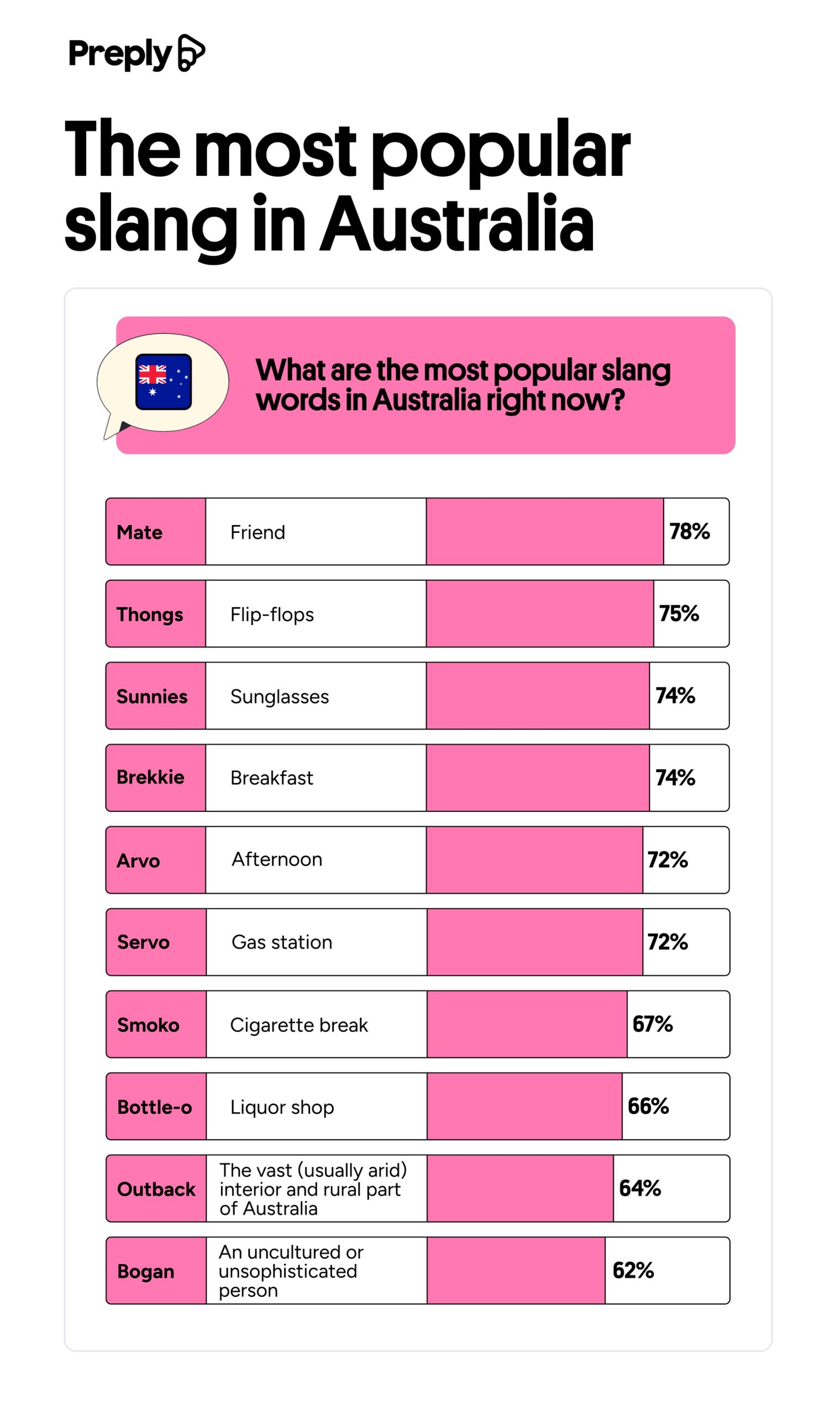
Aussies love incorporating unique slang into their daily conversations, with terms like “mate,” “thongs,” “brekkie,” and “arvo” topping the list of favorites. These playful words reflect the relaxed and friendly culture of Australia.
The slang term “mate” has gained immense popularity in Australia, with an impressive 77.95% of Australians feeling confident incorporating it into their conversations. Interestingly, this term is especially favored by the older generation, as 81.20% of individuals aged 55 and above regularly use “mate” in their speech.
Australia’s favorite slang words reflect its vibrant culture, with ‘thongs’ (flip-flops), ‘sunnies’ (sunglasses), ‘brekkie’ (breakfast), and ‘arvo’ (afternoon) topping the list as the most commonly used terms. These playful expressions capture the laid-back Aussie lifestyle perfectly!
While nearly all Australians enjoy using slang, research shows that women tend to feel more confident than men when incorporating these informal expressions into their conversations.
Learn a language online with our free learning materials.
Learn English online
Learn French online
The most annoying slang in Australia
As slang evolves within Australian English, not every term has been embraced by all. Certain expressions, such as “sheila,” “mate,” “crikey,” and “cake hole,” have become particularly notable for causing irritation among Australians.
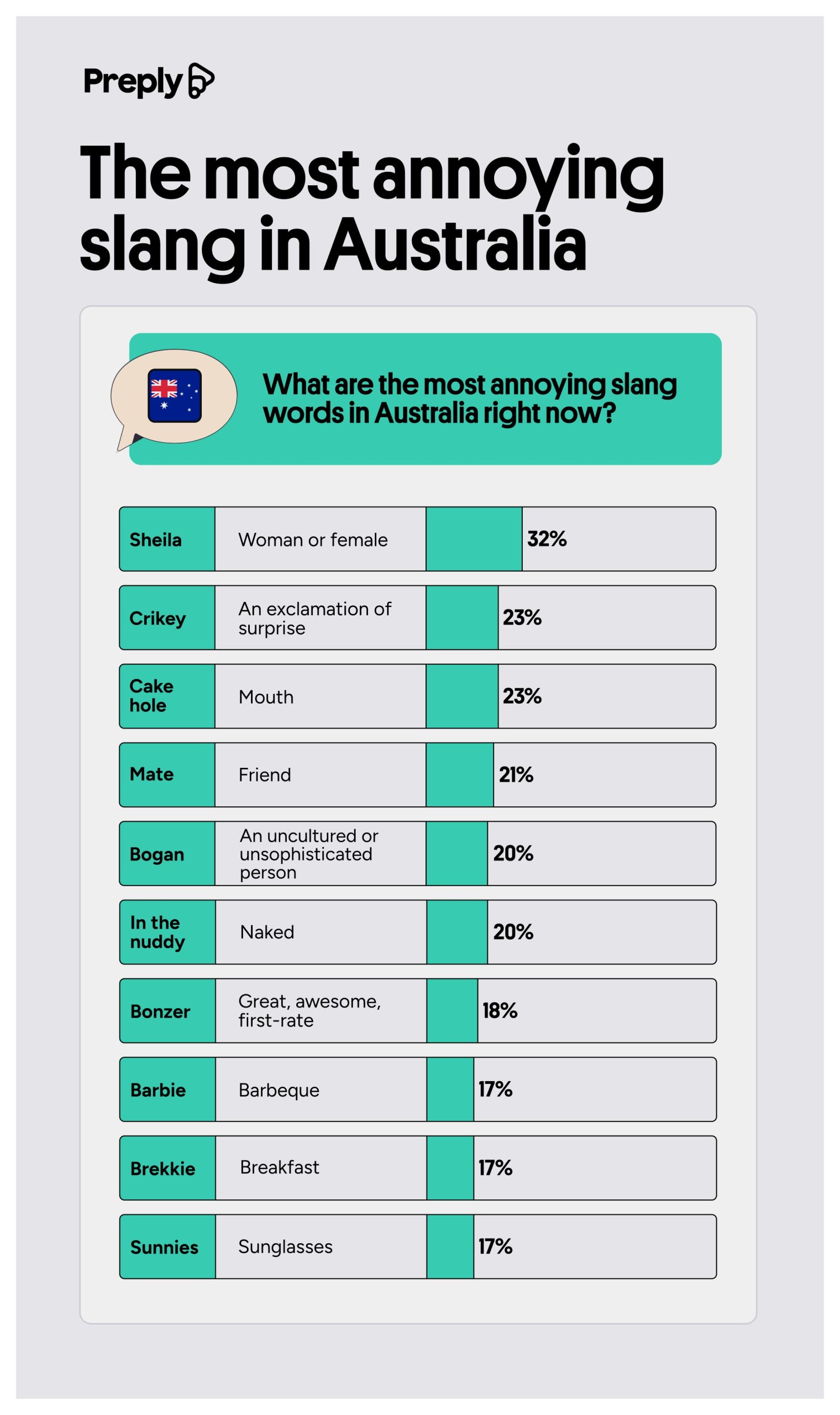
The term “Sheila,” which refers to a girl or woman, has been dubbed the most annoying slang word by Australians, with 31.71% voting it the least favorite. Interestingly, a higher percentage of women (32.96%) find the term irritating compared to men (27.24%). This discrepancy likely stems from the word’s outdated connotations and its potential to be perceived as derogatory.
The term “mate,” commonly used to mean friend, ranks high on the list of irritating slang in Australia, with 20.79% of respondents expressing their dislike for it. Notably, more men (24.25%) find “mate” annoying compared to women (19.93%), which may be attributed to the fact that men are more frequently addressed as “mate.”
‘Crikey’ (an expression of surprise) and ‘cakehole’ (the mouth) also place in Australia’s top 3 most annoying slang words.
Who uses the most slang?

Slang in Australian English is shaped by factors such as gender, age, culture, and location. But who tends to use slang more frequently, and what drives this usage?
Slang plays a versatile role in communication, with 37.57% of people incorporating it into casual conversations and a close 33.98% feeling comfortable using it in every interaction. This shows how slang can enhance everyday dialogue in various contexts.
Women were more inclined to incorporate slang into their daily conversations, with 35.01% using it regularly compared to 29.90% of men. However, men showed a greater tendency to use slang in every type of conversation, regardless of their company, with 9.97% doing so versus 8.35% of women.
Young adults aged 16 to 24 are the most likely to use slang in their conversations, with 11.57% embracing it regularly. In contrast, a significant portion of the over-55 age group, specifically 15.79%, reported that they never use slang at all.
What types of people are using slang?
Slang isn’t limited to a specific group; it spans across various contexts and is embraced by a diverse range of individuals. So, who tends to use the most slang, and who are they communicating with?
Friends are the most frequent users of slang, with an impressive 82.52% of people indicating that they primarily communicate in slang with their friends.
In the workplace, a significant 58.49% of individuals report that their colleagues commonly use slang. However, when it comes to communicating with their managers, the use of slang drops dramatically, with only 14.16% feeling comfortable enough to do so.
Women also emerged as the gender to feel more comfortable using slang with their friends, families and partners, compared to men.
When is it OK and not OK to use slang?
While slang is a staple in the everyday language of many Australians, some still hold the view that its use should be reserved for specific situations. But what are the appropriate contexts for incorporating slang into conversation?
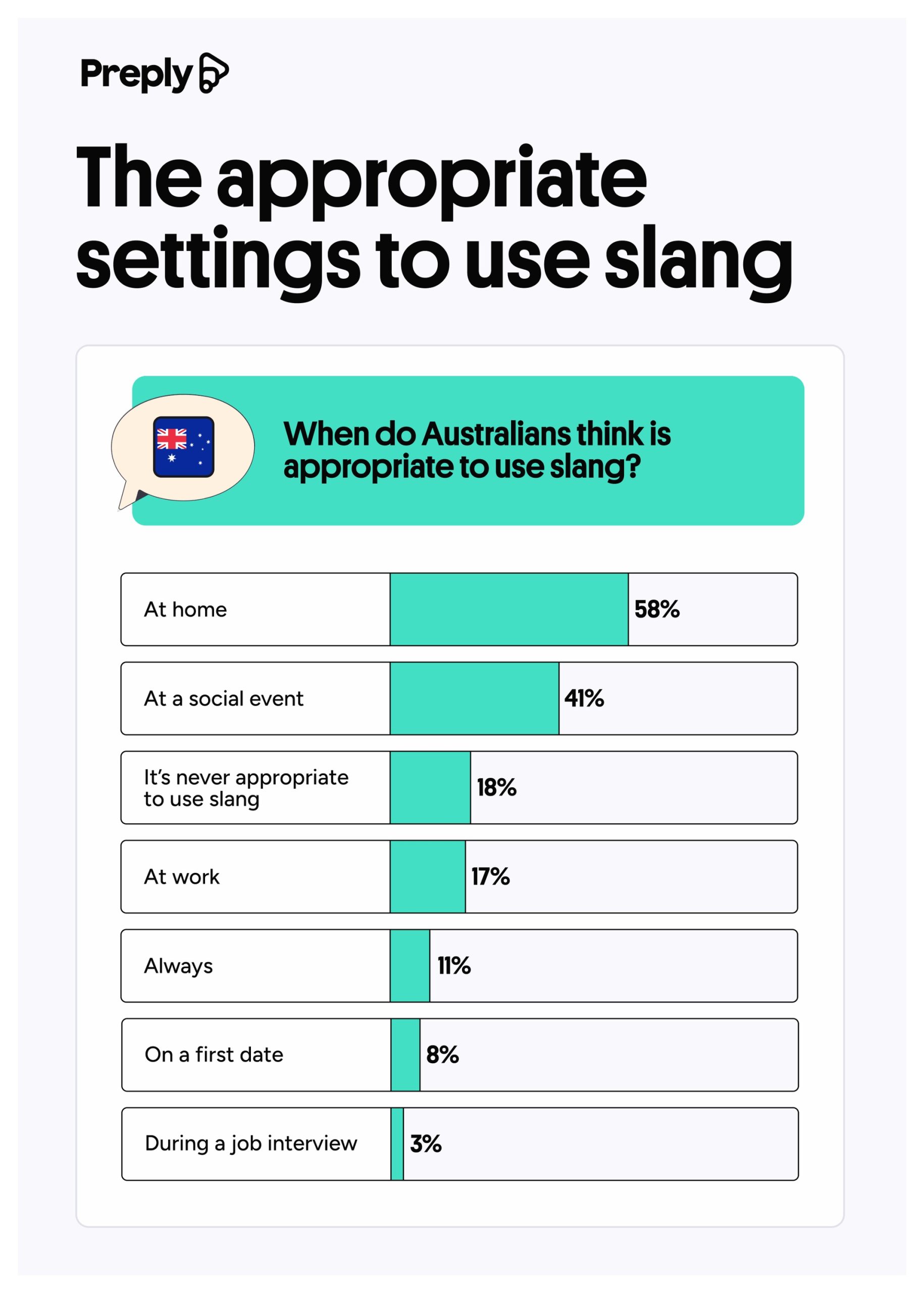
An impressive 57.89% of respondents feel that home is the ideal setting for using slang, especially when chatting with friends, partners, and family. In contrast, 21.80% of individuals aged 55 and older believe there is never a suitable time or place for slang.
The use of slang in the workplace sparks a lively debate, with 37.18% of people deeming it unprofessional. Interestingly, this sentiment is shared by 38.25% of women compared to 33.22% of men. However, a significant 46.97% of respondents feel that using slang at work falls into a gray area, considering it neither professional nor unprofessional.
When it comes to making a strong first impression, just 10.73% of people believe that using slang is acceptable on a first date. Even more telling, only 3.26% think it’s appropriate to use slang during a job interview. This highlights the importance of clear and professional communication in key social and professional settings.
Sylvia Johnson, a language expert at LingualNeeds, explores the fascinating evolution of slang over the years. She highlights how Australians have seamlessly integrated unique slang words and phrases into their everyday conversations, reflecting their vibrant culture and social dynamics.
Many classic Australian expressions that may sound a bit outdated to younger generations are rooted in the language brought over by British and Irish settlers. These phrases are a fascinating glimpse into our linguistic heritage, showcasing the rich history of communication in Australia.
Take the term “tucker,” which has meant food since the 1850s, or the Cockney rhyming slang “take a butcher’s,” meaning to have a look. Australia’s traditional English varieties—Broad, Cultivated, and General—are blending together. However, in today’s global English landscape, Australian vernacular is increasingly influenced by British and particularly American English.
Beyond social media and the internet, new slang often springs from popular culture and serves as a way to showcase your awareness of current trends. This informal language acts as a form of shorthand, encapsulating not just words but the connections that bind us together. Slang nurtures a sense of belonging, creating a unique identity within specific groups or circles of friends.
Slang is a dynamic aspect of language, constantly shifting in nuance and reflecting the identity of its users. Some slang terms are fleeting, disappearing once they gain mainstream attention—take “cheugy,” for instance, which lost its edge after being featured in the New York Times. In contrast, certain expressions withstand the test of time, like “cool,” which dates back to the 1930s and continues to thrive due to its adaptability in numerous situations.
Conclusion
Grasping Australian slang is crucial for meaningful communication and fostering connections in Australia. Although some may view slang as lacking sophistication, it plays a vital role in everyday interactions among friends, family, and colleagues. Embracing this informal language can enhance your experience and help you relate better to locals.
Mastering slang can be tricky, especially if you depend only on textbooks or online materials. That’s where LingualNeeds steps in to help you navigate and understand the nuances of everyday language.
Unlock the unique world of Australian English with LingualNeeds! Our experienced tutors offer personalized one-on-one lessons that go beyond just the language, immersing you in the culture and slang of Australia. Enhance your understanding and confidently incorporate local expressions into your conversations. Begin your journey with LingualNeeds today and elevate your language skills to new heights!
Methodology:
Censuswide conducted a nationwide online survey involving 1,500 Australians aged 16 to over 55 for LingualNeeds. The goal was to explore how Australians feel about popular slang terms and their usage in everyday conversation.
Frequently Asked Questions
What percentage of Australians use slang in most conversations?
Over 30% of Australians admit to using slang in most conversations.
Which slang term is considered the most annoying in Australia?
The term ‘sheila’ is considered the most annoying slang word by Australians.
How do Australians typically learn new slang terms?
Most Australians pick up slang from their friends (64%) and through the internet and social media (52.56%).
What are some of the most popular slang terms in Australia?
Popular slang terms in Australia include ‘mate’, ‘thongs’, ‘sunnies’, ‘brekkie’, and ‘arvo’.
Is it acceptable to use slang in professional settings?
While 37.18% of people deem slang unprofessional in the workplace, 46.97% consider it a gray area.