- Students:
- Tutors:
- 73% of students are concerned about AI use:
- Lack of human connection is a major concern:
- Generation Z is the least comfortable sharing private data with AI:
- 47% say AI-based learning is more affordable
- Demographics:
- The importance of human learning:
- What does genuine human engagement have that fosters motivation and drives learning outcomes?
- The future of language learning for students
- LingualNeeds combines human connection and artificial intelligence
- Methodology
- LingualNeeds Market Research on AI in Learning (August 2023)
- LingualNeeds Market Research with English Teachers (August 2023)
- Frequently Asked Questions
- What percentage of students value human interaction in learning?
- How many English teachers are incorporating AI tools in their teaching?
- What is the primary concern regarding AI-based learning?
- Which generation is the most cautious about sharing personal data with AI?
- What benefits do students associate with AI-driven learning?
We spoke with a diverse group of language learners to explore the transformative effects of AI-powered education on their learning journeys. They shared their aspirations and apprehensions, as well as their visions for a future shaped by AI alongside traditional human interactions. Additionally, we conducted a survey of over 1,000 English teachers to gauge the extent of AI integration in their classrooms.
Students:
Artificial Intelligence holds the promise of delivering a tailored learning experience for each student, significantly enhancing their skills and growth. Yet, as this educational technology evolves, the essential bond between students and teachers, along with the invaluable human interaction it fosters, will continue to play a crucial role in the learning process.
Our research reveals that a significant 70% of students appreciate the crucial role of human interaction and guidance in enhancing their learning experience.
In the United States, a significant 69% of students believe that having a human teacher actively involved in their education is essential. This statistic highlights the importance of personal interaction in enhancing the learning experience.


Learn a language with personalised 1-on-1 classes with our expert tutors from all over the world
French lessons online
Spanish lessons online
Tutors:
In contrast, a significant 52% of English teachers across the globe are incorporating AI and automated tools into their teaching. In the United States, this figure stands at 58%, yet it still trails behind Australia, where adoption rates soar to 63%.
This indicates that educators are rapidly embracing artificial intelligence to enrich their teaching methods. In contrast, the adoption of AI among teachers in Europe lags behind, with only 41% integrating these advanced tools into their classrooms.
Curious about how teachers are leveraging AI tools? The most common applications include crafting grammar and vocabulary exercises, utilized by 41% of educators. Following closely are language training support at 36% and the development of reading and listening activities, which engage 35% of teachers.

73% of students are concerned about AI use:
While the promise of AI in education is undeniably thrilling, it has sparked considerable apprehension among many individuals. Our study shows that a notable 73% of participants have expressed concerns regarding the integration of AI in learning environments.
In the U.S., 77% of students express significant concern about this issue, ranking them second only to Spain, where concern is slightly higher at 80%.
Notably, a gender gap exists in these concerns, with 76% of women expressing worry compared to 70% of men, indicating that women tend to feel more anxious about the issue.

Learn a language online with our free learning materials.
Learn English online
Learn French online
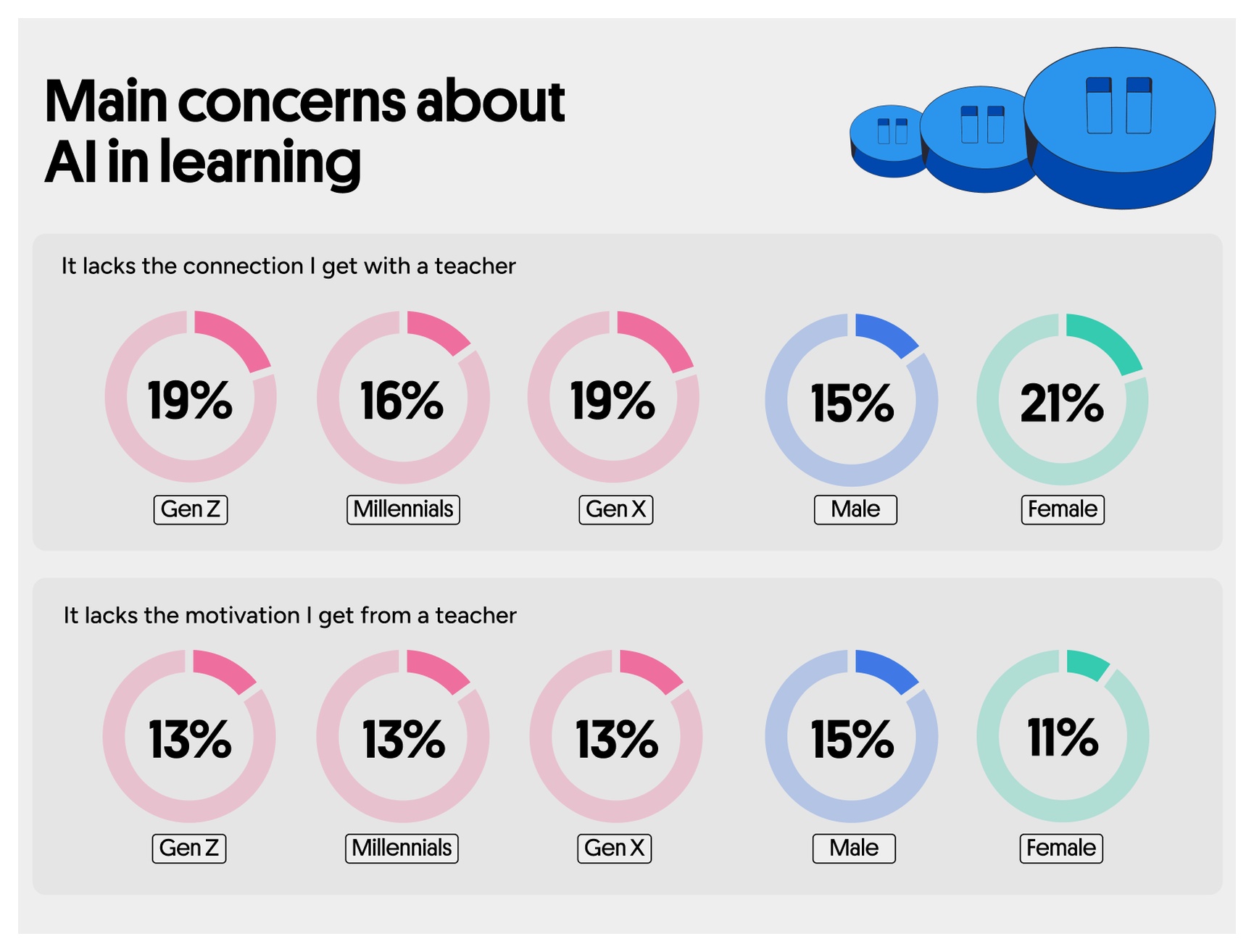
Lack of human connection is a major concern:
A significant 31% of participants express that their primary concern with AI-based learning is the absence of human connection and motivation from teachers.
While female respondents highlight the significance of human connection in education, male respondents focus more on the motivational benefits that arise from interactions between teachers and students.
This concern only underscores that students highly value the time spent with their teacher.
Generation Z is the least comfortable sharing private data with AI:
A recent study reveals that 31% of Generation Z feel uneasy about sharing their personal data with AI systems, a significant increase compared to 23% of millennials. This trend positions Generation Z as the most cautious demographic when it comes to data privacy in the age of artificial intelligence.
When it comes to gender demographics, women tend to be more cautious about sharing their personal data with AI systems designed for personalized learning. A notable 31% of women have expressed concerns, while only 23% of men share the same hesitation.
These concerns highlight the critical need to tackle privacy issues and foster trust in AI systems. By doing so, we can ensure that these technologies are integrated into educational settings responsibly and effectively.

47% say AI-based learning is more affordable
Affordability, personalized learning, and individualized approach
AI-driven learning is transforming the educational landscape in remarkable ways, presenting a host of benefits that educators must embrace and adapt to.

Our study highlights a key advantage of AI in education: cost savings. An impressive 47% of students report that AI-driven learning is more affordable, which can greatly enhance access to education for many.
One of the key benefits of AI-driven learning for students is its flexible, à la carte approach, which breaks free from the constraints of traditional classroom schedules. This means students can access educational resources anytime and anywhere, enabling them to learn at their own pace and on their own terms.
Lastly, students appreciate how AI personalizes their learning journey by catering to their specific needs and preferences, ensuring a more tailored educational experience for everyone.
Interestingly, while gamified learning experiences have attracted significant interest in the education sector, our research reveals that they are the least highlighted benefit of AI-driven learning. This could be due to the perception that gamification leans more towards entertainment rather than serving as a powerful educational tool.
Demographics:

Generation X shows a greater awareness of how AI can adapt to their needs compared to other age groups. Meanwhile, Millennials are especially enthusiastic about the prospect of faster learning through AI, with 41% eager to enhance their learning speed, outpacing both younger and older generations.
Moreover, men express a keen desire for rapid learning outcomes through AI, underscoring the widespread excitement about the transformative potential of artificial intelligence in education.
The importance of human learning:
While AI’s ability to offer personalized and accessible learning experiences holds incredible potential for the future of education and skill development, the fundamental value of human connection is something that technology cannot replicate.
What does genuine human engagement have that fosters motivation and drives learning outcomes?
Understanding the connection between human interaction and motivation is crucial. The benefits of personalized, goal-oriented lessons extend far beyond their effectiveness; they also foster meaningful relationships between students and teachers. Shared laughter, mutual understanding, and a sense of camaraderie create strong bonds that enhance the overall learning experience, making it both engaging and enriching.
Our brand tracking survey highlights a key insight: students often lose their motivation to learn, which leads them to abandon platforms such as Duolingo.
Our survey findings from LingualNeeds language teachers and students reveal a significant connection between the feeling of progress and the motivation to keep learning a language. This insight highlights how crucial it is for learners to perceive their advancements to stay engaged in their language journey.
Together, these two elements highlight that motivation is a key driver in perceiving learning progress. Moreover, dedicated teachers play an essential role in fostering that unique motivation.
As AI continues to transform education, the importance of human connection remains paramount; it is the key driver of genuine motivation and effective learning.
The future of language learning for students
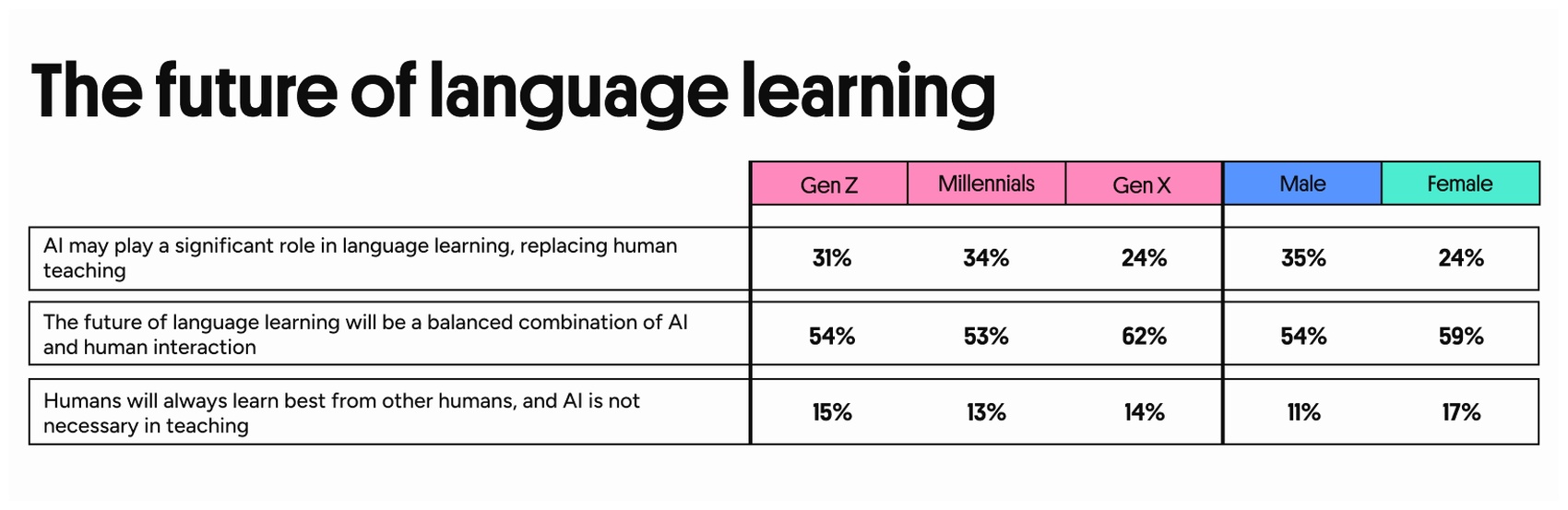
When we imagine the future of language learning, the interplay between AI and human interaction is evident.
A notable 30% of students believe that AI will significantly influence language teaching, with some even suggesting it could take the place of human instructors. This perspective is particularly prevalent among male students, with 1 in 3 sharing this view. In contrast, a larger majority—54%—envisions a future where language learning combines both AI technology and human interaction for a more effective educational experience.
This viewpoint is particularly prevalent in areas such as Southern Europe and Latin America, where personal connections are deeply cherished. In Spain and Italy, 59% and 57% of people, respectively, stress the significance of human interaction, while an impressive 64% in Brazil share this belief. These statistics suggest a promising future where AI complements rather than replaces human engagement in language learning.
Envision a future where the harmonious blend of technology and human interaction drives students to achieve higher levels of skill and cultural awareness. This dynamic represents the evolving nature of education in our digital era.
LingualNeeds combines human connection and artificial intelligence
Artificial Intelligence is becoming a common presence in our daily lives, including in online banking customer service. While these automated systems can be cost-effective for banks and work well in certain situations, they often fall short when it comes to addressing the unique nuances of individual problems. This is where the human touch is essential. Our goal in language learning is to combine the advantages of AI with the personalized support of a teacher, ensuring that students receive the best possible results at an affordable price.
Discover the exciting world of languages at LingualNeeds! We invite you to explore our French, Italian, Portuguese, and more classes, where we harness the power of AI to enhance your learning experience. Unlock your full potential with our innovative teaching methods!
Methodology
LingualNeeds Market Research on AI in Learning (August 2023)
The aim of this research was to understand the importance of human interaction in learning and perceptions of AI.
We carried out an extensive quantitative survey involving 2,503 participants across various online panels. Our diverse sample included 500 respondents from the United States, along with 401 from Germany, 400 from Spain, 402 from Italy, 400 from Poland, and 400 from Brazil.
The participants in this language learning program were a diverse group of working professionals hailing from various fields, including business, consulting, management, accounting, banking, finance, IT, and technology. The group comprised 1,280 men and 1,219 women, with generational representation including 685 from Generation Z, 952 Millennials, and 866 from Generation X.
LingualNeeds Market Research with English Teachers (August 2023)
We conducted a survey involving 1,035 English teachers from 40 countries around the globe, encompassing a diverse mix of both native and non-native speakers.
This research aimed to explore the teaching practices and experiences of English teachers around the globe, with a special focus on the integration of AI in their classrooms.
Frequently Asked Questions
What percentage of students value human interaction in learning?
70% of students appreciate the crucial role of human interaction and guidance in enhancing their learning experience.
How many English teachers are incorporating AI tools in their teaching?
52% of English teachers globally are incorporating AI and automated tools into their teaching.
What is the primary concern regarding AI-based learning?
31% of participants express that their primary concern with AI-based learning is the absence of human connection and motivation from teachers.
Which generation is the most cautious about sharing personal data with AI?
Generation Z is the most cautious demographic, with 31% feeling uneasy about sharing their personal data with AI systems.
What benefits do students associate with AI-driven learning?
47% of students report that AI-driven learning is more affordable, and they appreciate its personalized and flexible learning approach.