- Key findings
- Daily affirmations
- Brits love to “believe in yourself”
- Understanding the dislike for certain positive phrases
- Happiness isn’t a choice for most Brits
- Over 50% would not use a motivational phrase in their daily lives
- 1 in 3 Gen Z find positive phrases too cringey
- Londoners love to be positive
- How LingualNeeds can help
- Methodology
- Frequently Asked Questions
- What percentage of Brits enjoy uplifting expressions?
- Which positive phrase is considered the most loved in the UK?
- What is the most cringeworthy positive phrase among Brits?
- How do Londoners feel about positive phrases compared to other regions?
- What is the general attitude of Gen Z towards positive phrases?
In today’s world, culture plays a crucial role in shaping language and communication based on our location. It influences everything from the way we encourage others to how we brighten up a gloomy day. This means that a phrase that resonates positively in one culture might not have the same effect in another. While the UK speaks English, its unique cultural heritage adds layers of meaning to the language. With that in mind, let’s delve into the role of positivity in British culture and how the British embrace a sprinkle of optimism in their daily lives.
A recent survey conducted by LingualNeeds has uncovered intriguing insights into the British attitude toward positive phrases. Surprisingly, only 22% of respondents expressed a fondness for uplifting expressions, while over 39% described them as cringeworthy, annoying, or even outright disliked. Google search trends reflect this sentiment, showing a significant decline in interest as searches for positive phrases in the UK have plummeted. In just one year, monthly searches for “positive quotes” have fallen by more than 100%, dropping from 110,000 to 49,500. To delve deeper into this complex relationship, LingualNeeds has reached out to individuals across the UK to explore their mixed feelings about positive language.
Key findings
- 62% of Brits would never use a positive quote such as “Live, Laugh, Love” in their daily lives
- “Believe in Yourself” is the UK’s most loved positive phrase
- “Happiness is a Choice” is the UK’s most hated positive phrase
- “Live, Laugh, Love” is crowned the most cringey positive phrase
- Londoners are revealed to love positive phrases the most of any other UK region
- Those from the North West hate positive phrases the most, with Liverpudlians finding them the most cringey
- 53% reportedly avoid motivational quotes in their daily lives

Learn a language with personalised 1-on-1 classes with our expert tutors from all over the world
French lessons online
Spanish lessons online
Daily affirmations
Incorporating positive vibes into our daily interactions can brighten our lives, and interestingly, 35% of those surveyed frequently sprinkle uplifting phrases into their conversations. However, this represents a minority, as more than 65% tend to shy away from positivity. While only 22% express a love for cheerful expressions, a significant 39% find them cringeworthy or annoying, with some even admitting to disliking them altogether.
Brits love to “believe in yourself”
The phrase that stands out the most is “Believe in yourself,” cherished by 42% of survey respondents. This powerful statement highlights the importance of self-trust and confidence in reaching your goals. Close behind are the phrases “Tomorrow is a new day” and “Stay strong,” each favored by 37% of participants. Both of these expressions emphasize resilience and the idea of moving forward despite challenges, reinforcing the connection between mindset and goal achievement.
In the UK, people tend to prefer phrases centered on achievement over those that are merely inspirational. For instance, the well-known phrase “Carpe diem,” or “seize the day,” resonates with only 20% of the population. Meanwhile, phrases like “Good vibes only” and “Happiness is a choice” often elicit a cautious acknowledgment, albeit with a hint of skepticism.

Learn a language online with our free learning materials.
Learn English online
Learn French online
Understanding the dislike for certain positive phrases
Although 39% of respondents express disapproval of positive phrases, a notable 22% dislike them due to their perceived cringeworthiness. Common examples that top the cringe list include “Live, laugh, love,” “Good vibes only,” and “You are enough.”
We spoke with language expert Sylvia Johnson, Head of Methodology at LingualNeeds, to understand why many British people often cringe at certain phrases. She explains, “In cultures like America, there’s a strong emphasis on openness and the pursuit of happiness. This contrasts sharply with the traditionally reserved British mindset, where openly discussing and actively seeking happiness can feel awkward and uncomfortable.”
British culture is often characterized by its historical commitment to maintaining a “stiff upper lip,” yet this stoicism can sometimes be clouded by a prevalent cynicism that hinders our pursuit of positivity. When faced with common clichés about optimism, many of us instinctively cringe and dismiss them as nonsense. Instead, we Brits tend to embrace a subtler form of positivity, tempered with a good dose of skepticism.
Happiness isn’t a choice for most Brits
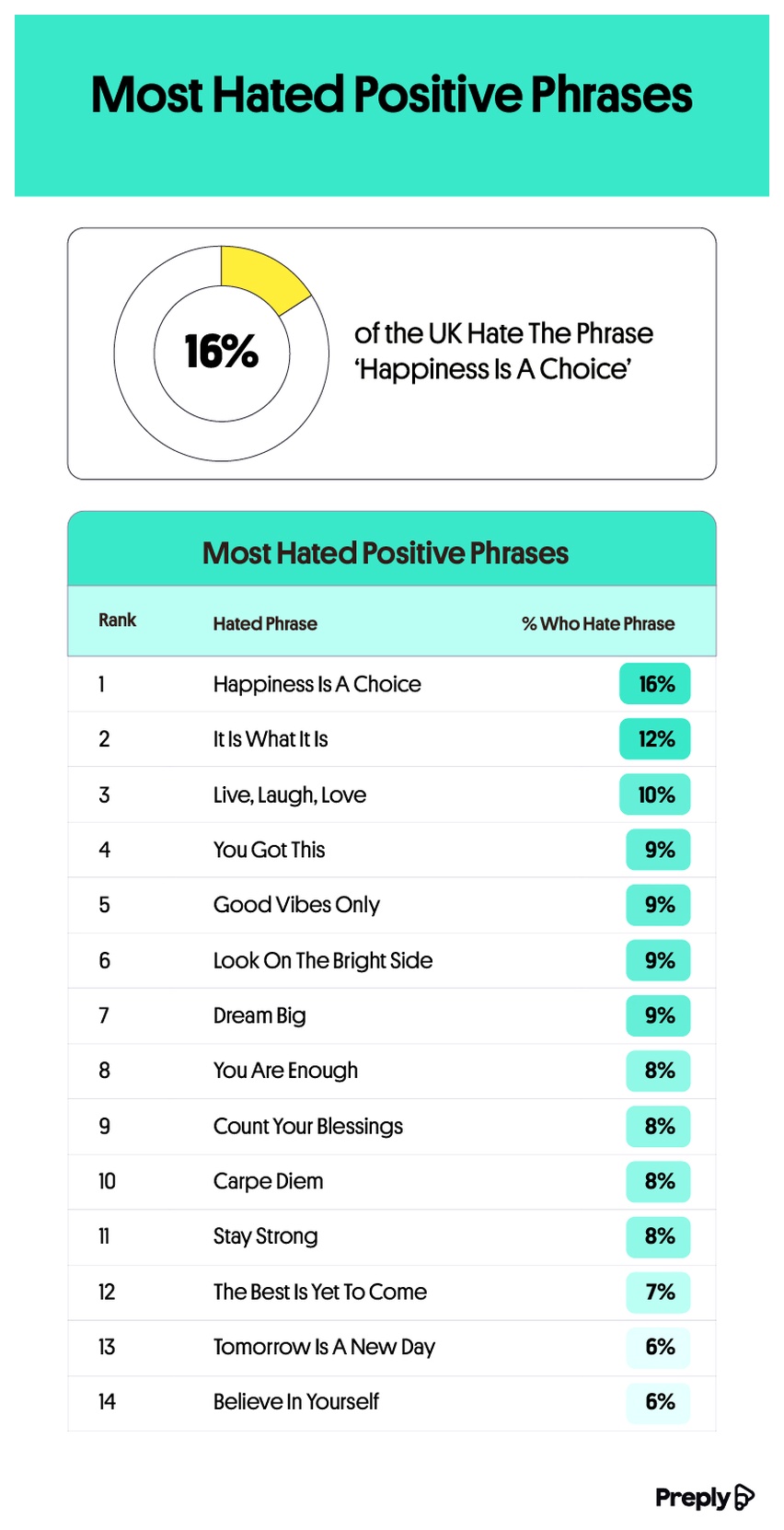
Building on this idea, it’s interesting to note that certain positive phrases have garnered significant dislike among individuals. Leading the pack is the phrase “Happiness is a choice,” which many perceive as overly simplistic and dismissive of deeper emotional complexities. In a recent survey, 16% of participants in the UK identified it as their most hated positive mantra. Following closely are “It is what it is” at 12% and “Live, laugh, love” at 10%.
Over 50% would not use a motivational phrase in their daily lives
We’ve all encountered that colleague or manager who attempts to inspire the team with motivational quotes. Interestingly, a recent survey revealed that 53% of respondents would never incorporate such quotes into their daily lives. Among those, half admitted that motivational phrases fail to inspire them, with “Do the impossible” ranked as the least motivating at 57%. Close behind are “The sky’s the limit” and “Keep calm and carry on,” both of which 54% of participants said wouldn’t motivate them.
Straight to the heart of motivation, the phrase “Keep up the good work” stands out as the top choice, resonating with 58% of people. Its clarity and straightforwardness not only acknowledge the hard work of team members but also inspire them to sustain their efforts.
1 in 3 Gen Z find positive phrases too cringey
A notable 32% of Gen Z individuals aged 16 to 24 view positive phrases as overly cringeworthy. This response stems from their strong emphasis on authenticity and honesty, leading them to perceive such expressions as superficial and lacking depth. In contrast, older generations appear to be more tolerant of this cheesiness; by the time individuals reach 55 and older, the cringe factor significantly declines to just 16%.
Young adults aged 25-34 are the biggest fans of positive phrases, with 35% expressing their love for them. In contrast, those aged 35-44 are surprisingly less enthusiastic, as 8% outright reject these uplifting expressions.
Londoners love to be positive
Exploring the essence of the UK, we find that London, alive with its energetic streets and rich diversity, is home to a remarkable community of positivity enthusiasts. An impressive 36% of Londoners are fans of uplifting phrases. Among these, “Believe in yourself” resonates most strongly, embraced by 52% of the city’s inhabitants as their favorite motto.
Interestingly, the Welsh, typically recognized for their cheerful and friendly nature, have a unique perspective on positive expressions. In fact, 29% of them find such phrases to be quite cringe-worthy. Similarly, residents of Liverpool share this sentiment, with 28% also perceiving these upbeat expressions as awkward.
How LingualNeeds can help
Cultural differences and personal identity play a crucial role in how we use language to convey our feelings. This survey highlights the subtle ways in which Brits respond to positive expressions, emphasizing the significance of context in communication. Whether you’re taking French or Spanish lessons online, understanding these nuances can greatly enhance your language experience.
LingualNeeds offers personalized one-on-one tutoring that goes beyond mere language skills; it immerses learners in the rich cultural nuances of the language. This cultural insight is crucial, particularly in online lessons, facilitating seamless shifts from casual conversations to formal dialogues. The goal is to build confidence, empowering you to communicate effectively in diverse situations, ensuring your language abilities are authentic and adaptable.
Language transcends mere vocabulary; it serves as a vital bridge to richer connections and insights. At LingualNeeds, we strive to nurture this understanding in every lesson, whether you’re diving into French or exploring Spanish online.
Methodology
To gain insights into UK consumers’ attitudes towards positive phrases, we conducted an extensive survey with a nationally representative sample of 2,007 individuals aged 16 and older. This methodology section details the approach we took to gather meaningful and reliable data, capturing a wide range of perspectives across various demographics throughout the UK.
The survey was designed to gauge participants’ feelings towards positive phrases, categorizing responses into several distinct attitudes.
Frequently Asked Questions
What percentage of Brits enjoy uplifting expressions?
Only 22% of Brits expressed a fondness for uplifting expressions.
Which positive phrase is considered the most loved in the UK?
‘Believe in Yourself’ is the UK’s most loved positive phrase, favored by 42% of respondents.
What is the most cringeworthy positive phrase among Brits?
‘Live, Laugh, Love’ is crowned the most cringey positive phrase.
How do Londoners feel about positive phrases compared to other regions?
Londoners love positive phrases the most of any other UK region.
What is the general attitude of Gen Z towards positive phrases?
32% of Gen Z individuals find positive phrases too cringey, as they emphasize authenticity.