- Key takeaways
- Slang in session: Family feedback
- Teachers’ takes on slang
- The future of classroom communication
- Methodology
- Frequently Asked Questions
- What percentage of K-12 parents oppose the classroom slang ban?
- How many K-12 teachers believe they should regulate student language?
- What do K-12 parents think about incorporating slang into curricula?
- What is the main concern K-12 teachers have about using slang in the classroom?
- What is the interest level among K-12 teachers in taking a course on slang terminology?
The recent controversy surrounding a teacher’s decision to ban slang in the classroom has ignited a national discussion about slang’s place in education. At LingualNeeds, we took a deeper look into this issue by surveying over 1,000 parents and 201 K-12 teachers to gather their perspectives. Our study examines whether slang helps or hinders the learning and writing abilities of young students. In this report, we share key insights into the role of slang in modern classrooms, its effect on student engagement, and how language is evolving in educational settings.
Key takeaways
- 33% of K-12 parents and 40% of K-12 teachers oppose classroom slang ban.
- More than 3 in 10 K-12 parents said teachers should incorporate slang terms into their curricula.
- 78% of K-12 teachers believe they should regulate student language in educational environments.
- Almost 48% of K-12 teachers are interested in taking a course on slang terminology.

Learn a language with personalised 1-on-1 classes with our expert tutors from all over the world
French lessons online
Spanish lessons online
Slang in session: Family feedback
As we explore classrooms across the country, we gathered insights from K-12 parents regarding the ongoing discussion about slang in education. To start, let’s highlight some of the 32 slang words that teachers found particularly troubling and have placed on their banned list:
- Bruh
- That’s cap
- Rizz
- Just vibe
- Just vibe twin
- What’s up twin?
- It’s giving
- Mun-yun
- Big dawg
- Bet!
When students are caught using slang like “bruh” or “that’s cap,” they face the task of writing an essay to explain their choice of expression in school. But what do parents think about this teacher’s approach to handling slang? In the following discussion, we’ll delve into their reactions and preferred disciplinary measures regarding slang usage in the classroom, as well as their perspectives on how it might influence students’ language development.
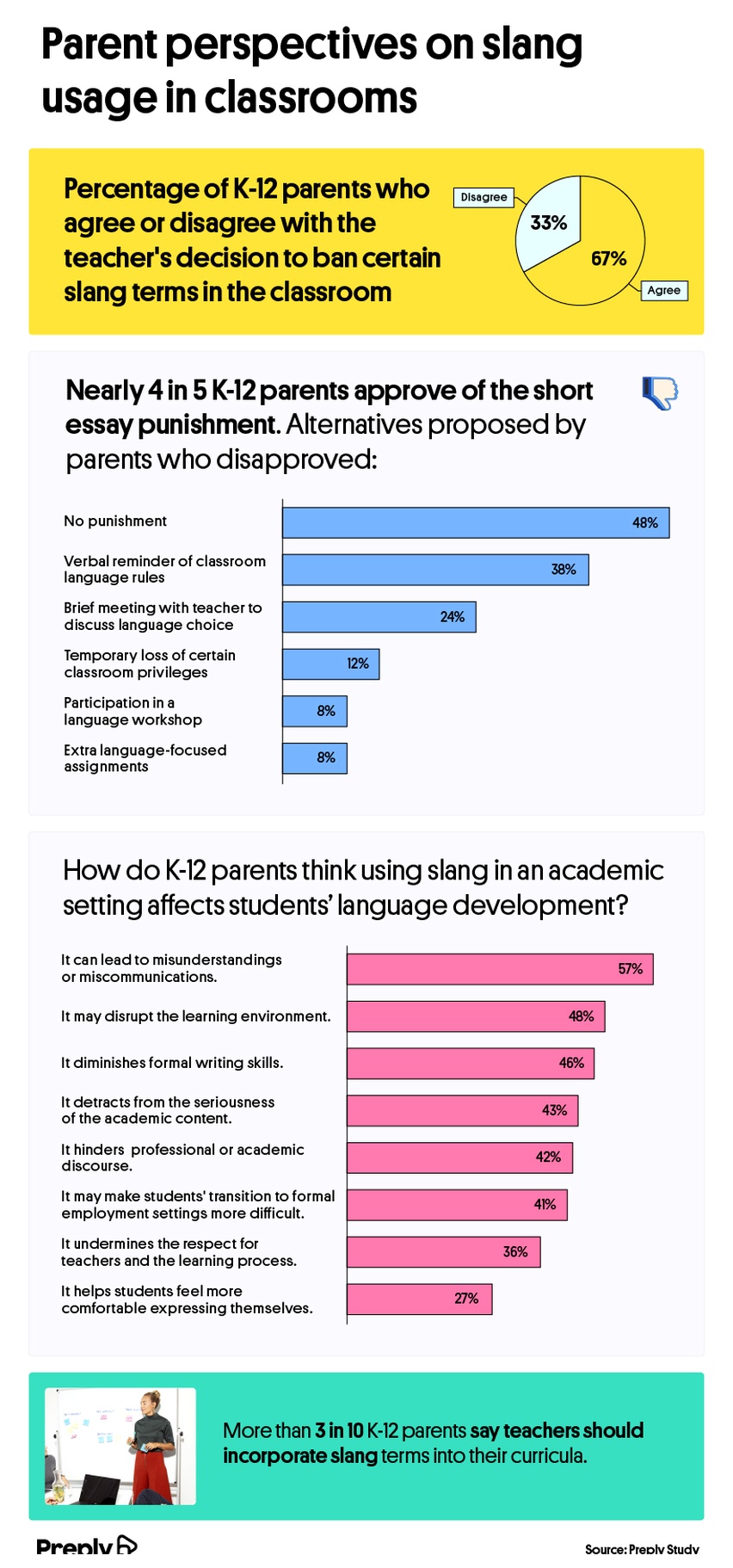
1 in 3 K-12 parents oppose the teacher’s classroom slang ban.
Percentage of K-12 parents in the following states who disagree with the teacher’s slang ban:
- California: 44%
- New York: 41%
- Pennsylvania: 39%
- Georgia: 36%
- Florida: 28%
- Texas: 26%
Among parents of K-12 students, women are 10% more likely than men to disagree with the slang ban.
77% of K-12 parents think teachers should have the power to police students’ language in an educational setting.
A recent survey reveals that 54% of fathers believe K-12 students shouldn’t face consequences for using slang in class, compared to only 43% of mothers. This highlights a notable difference in perspectives on language use in educational settings among parents.
More than 3 in 10 parents of K-12 students said teachers should incorporate slang terms into their curricula.
Almost 40% of parents with K-12 children (39%) express interest in enrolling in a class dedicated to exploring slang terms. Notably, women are 14% more likely to show this interest compared to men.
The following states show the percentage of K-12 parents interested in enrolling in a class dedicated to exploring slang terms:
- New York: 57%
- Florida: 43%
- California: 42%
- Texas: 36%
- Georgia: 31%
- Pennsylvania: 30%
Teachers’ takes on slang
Slang can sometimes cross the line into offense, but can it also serve as a teaching tool? In the following section, we explore the perspectives of K-12 teachers on the use of slang in the classroom. We highlight their preferred disciplinary approaches, their openness to integrating slang into the curriculum, and the potential benefits that slang can offer in an educational setting.
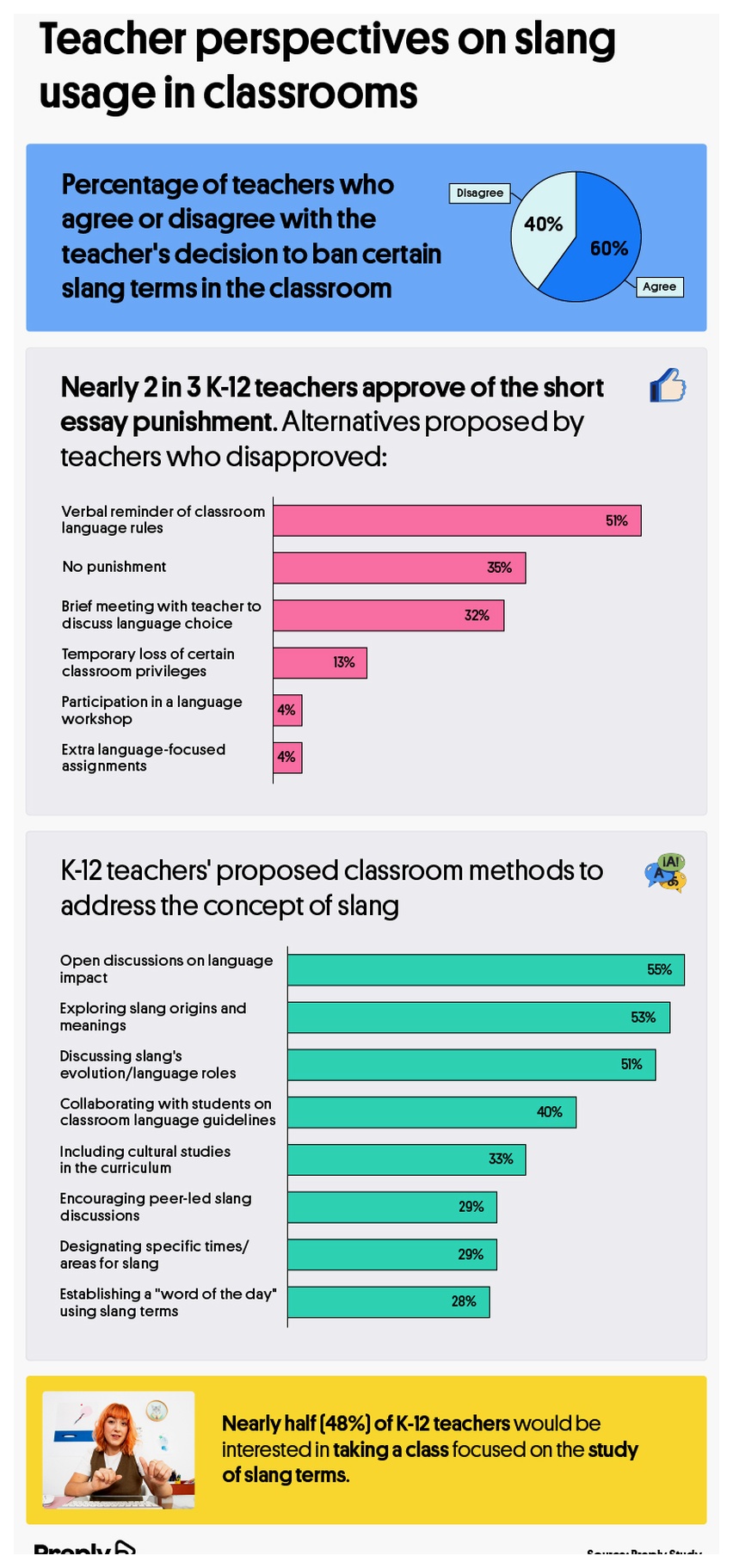
2 in 5 K-12 teachers oppose the teacher’s classroom slang ban.
78% of K-12 teachers think they should have the power to police students’ language in an educational setting.
Ways in which K-12 teachers think using slang in an academic setting affects students’ language development:
- It can lead to misunderstandings or miscommunications (54%).
- It may disrupt the learning environment (50%).
- It diminishes formal writing skills (41%).
- It helps students feel more comfortable expressing themselves (39%).
- It hinders professional or academic discourse (39%).
- It may make students’ transition to formal employment settings more difficult (38%).
- It detracts from the seriousness of the academic content (31%).
36% of K-12 teachers believe using slang in an academic setting reflects and respects cultural identity.
37% of K-12 teachers feel teachers should incorporate slang terms into their curricula.
Almost half of K-12 teachers—48%—expressed interest in enrolling in a course dedicated to exploring slang terms. Notably, a slightly higher percentage of female teachers (49%) showed interest compared to their male counterparts (46%).
Learn a language online with our free learning materials.
Learn English online
Learn French online
The future of classroom communication
The conversation about slang in classrooms reveals diverse educational philosophies among K-12 parents and teachers. Many parents advocate for disciplinary measures against slang, while teachers suggest more inclusive approaches that embrace its use. Educators believe that engaging in discussions about language and its influence on learning can create a more vibrant and dynamic educational atmosphere.
Sylvia Johnson, a Language and Intercultural Skills Expert at LingualNeeds, encapsulates this sentiment:
Banning slang may hinder both language growth and cultural expression. Slang plays a crucial role in the evolution of language, allowing students to interact with words in a lively and engaging manner. Importantly, every form of language, including slang, carries its own significance and depth.
Embracing slang in the classroom enables educators to engage students more effectively, making subjects feel relevant and enjoyable. For language learners, grasping and employing slang not only enriches their vocabulary but also fosters a deeper connection with the culture behind the language, ultimately boosting their overall proficiency.
This viewpoint presents exciting opportunities for educators to enhance their teaching strategies and for students to expand their linguistic and cultural awareness. As we navigate this intersection of tradition and innovation, we must consider: How can we harmonize the framework of formal education with the dynamic evolution of language to effectively support the learning journeys of future generations?
Amid the ongoing discussions about classroom slang, the importance of inclusive language learning for children is more relevant than ever. Our dedicated English tutors specialize in personalized one-on-one sessions, offering online classes not only in Spanish but also in a variety of other languages. We’re here to support your child’s language journey!
Methodology
We surveyed 1,007 K-12 parents and 201 K-12 teachers to explore perceptions about slang in the classroom.
Frequently Asked Questions
What percentage of K-12 parents oppose the classroom slang ban?
33% of K-12 parents oppose the classroom slang ban.
How many K-12 teachers believe they should regulate student language?
78% of K-12 teachers believe they should regulate student language in educational environments.
What do K-12 parents think about incorporating slang into curricula?
More than 3 in 10 K-12 parents said teachers should incorporate slang terms into their curricula.
What is the main concern K-12 teachers have about using slang in the classroom?
54% of K-12 teachers believe using slang can lead to misunderstandings or miscommunications.
What is the interest level among K-12 teachers in taking a course on slang terminology?
Almost 48% of K-12 teachers are interested in taking a course on slang terminology.