

- 1. Avoir le coup de foudre
- 2. Les carottes sont cuites
- 3. Poser un lapin
- 4. Faire la grasse matinée
- 5. Raconter des salades
- 6. En faire tout un fromage
- 7. Tomber dans les pommes
- 8. Les doigts dans le nez
- 9. Rouler dans la farine
- 10. L’habit ne fait pas le moine
- 11. Faire un froid de canard
- 12. Yeux de merlan frit
- 13. Avoir un oursin dans le portefeuille
- 14. Vendre la peau de l’ours avant de l’avoir tué
- 15. Ne pas faire d’omelette sans casser des oeufs
- 16. Donner sa langue au chat
- 17. Devoir une fière chandelle
- 18. Avoir la chair de poule
- 19. Avoir d’autres chats à fouetter
- 20. Avoir un chat dans la gorge
- 21. S’occuper de ses oignons
- 22. Avoir les yeux plus gros que le ventre
- 23. Ne pas y aller de main morte
- 24. Se serrer la ceinture
- 25. Prendre ses jambes à son cou
- 26. La goutte d’eau qui fait déborder le vase
- 27. Avoir le cafard
- 28. Avoir le coeur sur la main
- 29. Chercher midi à quatorze heures
- 30. Filer à l’anglaise
- Conclusion
- Frequently Asked Questions
- What does the French idiom ‘avoir le coup de foudre’ mean?
- What is the meaning of ‘poser un lapin’ in French?
- How is the idiom ‘faire la grasse matinée’ used?
- What does ‘les carottes sont cuites’ signify?
- What does the idiom ‘avoir un oursin dans le portefeuille’ describe?
Idioms are a fascinating feature of every language, offering expressions that diverge from their literal meanings. For instance, the phrase “It’s raining cats and dogs” clearly doesn’t mean animals are tumbling from the sky, and when someone says “break a leg,” it’s actually a way to wish you good luck. Exploring common French idioms can provide you with a fresh perspective on the language, enhancing your understanding and appreciation of its rich cultural nuances.
Just like in English, French is rich in idiomatic expressions that add color to the language. For instance, the phrase “être dans la lune” literally means “to be in the moon,” but it actually refers to someone who is daydreaming or lost in thought. Similarly, “prendre quelqu’un la main dans le sac” translates to “to catch someone red-handed,” while “coûter un bras” means “it costs an arm and a leg.” But what about the intriguing expression “faire la grasse matinée,” which means to sleep in? If you’re eager to enhance your French skills, dive into this curated list of popular and fascinating French idioms, complete with their meanings!
| French idiom | English meaning |
| avoir le coup de foudre | love at first sight |
| les carottes sont cuites | it’s over for good |
| poser un lapin | to be stood up |
| faire la grasse matinée | a long sleep |
| raconter des salades | spinning yarns |
| en faire tout un fromage | to make a big deal about something that is not worth giving much thought to |
| tomber dans les pommes | faint |
| les doigts dans le nez | to do something easily |
| rouler dans la farine | to get scammed |
| l’habit ne fait pas le moine | don’t judge a book by its cover |
| faire un froid de canard | cold weather |
| yeux de merlan frit | begging puppy dog eyes |
| avoir un oursin dans le portefeuille | someone who is stingy |
| vendre la peau de l’ours avant de l’avoir tué | count your chickens before they’re hatched |
| ne pas faire d’omelette sans casser des oeufs | no pain, no gain |
| donner sa langue au chat | cat’s got my tongue |
| devoir une fière chandelle | owe someone big time |
| avoir la chair de poule | goosebumps |
| avoir d’autres chats à fouetter avoir un chat dans la gorge |
bigger fish to fry have a frog in one’s throat |
| s’occuper de ses oignons | mind your own business |
| avoir les yeux plus gros que le ventre | eyes are bigger than your stomach |
| ne pas y aller de main morte | to give 100% |
| se serrer la ceinture | be careful with money |
| prendre ses jambes à son cou | run for your life |
| la goutte d’eau qui fait déborder le vase | the last straw |
| avoir le cafard | feel depressed |
| avoir le coeur sur la main | wear your heart on your sleeve |
| chercher midi à quatorze heures | making something difficult |
| filer à l’anglaise | sneak out |
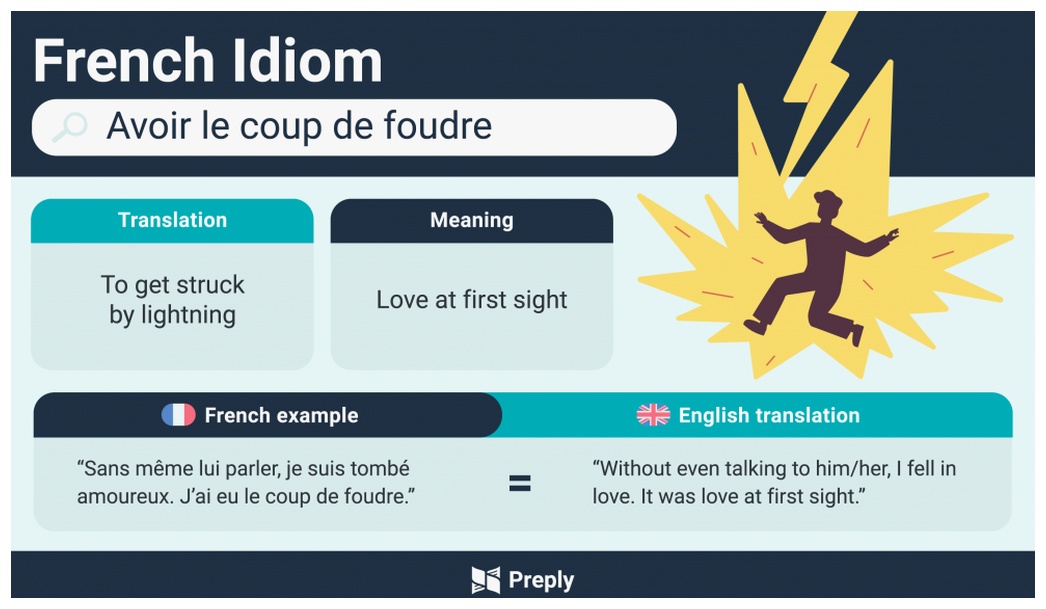
1. Avoir le coup de foudre
French is often referred to as the language of love, and the phrase “avoir le coup de foudre” perfectly exemplifies this sentiment. Literally translating to “to be struck by lightning,” it initially described something surprising and even unwelcome. However, over the years, its meaning has evolved into a romantic expression now synonymous with love at first sight. Isn’t that beautifully poetic?
Example:
Sans même lui parler, je suis tombé amoureux. J’ai eu le coup de foudre.
Without even talking to him/her, I fell in love. It was love at first sight.
2. Les carottes sont cuites
Though this idiom literally translates to “the carrots are cooked,” its true significance goes beyond the words. It symbolizes finality, indicating that something is irrevocably over—whether it’s the end of someone’s life or the realization that a project has no chance of success.
Example:
Il veut se présenter aux élections mais je pense que pour lui, les carottes sont cuites.
He wants to run for office but I think that it’s over for him.
3. Poser un lapin
The phrase “poser un lapin,” which translates literally to “to put down a rabbit,” is a French idiom that describes a situation where someone fails to show up for a date. In essence, it means to be stood up.
Example:
Elle ne me répond pas; je crois qu’elle va me poser un lapin.
She isn’t answering me; I think she’s going to stand me up.
4. Faire la grasse matinée
The term “grasse matinée,” which translates to “to do the fat morning,” refers to the delightful act of sleeping in—something often elusive for parents or those with demanding pets. Here, “fat” or “gras/grasse” conveys a sense of abundance and leisure, making “une grasse matinée” a perfect way to describe a luxurious, extended slumber.
Example:
Je me suis réveillée à 15h; j’ai fais une belle grasse matinée.
“I woke up at 3 p.m.; I slept in really late.”
5. Raconter des salades
The phrase “raconter des salades,” which translates to “to tell salads,” is often swapped with “raconter des histoires,” meaning “to tell stories.” This French idiom describes someone who embellishes or fabricates tales, akin to what we refer to in English as “spinning yarns.” A person who engages in this type of storytelling is sometimes labeled a “baratineur.”
Example:
Il ne savait pas quoi me dire alors il m’a raconté que des salades.
He didn’t know what to tell me so he told me stories.
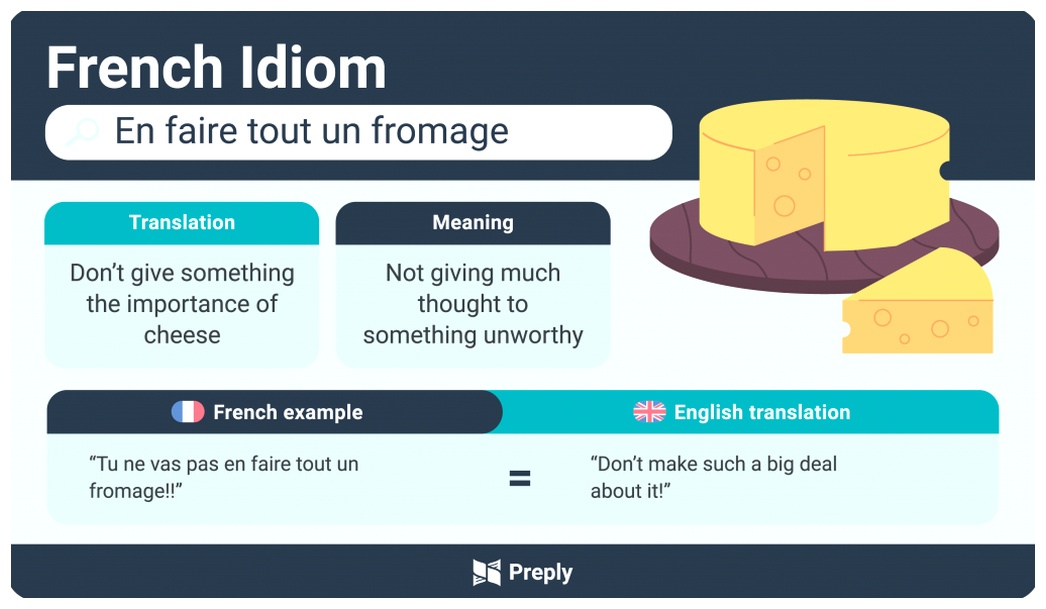
6. En faire tout un fromage
In France, cheese holds a special place, so much so that the phrase “en faire tout un fromage” literally means “to make a whole cheese about something.” This idiom serves as a playful reminder not to overinflate the significance of trivial matters. When the French use this expression, they’re cautioning against overreactions or exaggerations regarding issues that don’t merit such attention. After all, nothing is as sacred as cheese—so let’s keep things in perspective!
Example:
Tu ne vas pas en faire tout un fromage!
Don’t make such a big deal about it!
7. Tomber dans les pommes
In this context, the phrase “to fall in the apples” refers to fainting. This expression likely evolved from the old French word “pâmer,” which means “to faint,” eventually transforming into “pomme,” the word for “apple.”
Example:
L’odeur était si forte qu’il est tombé dans les pommes.
The smell was so strong that he fainted.
8. Les doigts dans le nez
The French idiom “les doigts dans le nez,” which literally translates to “fingers in the nose,” describes a task that can be accomplished effortlessly, almost as if no hands are needed at all. It’s important not to confuse it with “se curer le nez,” which means to pick your nose. This phrase is akin to the English expressions “to do something with one hand tied behind your back” or “I could do this with my eyes closed,” both of which convey a sense of ease in completing a task.
Example:
J’ai passé le test les doigts dans le nez.
I could have passed that test with my eyes closed.
9. Rouler dans la farine
The phrase “rolled in flour,” which literally translates to its original meaning, signifies being scammed. French speakers convey the same idea with the expression “se faire rouler.” Interestingly, “la farine” historically had a related connotation, akin to the expression “telling salades” (see number 5 for more details).
Example:
J’ai payé 3 euros mon croissant. Je crois que je me suis fait rouler dans la farine.”
I paid 3 euros for my croissant. I think I got ripped off.
10. L’habit ne fait pas le moine
This French saying, which translates to “the dress doesn’t make the monk,” serves as a reminder not to judge someone solely by their appearance. It emphasizes that outward looks can be deceiving and that true character lies beneath the surface. You can easily substitute “monk” with any profession that has a uniform, reinforcing the idea that what you see isn’t always the full story.
Example:
Je me suis fait rouler dans la farine par cet homme élégant. L’habit de fait pas le moine!
I got scammed by an elegant man. Don’t judge a book by its cover!
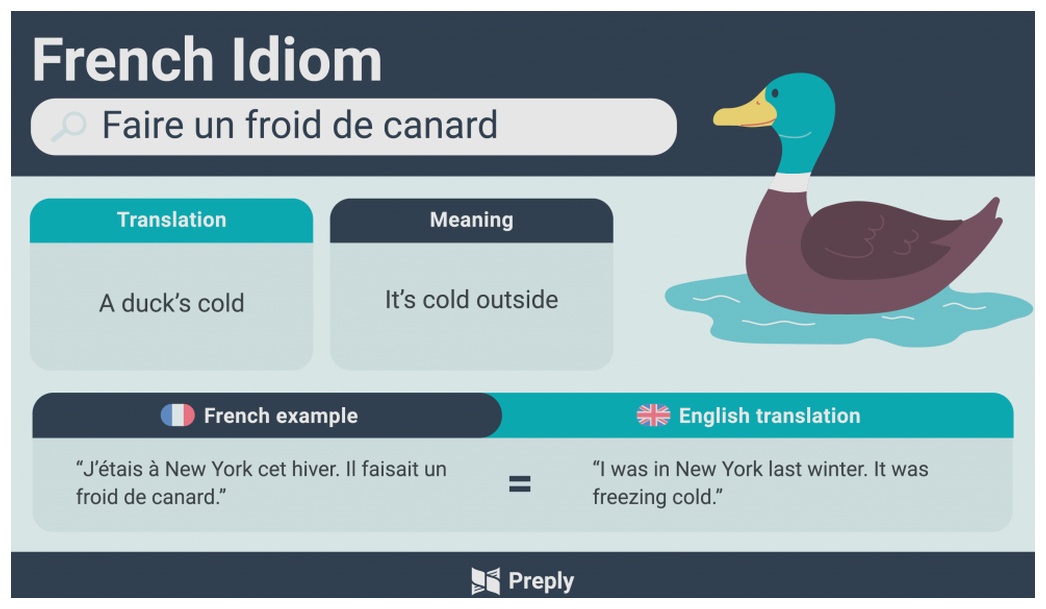
11. Faire un froid de canard
The expression “A duck’s cold!” likely originates from the historical practice of hunting ducks in winter, reflecting the frigid temperatures of the season. So, when you hear this phrase, it’s a reminder of the chill in the air. Be sure to grab your jacket before heading out!
Example:
J’étais à New York cet hiver; il faisait un froid de canard.
I was in New York last winter; it was freezing cold.
12. Yeux de merlan frit
The phrase “your fried whiting eyes” captures the adorable, pleading gaze someone gives when they’re eager to share your meal. It’s akin to the English expression “puppy dog eyes.” Interestingly, since whiting fish is uncommon in the Mediterranean, the phrase is sometimes playfully substituted with “yeux de gobie,” meaning “mudskipper eyes.”
Example:
Pas la peine de me regarder avec ces yeux de merlan frit; t’auras pas mon sandwich.
Don’t give me those puppy dog eyes; you’re not getting my sandwich.
13. Avoir un oursin dans le portefeuille
Have you ever encountered someone who winces at the thought of spending money? In French, this discomfort is humorously described as having “a sea urchin in the wallet,” symbolizing the difficulty and pain of parting with cash—much like the sharp spines of a sea urchin. This colorful expression paints a vivid picture of a person who is stingy or miserly, highlighting their reluctance to spend.
Example:
Il ne m’a même pas acheté une rose. Il doit avoir des oursins dans le portefeuille.
He didn’t even buy me a rose. He must be a cheapskate.
14. Vendre la peau de l’ours avant de l’avoir tué
Often employed to caution against premature celebration, the phrase “to sell the skin of the bear before even killing it” conveys a sentiment similar to the English idiom “counting your chickens before they hatch.” Both expressions serve as reminders to hold off on counting on success until it is assured.
Example:
Ils m’ont dit qu’ils m’embaucheraient — il faut qu’on fête ça!
Attends un peu; ne vend pas la peau de l’ours avant de l’avoir tué.”
They said they would hire me — let’s celebrate!
Wait a bit; don’t count your chickens before they hatch.
15. Ne pas faire d’omelette sans casser des oeufs
An omelet is a beloved dish, but crafting one requires breaking a few eggs. This saying highlights the idea that some achievements come with necessary sacrifices. Interestingly, this idiom translates similarly in French, emphasizing the universal truth: no pain, no gain.
Example:
En raison des travaux de rénovation, attendez-vous à un certain niveau de bruit. Cependant, il est important de rappeler qu’on ne peut pas obtenir de résultats sans faire quelques sacrifices.
The renovation will make a lot of noise, but you can’t make an omelet without breaking some eggs.
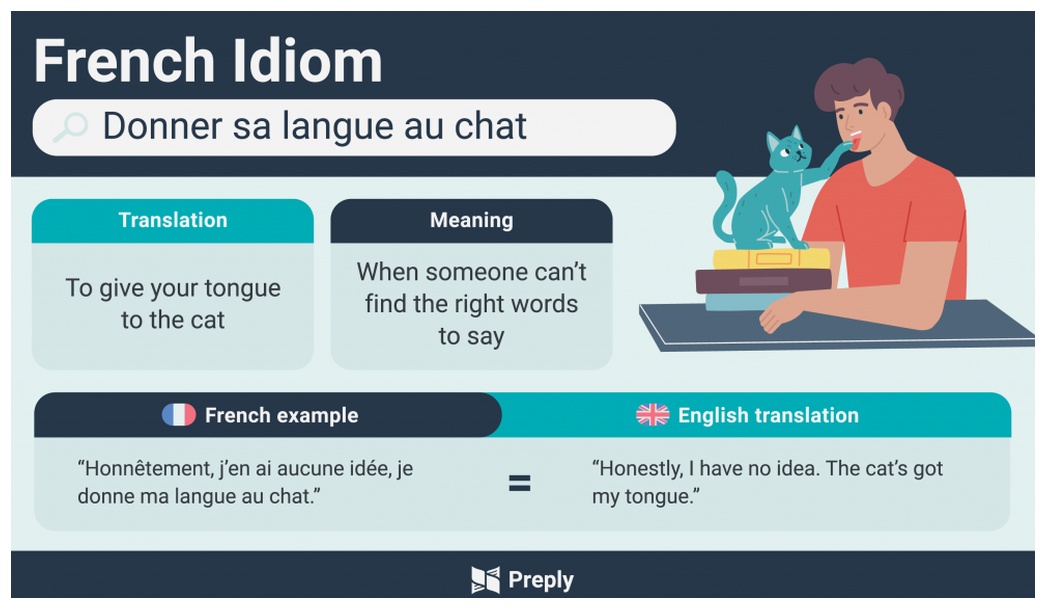
16. Donner sa langue au chat
Similar to English, the French language features a vivid expression related to cats: “donner sa langue au chat.” This idiom is used when someone is at a loss for words and decides to stop searching for an answer. It beautifully captures the feeling of surrendering in a conversation when the right response just won’t come.
Example:
Honnêtement, je n’ai aucune idée. Je donne ma langue au chat.
Honestly, I have no idea. The cat’s got my tongue.
17. Devoir une fière chandelle
The phrase “I owe you a proud candle” may not initially seem like a significant debt, but in French culture, it conveys a deep sense of owing someone a substantial amount of money or a major favor. Here, “proud” signifies something large and meaningful, while the “candle” symbolizes the gratitude expressed by lighting candles in church.
Example:
Il m’a sauvé la vie! Je lui doit une fière chandelle!
He saved my life! I owe him big time!
18. Avoir la chair de poule
This phrase relates to birds and comes into play during moments of fear, like watching a horror movie, or when you’re feeling chilly outside. It describes the sensation known as “la chaire de poule,” which translates to goosebumps.
Example:
Il fait un froid de canard — ça me donne la chair de poule.
It’s freezing cold — I have goosebumps.
19. Avoir d’autres chats à fouetter
The phrase “to have other cats to whip” may sound like it refers to cruel individuals, but its true meaning is quite different. It actually signifies having more pressing matters to attend to, highlighting a focus on priorities beyond what’s currently at hand.
Example:
On va pas trop s’attarder là-dessus. J’ai d’autres chats à fouetter.
Let’s not spend too much time on this. I have bigger fish to fry.
20. Avoir un chat dans la gorge
The phrase “to have a cat in the throat” is akin to the English expression “to have a frog in one’s throat.” This idiom describes two situations: when someone has a hoarse or raspy voice, or when they find it difficult to speak because of fear.
Example:
Quand il est allé faire son discours, il avait un chat dans la gorge.
When he went to give his speech, he had a frog in his throat.

21. S’occuper de ses oignons
This phrase can be translated as “to take care of your own onion” or “mind your own onions.” In English, we commonly substitute “onions” with “business,” resulting in the familiar expression “mind your own business.”
Example:
Elle n’a pas à connaître mon salaire; qu’elle s’occupe de ses oignons.
She shouldn’t know my salary; let her mind her own business.
22. Avoir les yeux plus gros que le ventre
The expression “to have eyes bigger than the belly” refers to the tendency to overreach or take on more than one can handle, often driven by ambition or greed. While it originates from the context of food, this saying is applicable in various scenarios where someone overestimates their capacity or resources.
Example:
Elle n’aurait pas dû jouer autant d’argent. Elle avait les yeux plus gros que le ventre.
She shouldn’t have gambled that much. She was too greedy.
23. Ne pas y aller de main morte
The phrase “not to go somewhere with a dead hand” doesn’t refer to anything lifeless; instead, it signifies a lack of strength or firmness. It suggests that one should approach tasks with vigor and determination, rather than half-heartedly. Essentially, this idiom encourages giving your all and not holding back in any endeavor.
Example:
T’as vu le combat? Poirier n’y est pas allé de main morte!
Have you seen the fight? Poirier didn’t go easy on him!
24. Se serrer la ceinture
The phrase “to tighten the belt” isn’t about physical size; it carries a similar meaning to its English counterpart. This idiom encourages individuals to monitor their spending and cut back on unnecessary expenses.
Example:
Je ne pense pas que je puisse venir au restaurant. Ce mois-ci je dois me serrer la ceinture.
I don’t think I can go to the restaurant. This month, I have to be extra careful with money.
25. Prendre ses jambes à son cou
In the past, travelers received quirky advice to “put your legs on your neck,” a playful way of reminding them to carry their luggage around their necks. This reflects the unique sense of humor in 17th-century France, which differs significantly from today’s interpretations. Today, the phrase has evolved to describe someone who is rushing out the door or even fleeing from a situation.
Example:
Quand il a vu la police, il a pris ses jambes à son cou.
When he saw the police, he ran for his life.

26. La goutte d’eau qui fait déborder le vase
Finally, consider the phrase “the drop of water that overflows the vase.” This expression illustrates how a seemingly minor issue can be the tipping point after a series of small annoyances. Just like the last straw that breaks the camel’s back, it’s the build-up of these little frustrations that can push your emotional capacity to its limit, causing an overflow of feelings.
Example:
Je passais déjà une mauvaise journée, mais ça c’était la goutte d’eau qui a fait déborder le vase.
I was already having a bad day, but this was the last straw.
27. Avoir le cafard
The French word “cafard” translates to “cockroach,” a term that evokes the same grimace we make when encountering these universally disliked pests. Interestingly, the term goes beyond mere disgust; it actually describes a state of feeling down or depressed, often accompanied by troubling thoughts.
Example:
Thomas avait le cafard tout le week-end à cause de sa rupture.
Thomas felt blue the whole weekend because of his break-up.
28. Avoir le coeur sur la main
The phrase “to have the heart in the hand” closely resembles the expression “wearing your heart on your sleeve.” It describes a person who openly shares their emotions and embodies selfless kindness, unafraid to show vulnerability.
Example:
Fernando m’a aidé à déménager gratuitement. Il a vraiment le cœur sur la main.
Fernando helped me move to my new house. He really is incredibly kind.
29. Chercher midi à quatorze heures
The phrase “to search for noon at fourteen o’clock” illustrates a common French idiom that highlights the tendency to complicate matters unnecessarily. Essentially, it suggests that someone is overcomplicating a situation when it could be much simpler.
Example:
“Tu veux prendre le bus, l’avion, la voiture, ou l’hélicoptère pour aller chez Jeanine?
Ne cherches pas midi à quatorze heure — c’est juste en face.
Do you want to take the bus, the plane, the car, or the helicopter to go to Jeanine’s?
Don’t overcomplicate it — it’s just across the street.
30. Filer à l’anglaise
This playful expression highlights the good-natured rivalry between the French and the English. The phrase “to leave like an Englishman” refers to someone who departs unnoticed, slipping away without a farewell. Interestingly, the English have their own version, calling it “to take a French leave,” both describing the same sneaky exit.
Example:
Je l’ai pas vu sortir, il a filé à l’anglaise.
I didn’t see him exit, he just snuck out.
Conclusion
French expressions showcase the dynamic evolution of language, humor, and cultural mindset. Although idioms are commonly used, native speakers often remain unaware of their origins, as these phrases have emerged from a lengthy journey of linguistic development.
Explore this curated list that offers a fascinating insight into the French passion for cuisine, their unique relationships with animals and insects, and their distinctive sense of humor. These idiomatic expressions, while they may have counterparts in other languages, are distinctly French and can spark engaging conversations in your next chat in French.
This list aims to pique your interest in the French language and, at the very least, equip you with the knowledge to sidestep any awkward situations that may arise from misinterpreting French idioms.
Frequently Asked Questions
What does the French idiom ‘avoir le coup de foudre’ mean?
‘Avoir le coup de foudre’ translates to ‘love at first sight’.
What is the meaning of ‘poser un lapin’ in French?
‘Poser un lapin’ means ‘to be stood up’ for a date.
How is the idiom ‘faire la grasse matinée’ used?
‘Faire la grasse matinée’ refers to the act of sleeping in or having a long sleep.
What does ‘les carottes sont cuites’ signify?
‘Les carottes sont cuites’ symbolizes finality, indicating that something is irrevocably over.
What does the idiom ‘avoir un oursin dans le portefeuille’ describe?
‘Avoir un oursin dans le portefeuille’ humorously describes someone who is stingy or reluctant to spend money.


