
- The languages Brits want to learn the most
- The UK’s language learning barriers
- The languages the UK learned during COVID
- UK language learning trends post COVID
- UK attitudes to languages and career opportunities
- The UK cities with the most attractive accents
- The UK cities with the most untrustworthy accents
- The UK cities with the most difficult accents to understand
- The UK cities with the most intelligent-sounding accents
- The UK cities with the most desired accents
- So what really are Brits’ attitudes towards learning a new language?
- Frequently Asked Questions
- What is the most attractive language to learn according to the report?
- What barriers did respondents cite for not learning a new language?
- Which age group showed the highest interest in learning languages during the COVID-19 lockdown?
- What percentage of Brits believe knowing a second language creates more job opportunities?
- Which UK accent was voted as the most intelligent-sounding?
The globe boasts a rich tapestry of languages, accents, and dialects that differ widely across countries, regions, and cities. While certain languages and accents captivate British listeners, sparking interest or a desire to learn, others can elicit negative reactions or seem difficult to understand.
To address this, we developed the 2023 British Attitudes Towards Languages Report. This comprehensive study involved a nationally representative online survey of 2,000 UK adults aged 18 and older, encompassing a diverse mix of age groups, genders, cities, and regions.
This report delves into individuals’ opinions and emotions about language learning, revealing the most and least preferred accents. Discover where your accent stands in this intriguing ranking!
The languages Brits want to learn the most
It’s no wonder that sunny Spain tops the list as the most attractive language to learn, with a striking 26.99% of respondents expressing a keen interest in online Spanish classes.
Hot on the heels of Spanish, the next top languages that Brits are eager to learn are the enchanting tongues of romance: French, with 20.48% of interest, and Italian, capturing 19.58%.
Among those surveyed, a smaller segment expressed interest in English lessons, with only 13.47% choosing this option. In comparison, 10.98% preferred to learn German, while 10.59% opted for Japanese.
Interestingly, a significant 26.69% of respondents expressed no desire to learn a new language, preferring instead to communicate solely in their native tongue.


Learn a language with personalised 1-on-1 classes with our expert tutors from all over the world
French lessons online
Spanish lessons online
The UK’s language learning barriers
Time emerged as a significant barrier for many respondents interested in learning a new language, with more than half (25.89%) citing a lack of available time as the main reason for not getting started.
While a notable 19.28% of individuals have no plans to learn a new language, feeling comfortable communicating in English suffices for them. This trend may stem from English’s widespread use across numerous countries, leading some Brits to view additional language acquisition as unnecessary.
A sizeable 18.79% stated that they struggle with learning languages, and 13.77% agreed that they can’t find an effective language-learning method.

The languages the UK learned during COVID
During the lockdown, many people took the opportunity to explore new hobbies, refine their skills, and even attempt learning a new language. Surprisingly, though, a significant 72.76% of individuals did not engage in language learning during this time.
Despite this, these are the languages that Brits did pick up during the lockdown:

During the COVID-19 pandemic, the survey showed that more females (74.26%) hesitated to pick up another language compared to males (71.23%).
Interestingly, the decision to learn a second language during lockdown showcased a notable age disparity. While only 41.59% of individuals aged 18 to 24 took the opportunity to pick up a new language, an impressive 89% of those aged 55 and older embraced this challenge.
Older adults tend to embrace learning new languages more frequently, likely because they often have more free time after retirement, alleviating the demands of childcare and career-building that younger individuals face.
Learn a language online with our free learning materials.
Learn English online
Learn French online
UK language learning trends post COVID
A remarkable 65.33% of individuals who began learning a language during lockdown are still actively pursuing their studies. Among them, nearly 40% (38.50%) have fully committed to the language they chose, while 26.82% participate in learning occasionally.
An impressive 20.62% of learners stopped studying a language because they achieved fluency or reached a level they felt satisfied with. In contrast, 8.03% reported losing interest as their reason for discontinuing their language studies.
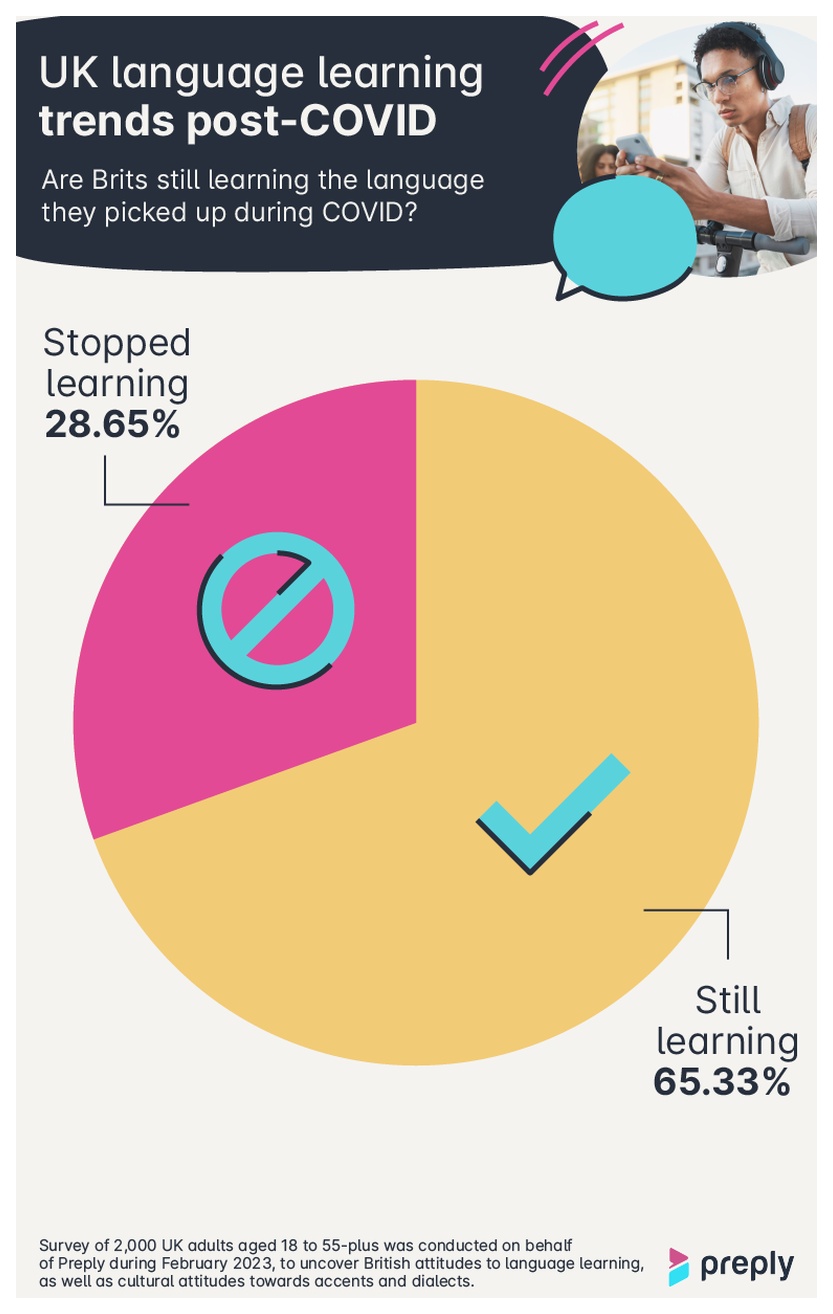
The age group most likely to abandon their language studies due to feeling satisfied with their progress is the 18-24 demographic, accounting for 28.8% of those surveyed.
Conversely, an impressive 74.07% of individuals aged 55 and older are actively learning a new language. This trend may stem from the fact that many in this age group are retired, allowing them the time and flexibility to focus on language study.
UK attitudes to languages and career opportunities
As attitudes toward remote work have evolved since the lockdown, being bilingual can significantly expand career prospects across international borders. In fact, 58.65% of individuals believe that knowing a second language creates more job opportunities. Embracing multilingualism can be a valuable asset in today’s global job market.

Among seasoned professionals nearing retirement (aged 55 and older), a significant 61.88% believe that being bilingual opens up more career opportunities. This perspective highlights the growing value of language skills in today’s job market.
Interestingly, perspectives varied on the impact of not knowing a second language on career opportunities. A significant majority, 66.25%, believed that language barriers had not hindered their career advancement. However, 19.43% felt that their lack of a second language had indeed cost them valuable job opportunities.

Among those aged 25 to 34, a significant 33.93% believe they’ve missed career opportunities due to a lack of bilingual or multilingual skills. In contrast, the perspective shifts dramatically in the older generation; a substantial 78.40% of individuals aged 55 and older feel confident that their monolingual status hasn’t hindered their professional prospects.
The UK cities with the most attractive accents
Sadly for the UK, 41.50% of people believe that no UK cities possess an attractive or romantic accent.
Fortunately, many people are charmed by British accents, with the London accent emerging as the most romantic, earning 17.89% of the votes. Following closely behind is the Liverpool accent, which attracted 10.24% of respondents, while Newcastle and Leeds accents garnered 10.19% and 4.37% respectively.
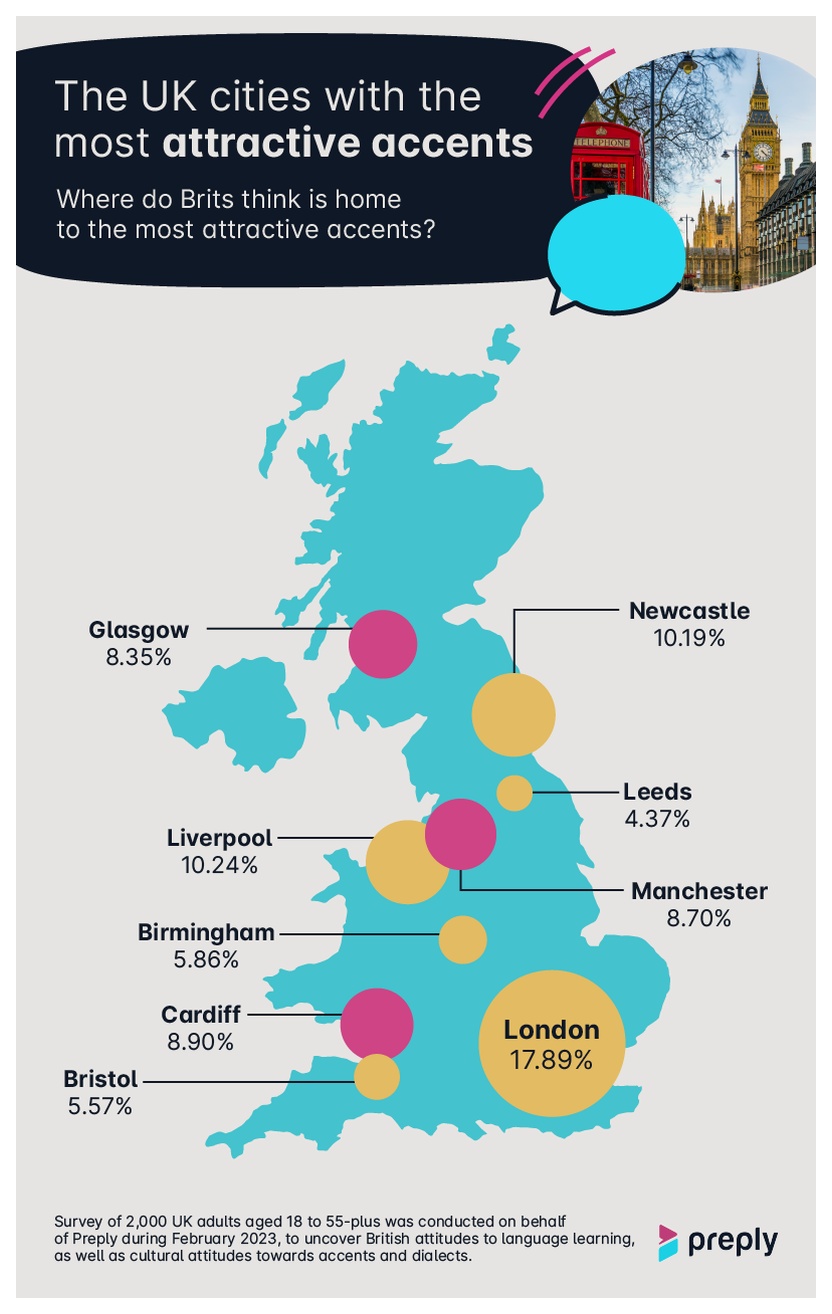
A recent survey revealed that a greater percentage of females (20.83%) than males (14.89%) find the London accent to be the most attractive in the UK. Following closely, the Liverpool accent was deemed the second most romantic, with 10.97% of males and 9.53% of females expressing their admiration. Coming in third place is the Newcastle accent, appreciated by 11.67% of males and 8.74% of females.
When it comes to regional accents, Yorkshire and Humber aren’t quite enamored, as a significant 52.12% of people in the area find UK accents unattractive.
While Yorkshire and Humber may not be in the running, a significant 47.18% of Greater London residents believe that Londoners possess the most appealing accent. It’s clear that confidence is key!
In Northern Ireland, 17.54% of residents believe that the Liverpool accent embodies the language of love. Meanwhile, a notable 34.15% of people in the North East are enamored with the Newcastle accent.
The UK cities with the most untrustworthy accents
The outlook isn’t bright for Scousers, as a recent survey reveals that 23.41% of people in the UK perceive the Liverpool accent as the least trustworthy. Following closely is Birmingham, with 15.11% of respondents sharing a similar sentiment, while London ranks third at 14.17%.
Bristol, on the other hand, has bagged the title of the most trustworthy accent, with only 4.03% deeming the accent untrusting.
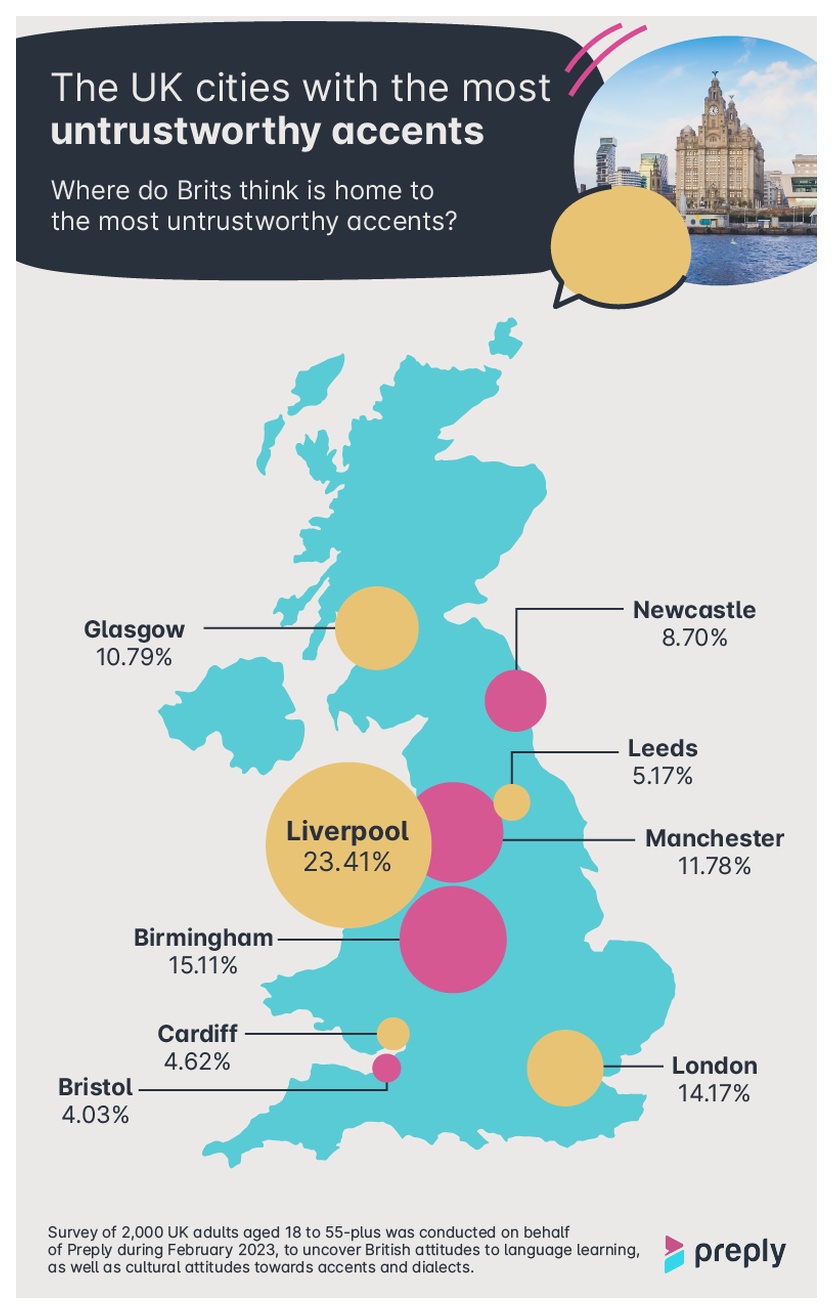
In the debate over the UK’s most untrustworthy accents, opinions vary by gender. Among men, 25.65% identified the Liverpool accent as the least trustworthy, while 16.11% of women chose the Birmingham accent. Additionally, 15.59% of men also considered the London accent to be another untrustworthy dialect.
28.38% of people living in the North West say Liverpudlians have the least trustworthy accent, whereas 26.14% of residents in the West Midlands find the Brummie accent the most untrustworthy.
Those living in Greater London believe that they themselves have the most untrusting accent, with 28.69% choosing the London accent.
What’s more, The Liverpool accent has got some seriously bad street cred, as 34.12% of people in Norwich and 29.11% of Liverpudlians have voted it the least trustworthy accent.
In a fascinating survey on accents and trust, cities have made their preferences clear. Among respondents, 26.63% of Brummies favored the Birmingham accent as the most untrustworthy, while 21.43% of Londoners selected their own London accent. Interestingly, almost half of Manchester residents, or Mancs, opted for the Manchester accent as their choice.
The UK cities with the most difficult accents to understand
Glasgow tops the list as the most challenging UK accent to comprehend, receiving 39.46% of the votes. Following closely is Newcastle, which ranks second with 20.43%, and Liverpool comes in third at 18.14%.
Bristol, however, arose as the easiest UK accent to understand, with only 3.53% voting it difficult to understand.

The Glasgow accent was voted the hardest to understand by females at 42.73%, whilst both males (20.72%) and females (20.14%) more or less equally agree Newcastle is difficult to understand.
Perhaps male accents are stronger than females; again, 18.41% of females agree that the Liverpool accent is hard to understand.
The UK cities with the most intelligent-sounding accents
Fortunately, despite 42.94% of Brits believing that there are no UK cities with intelligent-sounding accents, some cities did get credit for sounding clever.
London was voted the smartest UK accent at 29.62%, Manchester placed second for being the most intelligent-sounding at 6.91%.
Things aren’t looking great for Birmingham residents, as the city has been rated to have the least intelligent-sounding accent, scoring a rather disappointing 4.22%.
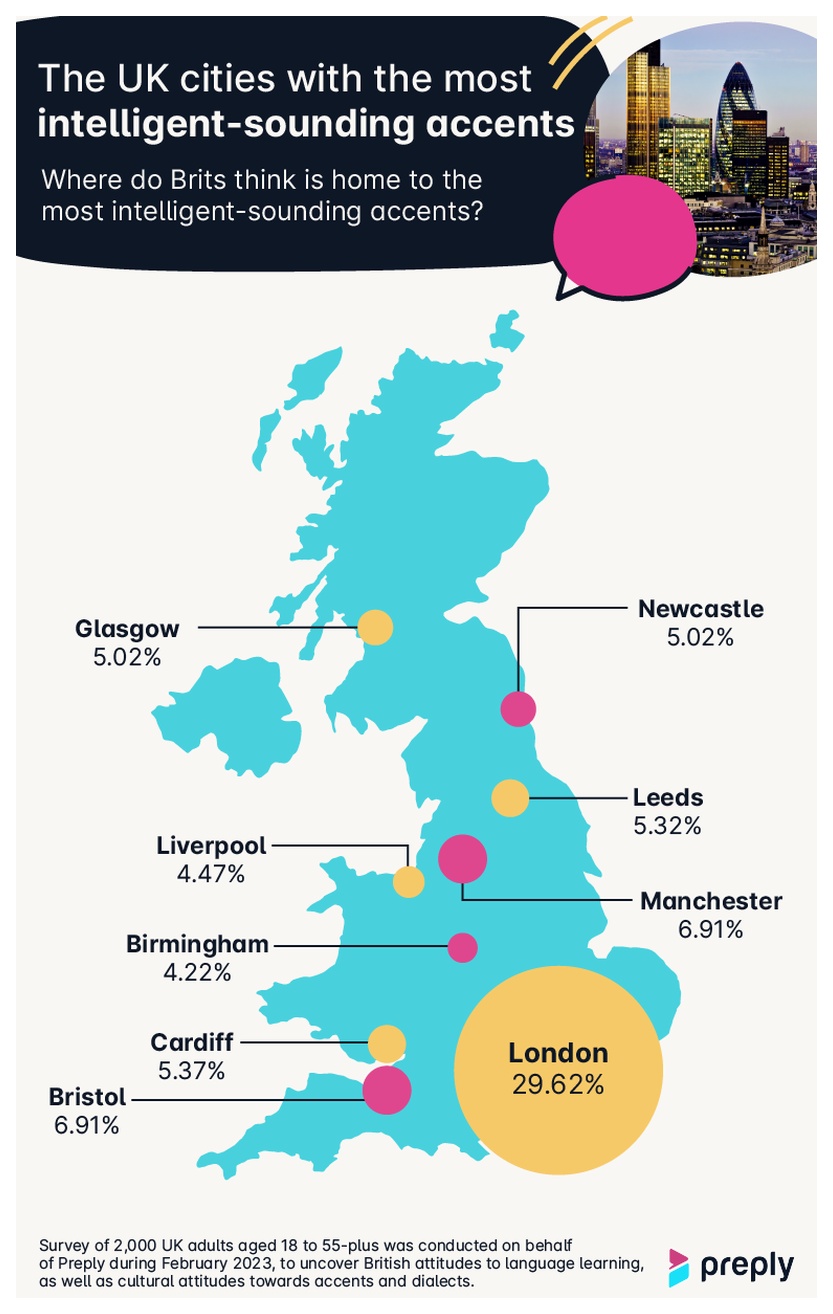
Collectively across the board, both males (25.55%) and females (33.60%) voted the London accent as being the most intelligent-sounding.
However, it’s bad news for Brits, as 56.80% of the over-55 age group believe that there are no UK accents with intelligent-sounding accents.
Fortunately, the younger generation appreciates the charm of various accents and dialects. A notable 36.01% of individuals aged 25-34 find the London accent particularly appealing, while 14.95% of those aged 18-24 favor the Manchester accent.
The UK cities with the most desired accents
Just under 50% (48.11%) of Brits said that there are no UK cities with an accent they’d like to have.
Among the remaining 50%, certain cities stood out for their appealing accents. London topped the list, with 13.22% of respondents favoring its accent. It was followed by the charming Newcastle accent at 9.79% and the distinctive Liverpool accent at 8.05%.
The Bristolian accent has struggled to win over the rest of the UK, earning a disappointing score of just 4.82%. This has landed it in the bottom spot as the least desirable accent in the country.
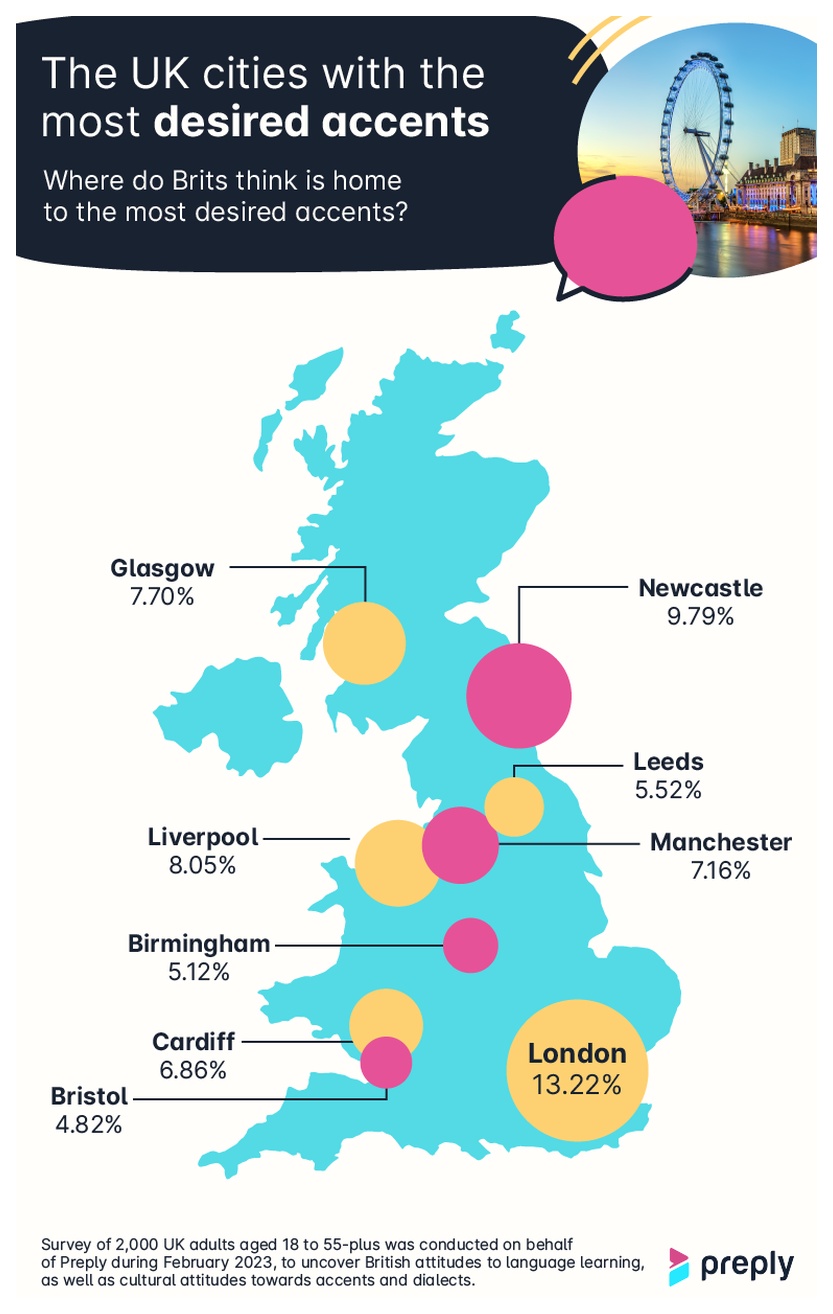
A recent survey revealed intriguing insights about UK accents and dialects. In the South East, a notable 56.74% of residents expressed that they have no preference for any particular accent. Meanwhile, 32.27% of Greater Londoners take pride in their own accent. In the West Midlands, 19.32% of respondents identified the Newcastle accent as their favorite, while 13.51% of those in the North West favored the distinct sounds of Liverpool.
So what really are Brits’ attitudes towards learning a new language?
A significant 58.65% of Britons recognize the advantages and opportunities that come with speaking a second language. However, 25.89% still feel they lack the time to pursue language learning.
When COVID-19 hit and altered our daily lives—whether through remote work, furloughs, or a halt in social interactions—the UK population gained something they had been missing: time. This unexpected gift led many to embark on new journeys, and impressively, 65.33% of those who began learning a language during lockdown continue their studies today.
While some individuals may feel they lack the time to learn a new language, many who have embarked on this journey are committed to seeing it through. Meanwhile, those who have yet to start still acknowledge the significant advantages and importance of language learning.
Whether you began your language journey during lockdown or are eager to seize the opportunity to learn now, you can enhance your skills with LingualNeeds. By taking online Spanish or English lessons with our experienced tutors, you’ll gain access to thousands of educators across the globe, ready to help you master some of the world’s most spoken languages, including Spanish.
Select tutors considering factors such as price, availability, ratings, and additional languages they speak, then schedule your trial lesson for a personalized 1-on-1 experience today. If your chosen tutor doesn’t meet your expectations, you have the freedom to switch to another tutor at no extra charge, or you can opt for a full refund.
Methodology
In February 2023, Censuswide conducted an engaging online survey involving 2,000 UK adults aged 18 to over 55, commissioned by LingualNeeds. This study aimed to explore British perspectives on language learning and shed light on cultural attitudes towards various accents and dialects across the nation.
Frequently Asked Questions
What is the most attractive language to learn according to the report?
Spanish is the most attractive language to learn, with 26.99% of respondents expressing interest.
What barriers did respondents cite for not learning a new language?
Time was the most significant barrier, with 25.89% citing a lack of available time as the main reason.
Which age group showed the highest interest in learning languages during the COVID-19 lockdown?
Individuals aged 55 and older showed the highest interest, with 89% engaging in language learning.
What percentage of Brits believe knowing a second language creates more job opportunities?
58.65% of individuals believe that knowing a second language creates more job opportunities.
Which UK accent was voted as the most intelligent-sounding?
The London accent was voted as the smartest UK accent at 29.62%.