- 10 Unusual Collective Nouns (+ Examples)
- 1. A Stand
- 2. A Clump
- 3. A Brood
- 4. A Bevy
- 5. A Host
- 6. A Swarm
- 7. A Pride
- 8. A Bed
- 9. A School
- 10. A Band
- Master Collective Noun Usage with LingualNeeds
- Frequently Asked Questions
- What are collective nouns?
- Can collective nouns be treated as singular or plural?
- What is an example of a collective noun for animals?
- How can I improve my usage of collective nouns?
- What is a unique collective noun for plants mentioned in the article?
Collective nouns can often be perplexing in English, encompassing everything from familiar terms to more unusual ones. With a rich variety of these nouns in the language, I’ve created this guide to help clarify what they are and how to use them effectively.
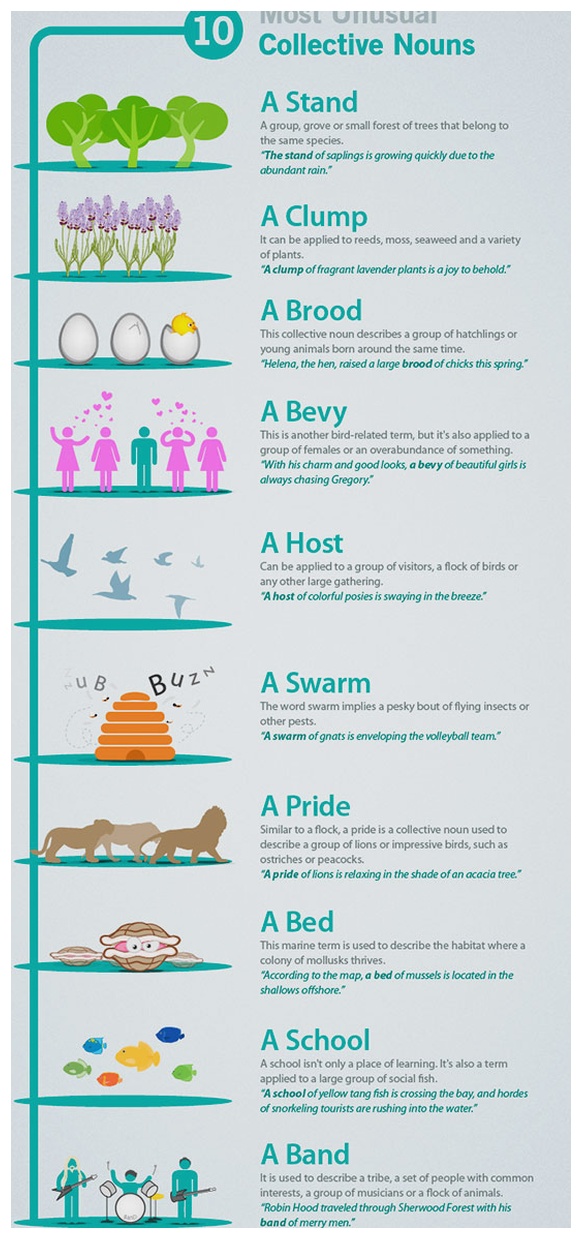
Discover the fascinating world of collective nouns with this engaging infographic that showcases ten of the most unusual examples in English. While I won’t delve into each one, I’ll highlight some intriguing choices that are sure to surprise you. Get ready to expand your vocabulary and learn something new about these quirky terms!
So…your attention, please…
Collective nouns are terms that describe groups of various entities, whether they be objects, people, animals, or plants. For instance, words like “family,” “group,” “team,” “crew,” “party,” “staff,” “audience,” and “congregation” specifically refer to collections of people.
Collective nouns offer a fascinating way to describe groups in the animal kingdom and beyond. For instance, we say “a flock of birds,” “a herd of goats,” and “a caravan of camels.” In the realm of nature, we might refer to “a school of fish” or “a herd of elephants.” Even everyday objects have collective terms, like “a bunch of flowers” or “a bunch of keys.” These terms not only enhance our language but also paint vivid pictures of the world around us.
It’s important to note that collective nouns in English can be treated as either singular or plural, similar to verbs. This flexibility allows you to decide whether to view the group as a single unit or as individual members, which influences verb choice. For instance, you can say, “Our team is not large,” treating the team as one entity, or “Our team are going to change into their street clothes after the game,” emphasizing the individuals within the team.
10 Unusual Collective Nouns (+ Examples)
Now it’s time to look at these ten unusual collective nouns in English.
1. A Stand
A group, grove, or small forest of trees that belong to the same species.
Example: The stand of saplings is proliferating due to the abundant rain.
2. A Clump
It can be applied to weeds, moss, seaweed and a variety of plants.
Example: A clump of fragrant lavender plants is a joy to behold.
3. A Brood
This collective noun refers to a group of hatchlings or young animals born around the same time.
Example: Helena, the hen, raised a large brood of chicks this spring.
4. A Bevy
This is another bird-related term, but it’s also applied to a group of females or an overabundance of something.
Example: With his charm and good looks, a bevvy of beautiful girls is always chasing Gregory.
5. A Host
Can be applied to a group of visitors, a flock of birds, or any other large gathering
Example: A host of tourists is looking for some places to eat.
6. A Swarm
The word swarm implies a pesky group of flying insects or other pests.
Example: A swarm of gnats is enveloping the volleyball team.
7. A Pride
Just like a flock refers to a gathering of birds, the term “pride” serves as a collective noun for a group of lions. It can also describe an impressive assembly of birds, including ostriches and peacocks, showcasing their beauty and social nature.
Example: A pride of lions is relaxing in the shade of an acacia tree.
8. A Bed
This marine term is used to describe the habitat where a colony of molluscs thrives.
Example: According to the map, a bed of mussels is located in the shallows offshore.
9. A School
A school isn’t only a place of learning. It’s also a term applied to a large group of social fish.
Imagine a vibrant school of yellow tang fish gracefully gliding through the bay, while excited snorkelers eagerly plunge into the water, ready to explore the underwater world.
10. A Band
The term can refer to a tribe, a community of individuals sharing common interests, a collective of musicians, or even a group of animals.
Example: Robin Hood travelled through Sherwood Forest with his band of merry men.
I hope everything was clear and understandable.
How often do you use collective nouns when you speak English? Let’s come up with some numbers, okay?
Master Collective Noun Usage with LingualNeeds
Here are some helpful examples of collective nouns, but to truly master their usage, engaging in one-on-one conversations with a native English speaker is essential. For this, LingualNeeds is your go-to platform, offering a chance to connect with enthusiastic and experienced tutors who cater to your budget, schedule, and learning objectives.
Frequently Asked Questions
What are collective nouns?
Collective nouns are terms that describe groups of various entities, such as objects, people, animals, or plants.
Can collective nouns be treated as singular or plural?
Yes, collective nouns can be treated as either singular or plural, depending on whether you view the group as a single unit or as individual members.
What is an example of a collective noun for animals?
An example of a collective noun for animals is ‘a pride,’ which refers to a group of lions.
How can I improve my usage of collective nouns?
To improve your usage of collective nouns, engaging in one-on-one conversations with native English speakers is recommended.
What is a unique collective noun for plants mentioned in the article?
A unique collective noun for plants mentioned in the article is ‘a clump,’ which can apply to weeds, moss, and various plants.