- Key takeaways
- Nearly two-thirds of Hongkongers admit smartphone addiction
- Hongkongers’ smartphone activities revealed
- Smartphone usage differences across generations in Hong Kong
- Over 95% of parents in Hong Kong use smartphones for childcare
- 41% of Hongkongers say late-night phone use hurts their sleep
- The impact of smartphone addiction at work
- How are Hongkongers dealing with smartphone addiction?
- Methodology
- Fair use statement
- Frequently Asked Questions
- What percentage of Hongkongers acknowledge smartphone addiction?
- What strategies are Hongkongers using to reduce smartphone usage?
- How does smartphone usage differ among generations in Hong Kong?
- What impact does smartphone addiction have on workplace productivity?
- How are parents in Hong Kong using smartphones for childcare?
Do you find yourself constantly reaching for your phone? In Hong Kong, it’s a familiar sight to see individuals absorbed in their screens at every turn—whether they’re waiting in line, riding the MTR, the city’s fast and convenient metro system, or enjoying a meal at restaurants.
As smartphone use continues to soar, so does the issue of smartphone addiction. Many residents of Hong Kong are becoming increasingly aware of their over-reliance on these devices and are looking for ways to reduce their screen time. At LingualNeeds, a language learning platform that connects users with English teachers and Mandarin tutors online, we conducted a survey involving 1,000 Hongkongers to explore their smartphone habits. Our findings revealed that 63.4% of respondents acknowledge their smartphone addiction, while a significant 76.5% are actively seeking to cut back—especially among teenagers and Gen Z. So, what strategies are Hongkongers employing to tackle their smartphone addiction?
Key takeaways
- Over 63% of Hong Kong residents recognize smartphone addiction, with 76% actively seeking to reduce their usage.
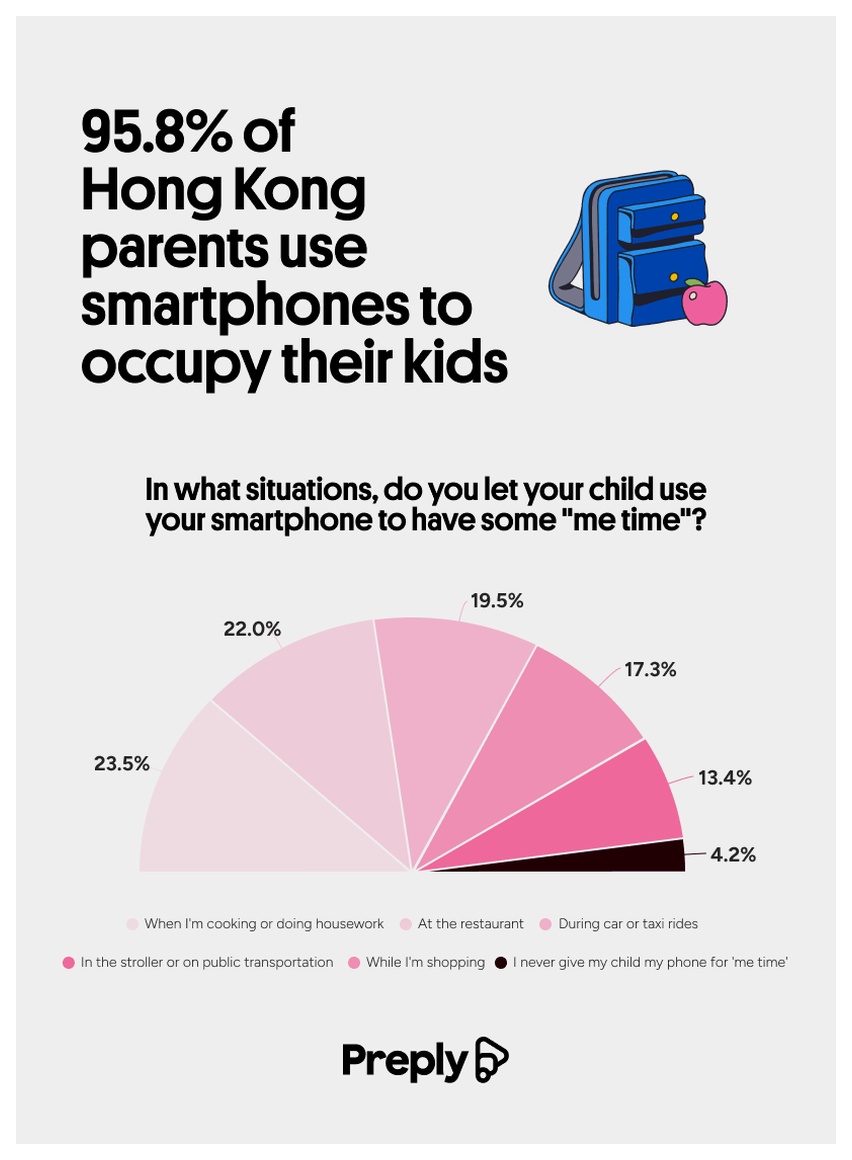
- 95.8% of parents in Hong Kong use phones to occupy children for “me time”
- 72.5% of workers in Hong Kong spend 1-4 hours daily on personal phone activities during work hours
- Over 25% of Hongkongers dedicate over 3 hours each day to entertainment activities such as gaming, video streaming, and social media browsing.
- Gen Z and Millennials prioritize video consumption and streaming, whereas Gen X and Baby Boomers mainly engage with social media.
- Over 38.5% of Gen X, Millennials, and Gen Z admit to using their phones in bed late at night, disrupting their sleep patterns.

Learn a language with personalised 1-on-1 classes with our expert tutors from all over the world
French lessons online
Spanish lessons online
Nearly two-thirds of Hongkongers admit smartphone addiction
In Hong Kong, phone addiction is a prominent concern, with 63.4% of residents recognizing their dependency on smartphones. Interestingly, the data reveals a gender disparity: 59.3% of men acknowledge their addiction, while a higher 68.8% of women report similar struggles, indicating that females are more likely to face this challenge.

Recent data reveals that women are more engaged in digital activities, spending over three hours on social media (35.9%), video streaming (34.3%), and online gaming (30.6%). In contrast, men report lower participation rates in these activities, with 21.0% on social media, 23.3% on video streaming, and 28.9% on gaming.
Younger generations, particularly Gen Z and Millennials, are increasingly acknowledging their dependence on smartphones, with two-thirds admitting to this addiction. In stark contrast, only about 20% of Baby Boomers recognize their own phone habits as problematic. These insights highlight the urgent need for strategies to help individuals manage and curb excessive phone usage.
Hongkongers’ smartphone activities revealed
Every day, Hongkongers are deeply immersed in a range of activities on their phones, with certain habits particularly noteworthy. A significant 25% of the population dedicates over three hours daily to entertainment, indulging in gaming, binge-watching videos, and streaming on platforms like Netflix and YouTube, as well as engaging on social media.
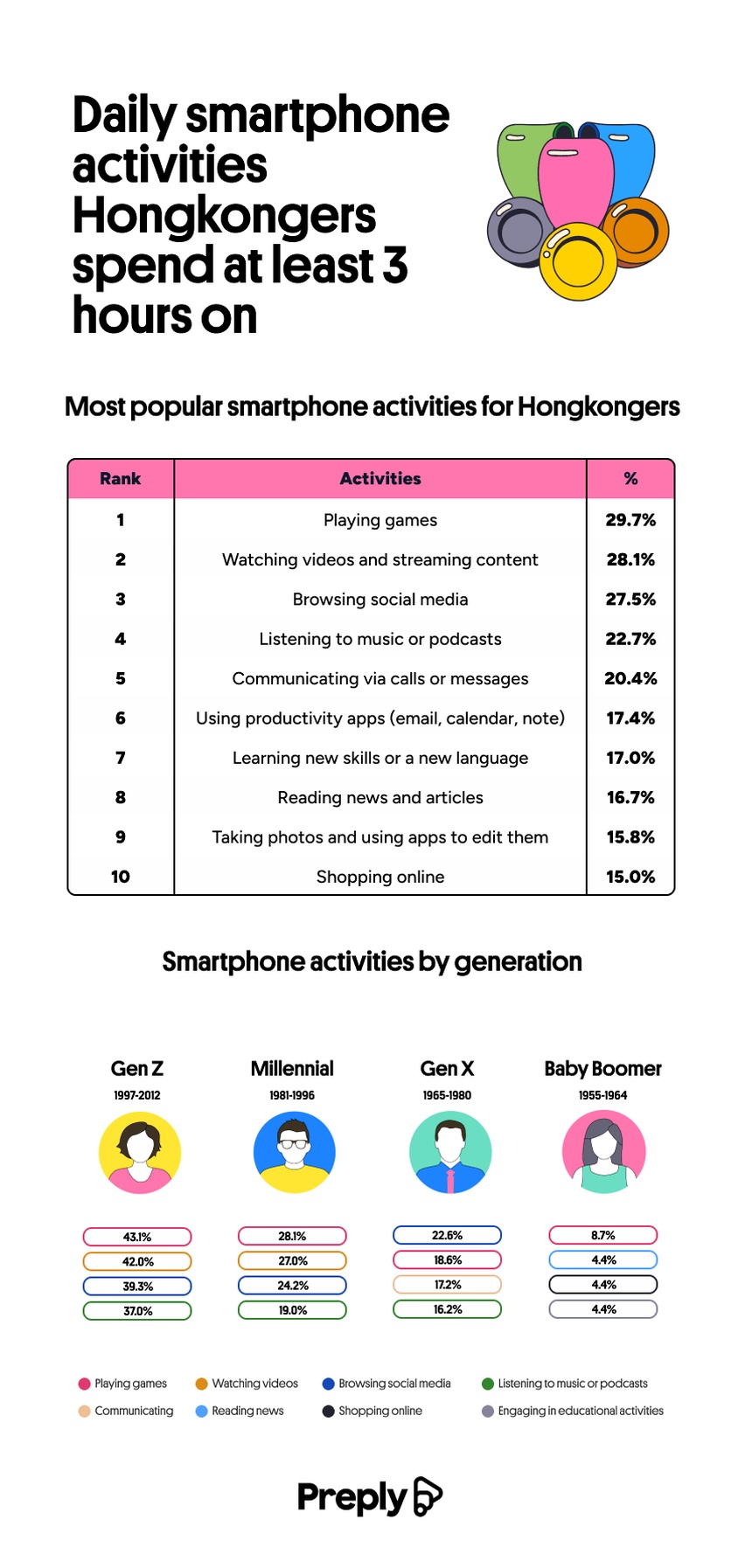
The most popular activities following music and podcasts are engaging in conversations through calls or messages, which account for 20.4% of usage, while listening to music and podcasts leads at 22.7%.
You might be surprised to learn that photography’s most popular subject isn’t selfies, food, or children, but rather outdoor and street scenes, with an average of 7.5 photos taken per week! Interestingly, Generation X particularly loves food photography, with over 50% capturing 1 to 5 images of their meals each week.
Learn a language online with our free learning materials.
Learn English online
Learn French online
Smartphone usage differences across generations in Hong Kong
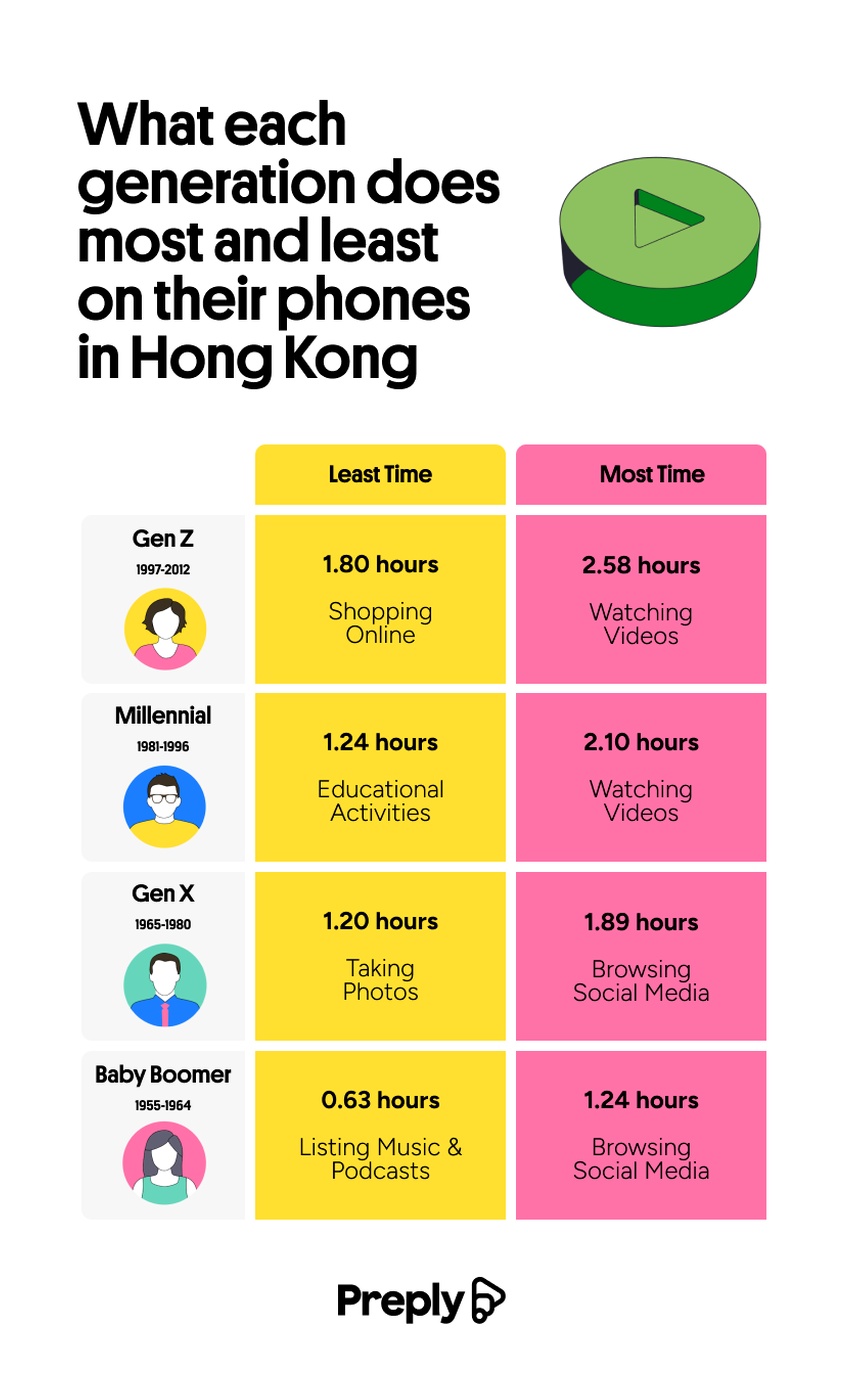
In Hong Kong, smartphones have become an integral part of life for all generations, but their usage patterns tell an interesting story. Gen Z and Millennials are primarily engrossed in watching videos and streaming content, whereas Gen X and Baby Boomers tend to prioritize browsing social media. This highlights the diverse ways different age groups engage with technology.
Gen Z and Millennials enjoy similar activities, but Gen Z dedicates more time to them. In contrast, Gen X and Boomers engage in these activities far less. For example, a striking 75.2% of Gen Z and 63.7% of Millennials spend at least an hour on social media, compared to just 38.1% of Boomers. The survey also highlights that 29.4% of Hongkongers do not participate in any educational activities. Notably, 16.3% of Gen Z, 7.6% of Millennials, and 8.8% of Gen X report not reading the news at all.
In contrast, Gen Z dedicates the least amount of time to online shopping, while Millennials focus more on educational pursuits. Gen X tends to invest their time in capturing and editing photos, whereas Baby Boomers enjoy listening to music and podcasts the most.
Our research reveals that nearly 50% of Millennials and Gen Z use emojis, memes, and stickers as key tools for expressing their emotions, in stark contrast to just 17.4% of Baby Boomers. Additionally, about one-third of people in Hong Kong utilize their phones to maintain connections with friends and family who are far away, with Generation X leading the way in this trend.
Over 95% of parents in Hong Kong use smartphones for childcare
Our research uncovered that an impressive 95.8% of parents in Hong Kong rely on cell phones to entertain their children, allowing them to enjoy some much-needed “me time.” This trend is particularly noticeable during everyday activities like housework, dining at restaurants, or while commuting. It highlights how smartphones have evolved into an essential tool for parents seeking a quick and effective distraction for their kids.
41% of Hongkongers say late-night phone use hurts their sleep
In addition to exploring the various activities on phones, we also examined how Hongkongers incorporate their devices into their daily lives. Notably, over half of the respondents reported using their phones while on public transportation, in bed, and during meals. This trend highlights that entertainment remains the leading use of smartphones among the population.
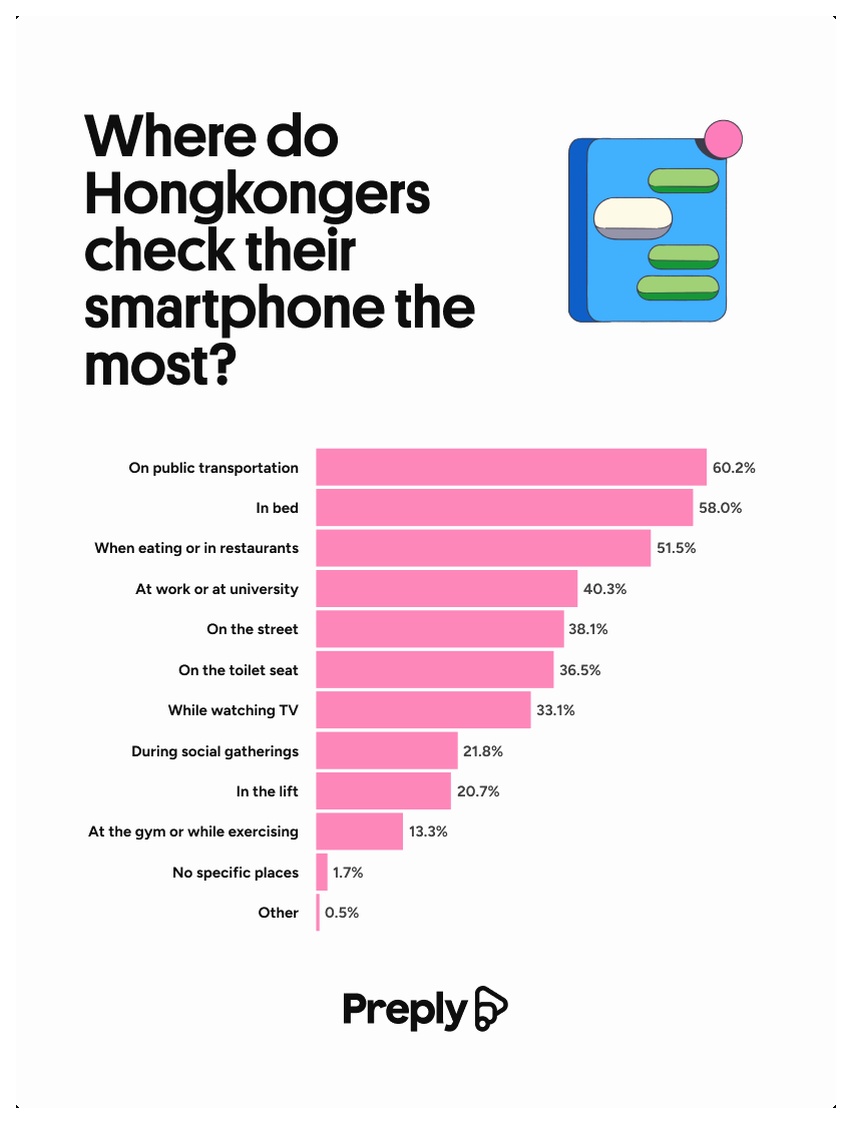
It’s fascinating to note that the conventional wisdom around screen time before bedtime warns against its negative impact on sleep quality. This is reflected in the statistics: only 30.4% of Baby Boomers admit to using their phones in bed, while 47.8% do so while watching TV. In stark contrast, younger generations—over 50% of Gen X, Millennials, and Gen Z—are much more likely to use their phones in bed, defying those traditional guidelines.
Our research uncovers a growing awareness of the detrimental effects of excessive smartphone use among individuals. Many respondents cited sleep disruptions, anxiety over battery life, incessant notifications, and late-night gaming or video streaming as common experiences. This underscores that feelings of fear of missing out (FOMO) and sleep disturbances are significant challenges associated with smartphone addiction.
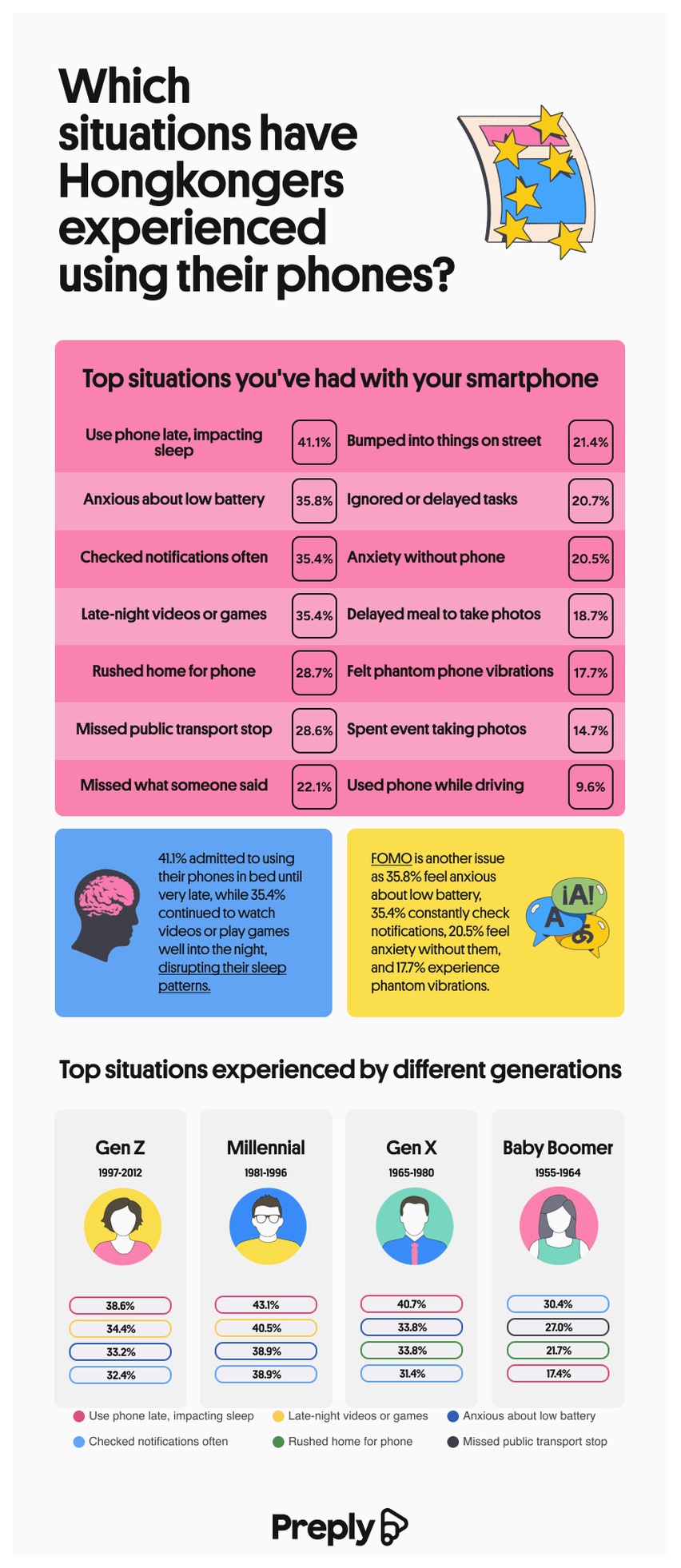
Moreover, a striking one in five residents of Hong Kong reported longing for face-to-face conversations, often distracted by their phones. Many experience phantom vibrations, feeling anxious when their devices are out of reach. Alarmingly, nearly 10% admitted to engaging in dangerous behaviors, such as texting or browsing the internet while driving.
The impact of smartphone addiction at work
Phone addiction significantly hinders workplace productivity, as a staggering 72.5% of individuals spend 1 to 4 hours a day on personal activities during work hours. Among these, teenagers and Gen Z stand out as the most distracted, with nearly 50% dedicating over 3 hours daily to non-work-related tasks—far surpassing the distraction levels observed in older generations.

Interestingly, a higher number of women than men admitted to using their phones for personal matters while at work. Additionally, while one in three Baby Boomers stated they never engage in personal activities on their phones during work hours, fewer than 10% of individuals from younger generations claimed the same.
How are Hongkongers dealing with smartphone addiction?
An impressive 76.5% of individuals have actively sought ways to combat phone addiction, with nearly a quarter having consulted a psychologist or utilized apps and screen time features for support. Among all age groups, Gen Z stands out for their proactive efforts, as 60.7% have already sought help for phone addiction, while 24.1% are contemplating or planning to do so in the near future.
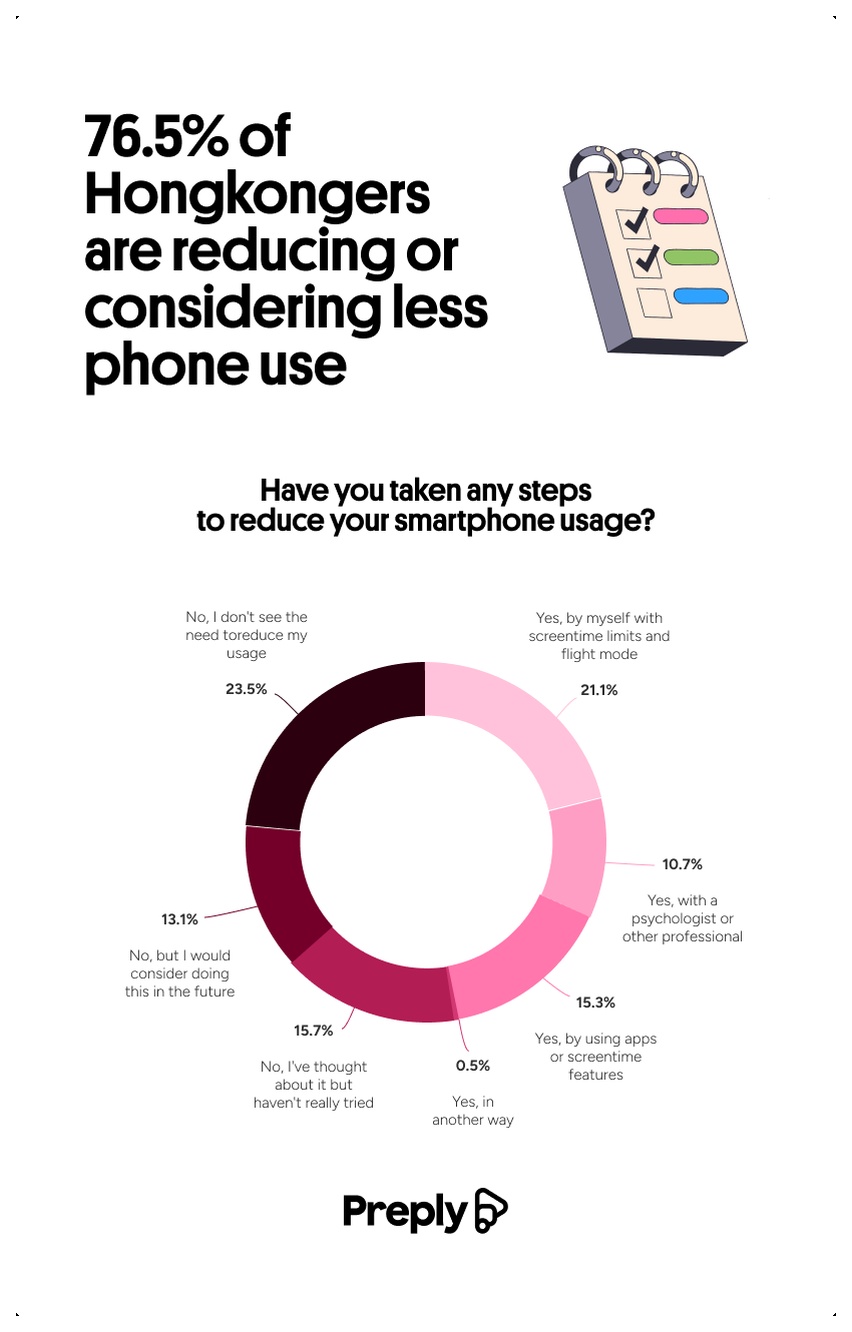
In contrast, Baby boomers exhibit a different trend: a significant 73.9% feel no urgency to curb their phone usage, with only 4.4% actively seeking to make changes. Our research indicates that Millennials, Gen X, and Baby boomers are generally reluctant to address phone addiction, while Gen Z demonstrates a notable willingness to tackle the issue head-on.
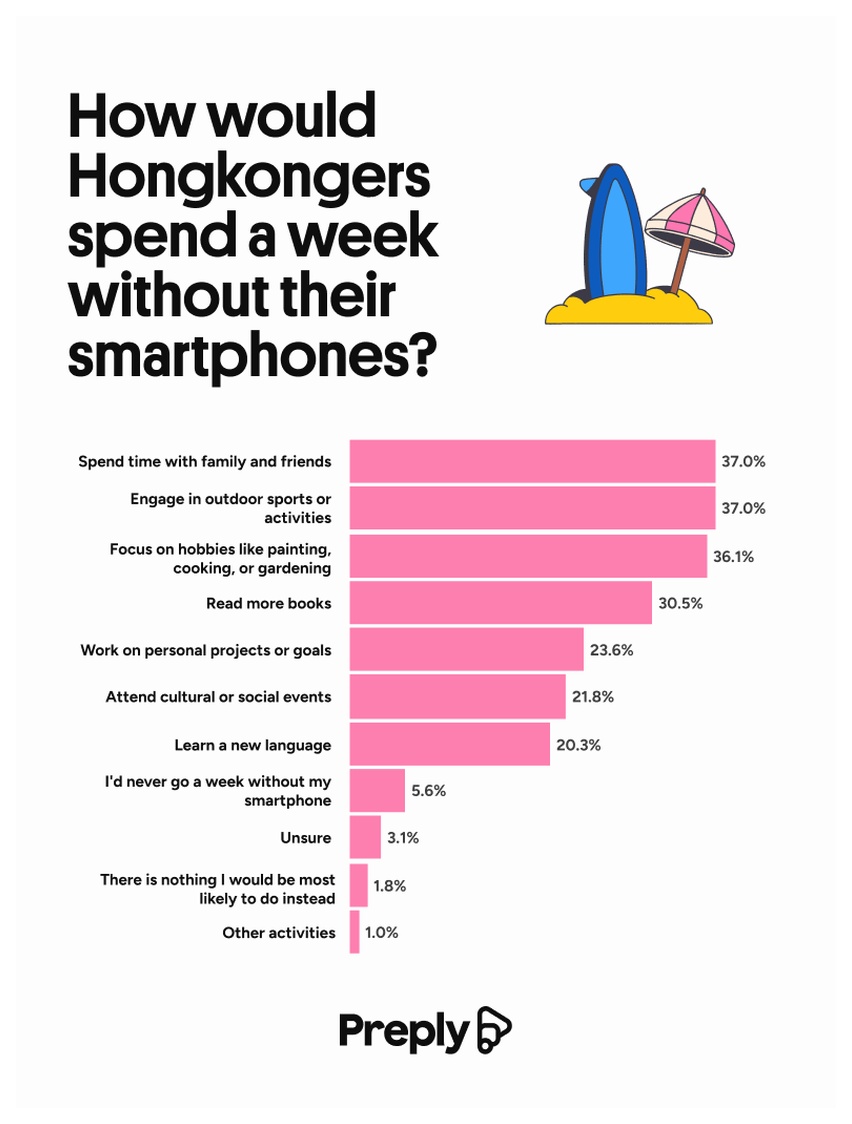
What would Hongkongers do if they had to spend a week without their phones? Our survey highlights the most popular activities: connecting with family and friends, a favorite among Millennials, Gen X, and Baby Boomers, and enjoying outdoor pursuits. In contrast, Gen Z leans more towards outdoor activities and personal hobbies, prioritizing individual interests over social interactions. Notably, 5.5% of respondents confessed they could never go a week without their smartphones.
This shift underscores the influence of smartphone usage on activities such as language learning, which require attention and commitment. At LingualNeeds, we offer language learning solutions designed for hectic schedules. By identifying those moments usually spent on your phone—like commuting, waiting in line, or unwinding at home—we inspire users to transform that time into a chance for self-improvement, such as learning a new language with our app. With LingualNeeds, you can easily schedule one-on-one lessons with French or Japanese tutors at your convenience, maximizing your smartphone’s potential for growth.
Methodology
In June 2024, LingualNeeds conducted a survey involving 1,000 residents of Hong Kong to explore the impact of smartphone addiction and usage patterns. It’s important to note that the findings are based on self-reported responses, which may introduce some biases in the data.
Fair use statement
Feel free to share this data! You can use any of the information or graphics provided above for non-commercial purposes. Just remember to include a linked attribution to this page in your article.
Frequently Asked Questions
What percentage of Hongkongers acknowledge smartphone addiction?
63.4% of Hongkongers recognize their smartphone addiction.
What strategies are Hongkongers using to reduce smartphone usage?
76.5% of Hongkongers are actively seeking ways to cut back on their smartphone usage.
How does smartphone usage differ among generations in Hong Kong?
Gen Z and Millennials primarily engage in video consumption and streaming, while Gen X and Baby Boomers focus more on social media.
What impact does smartphone addiction have on workplace productivity?
72.5% of workers spend 1 to 4 hours daily on personal phone activities during work hours, hindering productivity.
How are parents in Hong Kong using smartphones for childcare?
95.8% of parents in Hong Kong use smartphones to occupy their children, allowing for personal ‘me time’.